



Key Takeaways
- Indonesia is moving toward a more structured regulatory environment for digital assets and RWA tokenization under OJK oversight.
- RWA tokenization requires asset verification, legal frameworks, custody, compliance, and settlement infrastructure beyond blockchain development.
- RWA tokens can represent ownership interests, debt claims, revenue rights, or interests in SPVs and funds.
- A scalable RWA platform combines asset onboarding, token issuance, KYC/KYB, smart contracts, custody, compliance, valuation, and reporting.
Introduction
The digital assets market is entering a new phase in Indonesia. Tokenization is gradually moving towards speculative crypto trading toward real-world assets such as property, gold, securities, commodities and other productive assets. 2026 is an important period for RWA tokenization platform development in Indonesia.
With regulatory oversight now centered on the Otoritas Jasa Keuangan (OJK), Indonesian Financial Services Authority, the market is gaining a more structured foundation for experimentation and institutional adoption.
However, launching an RWA platform involves far more than putting an asset on a blockchain. In this blog post, understand the real challenge associated with connecting an on-chain token to a verified, legally enforceable off-chain asset while maintaining compliance, custody, investor protection, and reliable settlement.
Why RWA Tokenization Is Gaining Momentum in Indonesia
Real World Asset Tokenization Development in Indonesia is becoming a relevant market because several conditions are converging. The country already has a large and expanding digital-asset user base, while OJK’s digital financial asset framework is creating a more structured environment for businesses to test blockchain-based financial models.
At the same time, Indonesia has substantial property, commodity, infrastructure, and MSME markets that could benefit from alternative financing and fractional investment models. Tokenization can potentially make certain assets accessible to a broader investor base while improving how ownership and transactions are recorded.
However, crypto adoption should not be confused with RWA adoption. Having millions of crypto users does not mean the same users are ready to invest in tokenized real-world assets. The RWA market is still in an early infrastructure-building stage, creating opportunities for an RWA platform development company to develop compliant, asset-specific tokenization solutions for businesses in Indonesia rather than simply replicating existing crypto exchanges.
Planning to tokenize property, commodities, securities, or another real-world asset?
Indonesia’s OJK Regulatory Framework for RWA Tokenization
1. From Commodity-Based Crypto Regulation to OJK Oversight
Indonesia’s digital-asset oversight has shifted from Bappebti to the Otoritas Jasa Keuangan (OJK), bringing digital financial assets under a financial-services regulatory compliant framework. Businesses developing Security Token Platform Development solutions must therefore consider OJK requirements covering token classification, issuance, custody, trading, and investor protection.
2. Regulatory Sandbox and Tokenization Experiments
OJK’s regulatory sandbox has already tested tokenization models involving assets such as gold, securities, and property-related ownership benefits. These trials help evaluate asset verification, custody, valuation, investor rights, and settlement before wider commercial adoption.
The 2026 Regulatory Direction
Businesses must separate existing digital-asset rules, sandbox requirements, emerging RWA regulations, and laws governing the underlying asset. A token linked to property, for example, does not automatically represent direct legal ownership. The platform must establish a clear legal connection between the underlying asset, issuer, custodian, and token holder.
What Does an RWA Token Actually Represent?
An RWA token does not automatically represent direct ownership of a physical asset. It can represent beneficial ownership, an SPV or fund interest, a debt claim, revenue rights, or a tokenized financial instrument. The legal structure defines the investor’s rights and determines how custody, valuation, taxation, transferability, insolvency, and secondary trading are handled. For businesses pursuing RWA Tokenization Platform Development in Indonesia, establishing this connection between the off-chain asset and on-chain token is essential for creating a compliant and enforceable platform.
Technical Architecture for RWA Tokenization Platform Development in Indonesia
| Architecture Layer | Key Components | Technical Purpose |
| Asset Verification & Representation | Due diligence, ownership/title verification, valuation, asset documents, oracles, asset attestations | Establishes that the underlying asset exists, is verifiable, and can be reliably represented on-chain. |
| Token Issuance Layer | Token creation, supply management, fractionalization, metadata, mint/burn controls, corporate actions | Converts defined asset rights into programmable digital tokens. Standards such as ERC-3643 can support permissioned token models, although they are not an OJK-mandated standard. |
| Compliance & Identity | KYC/KYB, AML screening , wallet whitelisting, investor eligibility, transfer restrictions, jurisdiction controls | Ensures only authorized participants can hold or transfer specific tokens and supports compliance-by-design. |
| Custody & Settlement | Asset custody, digital-asset custody, fiat settlement, DvP, reconciliation | Connects blockchain transactions with the underlying asset, payment flows, and off-chain ownership records. |
Core Components of an RWA Tokenization Platform
An RWA tokenization platform combines asset management, blockchain infrastructure, compliance, and investor services. The components required will depend on the asset class and business model.
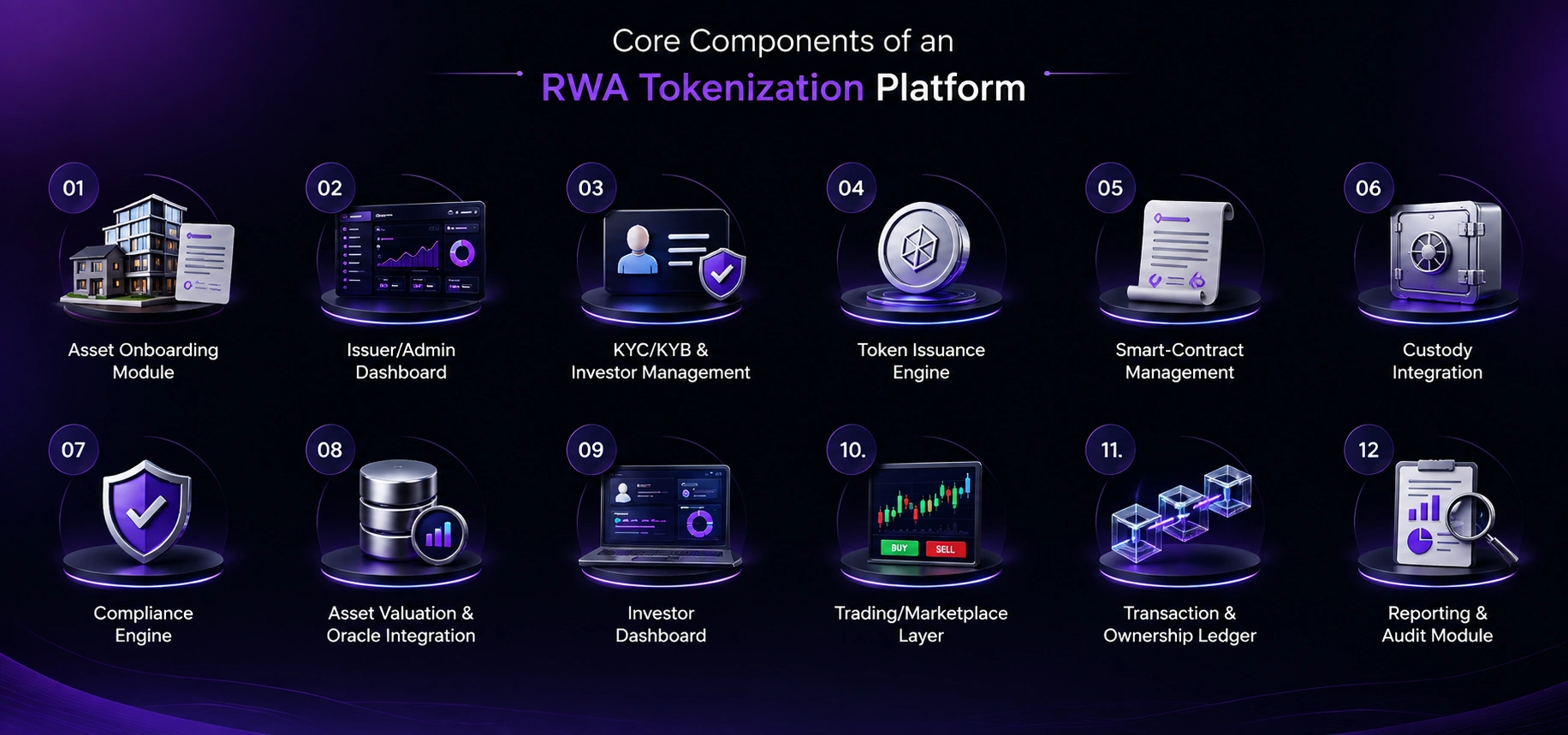
1. Asset Onboarding Module
Collects and verifies asset documents, ownership details, valuation data, and other information before the asset is tokenized.
2. Issuer/Admin Dashboard
Allows authorized issuers to manage assets, investors, token supply, permissions, and platform operations from a centralized interface.
3. KYC/KYB & Investor Management
Verifies individual and business identities, checks investor eligibility, and connects approved users with authorized wallets.
4. Token Issuance Engine
Creates and distributes tokens based on predefined asset rights, supply limits, fractionalization rules, and ownership structures.
5. Smart-Contract Management
Controls token functions such as minting, burning, transfers, permissions, and automated distribution rules.
6. Custody Integration
Connects the platform with approved custody arrangements for safeguarding underlying assets and digital tokens.
7. Compliance Engine
Applies AML screening, investor restrictions, wallet whitelisting, jurisdiction controls, and transaction-monitoring rules.
8. Asset Valuation & Oracle Integration
Connects verified external data, including asset prices, valuations, reserves, and other off-chain information, with the blockchain.
9. Investor Dashboard
Enables investors to view token holdings, asset information, transactions, distributions, and portfolio activity.
10. Trading/Marketplace Layer
Provides infrastructure for eligible investors to buy, sell, or transfer tokenized assets where secondary-market activity is permitted, forming the foundation of Tokenized Asset Marketplace Development in Indonesia.
11. Transaction & Ownership Ledger
Maintains an auditable record of token transfers and helps reconcile blockchain ownership with relevant off-chain records.
12. Reporting & Audit Module
Generates asset, transaction, compliance, and regulatory reports for issuers, auditors, and other authorized stakeholders.
Key Compliance Controls for RWA Platform Development
A compliant RWA platform should focus on the controls that directly connect investor identity, asset ownership, token transfers, and regulatory oversight:
1. KYC/KYB & AML/CFT
Discuss Your RWA Platform RequirementsVerify investors and businesses, perform AML checks, and monitor transactions for suspicious activity.
2. Asset Verification & Custody
Verify the underlying asset, its ownership, valuation, and legal status while maintaining appropriate custody arrangements.
3. Investor Eligibility
Restrict participation based on applicable investor, jurisdiction, and product eligibility requirements.
4. Wallet & Transfer Controls
Use whitelisted wallets and programmable transfer restrictions to prevent unauthorized token movements.
5. Smart-Contract Security
Audit token contracts and implement controlled minting, burning, permissions, and upgrade mechanisms.
6. Audit & Regulatory Reporting
Maintain immutable transaction records, asset-to-token reconciliation, and reporting capabilities for regulators and authorized stakeholders.
7. Data Protection & Incident Response
Protect investor and transaction data while maintaining procedures for security incidents, system failures, and unauthorized activity.
How Businesses Can Approach RWA Platform Development in Indonesia
Businesses entering RWA Platform Development in Indonesia should follow a phased approach that combines regulatory planning with technical development. Working with an experienced tokenization platform development company can help align these stages with the selected asset and business model.
Step 1: Select the Asset and Use Case
Identify the asset such as property, gold, commodities, securities, receivables, or funds and define the intended tokenization model.
Step 2: Assess Legal and Regulatory Requirements
Determine what the token represents and identify the OJK and other regulatory obligations that apply.
Step 3: Verify the Asset and Design Custody
Validate ownership, valuation, documentation, and establish how the underlying asset will be held and protected.
Step 4: Build the Platform Architecture
Design the blockchain, smart contracts, identity, compliance, custody, APIs, and settlement infrastructure.
Step 5: Develop and Test the MVP
Build a controlled version, test the token lifecycle, and use applicable sandbox or testing mechanisms where appropriate.
Step 6: Conduct Security and Compliance Audits
Review smart contracts, infrastructure, access controls, compliance workflows, and operational risks.
Step 7: Launch Issuance and Marketplace Functions
Deploy the platform and enable secondary-market or exchange integration only when the applicable regulatory and operational requirements are satisfied.
What It Costs to Build an RWA Tokenization Platform
The cost of RWA platform development depends on the asset, regulatory structure, technology stack, and level of marketplace functionality. A simple issuance platform will require a very different budget from institutional-grade tokenization infrastructure.
| Cost Driver | Approx. Impact on Total Cost |
| Asset & Legal/Regulatory Complexity | 15–20% |
| Blockchain Infrastructure | 8–12% |
| Smart-Contract Development | 10–15% |
| KYC/AML & Compliance Integration | 8–12% |
| Custody & Settlement Integration | 8–12% |
| Marketplace/Trading Functionality | 10–18% |
| Security Audits & Testing | 6–10% |
| APIs & Third-Party Integrations | 5–8% |
| Web/Mobile Interfaces | 5–10% |
| Institutional Integrations | 5–12% |
The Future of Indonesia’s RWA Market For Upcoming Years
Indonesia’s RWA market is likely to expand across real estate, gold and commodities, infrastructure, private credit, fund interests, MSME financing, agricultural assets, and carbon-related products as regulation and supporting infrastructure mature. The opportunity is not simply to launch another crypto product, but to build reliable systems connecting verified real-world assets, regulated financial structures, blockchain-based ownership records, and investors.
Businesses entering this space will need strong capabilities across tokenization, compliance, custody, and smart-contract infrastructure. Companies such as Techfyte are already positioning blockchain and RWA tokenization capabilities around areas such as fractional ownership, tokenized securities, commodities, and institutional custody, reflecting the broader shift toward enterprise-focused tokenization infrastructure.
Conclusion
Indonesia’s RWA opportunity extends beyond blockchain adoption. Successful platforms will need to combine legal enforceability, verified assets, regulated participation, secure smart contracts, compliant settlement, and credible liquidity. As the market develops in 2026 and beyond, businesses entering RWA tokenization platform development in Indonesia should treat compliance as a core part of the architecture, not something added after development.
Building regulatory, asset, and security controls into the platform from day one can create a stronger foundation for scalable and trusted tokenization solutions.
Frequently Asked Questions
1. What is RWA Tokenization Platform Development in Indonesia?
RWA Tokenization Platform Development in Indonesia involves building blockchain infrastructure to represent rights in assets such as property, gold, securities, and commodities through digital tokens, while meeting applicable OJK and asset-specific requirements.
2. Is RWA tokenization legal in Indonesia?
RWA tokenization is an emerging regulated area. Real world asset tokenization development in Indonesia requires businesses to assess the token structure, OJK requirements, and regulations governing the underlying asset before launch.
3. Does an RWA token represent ownership of the physical asset?
Not always. A token may represent ownership, an SPV or fund interest, debt, revenue rights, or another financial interest. Security token platform development must clearly define these rights.
4. What assets can be tokenized in Indonesia?
Potential use cases include real estate, gold, commodities, securities, infrastructure, private credit, funds, and agricultural assets, subject to applicable regulations and asset-specific requirements.
5. What are the main components of an RWA platform?
Core components include asset onboarding, token issuance, smart contracts, KYC/KYB, compliance, custody, valuation, investor dashboards, reporting, and marketplace functionality where permitted. These form the foundation of asset tokenization platform development in Indonesia.
6. What services are needed to build an RWA platform?
Blockchain asset tokenization services can include smart contracts, token issuance, compliance integration, custody, investor management, APIs, and marketplace development. A tokenization platform development company can customize these components for different business models.
7. How much does RWA platform development cost?
Costs depend on asset complexity, regulatory requirements, blockchain architecture, smart contracts, compliance, custody, security audits, integrations, and marketplace functionality. Custom tokenization platform development typically costs more as platform complexity and institutional requirements increase.
Ready to Build a Compliant RWA Tokenization Platform?
