



Key Takeaways
- SWIFT is bringing blockchain into mainstream payments by adding an always-on shared ledger for tokenized deposits without replacing existing payment rails.
- 24/7 settlement can reduce cross-border friction, improving transaction visibility, liquidity efficiency, and settlement speed across banking networks.
- Tokenized deposits and ISO 20022 create new infrastructure opportunities for banks and fintechs building compliant digital payment solutions.
- Integration, security, and regulatory fragmentation remain key challenges, especially when connecting blockchain infrastructure with legacy banking systems.
- Fintechs can capitalize on the transition by building interoperability, payment orchestration, compliance, and blockchain integration layers around SWIFT’s evolving infrastructure.
Introduction
For the past 50 years, SWIFT has been the invisible backbone of global finance, passing payment instructions between more than 11,500 institutions in 200 countries. That backbone is morphing at this very moment. In September 2025, SWIFT announced that it would incorporate a blockchain-based shared ledger into its infrastructure stack, and by July 2026, seventeen institutions from six continents were testing live transactions on it. The SWIFT blockchain ledger is not a replacement for existing rails, but instead provides an always-on settlement layer for tokenized deposits. This shift changes the potential look of “instant” and “cross-border” combined for fintech founders and payment providers.
What Is SWIFT’s Blockchain Ledger Initiative?
SWIFT’s blockchain integration began as a conceptual prototype developed in partnership with Consensys and over 30 financial institutions, which was unveiled at Sibos 2025 in Frankfurt. SWIFT did not create its own token or cryptocurrency, but instead built a permissioned, token-agnostic ledger to orchestrate the movement of tokenized value already issued by banks on their own systems.
In this concept, SWIFT digital asset settlement is the ledger that records, sequences and validates transactions between banks’ tokenized deposits and intelligent contracts that enforce the regulations of each transfer. SWIFT’s own notification of the milestone said that design work was completed by March 2026, with the initial production version live for real transactions in July.
This is correspondent banking modernization applied to the plumbing, not the policy. The nostro-vostro account structure that supports today’s correspondent chains remains, but instead of a series of bilateral messages passed from institution to institution, the ledger gives participating banks a shared, always-on view of payment commitments. SWIFT explained this in its announcement of the ledger’s initial use.
How SWIFT’s Blockchain Ledger Could Change Cross-Border Payments
A traditional correspondent chain may have between three and five institutions and can take between one and five working days to settle, as the banks only reconcile positions when they are open at the same time. A shared ledger continues forever without such limitation. SWIFT said instant cross-border settlement would enable banks to move customer funds overnight, on weekends and across time zones, with the ultimate settlement done through existing payment infrastructure once those systems open up again.
This is a substantial departure from public blockchain settlement where transfer and finality occur atomically on-chain. SWIFT’s tokenized settlement rails are a layer of coordination on top of current accounts, not a replacement. Treasurers at companies could cut business-hours overlap and manual interactions by moving cash between Singapore and São Paulo.
The same architecture means reduced intermediary friction, the most visible sign of how blockchain cross-border payments might move from being a niche experiment to mainstream practice. The ledger gives each bank in a transaction the same picture of its status, so the sequential confirmation messages that now delay settlement are redundant. This kind of cross-border payment rail construction could cut timelines from days to hours, without the need for every bank to tear out their existing core systems, something a Bank for International Settlements research note on next-generation correspondent banking sees as vital to tackling the structural drag in existing arrangements.
So what does this mean in practice for banks, fintechs and corporate treasurers?
-
24/7 settlement availability: Payments can be made outside of normal business hours, removing weekend and time-zone barriers that currently slow settlement times.
-
Reduced intermediary touchpoints: The always-on common ledger removes the need for sequential confirmation communications between banks, reducing processing time and potential failure points.
-
Real-time transaction visibility: All banks involved in a given transaction share the same view of the transaction status, reducing reconciliation costs and customer question response times.
-
Reduced liquidity requirements: Faster settlement means banks don’t need to pre-fund nostro accounts across many corridors anymore, releasing cash that is currently sitting idle.
-
Compatibility with existing rails: Final settlement is still done over existing payment infrastructure which means banks do not have to change fundamental systems to participate.
Develop Secure Blockchain Payment Solutions Built for Global Finance
SWIFT Tokenization and Digital Asset Settlement
The SWIFT tokenization program is about tokenized deposits – digital representations of regulated commercial bank money, which have a one-to-one relationship to a bank’s balance sheet. They are issued on their own internal ledgers and SWIFT’s common ledger organizes their transfer between institutions, acting as a connector, not a new asset class.
Alongside this effort, there are efforts to achieve CBDC interoperability. Building on previous multi-CBDC work from the BIS Innovation Hub’s mBridge project that found common ledger designs can reduce cross-border settlement times from days to seconds in test environments, SWIFT has conducted pilots to explore how central bank digital currencies can be transferred between different national systems and interoperate with commercial bank tokenized deposits.
A distributed ledger payment network cannot operate globally unless it can communicate with other such networks. Arguably, interoperability is more challenging to solve than the underlying ledger technology. SWIFT’s approach is to see its shared ledger as one node in a broader network of tokenized systems, not a closed environment competing with them.
Technical Architecture: How SWIFT Blockchain Integration Works
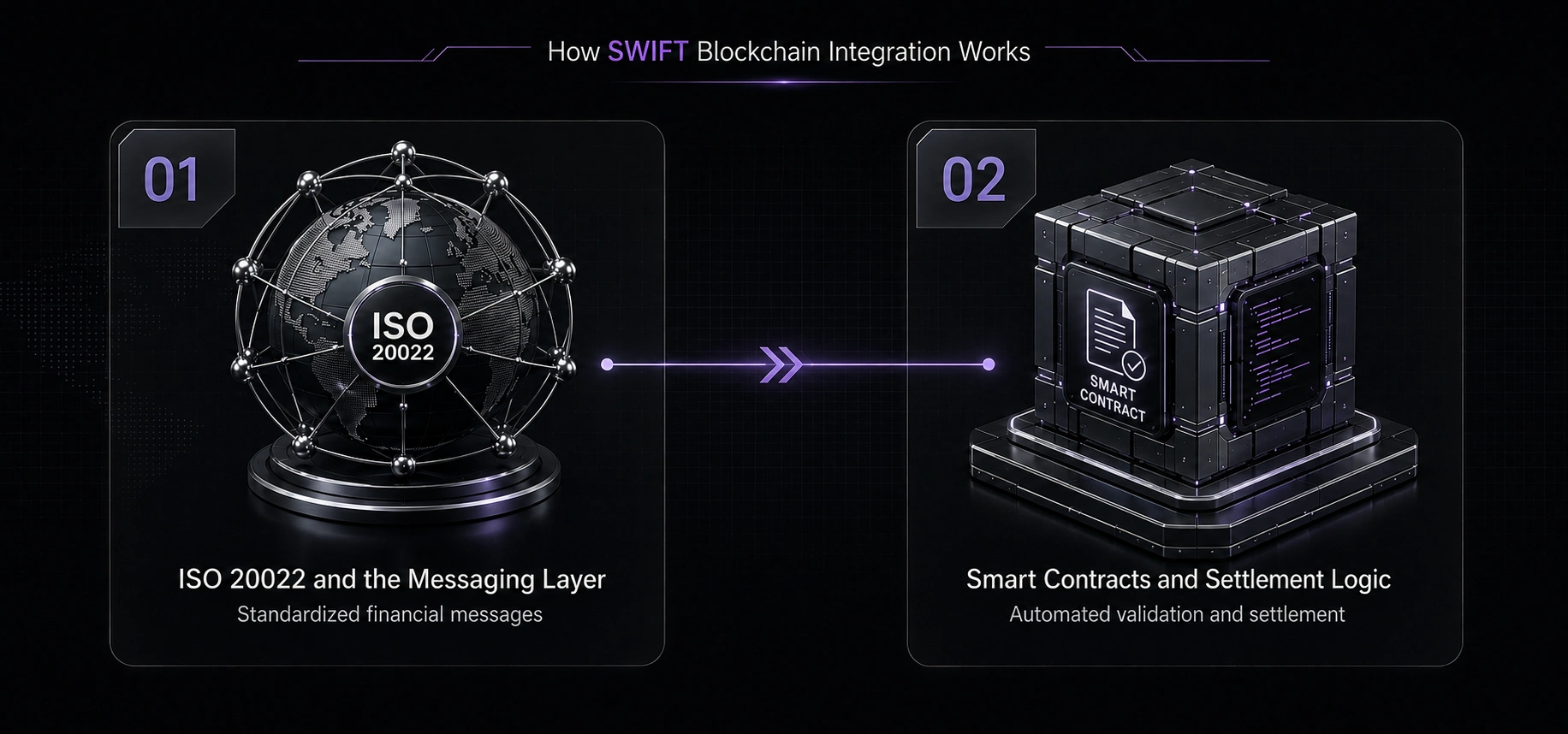
The announcements are on top of a very standard payments system using blockchain interbank messaging. Banks issue payment instructions that reference tokenized deposits. The shared ledger orders and validates the instructions. When requirements are satisfied, settlement instructions flow back into each bank’s existing systems.
1. ISO 20022 and the Messaging Layer
In this context, the ISO 20022 blockchain mapping is relevant, as SWIFT migrated cross-border payment instructions to the ISO 20022 messaging standard in November 2025. The more detailed, structured data format as defined in SWIFT’s own standards library, offers the ledger much more contextual data for each transaction relative to the legacy MT message format, which is one of the reasons why automated, rules-based settlement is feasible.
2. Smart Contracts and Settlement Logic
On top sits a payment orchestration layer that communicates instructions between the traditional rails and the new ledger depending on the corridor and counterparty. Smart agreements perform settlement logic such as conditional releases and compliance checks – making disciplined smart contract development just as critical for correspondent banking as it is for DeFi platform.
A testnet application can have errors, but settlement logic that moves regulated bank money cannot, because a stopped or mis-executed transaction on this scale has real counterparty and regulatory implications. This is why strong formal verification work is important in this context, unlike consumer-facing blockchain applications. For fintechs built on top of this stack, blockchain payment infrastructure development now requires planning for two settlement paradigms, not one.
Implications for Fintechs and Payment Providers
SWIFT’s change doesn’t eliminate independent blockchain payment infrastructure, but it does change the competitive question. crypto payment gateways providers are still there to support merchants and platforms that want to settle directly on-chain without a bank account, a use case that SWIFT’s bank-centric architecture was never designed for. Those merchants are often willing to sacrifice the compliance assurances that come with a regulated bank ledger in exchange for speed and finality, and that trade-off isn’t likely to change just because banks now have a faster settlement option of their own.
The same logic applies further down the payment chain in remittances to workers and families. Providers built on stablecoin remittance rails still provide atomic, on-chain finality that SWIFT’s coordination-layer approach does not try to replicate, and that difference is likely to dictate which use cases go where in years to come.
1. Where Fintechs Have a Head Start
In the area of liquidity management the two worlds are beginning to come closer and closer and fintechs may already have the most relevant experience. Cross-chain liquidity infrastructure pools and routes capital across chains. It solves a coordination problem that seems conceptually similar to what SWIFT’s shared ledger is now trying between banks with tokenized deposits on separate internal systems. Both problems arise from the need to keep a consistent, real-time view of value across a large number of ledgers.
multi-chain wallet architecture does as well, providing institutions with a unified operating view across otherwise disparate ledgers, rather than having to reconcile balances across each manually. Fintechs with multi-venue settlement expertise have a real advantage in advising banks heading into this territory, not least when industry data shows correspondent banking relationships have shrunk by around 30% since 2011 despite increasing cross-border volumes.
2. The Integration Opportunity
For incumbent players building fintech infrastructure, the near-term opportunity is integration work: hooking existing products to bank-issued tokenized deposits, building compliance tooling around new messaging formats, and helping institutions without in-house blockchain expertise participate in pilots without rebuilding their core systems from scratch.
Planning a Blockchain Payment Platform? Get a Tailored Cost Estimate
Challenges and Open Questions
The blockchain ledger that SWIFT runs is a huge step forward, but it also raises a number of issues that banks, fintechs and regulators will have to address before the technology can be scaled beyond the current trial group. Among the challenges: regulatory complexity, security rigor and strategic unpredictability.
1. Regulatory Fragmentation Across Jurisdictions
Tokenized deposits do not have a consistent regulatory status across jurisdictions, and a ledger that spans institutions and dozens of regulatory regimes needs to comply with each one at the same time. Some governments consider tokenized deposits to be regular bank liabilities, while others are still putting digital asset settlement regimes in place. This patchwork makes compliance complicated: a transaction that is fully compliant in Singapore may raise concerns in Brazil or the European Union.
The net result is that institutions participating in SWIFT’s pilot face a tangle of overlapping and often contradictory rules. A shared ledger can’t just adopt the compliance posture of one country, it needs to be built to apply different rules by corridor, counterparty and asset class. It’s a solvable problem, but it requires constant engagement with regulators, not a one-off permission.
2. Legacy System Integration Risk
Most of the institutions involved are hooking up decades-old core banking technologies to a shared ledger over which they have little control. These systems were built for batch processing, business-hours reconciliation and bilateral communications, not for continuous settlement with a distributed ledger. The combination of the two worlds increases operational risk during transition time, especially for reconciliation, exception management and failure recovery.
Integration difficulty is both technical and operational. People working in bank operations, who are used to working with legacy workflows, now have to deal with settlement exceptions in near real-time, with fewer manual touch points and less tolerance for delayed reconciliation. This means new procedures, monitoring tools and a phased rollout strategy to give banks confidence in the new rails before moving volumes fully.
3. Security and Smart Contract Risk at Institutional Scale
The larger the stakes, the more security considerations matter. A ledger that orchestrates tokenized deposits across the globe’s banks requires the same level of rigor as any high-value financial system and independent smart contract audit work should be viewed as a prerequisite rather than a box to check before any settlement logic touches live bank funds. One unhandled edge case in code that moves tokenized deposits between institutions has a very different chain of events than a problem in a retail DeFi application.
And on this scale, correctness is as important as performance. The global settlement-level transaction volumes require careful gas optimization so that the settlement logic can consistently work at scale and not just in pilot settings with a limited number of participating banks. The seventeen-bank pilot is a controlled environment, and taking it to hundreds of institutions across thousands of corridors will test the ledger in ways no pre-production audit could have imagined.
4. Strategic Open Questions for Fintechs
Fintechs are also raising a series of strategic questions that will influence their positioning vis-à-vis SWIFT’s evolving infrastructure, as well as technical and regulatory barriers.
-
Payment system modernization: What does SWIFT’s shared ledger imply for correspondent banks’ relationships and cost structures? Will banks pass on benefits of settlement efficiency to customers or eat them to improve margins?
-
Financial messaging standards: What is the governance of tokenized deposit transfers under ISO 20022? Will other message types and data fields be standardized? Who decides the roadmap?
-
Settlement migration: If banks provide faster, more compliant settlement options, will the volume from stablecoins shift to bank-issued tokenized deposits? Can stablecoins retain their on-chain finality edge and DeFi composability?
-
Interoperability limits: Where does the SWIFT ledger end and the independent blockchain payment system begin? Will fintechs run on top of SWIFT, alongside SWIFT, or in competition with SWIFT?
-
Timeline risk: How fast will adoption spread beyond the current set of trialists? And what if adoption stalls or fragments due to competing ledger standards?
These are important questions, but we don’t have definitive answers yet. Fintechs and payment providers that wait for full clarity risk falling behind in an infrastructure transformation that is already happening. Flexibility needs to be built into the tactics of early movers, hedging across different settlement models rather than committing to one.
What to Watch Next
SWIFT took roughly nine months to build and deliver the MVP of its shared ledger from initial design, and intends to add functionality and settlement asset types incrementally rather than in one fell swoop. The current pilot group of seventeen banks is a proving ground; broader participation will likely depend on how well the ledger fits into each bank’s existing infrastructure.
One architecture overview of the rollout shows that real-time gross settlement blockchain models and interbank blockchain settlement in general are moving from research papers to production pilots faster than most of the industry expected even a year ago, with the ledger working alongside existing rails rather than supplanting them. The ongoing trial phase should be seen as a signpost and not as a finished product for fintechs and organizations looking to explore this market. The focus should be on partners who understand both traditional payment rails and blockchain settlement architecture.
Concluding Note
SWIFT’s foray into blockchain settlement is not a substitute for correspondent banking or a surrender to crypto rails. It is an attempt to bring always-on, tokenized settlement to the infrastructure that over 11,500 institutions already use. The SWIFT blockchain ledger is still in its early stages, with only a small pilot group and building on years of interoperability effort. The near-term opportunity for fintechs and payment providers is in the integration layer between legacy rails and tokenized settlement, rather than waiting for one system to fully replace the other.
Frequently Asked Questions
1. What is SWIFT’s blockchain ledger?
The SWIFT blockchain ledger is a permissioned, token-agnostic shared ledger that is used to coordinate the movement of tokenized deposits between participating banks. It does not replace SWIFT’s existing communications network or create its own coin. Rather, it adds an always-on settlement layer that offers banks a single, real-time view of payment obligations, eliminating the need for sequential bilateral messages and enabling faster cross-border settlement.
2. How does SWIFT’s blockchain ledger differ from public blockchains?
Unlike public blockchains like Ethereum, where transfers and finality are atomic on-chain, SWIFT’s ledger is a coordinating layer that sits on top of existing bank accounts. Once these systems are up and running again, the last settlement can still be done via the existing payment infrastructure. So the game plan for SWIFT is to lean into the interoperability with existing rails and the regulatory compliance rather than the trustless, permissionless settlement that public blockchains enable.
3. When did SWIFT launch its blockchain ledger?
SWIFT launched its blockchain ledger concept at Sibos in Frankfurt in September 2025. The design work was completed in March 2026, and the initial production version launched for real transactions in July 2026 with seventeen banks from six continents participating in the pilot.
4. What are tokenized deposits?
Tokenized deposits are digital equivalents of regulated commercial bank deposits with a one-for-one relationship to the bank’s balance sheet. They are issued by banks on their own internal ledgers, and SWIFT’s shared ledger manages their transfer between institutions. Stablecoins, by contrast, are generally issued by non-bank companies and settle on-chain immediately.
5. Will SWIFT’s blockchain ledger replace correspondent banking?
No. The structure of the nostro-vostro account that forms the backbone of the current correspondent banking system still exists. The SWIFT ledger gives a common, real-time view of payment promises for member banks, but it does not remove the need for correspondent relationships. It ought to be viewed as an upgrade, rather than a replacement, of correspondent banking infrastructure.
Build Next-Gen Payment Infrastructure for 24/7 Cross-Border Settlement
