



Key Takeaways
- TaaS is making RWA tokenization more scalable by turning issuance, compliance, and custody into reusable infrastructure.
- Faster launches and lower upfront costs make TaaS attractive to institutions moving beyond tokenization pilots.
- Compliance, custody, and investor onboarding are becoming core components of production-ready TaaS platforms.
- Custom builds offer more control, while TaaS provides faster deployment with less initial development overhead.
- Vendor selection matters: issuers should assess security, compliance, APIs, custody, and data portability before committing.
Introduction
Real-world asset tokenization has moved past the pilot stage. Tracked on-chain value for tokenized assets has climbed from roughly $11–14 billion a year ago to more than $33 billion in mid-2026, and institutional issuers are no longer treating blockchain rails as experimental. What has changed is not just the volume of assets moving on-chain, but how they get there. Instead of commissioning a bespoke build for every issuance, asset managers and fintechs are turning to Tokenization as a Service – a managed infrastructure layer that handles issuance, compliance, and custody through reusable APIs. This shift from project-based development to platform-based infrastructure is why TaaS is quickly becoming the backbone of RWA finance. This article covers what TaaS actually is, why institutions are adopting it, the architecture behind it, the market forces driving demand, and the trade-offs worth weighing before committing to a provider.
What is Tokenization as a Service?
Tokenization as a Service (TaaS) is a type of tokenization infrastructure that enables issuers to build, manage and distribute tokenized assets on a common platform rather than a bespoke one. Tokenization API provides callable endpoints for issuance, transfer and reporting, allowing a fund administrator or fintech company to launch a tokenized product without having to build smart contract infrastructure from scratch or build their own blockchain integration team.
This is a far cry from building a RWA tokenization platform the old-fashioned way, where a company would hire a vendor to build a bespoke system for a single use case. Rather, TaaS is tokenization middleware: a layer between the issuer’s existing operations and the blockchain that standardizes how assets are represented, exchanged and serviced. A 2026 market report forecast the RWA tokenization market to keep growing at a double-digit compound annual rate through 2030. The end result is that blockchain asset servicing (investor records, corporate actions, redemption processing) is a configuration exercise, not an architecture one. Issuers will utilize existing rails instead of building new ones for every asset class or jurisdiction.
Why TaaS is Becoming the Backbone of RWA Finance
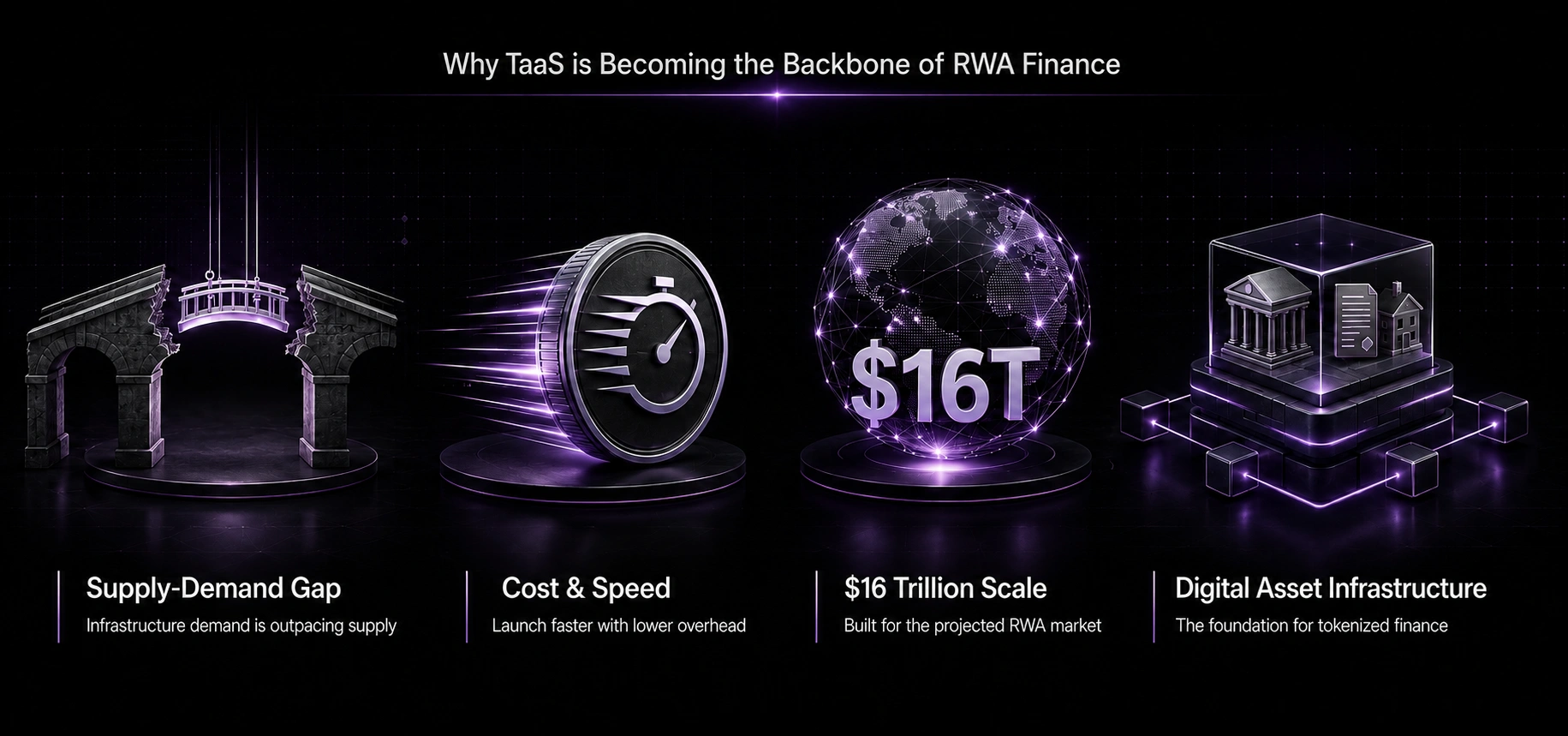
The demand for tokenized real world assets from institutional investors has outstripped the availability of in-house teams with the capacity to build compliant infrastructure. TaaS meets this requirement by treating tokenization as a common utility, not as a one-off exercise. Here are four reasons why TaaS is emerging as the backbone of RWA finance.
-
Supply-demand gap in infrastructure: As allocators move from pilot programs to production deployments, they need RWA finance infrastructure that can support many asset classes without having to design each one individually. TaaS fills that gap with standardized rails that many issuers can plug into.
-
Cost and speed advantages: A custom build can take months to take to production readiness by a specialist technical team, but a TaaS integration can often be achieved in weeks from onboarding to a live pilot. white-label tokenization is important when it counts: a fintech or asset manager can launch under its own brand while the underlying issuance engine, compliance checks and custody connectors have already been built and tested.
-
The $16 trillion scalability argument: A widely cited report by Boston Consulting Group with ADDX suggests asset tokenization could be a $16 trillion opportunity by 2030, or roughly 10% of expected global GDP. The way payment infrastructure was scaled to get to this scale is how asset-backed tokens have to be issued: on common rails, not proprietary systems.
-
TaaS as digital asset infrastructure: TaaS providers are positioning themselves as that layer of digital asset infrastructure, and institutional tokenization on common platforms gives credence to the $16 trillion forecast, rather than aspiration.
Core Components of Tokenization as a Service
Actually, a functional TaaS platform is a group of interconnected modules, where each module handles a different part of the issuing and servicing lifecycle. So here’s the rundown of the components:
1. Issuance, Compliance, and Onboarding
-
Token Issuance Engine: Creates and maintains the on-chain representation of the asset, often using a permissioned standard meant for regulated securities.
-
Compliance automation tokenization: Automates KYC/AML, investor eligibility, and jurisdictional transfer limit enforcement at the protocol level instead of manual review.
-
Custody integration tokenization: connects issued tokens with qualified custodians, enabling institutional investors to meet fiduciary and regulatory custody requirements.
-
Investor onboarding: Automates the input, verification, and accreditation workflows so that new holders can be approved without going through human documentation cycles.
2. Secondary Market and Token Design
A secondary marketplace module offers holders a source of liquidity after the initial offering while regulatory-compliant token design ensures that the token structure itself: transfer restrictions, voting rights, redemption logic: is consistent with the legal characterization of the underlying asset. This modularity is a direct boon to tokenized securities, since a bond, a fund share, and a real estate interest can all run on the same basic rails with different compliance criteria layered on top.
This mode of business is baked into protocols such as ERC-3643 and ERC-1400, which embed identity verification and transfer rules directly into the token contract, ensuring compliance moves with the asset and not out to a separate system. Tokenized funds, including money-market products like BlackRock’s BUIDL and Franklin Templeton’s BENJI have shown they can scale to billions of assets, as long as the underlying compliance and custody rails are standardized, rather than built for each product.
Build Scalable RWA Infrastructure with Issuance, Compliance, and Custody Built In
TaaS vs. Custom Tokenization Platform Development
The build-versus-buy decision usually comes down to cost, timeline, and control. Here is how the two paths compare:
1. Custom Build: Higher Cost, Longer Timeline, Full Control
A custom-built tokenization platform can cost in the high six figures or low seven figures if legal structure, smart contract audits and custodial integration are included. These are illustrative estimates and actual costs can vary widely depending on jurisdiction and asset complexity. Custom development typically takes between six and twelve months to get a compliant product launched. Custom builds are still useful when an institution requires a proprietary structure, full control over the codebase or asset-specific functionality that no other RWA tokenization platform offers out-of-the-box. The largest single engineering line item here is Smart contract development.
2. TaaS Integration: Lower Upfront, Faster Launch
A TaaS integration may be a fixed startup cost and ongoing usage fees and thus a much lower initial financial commitment. The compliance logic and custody links and audit work are already in place so timelines can be reduced down to a matter of weeks. For most new issuers, TaaS provides a faster, lower risk route to a compliant product.
Market Drivers Behind TaaS Adoption
Several converging factors are pushing issuers to shared infrastructure rather than proprietary builds. Tokenized Treasuries are still the biggest category and institutional custody integration is no longer a differentiator but a must. As vendor due diligence takes center stage, providers who cannot name a qualified custody partner are being progressively excluded.
New Asset Classes and the Benji Expansion Pattern
Tokenized bonds are gaining traction and the recent expansion of its Benji tokenization platform on a new blockchain network demonstrates the ability to extend an individual TaaS implementation to other chains and asset classes without the need for a complete overhaul. Real estate tokenization is enabling fractional ownership structures at scale and commodity tokenization is following. RWA.xyz-tracked aggregators data projects the on-chain tokenized asset market reaching roughly $33.5 billion in distributed value by mid-2026.
Challenges and Risks of Tokenization as a Service
There are trade-offs to using a third-party platform other than the efficiency gains. All of these risks should be mitigated in the vendor due diligence as they can arise months after launch making mitigation far more expensive. The five main challenges are:
1. Vendor Lock-in
Moving issued assets and investor information from a provider’s infrastructure later can be costly and challenging from a technical perspective. Once assets are live on a TaaS platform, their data structures, token contracts, and investor records are inextricably tied to the provider’s proprietary systems. Before signing, not after, issuers should test the waters of data portability guaranties and exit clauses.
2. Security Concentration Risk
A shared platform concentrates risk because a single flaw in the provider’s intelligent agreements or critical management infrastructure could damage all issuers on the platform. The provider’s smart contract audit history and incident record are as important as its feature set. The issuers should require real audit reports, not just summaries. And they should know what happens if a security hole is found after the product is launched.
3. Compliance Variability Across Jurisdictions
A platform designed for one regulatory environment may need to be completely modified to suit another. KYC/AML thresholds, transfer restrictions and reporting requirements differ significantly in the EU, UAE, Singapore and the United States. Issuers operating in multiple jurisdictions should verify that the platform’s compliance layer supports each target market, instead of assuming a single configuration is universal.
4. Data Ownership and Record Control
If the partnership is terminated, issuers should confirm who has the investor records. In regulated markets, the platform provider usually does not have to meet all the recordkeeping requirements, but the issuer does. If the provider owns the master copy of investor records, then the issuer is at risk if the provider fails, gets bought or changes its data policies. You have to agree on independent export rights from the beginning.
5. Integration Complexity with Legacy Systems
The integration with existing fund administration, accounting and reporting systems may result in schedules that exceed the original projections. If a TaaS platform cannot integrate with existing systems and requires a parallel process, it introduces operational friction that grows with the volume of issuance.
Mitigation: Compliance Reporting as a Counterweight
Strong compliance reporting capabilities that provide issuers with an independent, exportable audit trail (rather than just relying on the provider’s internal records) alleviate several of these risks. An issuer that can export its own compliance data at any time has leverage in vendor negotiations and a plan B if things go south.
Planning an RWA Tokenization Platform? Get a Tailored Cost Estimate
How to Choose a Tokenization as a Service Provider
When evaluating a TaaS provider, the first step is to look at its track record: how many live issuances has the platform managed and in what asset classes and jurisdictions? Here’s a checklist to help you evaluate candidates in an organized manner:
-
Track Record: How many live issuances has the platform completed, and in what asset classes and jurisdictions?
-
Compliance Depth: How does the platform handle multi-jurisdiction KYC/AML, accredited investor verification and transfer restrictions?
-
Custody Partnerships: What custodians are eligible, named and verifiable, versus stated broadly?
-
API Flexibility: Can it work with existing fund administration and reporting systems or does it require a separate workflow?
-
Exit Terms: When you sever the link, what happens to the investor records and issued assets? What are the guaranties around data portability?
These answers will differentiate a true infrastructure partner from a platform that creates new dependencies.
Concluding Note
Tokenization as a Service takes what had been a one-off, months-long technical exercise and turns it into a repeatable, compliant operation, which is why it is becoming the backbone of RWA finance. As the demand from institutions for tokenized assets grows, companies that treat Tokenization as a Service as infrastructure, and not a one-off, will be better positioned to scale across asset classes and countries without having to re-invent their platform each time. The winners will be those who treat their TaaS selection as an infrastructure decision, with the same rigor as choosing a custodian, transfer agent or core banking system.
Frequently Asked Questions
1. What is Tokenization as a Service?
Tokenization as a Service is a managed infrastructure that allows issuers to issue and distribute tokenized assets using APIs on a shared platform. TaaS serves as tokenization middleware between conventional operations and the blockchain, making blockchain asset management a configuration exercise rather than an engineering undertaking.
2. Why is TaaS becoming the backbone of RWA finance?
There are four reasons TaaS is popular: First, infrastructure supply and demand are not balanced. Second, TaaS is cheaper and faster ( launch in weeks vs months ). Third, BCG/ADDX’s $ 16 trillion argument for scaling. Fourth, TaaS is positioned as digital asset infrastructure. Assets-backed token issuance needs shared rails, not proprietary systems.
3. What are the core components of a TaaS platform?
The following are the key components of a TaaS platform: token issuance engine, compliance automation (KYC/AML at protocol level), custody integration, investor onboarding, secondary marketplace, and regulatory-compliant token design. Standards such as the ERC-3643 embed compliance into the token contract.
4. How does TaaS compare to custom tokenization platform development?
Custom builds from high six to low seven figures, 6-12 month deadlines, full codebase management. TaaS has set up fees and usage-based charges with a start date of weeks. TaaS works for most new issuers coming to the market and custom suits proprietary arrangements.
5. What market drivers are accelerating TaaS adoption?
The first category is tokenized treasuries. Institutional custody is becoming a must-have and regulatory clarity is getting better. Franklin Templeton’s Benji expansion is an example of how one TaaS deployment expands to new chains. Real estate and commodity tokenization is following the Treasury model.
6. What are the main risks of using a TaaS provider?
Risks include vendor lock-in, concentration of security on shared platforms, compliance differences across jurisdictions, uncertainty of data ownership, and interaction with existing systems. We address these issues with solid compliance reporting that provides an independent and exportable audit trail.
7. How do I choose Tokenization as a Service provider?
Evaluate the track record, depth of compliance, named custody partnerships, flexibility of APIs and exit terms. The answers differentiate between a true infrastructure partner and a platform that creates new dependencies.
Launch Tokenized Assets Faster with Flexible APIs and Institutional-Grade Infrastructure
