



Key Takeaways
- Tokenized money market funds have become institutional-grade financial infrastructure, with leading asset managers demonstrating how regulated funds can operate on blockchain while maintaining compliance and investor protections.
- Successful MMF platforms integrate investor onboarding, permissioned token issuance, custody, NAV calculation, yield distribution, and compliance reporting into a single end-to-end architecture.
- Compliance and custody are foundational design requirements, requiring permissioned token standards, continuous KYC/AML monitoring, qualified custodians, smart contract audits, and regulatory-grade audit trails.
- Tokenized MMFs are expanding beyond investment products into treasury management and collateral markets, enabling 24/7 settlement, programmable liquidity, and real-time use of fund shares across financial ecosystems.
- Development costs range from low-to-mid six figures for a single-fund MVP to high seven figures for multi-jurisdiction institutional platforms, making experienced tokenization partners and compliance-first architecture critical for long-term success.
Introduction
Tokenized Money Market Fund Platform Development has moved from experiment to institutional infrastructure. By mid-2026, the combined value of on-chain tokenized Treasury and money market assets surpassed $12 billion, led by BlackRock’s BUIDL, Franklin Templeton’s BENJI, and JPMorgan’s MONY.
For asset managers and treasury teams considering tokenized money market fund platform development, the debate has shifted from whether to build to how to architect for compliance, custody, and scale from day one.
This guide covers the essential platform features, architecture, regulatory requirements, development timeline, and realistic cost ranges that institutional decision-makers need to understand.
Tokenized Money Market Fund Platform Development: What It Is and Why It Matters
Tokenized money market funds represent on-chain shares in a regulated money market fund. They typically maintain a constant net asset value of $1.00, while the ownership and transfer of fund shares are recorded on a blockchain rather than through conventional book-entry systems.
This structure enables 24/7 settlement, real-time yield accrual based on the duration of ownership, and fractional ownership that traditional fund management systems cannot easily support.
The key differences between traditional and tokenized MMFs include:
- Programmable settlement: Fund transactions can be automatically executed through smart contracts.
- Continuous availability: Investors can settle eligible transactions beyond traditional banking and market hours.
- Composability: Tokenized shares can interact with other approved on-chain financial instruments.
- Transparent fund data: Authorized participants can obtain faster and more verifiable visibility into holdings and NAV.
- Fractional ownership: Investors may access smaller portions of fund shares through tokenized units.
Major fund complexes are already experiencing increased institutional adoption. The BlackRock BUIDL fund, launched in March 2024, now has approximately $9 billion in monitored asset value across multiple blockchain networks.
JPMorgan expanded into the category with MONY in December 2025, followed by JLTXX only a few months later. These launches indicate that blockchain-based money market funds are moving beyond isolated experiments and becoming regular products offered by leading asset managers.
The Franklin Templeton BENJI suite became the first U.S.-registered mutual fund to use a public blockchain as its official transaction-recording system and has since grown to more than $1.9 billion in assets under management.
Core Platform Architecture: From Fund Shares to On-Chain Tokens
Building a tokenized MMF platform involves several coordinated layers, including investor onboarding, KYC verification, token issuance against verified deposits, daily NAV calculation, automated yield distribution, redemption, and ongoing custody reconciliation.
Most institutional platforms use smart contract development based on permissioned security token standards. Under this approach, investor eligibility, KYC verification, jurisdictional restrictions, and transfer limits are built directly into the token contract rather than being added as a separate compliance layer over an unrestricted token.
How the Architecture Works
- Investor onboarding: The platform verifies identity, accreditation status, sanctions exposure, and jurisdictional eligibility.
- Wallet whitelisting: Only approved wallets are authorized to subscribe to, hold, or transfer fund tokens.
- Subscription settlement: Investors deposit approved fiat currency or stablecoins through connected payment and banking rails.
- Token issuance: Fund shares are minted only after the subscription funds have been verified and settled.
- NAV calculation: The fund administrator calculates NAV, and approved data is transmitted on-chain through a trusted oracle.
- Yield distribution: Smart contract logic calculates or distributes yield according to verified token ownership.
- Redemption: Fund tokens are burned when investors redeem their shares and receive the corresponding settlement amount.
- Custody reconciliation: On-chain token balances are continuously reconciled with the underlying off-chain fund assets.
How Tokens, Custody, and Legacy Systems Connect
Under this model, fund shares are minted only to whitelisted wallets after subscription funds settle. NAV updates are pushed on-chain through a trusted oracle feed, while yield distributions are managed through automated contract logic rather than manual back-office processing.
Transfers are completed only after the fund verifies the eligibility and credentials of both parties in accordance with its compliance policies.
The blockchain layer does not replace the transfer agent, fund administrator, or custodian. Instead, it connects these entities to a new settlement layer capable of operating continuously.
This is where institutional custody becomes the architectural foundation. It maintains the relationship between on-chain token holdings and the off-chain fund assets held by a qualified custodian, similar to how BNY Mellon holds the underlying Treasury assets for BUIDL.
Essential Platform Features for Tokenized MMFs
A production-grade tokenized MMF platform must support the complete lifecycle of the fund rather than only minting and transferring tokens. Each feature addresses a regulatory, technical, or operational requirement that can become a serious compliance gap if it is overlooked during development.
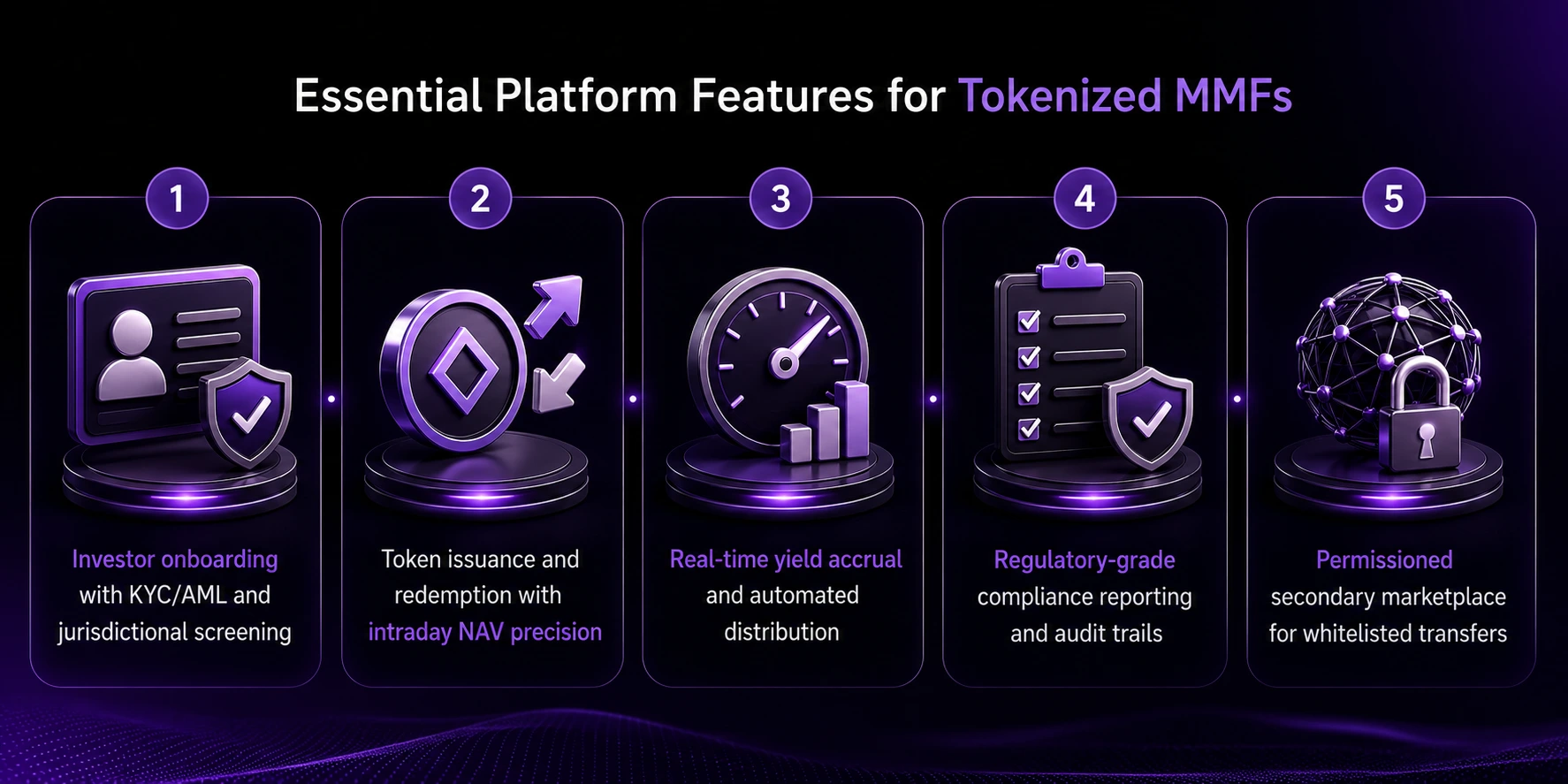
1. Investor Onboarding With KYC/AML and Jurisdictional Screening
No wallet should be whitelisted until the investor onboarding workflow completes all required identity and eligibility checks.
The onboarding module should support:
- Individual and institutional identity verification.
- KYC and AML checks.
- Investor accreditation verification.
- Sanctions and politically exposed person screening.
- Jurisdiction-specific eligibility rules.
- Wallet ownership verification and whitelisting.
- Ongoing transaction and risk monitoring.
This gating layer determines who is legally permitted to hold fund tokens. Errors at this stage can expose the fund to regulatory action in every jurisdiction in which it operates.
2. Token Issuance and Redemption With Intraday NAV Precision
Fund shares must be minted only against verified fiat or stablecoin deposits and burned when an investor completes a redemption.
The platform must accurately calculate and reflect NAV on-chain. Unlike conventional fund systems that rely heavily on end-of-day cutoffs, tokenized funds may support continuous or near-continuous settlement.
Intraday accuracy is therefore not merely an optional feature. It is a core technical requirement that many legacy fund infrastructures were not originally designed to manage.
3. Real-Time Yield Accrual and Automated Distribution
Yield must accrue according to verified ownership and be correctly allocated as fund shares change hands during the trading day.
Depending on the fund structure, the platform may distribute yield through:
- Automatic token rebasing.
- Distribution of additional fund tokens.
- Stablecoin-based yield payments.
- NAV appreciation reflected in the token value.
Manual distribution cycles can create reconciliation gaps between on-chain ownership records and off-chain fund records. Auditors increasingly view these inconsistencies as control vulnerabilities in tokenized fund systems.
4. Regulatory-Grade Compliance Reporting and Audit Trails
Compliance reporting must generate investor statements and audit trails that are immutable, exportable, and accessible to authorized auditors and regulators.
The reporting infrastructure should capture:
- Investor onboarding and approval records.
- Token issuance and redemption activity.
- Wallet transfers and ownership changes.
- NAV updates and oracle submissions.
- Yield calculations and distributions.
- Compliance alerts and intervention records.
- Custody and reserve reconciliation data.
Compliance reporting is not a quarterly administrative exercise. It is continuous infrastructure that must produce accurate and defensible data whenever it is requested.
5. Permissioned Secondary Marketplace for Whitelisted Transfers
A secondary marketplace allows approved investors to transfer fund tokens to other eligible and whitelisted participants.
This becomes particularly important when the fund serves investors across multiple jurisdictions. Liquidity requirements, settlement expectations, market hours, and eligibility rules can differ significantly by geography and investor type.
The marketplace should therefore enforce:
- Whitelisted wallet-to-wallet transfers.
- Jurisdiction-specific transfer restrictions.
- Investor classification rules.
- Holding-period requirements.
- Transaction limits and approval workflows.
- Automated pre-transfer compliance checks.
A static holdings list cannot efficiently serve investors operating across different regions and market schedules.
On-chain data providers such as RWA.xyz monitor tokenized asset movements in real time, providing institutional allocators with additional data for evaluating funds before committing capital.
Designing for the complete fund lifecycle from the beginning is significantly less expensive than retrofitting compliance, reporting, liquidity, and custody features after the fund has launched.
Tokenized Funds as Collateral and Treasury Management
One of the strongest institutional use cases is the use of tokenized money market fund shares as collateral.
On-chain MMF shares are increasingly being used as collateral for derivatives, lending, and repurchase agreement transactions. Some major trading venues already accept tokenized fund shares for these purposes in live production environments.
This composability makes tokenized treasury management more valuable than simply digitizing a conventional fund statement. Corporate treasury departments can hold yield-bearing tokenized MMF shares instead of idle cash while retaining the ability to deploy that value as collateral when required.
How Tokenized MMFs Support Treasury Operations
- Yield generation: Treasury reserves can remain invested in yield-bearing fund shares rather than sitting idle.
- Near-instant collateral deployment: Approved tokenized shares can be transferred or pledged without waiting for conventional settlement cycles.
- Automated margin management: Smart contracts can support automatic margin calls and collateral top-ups.
- Continuous valuation: Approved oracle feeds can provide up-to-date fund values for collateral calculations.
- Improved liquidity: Eligible treasury assets can be mobilized more quickly across connected financial platforms.
These platforms require automatic margin calls, continuous on-chain valuation, and immediate settlement for tokenized collateral management, compared with the multi-day processing cycles common in traditional repo markets.
The same architectural pattern takes institutional asset tokenization beyond money market funds and into private credit, corporate bonds, and structured products. Each category can benefit from programmable settlement rails and shared compliance infrastructure.
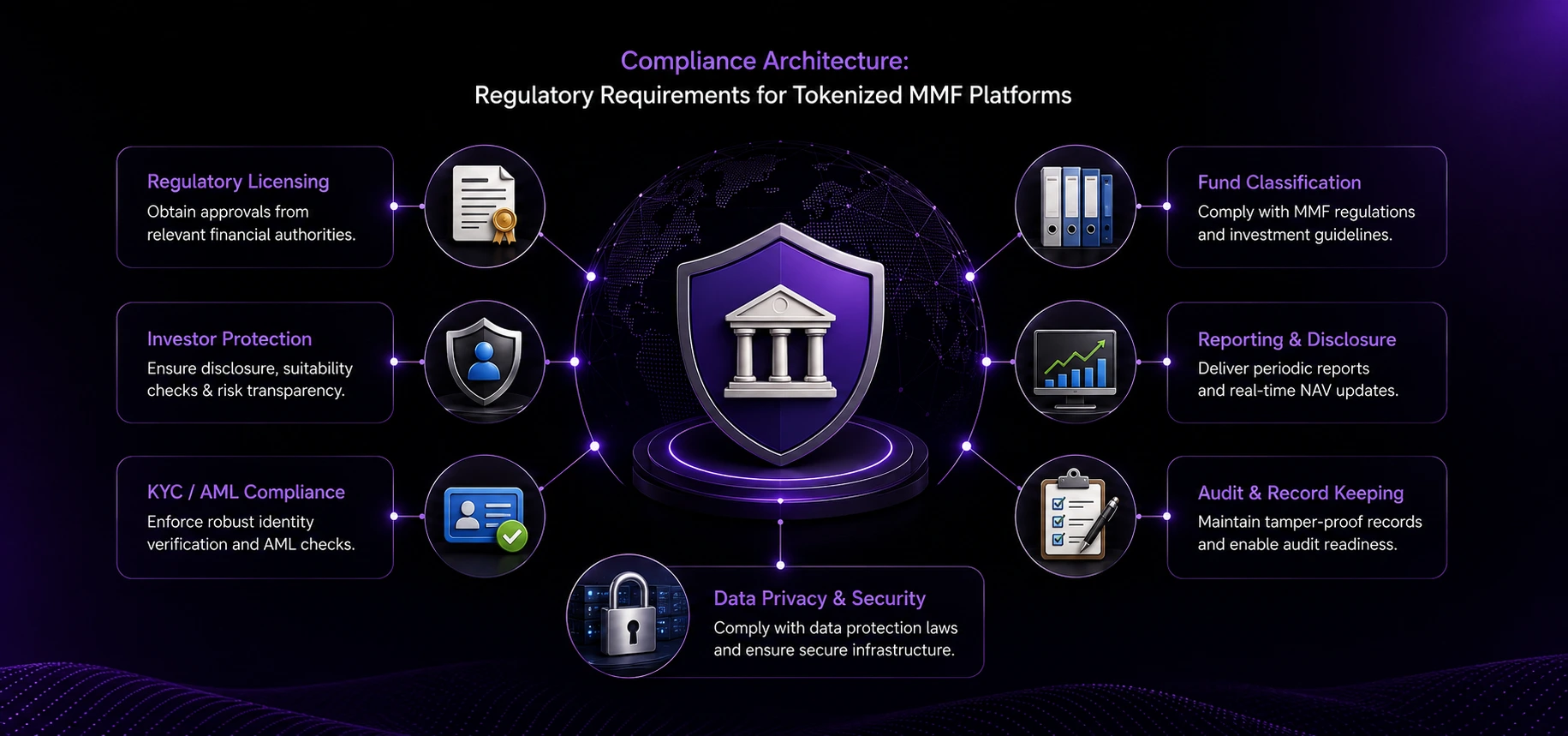
Compliance Architecture: Regulatory Requirements for Tokenized MMF Platforms
In the United States, the SEC’s January 2026 staff statement on tokenized securities confirmed that tokenization changes the technological format used for recordkeeping but does not remove the underlying regulatory obligations.
Tokenized fund shares remain subject to the applicable requirements of the Investment Company Act, transfer agent rules, investor protection obligations, and regulatory reporting duties that apply to traditional book-entry shares.
Tokenized MMFs operating in the European Union may need to comply with relevant UCITS requirements while also considering the applicable provisions of the Markets in Crypto-Assets framework.
The UAE and Singapore are also becoming prominent jurisdictions for purpose-built tokenized fund structures outside the United States.
Key Compliance Requirements
-
- Permissioned token design: Only approved investors and wallets should be able to hold or transfer fund tokens.
- Continuous KYC/AML monitoring: Investor risk must be reviewed throughout the investment lifecycle, not only during onboarding.
- Sanctions screening: Wallets, investors, counterparties, and transfers must be checked against applicable sanctions lists.
- Transfer restrictions: Smart contracts must enforce jurisdictional, investor-type, and holding-period rules.
- Qualified custody: The underlying fund assets and relevant digital assets must be handled through an approved custody structure.
- Immutable audit trails: The platform must preserve complete records of investor, token, custody, NAV, and compliance activity.
- Smart contract security: Fund-share contracts must be independently tested before live issuance.
KYC/AML screening and sanctions monitoring must remain ongoing because secondary transfers and collateral use can move financial risk across jurisdictions within seconds.
A smart contract audit is non-negotiable given the regulatory and financial consequences of a fund-share contract failing under real-world market conditions.
Regulatory-compliant token design, permissioned transfers, integrated whitelist verification, and automated contract-level compliance enforcement should be foundational components of any meaningful RWA tokenization platform development project rather than features added after launch.
Independent formal verification provides an additional level of assurance by mathematically checking smart contract logic against its defined specification before any fund shares are issued.
Development Cost and Timeline for a Tokenized MMF Platform
The cost of tokenized MMF platform development includes more than software engineering. Project budgets must account for legal and regulatory structuring, platform design, custody integrations, compliance systems, external data providers, security audits, and operational readiness.
Estimated Development Cost
- Single-fund, single-jurisdiction MVP: Generally ranges from the low-to-mid six figures.
- Institutional single-fund platform: May require a higher six-figure investment depending on custody, compliance, reporting, and integration requirements.
- Multi-fund and multi-jurisdiction platform: Can reach the seven-figure range when it includes secondary trading, multiple custodians, advanced reporting, and complex jurisdictional controls.
- Large institutional ecosystem: Platforms supporting multiple funds, jurisdictions, custodians, settlement assets, and external financial systems may reach the high seven figures.
Estimated Development Timeline
- MVP platform: Approximately four to eight months from kickoff to deployment.
- Full-featured institutional platform: Approximately nine to fourteen months, depending on the number of jurisdictions, integrations, and audit requirements.
Major Cost Factors
- Number of funds and investor categories.
- Number of supported jurisdictions.
- Token standard and smart contract complexity.
- Custodian and transfer-agent integrations.
- Banking, fiat, and stablecoin settlement rails.
- NAV calculation and oracle requirements.
- Investor onboarding and compliance integrations.
- Secondary marketplace functionality.
- Reporting and audit requirements.
- Smart contract auditing and formal verification.
White-Label Infrastructure vs. Custom Development
Teams launching their first tokenized fund often need to choose between white-label infrastructure and a custom platform developed from the ground up.
White-label infrastructure can shorten the time to market and reduce initial engineering requirements. However, it may introduce limitations related to custodian selection, custom investor workflows, unique compliance rules, data ownership, and future scalability.
A custom platform provides greater control over the architecture, integrations, token logic, compliance processes, user experience, and expansion roadmap. It normally requires a higher initial investment and a longer development timeline.
Regardless of the chosen approach, the development partner should have proven expertise in asset tokenization and institutional finance rather than only general blockchain development capabilities.
Concluding Note
Tokenized money market funds are becoming one of the fastest-growing institutional real-world asset categories. The supporting infrastructure is rapidly evolving across custody, compliance, fund administration, secondary trading, and treasury management.
Platforms that attract sustainable institutional assets are those that treat compliance, custody, reconciliation, and auditing as foundational architectural requirements rather than controls added to a smart contract after development.
Today’s first movers are establishing the technical and operational standards that future teams considering tokenized money market fund platform development will be expected to meet.
Frequently Asked Questions
1. What Is Tokenized Money Market Fund Platform Development?
Tokenized money market fund platform development involves building infrastructure that represents ownership in a regulated MMF through on-chain fund shares. The platform manages investor onboarding, token issuance against verified deposits, NAV calculation through approved data sources, automated yield distribution, transfers, and redemptions while integrating with transfer agents, fund administrators, banks, and qualified custodians.
2. How Do Tokenized Money Market Funds Differ From Traditional MMFs?
Tokenized money market funds can provide 24/7 settlement, more precise yield accrual, fractional ownership, and faster visibility into fund ownership and NAV. Their main differentiators include programmable settlement, controlled on-chain transfers, and composability as collateral for approved lending, derivatives, and repo transactions.
3. What Platform Features Are Essential for a Tokenized MMF Platform?
The five essential features are investor onboarding with KYC/AML and jurisdictional screening, token issuance and redemption with accurate NAV processing, automated yield accrual and distribution, regulatory-grade compliance reporting with immutable audit trails, and a permissioned secondary marketplace for whitelisted transfers.
4. How Much Does Tokenized Fund Platform Development Cost?
A single-fund, single-jurisdiction MVP generally costs in the low-to-mid six figures and may take four to eight months to develop. A full-featured, multi-fund platform with secondary trading, multi-custodian connectivity, and multi-jurisdiction compliance may reach the seven-figure range and take approximately nine to fourteen months.
5. How Are Tokenized Funds Used as Collateral and in Treasury Management?
Tokenized fund shares can be used as collateral for derivatives, loans, and repo transactions on approved platforms. Tokenized treasury management also allows corporate treasuries to hold yield-bearing MMF shares instead of idle cash while accessing their value as collateral through automated margin management and near-instant on-chain settlement.
