



Key Takeaways
- x402 enables AI agents to make autonomous stablecoin payments for APIs, tools, data, and computation.
- The protocol combines agent wallets, MCP tools, payment requests, facilitators, and on-chain settlement.
- A secure x402 integration requires wallet setup, payment handling, API integration, testing, and monitoring.
- Use cases include paid APIs, premium data, GPU resources, specialized models, and multi-agent services.
- Basic integrations can take 4–8 weeks, while full agent payment platforms may require 3–6 months.
- Cost depends on agent scale, payment volume, custody architecture, network support, and compliance requirements.
Introduction
AI agents can surf the web, reason through multi-step problems, and run code. But until recently, they didn’t have a native way to pay for anything. All paid API calls still went through a human-managed credit card or a pre-funded subscription. So, a person had to be in the loop the moment an agent needed a paid resource. x402 payment integration takes the bottleneck out. An open protocol, x402 settles stablecoin payments directly in HTTP requests, allowing autonomous agents to identify, pay for, and consume paid services without a person having to click “approve.” x402 was created by Coinbase and is now governed by the x402 Foundation. This blog covers x402 operation, how the architecture fits into an agent stack, what a development project looks like, where it is already in use, and the cost to build.
What Is x402? The Protocol That Gives AI Agents a Wallet
x402 revives the long dead HTTP status code 402 “Payment Required” and makes it into a working payment negotiation layer. When an agent requests a paid resource, the server responds with a 402 status and a list of accepted payment terms in a machine-readable form; the agent signs a transfer of a stablecoin, attaches it to the request, and resends it; the server verifies the payment on-chain before returning the result. There is a detailed description of this flow in the official x402 specification, including the role of the facilitator which does verification and settlement.
How x402 Extends MCP for Payments
Model Context Protocol (MCP) is the standard for AI agents to identify and call external tools, and x402 protocol development is built directly on top of MCP. x402 extends that discovery layer and introduces a payment requirement, so a tool can advertise a fee just as it advertises its inputs and outputs. That combination makes x402 AI agent payments practical: instead of a monthly subscription or pre-purchased credit balance, a service can charge per request with x402 MCP integration and an agent only pays for what it actually consumes.
x402 Architecture: How the Payment Layer Integrates with AI Agents
The request-and-response cycle has a few pieces: an agent-driven wallet, a payment request schema, an on-chain settlement layer, and a service discovery mechanism. The flow itself is simple: the agent makes a request with a signed USDC payment, a facilitator confirms that payment on chain and the service gives its result once settlement is complete. USDC on Base is the default coupling because Base’s cheap costs and fast finality make it economical to settle payments as little as a fraction of a cent. This is what makes genuine per-request pricing possible instead of the batching schemes older rails require.
On the tool side, MCP servers wrap each paid tool with its x402 requirements. So when an agent discovers a new service, it also discovers what it costs. This is a pattern from the MCP documentation. A typical well-scoped x402 API integration starts with wrapping one existing endpoint like this, before expanding. The smart contract development effort is most valuable there, building the settlement layer safely. Payment channels, facilitator logic, wallet permissions – all need the same rigor as any contract handling live cash. Combine it with existing crypto payment gateways, and you can have a service that accepts x402 as well as other payment methods. Payments to autonomous AI agents can then scale without a human having to validate each payment individually.
x402 Integration Services: Development Process and Key Considerations
The x402 integration services engagement is organized into five phases, from wallet setup to production monitoring. Every step depends on the one before. Skip processes, especially security testing, and a fast launch becomes an expensive remedy once real payments are flowing.
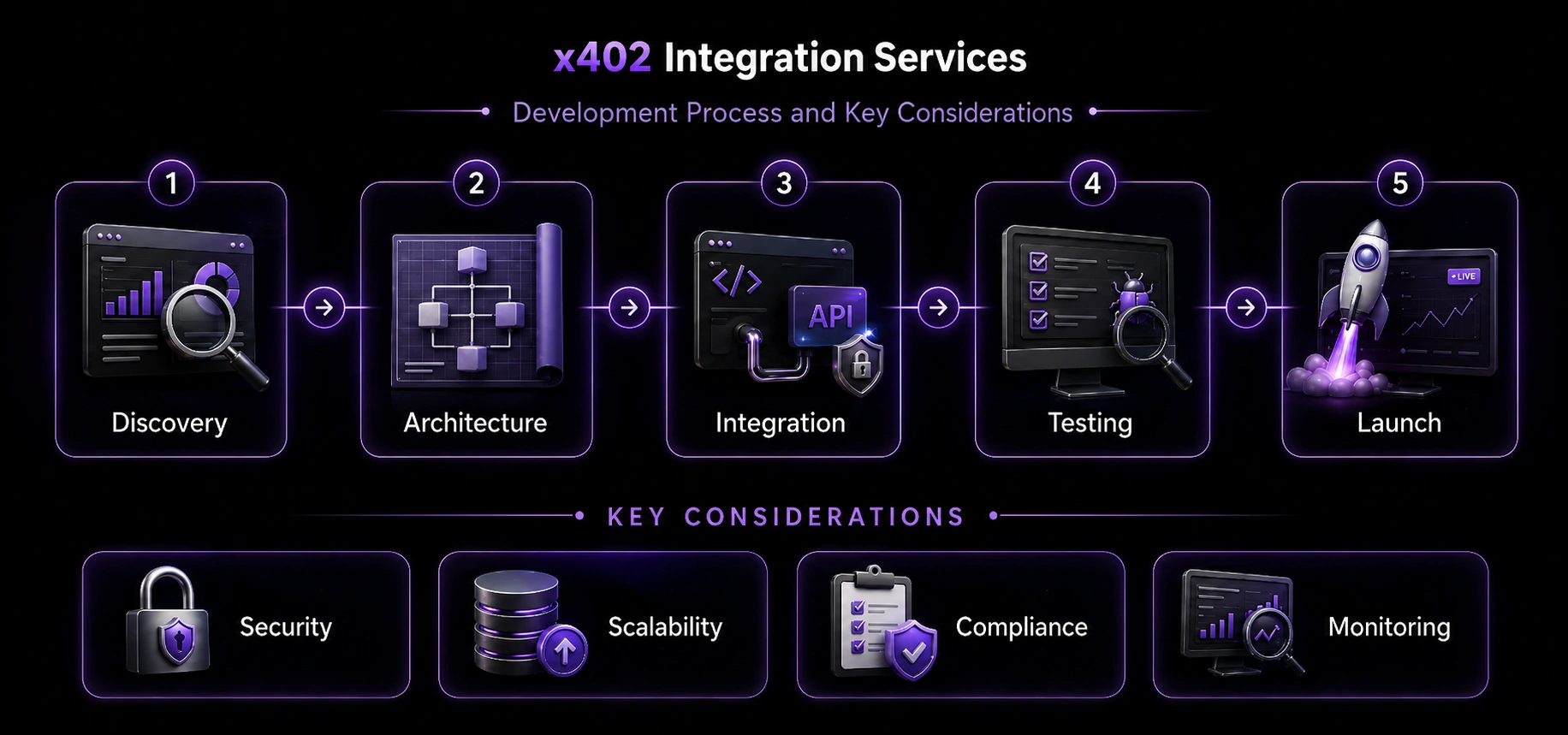
Here is the outline of the development process:
Phase 1: Agent Wallet Setup
Key generation, custody decisions and initial USDC funding is the foundation. The architecture of wallet should balance security and autonomy reasonably. Over-managing defeats the purpose of agent-driven payments, while under-managing leaves financial risk. Teams often choose self-custody, MPC-based key management or delegated custody depending on the number of transactions and regulatory requirements.
Phase 2: Payment Request Handling
Implementing x402’s payment-request handling inside the agent’s tool-use layer, following patterns from the Coinbase Developer Platform documentation, so the agent can read a 402 response, select a payment scheme, and resend the request automatically. This phase connects the agent’s reasoning loop to the payment protocol, extending the same AI agent infrastructure the agent already uses for its other tools rather than building a parallel system.
Phase 3: API and MCP Tool Integration
Connecting x402-enabled APIs and MCP tools into the agent’s existing workflow. This is where the agent gains access to paid services: premium data feeds, compute resources, specialized models, that it can discover, evaluate, and pay for autonomously based on the task at hand.
Phase 4: Security and Testing
A smart contract audit of any custom settlement logic, payment verification tests, error handling for failed or disputed payments, and gas optimization so routine transactions stay cheap at volume. This phase is non-negotiable – a payment bug in an autonomous agent can drain funds at machine speed before a human even notices.
Phase 5: Deployment and Monitoring
Going live with anomaly detection on payment patterns to catch runaway spending, compromised wallets, or unusual transaction volumes before they become expensive problems. Post-deployment monitoring is where most teams discover edge cases – failed payments, partial settlements, rate-limited endpoints – that testing alone didn’t surface.
Use Cases: Where x402 AI Agent Payments Create New Possibilities
The use cases are proof of concept in the past. Instead, data and compute vendors charge the agent directly for premium API access, GPU time, or specific model calls, rather than charging a human account behind the agent. Developers will publish paid MCP tools, compatible agents will find them, pay for them immediately. A script or a data set can be a monetized service without a sales process. In multi-agent orchestration systems, agents may compensate each other for subtasks they have completed. Now it begins to resemble some sort of internal labor market rather than a fixed pipeline.
Enterprise Adoption and the Agent Economy
Enterprises are applying the same methodology to their AI automation systems for procurement, subscription renewals and vendor payments that don’t require a person to approve each line item. Already integrated into the agent platforms of major cloud providers in recent coverage of enterprise agent payment infrastructure, the protocol is a sign that AI agent payment integration is moving out of the experimental phase and into the fold of professional AI agent teams.
Development Cost and Timeline for x402 Payment Integration
Cost is itemized into a few line items: wallet infrastructure, protocol integration work, any bespoke smart contract creation, security audit and deployment. Basic single-agent integration: wallet setup + support for a number of x402 endpoints, is a scoped project of weeks. A full payment platform for a fleet of agents with custody controls, multi-network support and compliance reporting is a much bigger development. What drives the difference is the number of agents, the estimated volume of payments, the custody requirements and the amount of compliance tooling the firm needs around USDC settlement itself.
As a rough rule of thumb, a basic integration takes four to eight weeks, a production-grade agent payment platform takes three to six months. Having done fintech infrastructure and stablecoin development before reduces timescales because instead of starting from zero, most of the settlement, custody and monitoring logic is carried over from previous stablecoin work. But that record is also what distinguishes a run-of-the-mill blockchain shop from a true x402 development company.
Choosing an x402 Development Partner
Find someone who has experience in building AI agents and experience with authentic blockchain payments, because you don’t find those two skill sets on the same team by accident. Technical depth matters: ask about experience with MCP integration, USDC settlement expertise, and how they approach smart contract security,not if they’ve “worked with crypto.” Inquire about prior agent payment deployments, key management practices, and what post-launch monitoring looks like. The agent economy is still young enough that market growth outpaces best practices in spots.
Experience in custom LLM development and models is a plus in a partner that can support the entire lifecycle of the agent, not just the payment layer tacked onto it, which is important when the agent and its wallet need to change together.
Concluding Note
x402 offers a viable way for AI agents to pay for services themselves. This opens up an agent economy that can not be achieved with human-approved billing. The core components of the protocol are already live (USDC, Base and MCP) and integrations are being added by major cloud and payment providers, so it’s clear this is an infrastructure, not an experiment. x402 payment integration is a practical step for teams willing to build on it, not a speculative gamble. The platforms that build payment capability into their agents now will be the ones that capture value when autonomous transactions become the default as the agent economy scales and more services become chargeable per request.
Frequently Asked Questions
1. What is x402 payment integration?
x402 payment integration links AI agents to an open protocol for settling stablecoin payments within HTTP requests. Built by Coinbase, it revives the HTTP 402 status code, allowing agents to discover paid services, attach USDC payments, and get results once finalized on-chain; all without human approval.
2. Can AI agents make autonomous payments using x402?
Yes. The agent requests a paid resource, receives a 402 response with payment terms, signs a stablecoin transfer, and resubmits the request. The server checks payment on chain and returns the result. The entire cycle is automated, which makes possible real micropayments per request.
3. Which stablecoins can be used with x402?
USDC on Base is the best trading pair for low fees, fast finality and institutional-grade reserve backing. The protocol can have multiple stablecoins, but USDC remains the main settlement asset because of deep liquidity and regulatory clarity.
4. How much does x402 integration cost?
A simple, single agent integration is a scoped multi-week effort. A full-payment platform for an agent fleet with custody controls and compliance monitoring is a far bigger development. Costs vary based on number of agents, volume of payments and the compliance requirements.
5. Can x402 be integrated with an existing API?
Yes. The x402 API integration starts by wrapping an existing endpoint with the payment requirements. The protocol extends MCP to allow any compatible tool to advertise a price and accept payment without having to rewrite the underlying service.
6. Does x402 require smart-contract development?
In the facilitator model, standard integrations may not require specific contracts. But platforms that develop proprietary settlement logic or payment channels do require smart-contract development, with independent audits to match the rigor of any contract that handles real funds.
7. Can x402 work with MCP servers?
Yes. x402 MCP integration is core, MCP servers wrap paid tools with x402 needs so agents can find both service and pricing. This adds a native payment layer to MCP’s tool discovery offering per request billing.
8. Is x402 suitable for enterprise applications?
Yes. Many companies are adding x402 to their AI automation systems for procurement and vendor payments. The big cloud providers have baked the protocol into their agent platforms. It’s a sign that AI agent payment integration is becoming standard in the enterprise.
9. How long does x402 development take?
Basic integration takes 4-8 weeks. A production-grade platform with multi-agent support, custody controls and compliance reporting will take 3-6 months to build, depending on scope and security needs.
10. Which company can build an x402-powered AI agent?
So an x402 development company needs to integrate AI agent creation with blockchain payment competence – MCP integration, USDC settlement, and smart contract security. The right partner supports both the agent lifetime and payment infrastructure.
