



Key Takeaways
- Centralized examination systems create multiple opportunities for paper leaks, unauthorized access, and document tampering.
- Blockchain records every exam-related action on an immutable ledger, improving transparency and accountability.
- Cryptographic hashing helps authorities verify that question papers remain unchanged throughout the distribution process.
- Smart contracts automate access control and release schedules, reducing the risk of human intervention and early exposure.
- Blockchain-based examination systems can secure papers, results, certificates, and academic credentials within one framework.
- A phased implementation approach helps institutions strengthen exam security without disrupting existing operations.
Introduction
Recurring examination paper leaks have damaged public trust in education boards, universities, recruitment bodies, and certification authorities. When confidential papers are exposed before an exam, the impact goes beyond cancellation; it affects student careers, institutional credibility, legal compliance, and administrative costs. Question paper leakage prevention using blockchain development introduces a paradigm shift by creating an immutable ledger for exam records, access events, approval workflows, and document integrity checks. Instead of relying on vulnerable manual distribution, education authorities can build tamper-proof exam delivery systems using custom blockchain solutions. This guide breaks down the architecture of a truly secure examination system.
The Anatomy of an Exam Leak: Why Centralized Systems Fail
Most exam leaks are not the result of a single vulnerability, but rather the centralization of the whole question paper lifecycle. The manuscript may be written by a single author on a device without protection. Files may be distributed to the review committee via e-mail or shared storage. Documents can be stored without heavy encryption, printed by third-party vendors, transported by logistics personnel, and then accessed by local staff at examination centers. Every step depends on people and passwords and sealed envelopes and paper records and lagged reporting.
That model is based on human trust, not cryptographic truth. If a file is copied, photographed, altered or accessed prematurely, the system may remain oblivious until the breach has already spread. Centralized databases can be tampered, access logs can be incomplete, and accountability often begins after damage is done. The education boards are looking at decentralised delivery of question papers to avoid any single point of failure and to have a verifiable oversight on the entire examination process.
A Global Crisis in Trust: Real-World Exam Paper Leaks
The integrity of examinations is now a worldwide concern, not just a local administrative one. Leaks, insider fraud, poor distribution controls, and ambiguous decision-making have compromised high-stakes tests around the world.
-
NEET-UG Exam Hack, India, 2026
The medical entrance system in India faced a massive trust deficit following allegations of systematic examination fraud and a paper leak in NEET-UG 2026. The scandal led to a CBI probe, arrests and cancellations, triggering public outrage and causing the government to decide to temporarily ban Telegram pending a review, amid allegations that cheating networks were using messaging platforms to dupe or defraud candidates. The fallout was brutal, with millions of candidates left in limbo, hard-working students losing faith in the system, and the management of national exams being scrutinized heavily.
-
Qiyas Examinations – Saudi Arabia
High-stakes admission testing, such as Saudi Arabia’s Qiyas exams that are used for university admissions and national academic evaluation, illustrates the need for stronger digital protections. Public internet discourse on allegedly “leaked” Qiyas preparatory materials and social media groups underscores the vulnerability of centralized testing systems to screenshots, monetized distribution, and the erosion of trust.
-
Kenya – KCSE and KCPE Examinations
Kenya has been fighting examination malpractice involving teachers, school administrators, candidates and social media platforms. In 2024, the Directorate of Criminal Investigations in Kenya announced the arrest of a KCSE examination malpractice suspect, while national news have reported widespread problems with online fraud, mobile phones and examination leaks. The implications are dire. Deserving students are met with disbelief, delayed results, cancelled marks and a diminished trust in the sanctity of national examinations.
-
United Kingdom 2020 A-Level Algorithm
The UK’s 2020 A-Level grading controversy was not the result of a leaked paper, but rather another flaw in centralised education systems: a lack of transparency in decision-making. An algorithm reduced many students’ predicted grades, causing outrage, and was eventually scrapped. Results imply that examination systems require transparent and auditable governance including on-chain transparency for educational boards particularly when automated judgments impact the future of students.
A Technical Primer: How Blockchain Secures Exam Data
Blockchain protects exam data by replacing blind trust by provable evidence. In a conventional system the authorities have to rely on the integrity of a document that it has not been modified, copied, accessed early or replaced, during storage and transmission. In a blockchain approach, each significant event is cryptographically recorded and can be independently verified through blockchain development architecture. This is where smart contract development becomes critical, as access permissions, paper release windows, approvals, and audit trails can be automated without depending on manual intervention.
- Cryptographic Hashing for Question Integrity: The hash is a unique digital fingerprint of the examination paper. If you change one word , image , mark or page number , the hash will change entirely. This enables examining boards to rapidly ascertain whether the final paper is consistent with the approved original.
- Immutable Ledger: When the paper hash, approval time, access event or delivery record is entered into the blockchain it cannot be surreptitiously changed or deleted. This gives writers, reviewers, boards, vendors and centers an unchangeable record of their examinations.
- Smart Contracts for Exam Logistics: Logistics for Examination Smart contracts are automated conditional statements. For example, if the exam is scheduled for 10:00 AM, the decryption key might be published by the contract 30 minutes before the exam, but only to authorized locations. Techfyte’s AI blockchain solutions can help institutions create automated exam workflows that incorporate decentralized trust with advanced access control.
Think of it as a tamper-proof, transparent envelope watched by millions but unopened by anyone before its time.
Step-by-Step: Question Paper Leakage Prevention Using Blockchain
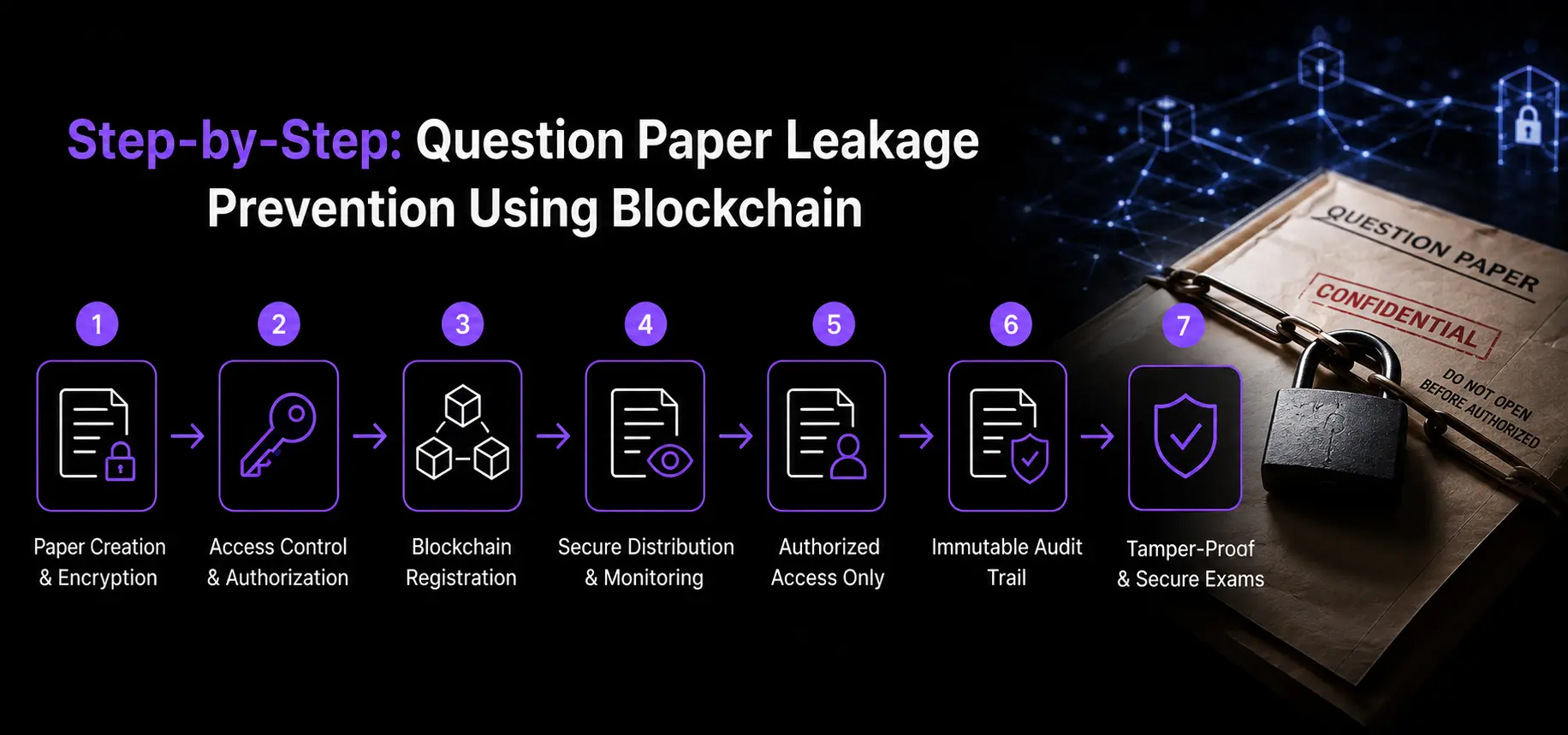
The question paper of a safe blockchain examination system is not stored publicly on-chain. It integrates encryption, decentralized storage, access control and verification to build tamper-proof examination delivery systems.
-
Hashing On-Chain
When the final paper is approved, the system creates a cryptographic hash of the paper. This hash is stored on-chain with metadata such as subject, exam code, version, timestamp and signatures of approval. The document itself stays classified and the authenticity verification becomes irreversible.
-
Decentralized and encrypted storage
The PDF is encrypted at the time of being stored on IPFS or other decentralized storage layer. This reduces dependency on a single server that can be hacked, changed, deleted or used by one administrator. Techfyte’s guidance on Web3 development describes how decentralized storage, smart contracts, and dApps work together, which is useful for education boards evaluating decentralized infrastructure. For boards evaluating decentralized infrastructure, Techfyte’s guide on what Web3 development is explains how decentralized storage, blockchain records, and dApps work together in secure digital systems.
-
Smart Contract Access
The decryption key release is controlled by a time locked smart contract. No examination officer, vendor or centre administrator shall be permitted to manually override the access window. In the case of high-stake exams, institutions should employ smart contract audit services to examine the contract logic before deployment.
-
Reliable Final Mile Delivery
Each test centre checks the hash of the received document against the on-chain record before printing. If the hash is identical, the document is authentic. If a failure occurs the printing is stopped and an alarm is transmitted. Techfyte’s approach to on-chain AI training logs is architecturally similar, with sensitive files stored off-chain, and hashes secured on-chain for validation. The Blockchain technology changes the exam distribution process from trust-based to proof-based workflow and thus prevents the leaking of question paper. Similar integrity models are used in on-chain AI training logs, where sensitive data remains off-chain while blockchain hashes prove authenticity and prevent silent tampering.
Beyond the Leak: A Full-Scale Secure Examination System
The real value of blockchain is not just to prevent the leak of exam papers. A comprehensive secure examination system can protect the entire academic process: test development, administration, assessment, result dissemination, credential issuing and employer validation. School boards can give verifiable credentials for results that companies, colleges and government organizations can verify on-chain instantly in 2026.
Instead of calling up a university, looking at scanned certificates or relying on manual background verification, an employer can verify a degree, rank, scorecard or certification through a blockchain-backed credential database. Student information can be held confidential and the validity can be documented securely. This creates a trust chain from exam to profession. This framework can also connect with AI blockchain solutions to support fraud monitoring, automated verification, and intelligent anomaly detection across the examination lifecycle.
This reduces examination fraud with Distributed Ledger Technology at the credential level and not just at the question paper level. It reduces fake degrees, modified transcripts, forged rank cards, and long verification time. The solution offers institutions a single integrity layer for examinations and results and secure storage of academic documents.
High-stakes exams such as India’s JEE and UPSC, the SAT and GRE in the USA, or major European admission or professional certification assessments are prime candidates for first adoption as a single integrity breach can affect millions of students, institutions and companies.
Overcoming the Human Barrier: It’s Not Just a Tech Problem
The challenge is not blockchain maturity but the change in management. Education boards, institutions and testing agencies should not see this as a ‘crypto project. It should be framed as a high level cybersecurity and integrity protocol for examination governance. For advanced risk monitoring, AI fraud detection solutions can help institutions detect suspicious access patterns, repeated download attempts, unusual login behavior, and potential insider threats.
The message to administrators is clear: cut leak risk, cut legal liability, cut reliance on manual processes and cut public confidence. Educational boards get on-chain transparency with all major actions being auditable but sensitive exam materials being protected. This process gives officials more control, clear accountability, and concrete evidence when the integrity of examinations is called into question.
Ready to Build a Tamper-Proof Exam System?
Techfyte architects blockchain solutions for educational and government bodies.
A Practical Roadmap: From Pilot to National Scale
The implementation of question paper leakage prevention using blockchain should be gradual, measurable and practically feasible. The education boards need not change the entire examination system all at once. They can begin with integrity checkpoints and develop a full trust architecture over time.
- Phase 1, Year 1: Deploy a pilot for a single low-stakes exam focused on cryptographic hashing to ensure question integrity. The goal is to show that approved documents, final PDFs and copies sent to test-centers can be checked against an unbreakable hash on the blockchain.
- Phase 2: Years 2-3: Broaden the scope to include high stakes testing and introduce smart contracts for testing logistics. Access is limited to a specific time, requires multiple signatories and includes automatic unlocking procedures, thus reducing the risk of early access or unauthorized release. During national-scale deployment, Hyperledger enterprise solutions can be suitable for permissioned examination networks where boards, universities, vendors, and government bodies require controlled access.
- Phase 3, Years 4-5: Build a complete ecosystem with verifiable credentials, secure posting of results, and a permanent immutable ledger for examination data. This makes examination security a national digital trust framework.
Frequently Asked Questions
1. How does question paper leakage prevention using blockchain work?
Blockchain in preventing question paper leaks involves creating a verifiable digital chain of custody for each exam paper. The full paper is encrypted, its cryptographic hash is stored on-chain and access is controlled by smart contracts, which allows to detect any manipulation, premature access or substitution of the file.
2. Can’t someone just steal the private key?
A poor system design may result in a compromised private key, hence a strong architecture is required. High-stakes testing systems should utilize hardware security modules, multi-signature authorizations, role-based access controls, key rotation protocols, and time-locked smart contracts to prevent any one individual from unlocking or misappropriating the examination materials.
3. Is this cost-effective for government bodies?
Indeed, especially when compared with the costs of cancelled examinations, re-examinations, legal disputes, inquiries, demonstrations and erosion of public confidence. A phased approach to blockchain adoption can start with low-risk pilots and a gradual rollout, which is more feasible for educational institutions and government agencies.
4. How does this prevent last-mile paper switching?
Each examination center can verify the received file by comparing the hash of the received file with the original hash stored on the chain prior to printing. A hash mismatch will mean that someone has changed the PDF, changed questions, or is using an unauthorized version and the system will either stop printing or give an alert.
5. What role do verifiable credentials play in preventing exam fraud?
Verifiable credentials make the examination more secure than just the examination paper. They allow universities, employers and government agencies to instantly verify results, degrees, certificates, rankings and scorecards without the need for PDFs, human verification or lengthy institutional processes.
6. What happens if the blockchain network itself experiences a failure or outage?
Blockchain-based examination systems can be designed with redundancy and distributed nodes so that there is no single point of failure. Even if one node or server becomes unavailable, other nodes maintain the ledger and preserve data integrity. In permissioned blockchain systems used by governments or institutions, backup nodes and disaster recovery mechanisms ensure continuous availability and secure access to examination records.
Concluding Note
No technology can eliminate human malevolence; but, blockchain development can make it much harder to hide examination fraud. Openness, cryptographic validation and immutable records provide education boards a strong mechanism to rebuild confidence from document generation to validation of results. The main point is simple: exam security needs to move from human oversight to evidence-based integrity. For high-stakes evaluators, blockchain has moved out of the experimental phase and into a credible trust infrastructure. It is time to develop secure, verifiable, tamper-proof examination systems. Techfyte’s expertise in formal verification can help examination authorities mathematically validate critical smart contract rules before they are used in real-world exam delivery systems.
Build an Uncheatable Examination System
Partner with Techfyte for a customized, end-to-end blockchain deployment.
