



Key Takeaways
- Philippines Market Opportunity: The Philippines is emerging as a promising market for RWA tokenization, driven by a large overseas worker economy, strong mobile adoption, and increasing regulatory support from both the BSP and SEC.
- Revenue Model Potential: Successful tokenization platforms typically combine issuance fees, transaction fees, and custody revenues, with real estate, agricultural assets, and SME investments offering strong market opportunities.
- Compliance Advantage: Compliance is the primary challenge and competitive advantage, as founders must navigate both BSP and SEC regulations while often partnering with existing licensed financial institutions.
- Mobile-First Product Design: Fractional ownership capabilities, automated payouts, and regulated custody infrastructure are essential features for building scalable platforms in the Philippine market.
- Compliance-First MVP: Founders should prioritize a single asset class MVP, leverage regulatory sandboxes, work with licensed partners, and use experienced development providers to accelerate market entry.
RWA Tokenization Platform Development in the Philippines: Business Model, Features, Cost, and Compliance
The Philippines presents a unique opportunity for real-world asset tokenization platform development: a mobile-first population, one of the largest overseas worker economies in the world, and two regulators – the Bangko Sentral ng Pilipinas (BSP) and the Securities and Exchange Commission (SEC) – that are signaling openness, not resistance.
The BSP is also continuing to strengthen the way licensed exchanges examine digital assets. SEC Commissioner Rogelio Quevedo told delegates of Philippine Blockchain Week in June 2026 that the agency is “fully convinced” it has the legal foundation to support tokenized assets.
That blend of readiness and scrutiny is what the opportunity looks like for founders planning to build an RWA tokenization platform Philippines. This guide walks through the business strategy, essential features, development cost, and compliance path founders need to plan for.
The Philippine Market Opportunity for Real-World Asset Tokenization
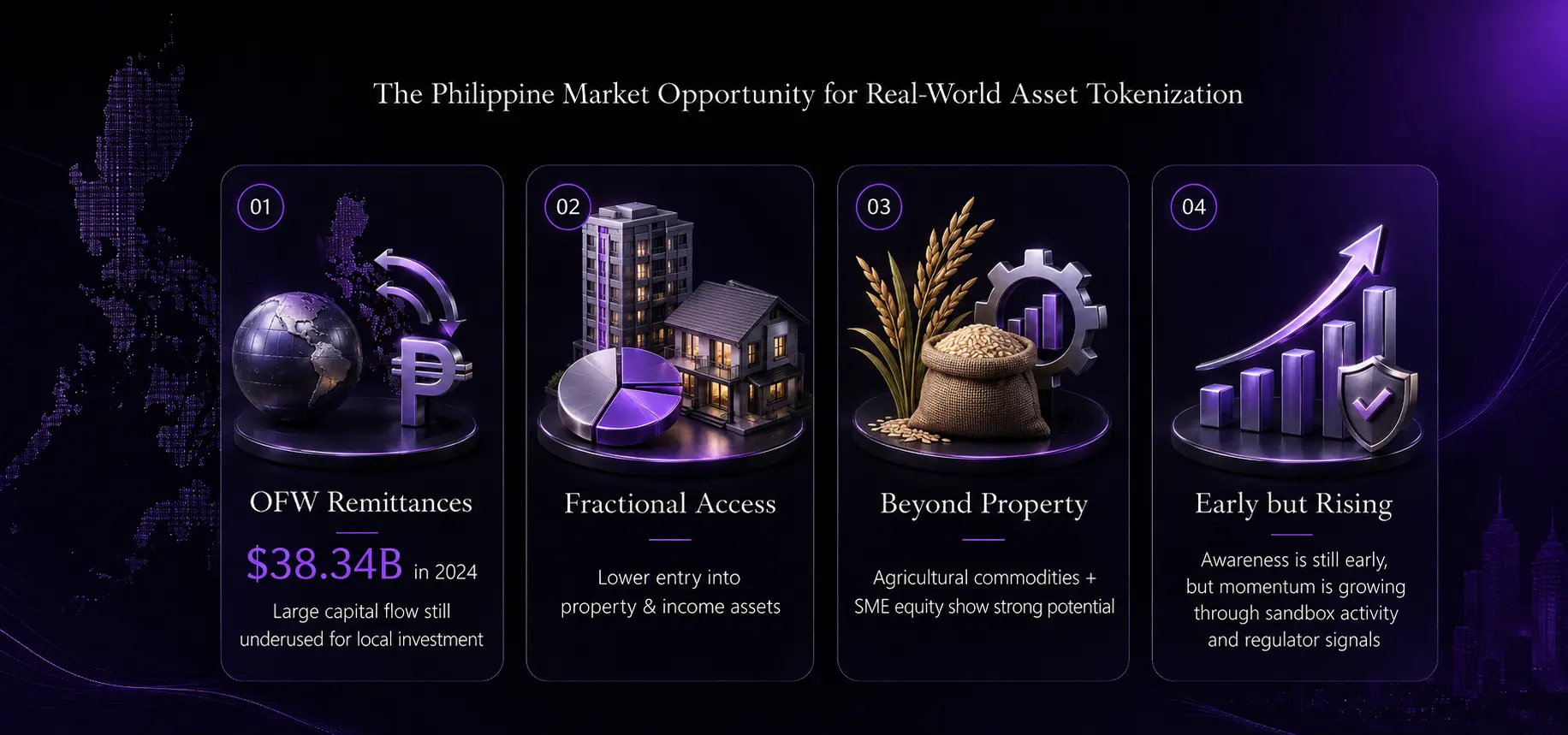
Overseas Filipino worker remittances reached roughly $38.34 billion in 2024, a market Filipino investment platforms have yet to turn into productive local investment, not just consumption transfers.
This is where real-world asset tokenization becomes interesting, because fractional ownership reduces the entry price for property and income-generating assets. It gives OFWs and domestic retail investors a way into asset classes that were previously accessible mainly to higher-net-worth buyers.
Outside of property, agricultural commodity tokenization and SME equity are also strong product-market-fit opportunities because of the country’s agribusiness base and entrepreneurial economy.
Overall awareness of blockchain asset tokenization is still early compared with places like Singapore or the UAE, but sandbox activity and regulator commentary suggest the gap is closing quickly.
Business Models That Work for a Tokenized Investment Platform in the Philippines
Most viable platforms combine fractionalization fees on primary issuance, transaction fees on secondary trading, and custody or servicing fees for holding underlying assets.
Three structural models dominate:
- Primary-Issuance-Only Platform: The platform originates and distributes tokenized assets without operating a secondary trading venue.
- Full-Exchange Model: The platform supports both primary issuance and regulated secondary trading for eligible token holders.
- Hybrid Model: The platform starts with issuance and adds secondary trading once asset volume, liquidity, and regulatory readiness justify expansion.
Because the Philippines applies a Howey-style investment contract test, a tokenized bonds and equities offering will almost always fall under SEC jurisdiction, shaping investor access into retail and accredited tiers.
Working with SEC-registered brokers and BSP-supervised custodians is not optional. It is how a platform gets distribution partners willing to onboard Philippine investors.
Engaging experienced RWA platform development services early helps founders map which model fits their asset class, compliance runway, and licensing strategy before committing to a build.
Core Platform Features Required for the Philippine Market
A platform built for this market needs more than asset listings. It must support mobile-first investing, localized documentation, secure custody, and regulated transaction flows.
The most important platform features include:
- Fractionalized Asset Listings: Asset pages should include due diligence documents, ownership structure, risk disclosures, asset performance data, and investor eligibility information in Filipino and English.
- Peso and Stablecoin On/Off Ramps: These are essential because much of the target audience transacts through remittance channels rather than card-first payment rails.
- Automated Income Distribution: Rental income, dividends, profit shares, or yield payouts should be automated to reduce manual reconciliation as investor counts scale.
- Secondary Marketplace Controls: A regulated secondary marketplace allows token holders to exit positions within defined compliance limits.
- Institutional Custody Infrastructure: Institutional Custody arrangements must satisfy BSP expectations around virtual asset safekeeping and investor protection.
- Smart Contract Logic: Disciplined smart contract development governs issuance, distribution, redemption, transfer restrictions, and asset lifecycle events.
- Mobile-First UX: The Philippines consistently ranks among the top countries globally for mobile internet usage, so a desktop-first platform will lose adoption regardless of asset quality.
For a tokenized investment platform Philippines, the strongest product experience is simple, localized, secure, and built for smartphone-first investors from day one.
Compliance for Tokenization in the Philippines – What Founders Must Know
In the Philippines, tokenization compliance is shaped by two regulators at the same time. The BSP regulates virtual asset service providers, while the SEC regulates securities and investment contracts.
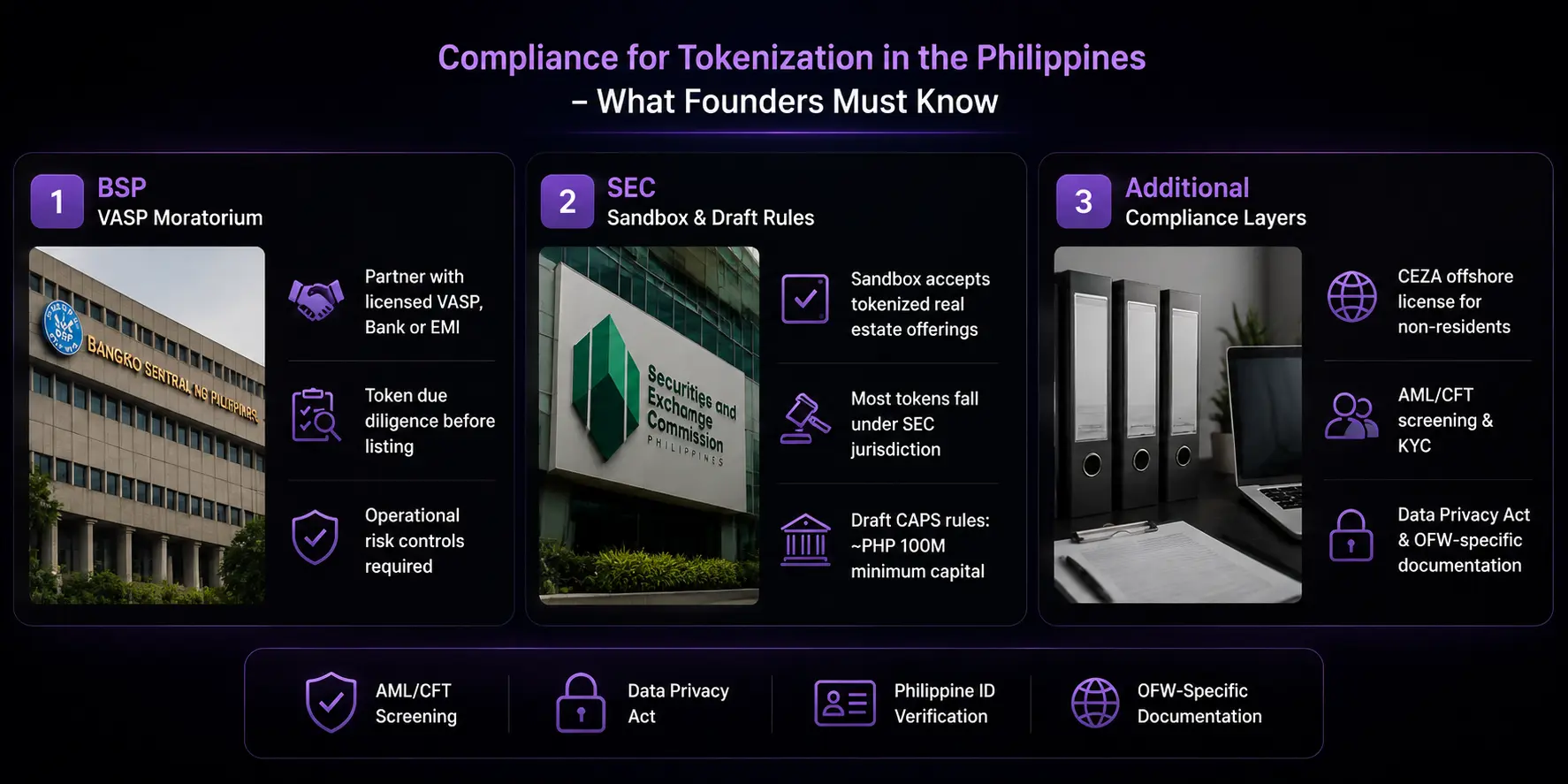
The result is a dual compliance pathway where platform structure, custody, token design, investor onboarding, and secondary market access must be planned before development begins.
1. BSP: The VASP Moratorium and What It Means
The BSP regulates virtual asset service providers under Circular No. 1108, but has maintained a moratorium on new VASP licenses since September 2022. As of mid-2026, this still largely requires most new entrants to partner with an already licensed VASP, bank, or electronic money issuer instead of applying for a new standalone license.
Under recent BSP guidelines, any token must undergo additional due diligence before listing, including background checks on the issuer, market maturity, redemption procedures, and operational risk controls.
This affects the business model and technology stack from the beginning. Any platform that has custody of virtual assets for exchange must work with a currently licensed VASP, BSP-supervised bank, or electronic money issuer.
2. SEC: Sandbox, Draft Rules, and the Path Forward
The SEC takes a more forward-looking position. In November 2025, its StratBox sandbox accepted a tokenized real estate offering, indicating a willingness to test tokenized items under restricted circumstances.
Since the SEC’s investment contract test is based on a Howey-style analysis, most tokenized real estate, bonds, and equity securities will fall within SEC jurisdiction and need to comply with the Securities Regulation Code.
Its draft rules for Crypto-Asset Service Providers, still in comment and finalization stages, propose a minimum capital requirement of approximately PHP 100 million and require Philippine incorporation.
3. Additional Compliance Layers
CEZA offers an alternative fintech licensing pathway through its offshore virtual currency framework, but that route is restricted to serving non-Philippine residents.
Beyond licensing, founders need regulatory-compliant token design, built-in compliance reporting, and investor onboarding compliance that handles AML/CFT screening, Data Privacy Act obligations, Philippine ID verification, and OFW-specific documentation.
Development Cost and Timeline Estimates
An MVP tokenization platform scoped for a single asset class typically runs into the low-to-mid six figures once compliance tooling and audits are included. A full-featured platform with multi-asset support, custody integrations, and secondary trading climbs meaningfully higher.
Choosing white-label tokenization over a ground-up build can compress both cost and timeline substantially, though founders trade away some flexibility in token standards and integrations.
Key cost drivers usually include:
- Compliance Engine: KYC, KYB, AML/CFT screening, investor eligibility checks, reporting workflows, and audit trails.
- Peso-to-Crypto Ramps: Bank, wallet, remittance, and stablecoin integrations suitable for Philippine investors and OFWs.
- Mobile Development: A smartphone-first product experience, especially for onboarding, investment discovery, and payout tracking.
- Custody Integrations: Connections with licensed custodians, banks, VASPs, or electronic money institutions.
- Smart Contract Audits: Independent smart security audit work, which regulators and institutional partners increasingly expect as a precondition for listing.
- Bilingual Customer Support: Support operations in Filipino and English for domestic investors and overseas workers.
Timelines from concept to soft launch commonly span six to twelve months once regulatory engagement is factored in. Ongoing costs include compliance monitoring, custody fees, audit updates, customer support, and asset servicing operations.
Choosing the Right Development Partner for a Philippine RWA Platform
The right partner for a Philippine RWA platform should understand regulation, asset structuring, mobile-first product design, and secure blockchain infrastructure.
Founders should look for a development partner with:
- BSP and SEC Awareness: Direct experience building around BSP and SEC requirements, not just generic Web3 development experience.
- Mobile-First Delivery: A proven record of building mobile-friendly platforms for retail and cross-border users.
- Audit-Ready Smart Contracts: Experience developing smart contracts that can pass independent audits and support regulated asset flows.
- Licensed Partner Network: Access to local legal counsel, SEC-registered entities, BSP-supervised institutions, or licensed custody partners.
- Cross-Border Distribution Planning: The ability to structure the platform for cross-border distribution from day one as Southeast Asian frameworks mature.
An experienced provider of RWA platform development services can help founders avoid costly rebuilds by aligning the product, compliance model, and asset lifecycle before engineering begins.
Concluding Note
The Philippine market for tokenized real-world assets is real, but it is a dual BSP-SEC regulatory path that favors platforms developed for compliance from the beginning, rather than retrofitted later.
Mobile-first infrastructure and product design for both domestic and OFW investors will separate platforms that scale from those that stall in pilot mode.
Founders looking to build an RWA tokenization platform Philippines should consider participating in the SEC sandbox or partnering with a licensed VASP, building a mobile-first MVP with a single asset class focus, and engaging local counsel with direct BSP and SEC experience.
With the SEC gaining confidence in its own framework, the Philippines is positioning itself as one of Southeast Asia’s more important, if still nascent, tokenization markets.
Frequently Asked Questions
1. What makes the Philippines a viable market for an RWA tokenization platform Philippines build?
With $38.34 billion in annual OFW remittances, a mobile-first population, and authorities that are actively signaling openness, the Philippines has the right conditions for fractional real-world asset investment.
Tokenization makes property and income-generating assets more accessible to domestic retail investors and overseas workers that were previously priced out of traditional ownership models.
2. Which regulators govern compliance for tokenization in the Philippines?
Compliance for tokenization in the Philippines is overseen by both the BSP and SEC. The BSP regulates virtual asset service providers under Circular No. 1108 and has maintained a VASP licensing moratorium since 2022.
The SEC regulates securities and investment contracts under the Securities Regulation Code and is testing tokenized goods through its StratBox sandbox.
3. What are the core features a tokenized investment platform needs for the Philippine market?
A tokenized investment platform needs peso and stablecoin on/off ramps, fractionalized listings with Filipino and English documentation, automated income distribution, and a regulated secondary market for liquidity.
Mobile-first design is crucial because the Philippines is among the top countries globally for mobile internet usage, and many financial services are accessed primarily through smartphones.
4. How much does it cost to build a blockchain asset tokenization platform in the Philippines?
An MVP targeting a single asset class generally costs in the low-to-mid six figures when compliance tooling and audits are included. A feature-rich multi-asset platform with custody integrations and secondary trading costs more.
The biggest cost drivers are the compliance engine, peso-to-crypto ramps, mobile development, custody integrations, and independent smart contract audits.
5. What should founders look for in RWA platform development services for the Philippines?
Founders should look for hands-on experience with BSP and SEC standards, proven mobile-first delivery, successful smart contract audit experience, and access to local legal or licensed partner networks.
A vendor with cross-border distribution experience can also help position the platform for future expansion across Southeast Asia.
