



Key Takeaways
- AI chatbot development costs in 2026 vary significantly based on complexity, ranging from $5,000 for basic FAQ bots to over $500,000 for autonomous AI agents with enterprise-grade capabilities.
- The biggest cost drivers are model selection, integrations, data preparation, governance, and compliance requirements, rather than the chatbot interface itself.
- Enterprise AI assistants increasingly rely on retrieval-augmented generation (RAG), private data pipelines, and robust monitoring frameworks to deliver reliable and compliant outcomes.
- A hybrid build approach combining platform tools with custom integrations and governance layers offers the best balance between speed, flexibility, and total cost of ownership.
- Successful AI chatbot projects prioritize discovery, data readiness, evaluation, and ongoing optimization, treating conversational AI as a long-term operational system rather than a one-time software deployment.
Introduction
By 2026, chatbot budgets are infrastructure budgets. Startups use LLM assistants to reduce support load and qualify leads, while enterprises are moving from rule-based bots toward governed assistants and autonomous agents. Pricing is not one number. A small FAQ bot has narrow scope; a regulated assistant may require private data pipelines, role-based access, audit logs, and governance. This guide covers AI chatbot development cost ranges, key drivers, build-versus-platform trade-offs, recurring expenses and budgeting questions for founders, product managers, CTOs, and IT leaders.
What Drives AI Chatbot Pricing in 2026
The main drivers behind 2026 AI chatbot pricing are bot complexity, model choice, integration depth, data preparation, and compliance. A domain-specific assistant costs more because it must retrieve verified knowledge, understand context, manage fallback logic, and escalate when confidence is low.
LLM selection changes the operating model. API-based models reduce initial engineering but add usage-linked charges. A proprietary platform can speed delivery, but limits control over retrieval design and model routing. A custom architecture, especially one involving custom LLM development, increases upfront budget but may reduce long-term dependency and support stricter deployment requirements. That is why custom AI chatbot budgets rise sharply as integrations, permissions, workflows, and governance layers are added.
For infrastructure planning, businesses should also review AI deployment and model serving before estimating production costs.
Cost Ranges by Chatbot Type – Simple, Intelligent, and Autonomous
A basic rule-based or FAQ chatbot can cost $5,000 to $20,000 and take two to six weeks to build. This includes conversation flows, a minimal knowledge base, basic analytics and distribution through a website or messaging channel. It is usually thin on CRM logic and deep customisation.
Intelligent and Autonomous Tiers – Where Costs Escalate
A smart chatbot that can talk to users, with retrieval-augmented generation, business connectors and human handoff, will usually run between $25,000 and $120,000. It can connect to helpdesk, CRM, ERP, documentation and authentication systems. At this level, companies are looking at enterprise AI assistants, not basic chat widgets.
A fully autonomous AI agent with reasoning, tool use, approvals and monitoring can cost anywhere from $150,000 to $500,000 or more, depending on risk. Costs cover LLM API use, vector database hosting, observability, security reviews, feedback evaluation, and upgrades. Get a reliable cost estimate for AI chatbot development by sharing message volume, channels, roles, languages, data sources, latency, and escalation procedures. Budgets for production should also include model deployment and serving.
If the project is moving beyond a chatbot into task execution, compare the scope with custom AI agent development for US businesses to understand how agent workflows affect cost.
The AI Chatbot Development Process: Where the Budget Actually Goes
The process of developing an AI chatbot starts with exploration and scoping. This step includes mapping business objectives, user intents, data sources, risk categories, escalation rules and success measures. It is a small budget line, but if skipped, there will be scope creep and rework.
Design includes conversation flows, response restrictions and fallback states. The development team owns the LLM selection, RAG pipeline architecture, prompts, integrations, tracking, and access control. For enterprise applications, ML pipeline development may be needed to handle intake, indexing, evaluation and versioning.
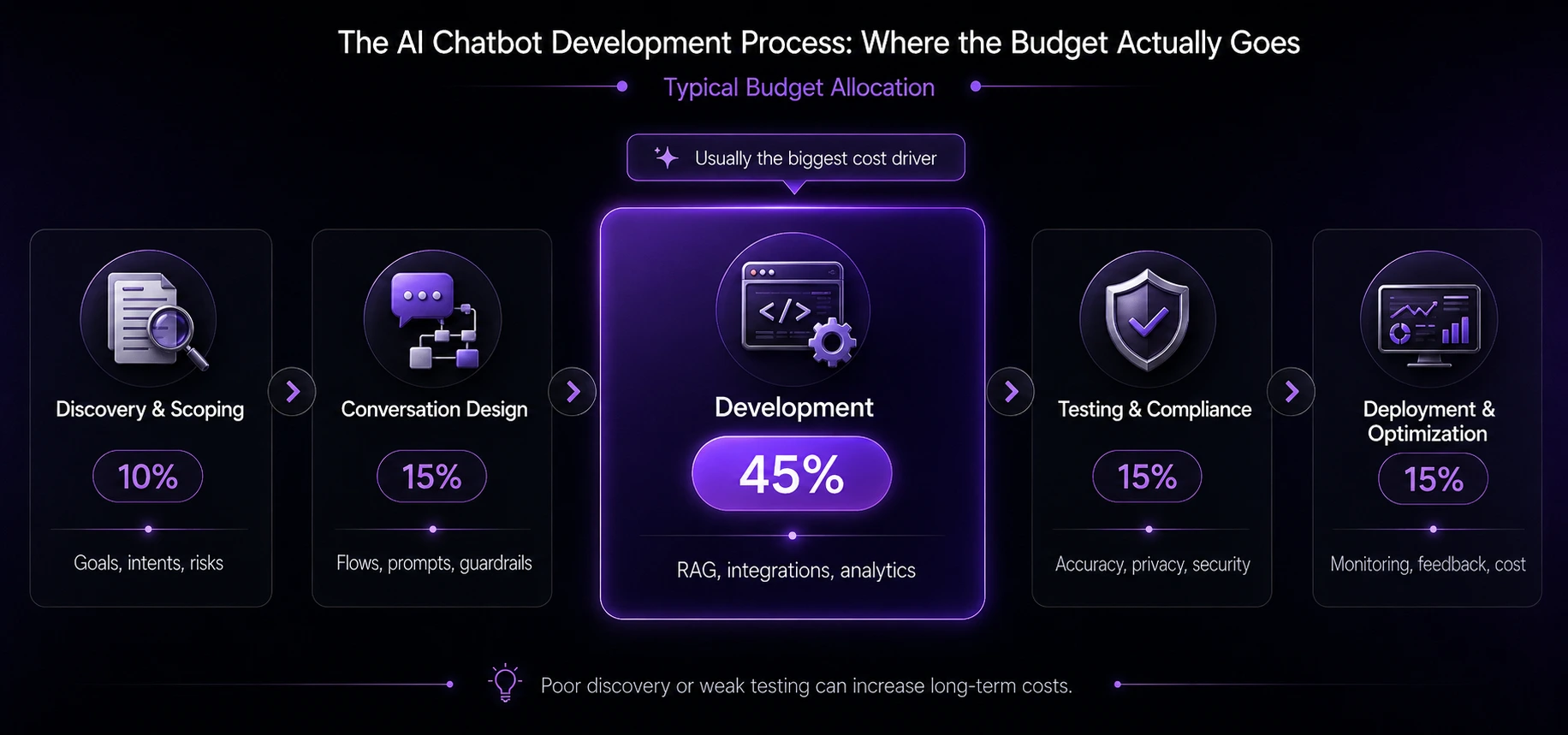
Testing and compliance measure accuracy, bias, hallucination risk, security, privacy, and regulatory exposure. Monitoring and deployment look at latency, containment, escalation, cost per call, and feedback quality. Development normally accounts for 40% to 50% of the original budget, however poor retrieval, token waste, and recurring fixes can increase long-term costs if discovery or testing is ineffective. Mature systems also use automated retraining when data changes frequently.
Typical Budget Allocation
- Discovery and scoping: business goals, user intents, risks, success metrics, and escalation logic.
- Conversation design: flows, prompts, guardrails, fallback states, and human handoff rules.
- Development: RAG pipelines, integrations, authentication, analytics, access control, and admin tools.
- Testing and compliance: hallucination checks, red-team testing, data privacy review, and security validation.
- Deployment and optimization: monitoring, feedback loops, latency control, retraining, and cost management.
Build vs. Buy: AI Chatbot Development Solutions Compared
Custom-built AI chatbots are preferable to purchased solutions when dealing with proprietary workflows, confidential data, sophisticated permissions, or domain-specific reasoning. They are more costly and time-consuming to implement, but offer greater control over architecture, integration and governance. Platform solutions are faster for common support, lead capture and FAQ use cases, but customisation, data portability and model flexibility may be limited.
Usually, in 2026, the hybrid strategy is to start with a platform base for channels and admin tools, and then add bespoke retrieval, connectors, compliance layers, or evaluation pipelines. AI chatbot development solutions and services should be compared on the basis of total cost of ownership, not just launch pricing. Multi-agent orchestration, where support, research, and approvals are handled by different agents, may be required for complex deployments.
Teams comparing vendors can also review the top AI agent development companies in 2026 to benchmark capabilities before choosing a partner.
Voice AI: The Next Frontier in Customer-Facing Automation
Voice-enabled AI agents are rapidly growing as latency declines and speech models improve while text-based chatbots will dominate 2026 budgets. Speech agents, unlike text chatbots, must handle interruptions, accents, background noise and the expectation of real-time response. This adds a level of engineering complexity that is avoided in text-only deployments. For real estate, healthcare, hospitality, and professional services firms that still rely on phone calls as their primary client channel, a voice agent often offers a quicker return on investment compared to implementing a text bot.
Techfyte’s Maica AI voice agent platform handles client queries, scheduling and multi-lingual support over the phone and web channels with near-human latency. It integrates with existing telephony systems, CRMs and scheduling applications, making it an ideal starting point for organizations wishing to automate voice calls without having to build proprietary telephony infrastructure from scratch. Maica, used either alongside a chatbot or as a standalone speech channel, is an example of how voice AI fits into a larger automation strategy; and why voice should be a line item in any 2026 AI budgeting exercise and not an afterthought.
How AI Voice Automation Works: Maica Demo
AI Chatbot Use Cases That Justify the Investment
AI chatbots are best for repetitive questions, known labor costs, clear escalation rules and structured knowledge. Bots handling password resets, order status, onboarding queries and policy clarifications can reduce ticket costs. Internal knowledge assistants reduce the time spent on researching policies, documents, HR or finance procedures.
Sales chatbots can qualify leads, route prospects, explain requirements, and schedule follow-ups. Bots can be used in regulated businesses for intake, eligibility checks, claim triage and paperwork review, but they must be subject to stricter controls. Many teams build chatbots that connect to AI automation systems so that discussions generate summaries, issues, quotes, or internal actions.
Businesses evaluating emerging models can also explore decentralized AI platforms if they want to compare centralized, private, and distributed AI infrastructure options.
Hidden Costs Most Founders Do Not Budget For
The first hidden cost is scale LLM consumption. A pilot with a few thousand messages may seem cheap, but production traffic, long context windows, retries and agentic tool calls can quickly add to monthly spend. Role-play best case, expected case, and high-volume usage before launch.
Other hidden costs include prompt optimization, evaluation datasets, compliance reviews, security testing, localization, integration maintenance and analytics. GDPR compliance demands careful treatment of personal data, transparency and legal grounds for processing. Federated learning can help reduce the centralization of data in privacy-sensitive deployments, and anomaly detection and monitoring can detect abuse, drift, and unusual usage patterns.
How to Choose an AI Chatbot Development Company
A trustworthy AI chatbot development company should be able to describe the architecture, cost assumptions, security controls, and responsibilities after launch. Ask whether the solution is LLM-agnostic, how retrieval quality is measured, how hallucinations are reviewed, and how failed conversations are analyzed.
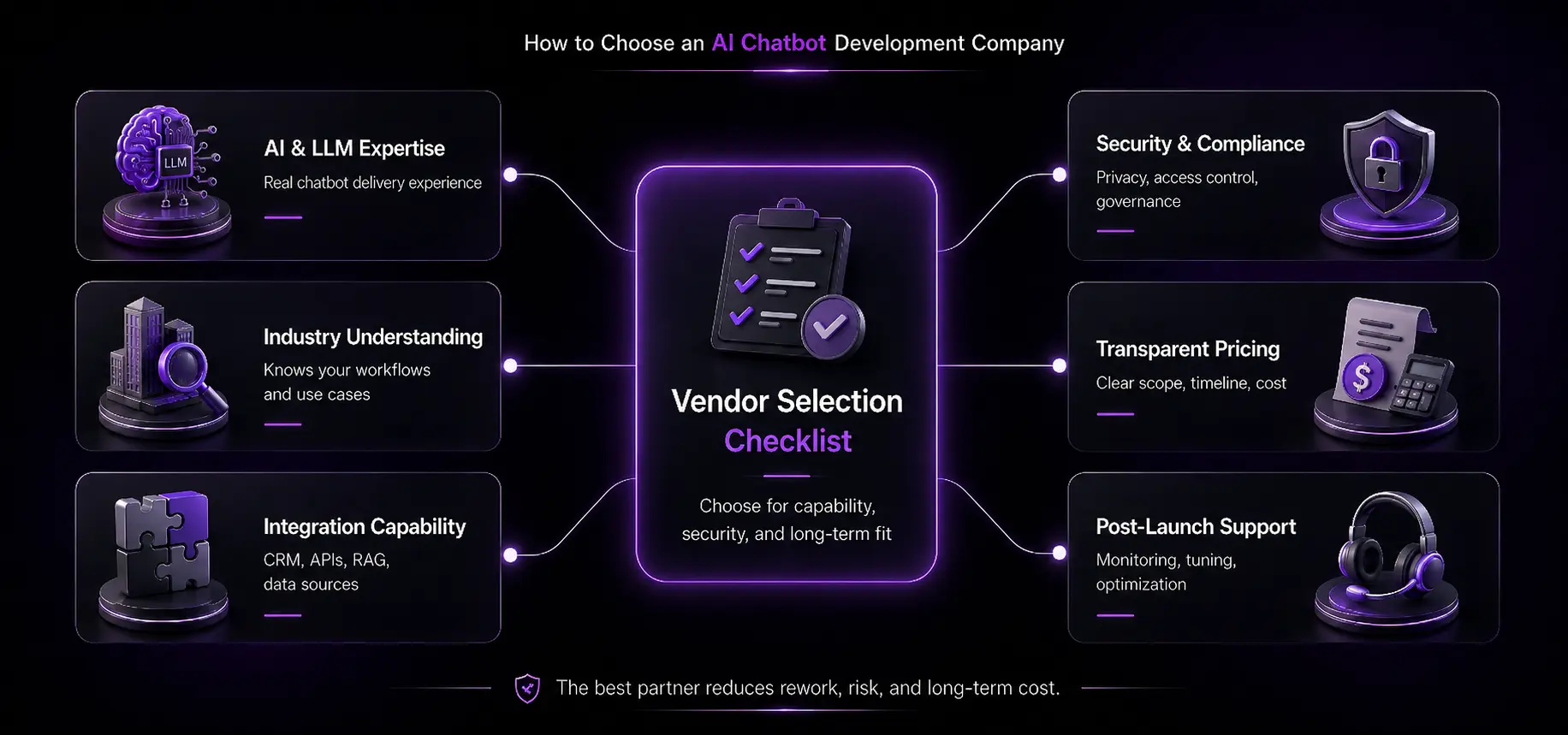
For regulated or high-stakes workflows, look for RAG experience, audit logging, access control, red-team testing and compliance documentation. For teams working on decision-heavy systems, neuro-symbolic AI might be a way to combine language models with rules, constraints, or structured reasoning. AI and blockchain solutions experience may matter if the chatbot touches payments, identity, tokenized assets, or verification workflows.
If you need an end-to-end delivery partner, compare chatbot requirements with the scope of an AI agent development company, especially when the assistant must take actions instead of only answering questions.
Concluding Note
Pricing will reflect a maturing market by 2026: basic chatbots will be inexpensive, but reliable enterprise assistants will take planning, data engineering, governance and ongoing optimization. The best way to manage the AI chatbot development cost is to invest up front in scoping, data readiness, and realistic usage modeling. Budgets in 2027 will likely move from single-use bot builds to monitored AI systems with feedback, evaluation and safer automation.
Ready to plan your chatbot budget? Explore Techfyte’s AI development services and build a chatbot architecture that fits your use case, compliance needs, and long-term operating cost.
Frequently Asked Questions
1. What is a realistic AI chatbot development cost for a startup in 2026?
Basic FAQ chatbot pricing usually ranges from $5,000 to $20,000. A RAG-based intelligent chatbot with business integrations can cost $25,000 to $120,000. Before asking vendors for an accurate estimate, decide message volume, channels, data sources, languages, and escalation rules.
2. How does the ai chatbot development process allocate budget across phases?
The AI chatbot development process includes discovery, design, development, testing, deployment and optimization. Development often takes 40% to 50% of the initial budget, but underfunding discovery or testing increases long-term costs due to scope expansion and frequent fixes. Mature systems also plan for automated retraining as data changes.
3. What drives the difference between custom ai chatbot development cost and platform pricing?
The price of developing a custom AI chatbot varies with integration depth, authorization complexity, data readiness, domain-specific reasoning and governance controls. Platform solutions are faster for common use cases, but have less control over retrieval and model flexibility. A hybrid approach that combines platform foundation with custom components is common in 2026.
4. What ai chatbot use cases deliver the fastest ROI?
Ticket deflection and 24/7 support coverage are usually the fastest ROI use cases. Internal knowledge assistants reduce time spent searching policies and documentation. Sales qualification and regulated industry workflows take longer, but can have higher strategic value when compliance controls are planned from the beginning.
5. What should I look for in an AI chatbot development company?
A good AI chatbot development company should provide LLM-agnostic architecture, RAG knowledge, audit logging, access control, security testing, and post-launch compliance support. Ask for live deployments in your industry, not only demos. If many agents will handle different jobs in regulated workflows, validate their experience with red-team testing and multi-agent orchestration.
