



Key Takeaways
- Building a secure DeFi staking platform begins with the right staking model, reward mechanism, and tokenomics, because these architectural choices determine platform complexity, audit scope, and long-term sustainability.
- A robust development process includes architecture, smart contract development, frontend integration, testing, audits, and monitoring, with each phase playing a critical role in protecting user funds.
- Security is the most important investment in DeFi staking development, requiring independent smart contract audits, formal verification for complex protocols, and continuous post-launch monitoring.
- DeFi staking development costs in 2026 can range from low-to-mid five figures to six figures depending on audit depth, cross-chain support, governance features, and reward model complexity.
- Choosing a development partner with staking-specific expertise is essential for building a trusted, scalable, and resilient DeFi staking platform.
Introduction
DeFi staking has evolved far beyond simple token lockups into yield infrastructure with tiered rewards, governance rights, and cross-chain liquidity. A staking platform holds user funds directly and calculates rewards continuously, so DeFi staking platform development is not a project where security is optional. This guide covers architecture decisions, development phases, tech stack, cost ranges, and audit requirements that separate a platform users trust from one that becomes a headline.
Core Architecture Decisions: Staking Models and Reward Mechanisms
Every staking platform starts with a model decision: fixed-term lockups versus flexible unstaking, single-asset pools versus liquidity-provider (LP) staking, and fixed APR versus dynamic or vote-escrowed (veToken) reward curves. Each choice reshapes smart contract complexity and audit scope. A fixed APR single-asset pool is relatively contained; a veToken system with boosted rewards and multiple pool tiers introduces far more state to secure.
1. Single-Asset vs. LP Staking – Security and Complexity Trade-Offs
A single-asset staking pool is the simplest to build and audit: users deposit one token, earn rewards in the same or a different token, and withdraw on a set schedule. LP staking adds complexity because the staked asset is itself a liquidity pool token with its own price dynamics and impermanent loss considerations. This is where yield farming and staking overlap conceptually but diverge technically, since farming rewards tie to liquidity provision rather than pure token lockup.
2. Reward Models – Fixed APR, Dynamic, and ve-Token Systems
Reward sourcing matters too – native emissions, fee-sharing, and treasury allocations carry different sustainability implications. Total value locked across DeFi has fluctuated over recent cycles, and platforms with clear, defensible TVL and yield data tend to earn more user trust. DeFi staking software development effort scales with how many reward mechanisms you support at launch. Each additional model adds contract complexity, audit surface, and ongoing maintenance overhead.
The DeFi Staking Platform Development Process: Phase by Phase
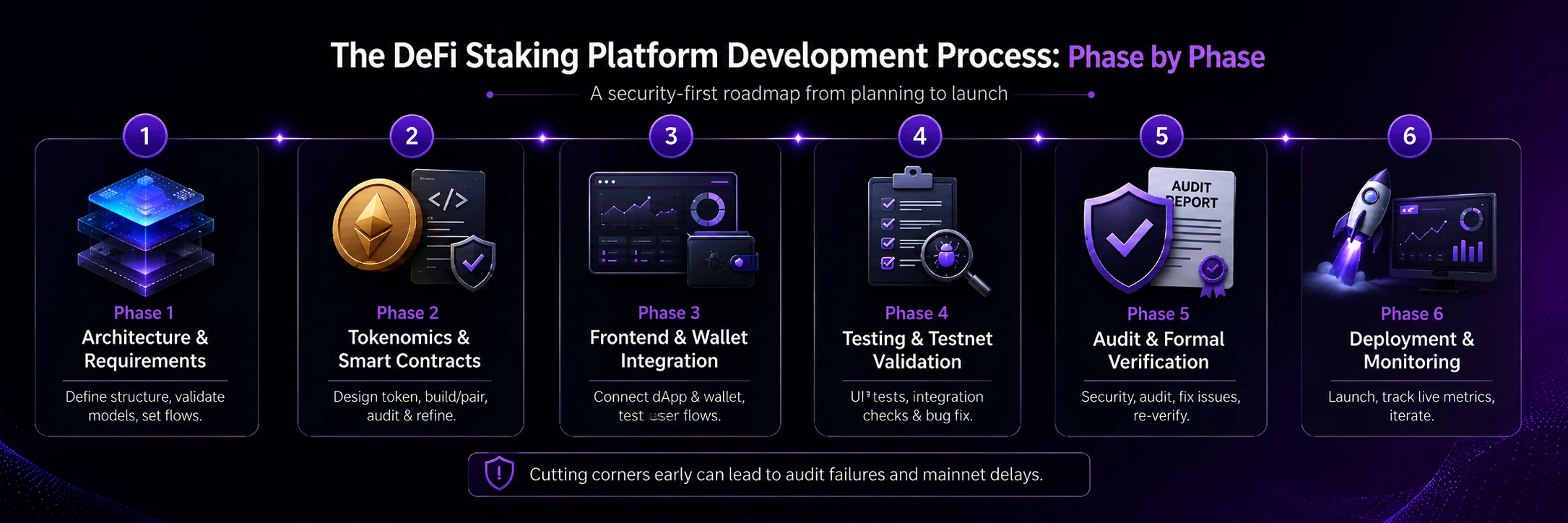
Building infrastructure for DeFi staking platforms is a security-focused effort, not a typical dApp build. Each phase depends on the one before it. If you cut corners early on, especially architecture or testing, you will have audit failures and mainnet delays later.
1. Phase 1-2: Architecture, Tokenomics, and Smart Contract Development
Phase one is needs analysis and architecture. Staking settings, reward logic, and tokenomics should be stress-tested on paper before moving forward. Phase two is smart contract development itself: pool contracts, reward distribution logic, and any penalty or slashing mechanisms for early withdrawal. These two phases are the economic design and security foundation of the platform.
2. Phase 3-4: Frontend, Wallet Integration, and Testing
Phase three is the frontend and wallet integrations, including a staking dashboard, live APR displays, and clear transaction flows so users can see what they are locking up. Phase four includes unit testing, integration testing, testnet deployment, and stress testing under demand. Testnet validation is often done poorly, and platforms can ship with bugs in reward calculation that audits discover late, causing launch delays of weeks.
3. Phase 5-6: Audit, Formal Verification, Deployment, and Monitoring
The fifth phase is a smart contract security audit, and for higher-risk designs, there is a formal verification step before mainnet deployment. Phase six is launch, monitoring, and upgrade planning. Incentive criteria usually require governance-controlled tweaks long after go-live, often years later, as market conditions change. That is why good development partners plan for iteration, not only launch.
Tech Stack – Blockchain, Smart Contracts, and Frontend
Blockchain selection shapes gas costs and reachable user base. Ethereum offers deep liquidity and institutional trust, while BNB Smart Chain, Solana, and Avalanche offer lower fees and faster finality. Contract language follows the chain: Solidity for EVM chains, Rust for Solana, or Move for Aptos and Sui.
On the frontend, React or Next.js paired with ethers.js or web3.js handles wallet connections and transaction signing. Backend indexing typically relies on The Graph for subgraph queries, with a decision on whether reward calculations happen on-chain, which is more trustless but higher gas, or off-chain with on-chain settlement, which is cheaper but more centralized.
Gas optimization for batch reward distribution and auto-compounding can meaningfully affect retention, and cross-chain liquidity aggregation broadens access for users holding assets across ecosystems. Most platforms also need a dedicated reward or governance token, which is a separate scope of work best planned early during architecture rather than bolted on after the contracts are already live and generating rewards.
For secure token planning, businesses can also explore token development services before finalizing reward logic, governance rights, emission schedules, or utility design.
DeFi Staking Development Cost – What to Budget in 2026
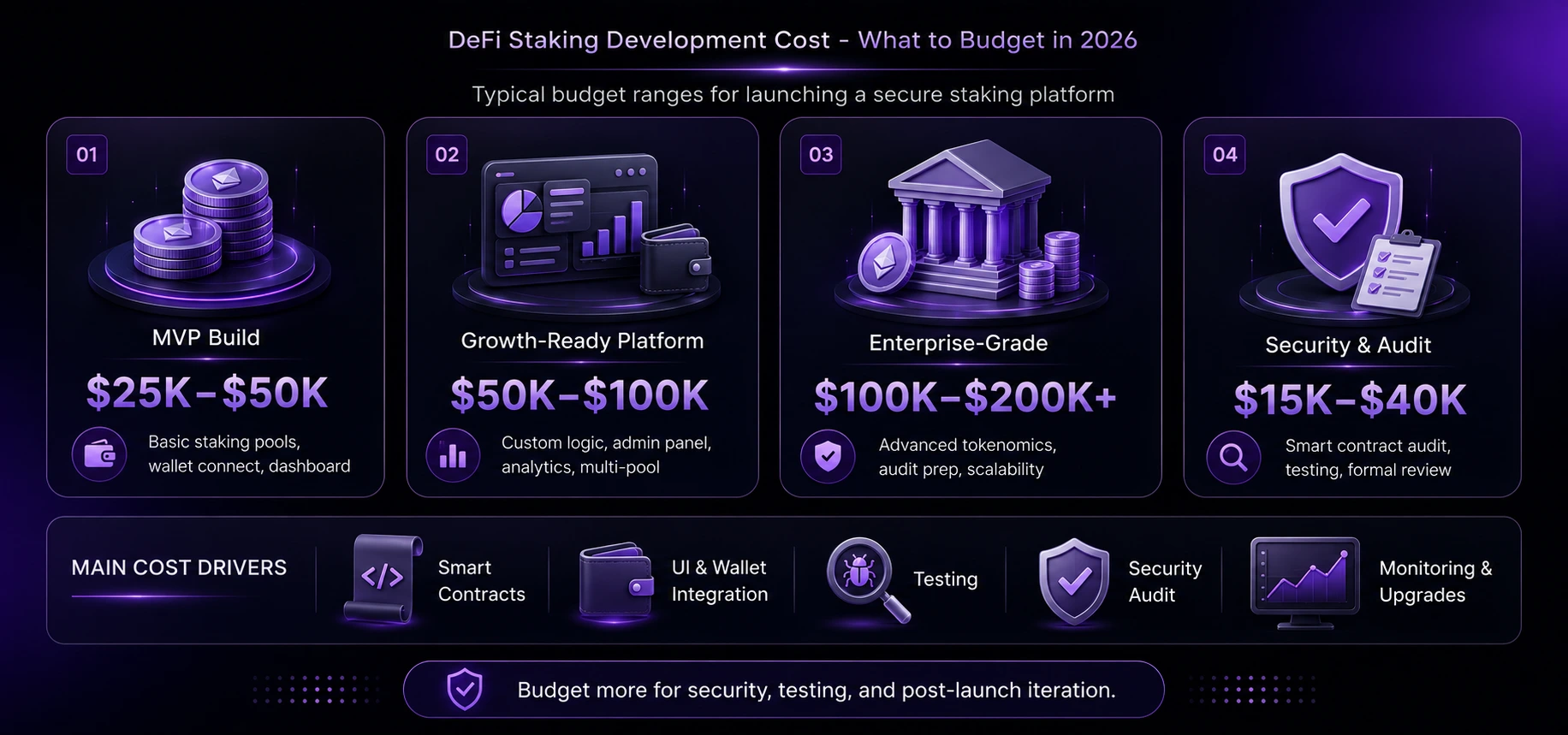
Costs break down across architecture and design, smart contract development, frontend build, security audit, and deployment. As illustrative ranges only, a basic single-pool staking platform on one chain might run in the low-to-mid five figures, while a multi-tier veToken system with governance and cross-chain support can climb into six figures. These are estimates. Actual DeFi staking development cost depends on your requirements and vendor.
1. What Drives Cost – Audit Depth, Chain Complexity, and Multi-Chain Support
- Chain complexity and the number of supported blockchain networks.
- Pool count, reward model sophistication, and governance requirements.
- Smart contract audit depth, formal verification, and multiple audit rounds.
- Frontend dashboard complexity, wallet support, analytics, and admin controls.
- Post-launch monitoring, upgrade planning, and bug bounty programs.
2. Multi-Chain and Liquidity Cost Multipliers
Supporting cross-chain liquidity across several networks acts as a further multiplier, since each additional chain means its own deployment, its own audit surface, and its own ongoing operational monitoring for as long as the platform runs. Multi-chain platforms almost always need a dedicated liquidity management layer to keep pool balances healthy across every supported network.
Security and Audits – The Non-Negotiable Layer
Staking platforms are appealing targets because they pool locked-in wealth into a few contracts. The audit should include reentrancy, overflow and underflow, access control issues, reward calculation accuracy, and flash loan vectors. Formal verification is especially important where a small rounding error could drain a pool over time.
Post-deployment security is not finished with the audit report. Ongoing monitoring, scoped upgrade procedures, and bug bounty programs help reduce risk. Widely analyzed DeFi postmortems on reward-calculation errors show that even audited contracts can ship serious vulnerabilities if monitoring and upgrade planning are weak.
Choosing a DeFi Staking Platform Development Partner
Look for a team that has audited staking contracts running in production on your target chain, rather than looking for basic blockchain experience. In-house security competence combined with independent audits sends a stronger signal than either one on its own. If you are looking to decentralize control, ask about upgradeability, emergency pause mechanisms, and how governance integration, including DAO governance, will be handled.
What Separates Staking-Specific Expertise from General Blockchain Development
DeFi staking platform development services differ from standard blockchain development because they require specialized knowledge of staking-specific attack vectors such as reward drain, slashing manipulation, and governance capture. DeFi token staking development history is more important than having a huge portfolio. White-label DeFi solutions can help companies get to market faster, but they must go through the same audit rigor as custom builds.
Conclusion
Institutional staking adoption continues to accelerate, while regulatory frameworks for staking are still developing in many markets. DeFi staking platform development is a security-first engineering project, not a feature sprint. The strongest solutions prioritize audits, formal verification, and monitoring from day one. If you are going to build a DeFi staking platform, start the security discussion even before writing the first line of contract code.
Ready to launch a secure, scalable, and audit-ready staking product? Explore Techfyte for DeFi staking platform development support across architecture, smart contracts, frontend, audits, and launch planning.
Frequently Asked Questions
1. How much does DeFi staking platform development cost in 2026?
A simple single-pool staking platform on one chain usually costs in the low-to-mid five figures, while a multi-tier veToken system with governance and cross-chain compatibility can run into six figures. The most commonly underestimated line item is smart contract auditing, because serious platforms often need multiple audit rounds before mainnet.
2. What is the development process for a DeFi staking platform?
The process usually includes six phases: architecture and tokenomics, smart contract development, frontend and wallet integration, testing, security audit and formal verification, and mainnet release with ongoing monitoring. Skipping early steps, especially architecture and testing, often leads to audit failures and delays.
3. How does DeFi staking software development differ from general blockchain development?
DeFi staking software development requires specialized experience because staking platforms face unique risks such as reward drain, slashing manipulation, governance capture, reentrancy, reward calculation errors, and flash loan vectors. These systems hold user funds directly and calculate rewards continuously.
4. What should I look for in a DeFi staking platform development company?
A strong DeFi staking platform development company should have audited staking contracts in production on your target chain, in-house security knowledge, and clear answers around upgradeability, emergency pause mechanisms, governance, audits, and post-launch monitoring.
5. What DeFi staking platform development services are essential for a secure launch?
Essential services include architecture planning, smart contract development, formal verification for complex systems, independent audits, frontend and wallet integration, multi-chain support, deployment planning, monitoring, upgrade mechanisms, and bug bounty preparation.
