



Key Takeaways
- Singapore is rapidly scaling AI diagnostics across its public healthcare system, leveraging centralized infrastructure, regulatory support, and nationwide deployments to address growing clinical demand.
- AI is already delivering measurable value in medical imaging, predictive analytics, clinical decision support, and patient monitoring, helping clinicians improve efficiency without replacing human judgment.
- Successful healthcare AI depends as much on workflow integration as model accuracy, with AI tools designed to work seamlessly within existing EMR and clinical reporting systems.
- Singapore’s regulatory framework, led by the HSA, MOH, and PDPA, provides clear governance for AI-based medical devices, emphasizing transparency, patient safety, data privacy, and continuous monitoring.
- Future-ready AI diagnostic systems require robust data pipelines, multi-agent orchestration, ongoing model validation, and strategic technology partnerships to support secure, scalable, and compliant healthcare innovation.
Introduction
Singapore’s public healthcare system is under sustained demographic pressure. By 2030, close to a quarter of residents will be over 65, and the clinician-to-patient ratio in acute hospitals is tightening even as chronic disease caseloads rise. AI diagnostic systems Singapore deployments are one of the few levers available to scale clinical capacity without proportionally scaling headcount. The Ministry of Health has named healthcare one of five strategic sectors under the national AI strategy, while the Health Sciences Authority has built a dedicated regulatory pathway for AI-based medical devices. This piece walks through where AI is already embedded in imaging, predictive analytics, clinical decision support, and patient monitoring across Singapore’s public hospital clusters, and what the regulatory landscape means for anyone evaluating adoption.
Singapore’s Healthcare AI Landscape: Why Adoption Is Accelerating
Singapore’s aging population and rising chronic disease burden have made healthcare AI adoption in Singapore a national priority rather than a hospital-by-hospital experiment. Synapxe, the country’s national HealthTech organisation, is the common infrastructure layer across all public hospitals. Once cleared, the validated model can be deployed concurrently across the NHG, SingHealth and NUHS clusters.
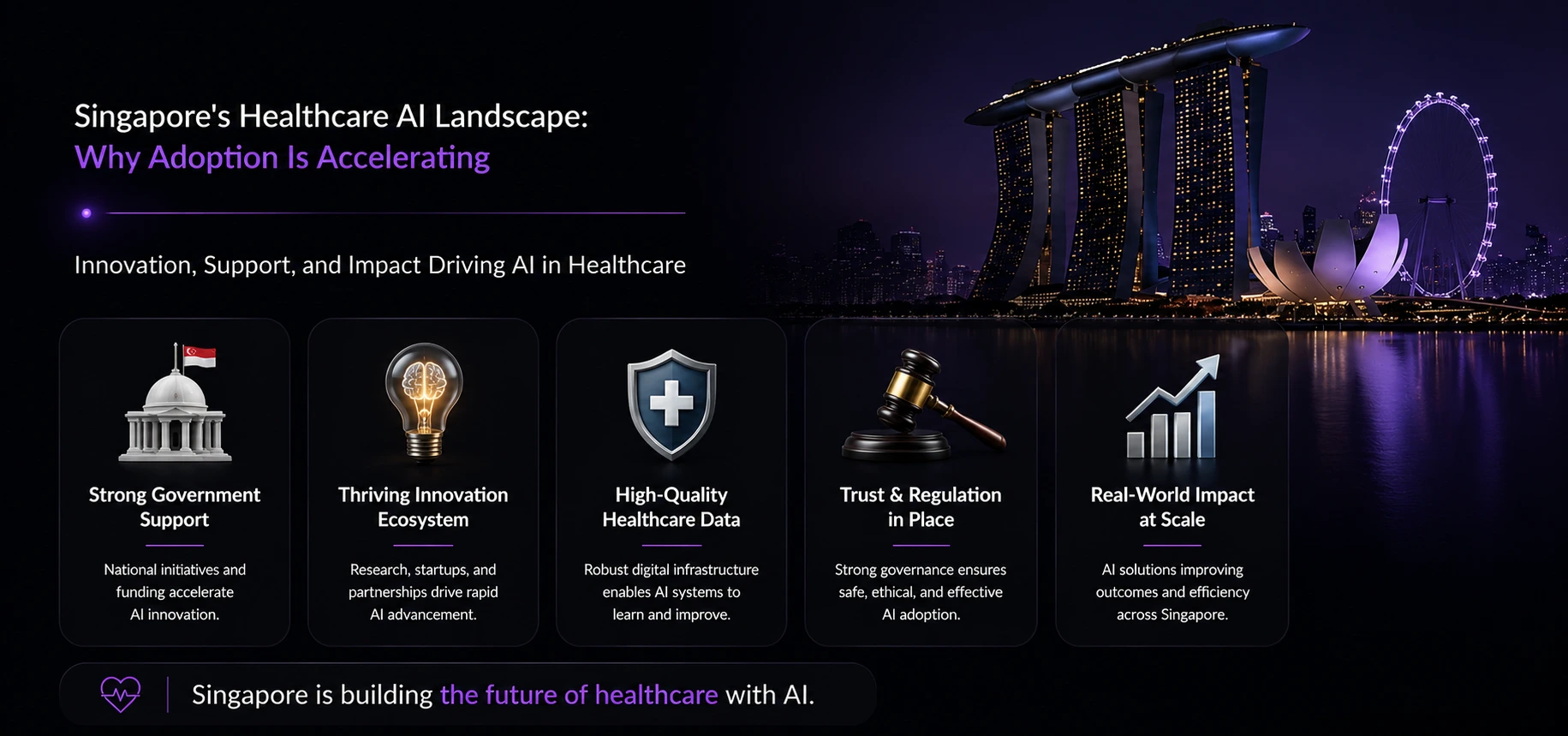
Its reported portfolio of deployed health AI projects includes pneumonia triage, readmission risk prediction and drug safety signal identification, all leveraging countrywide hospital data. As highlighted in a US trade assessment of the Singapore healthcare AI market, this centralized paradigm is unparalleled globally. It provides Singapore healthtech AI with a structural advantage that fragmented health systems elsewhere do not have.
AI Medical Imaging: Radiology, Pathology, and Beyond
The most mature diagnostic application case in Singapore is probably AI in medical imaging. Developed by Synapxe, SingHealth and NTT Data, AIM.SG is a vendor-neutral platform that ingests AI models from various sources across imaging modalities. It has been tested at Changi General Hospital and Singapore General Hospital to help radiologists triage urgent cases and write reports faster.
1. Ophthalmology and Retinal Screening: The SiDRP-SELENA+ Program
The Singapore Integrated Diabetic Retinopathy Programme (S-IDRP) uses SELENA+, a deep learning system jointly developed by the Singapore Eye Research Institute and NUS, for pre-screening of retinal images of polyclinic patients before a human grader certifies the referable cases. A peer-reviewed validation of this deep learning approach in multiethnic populations showed accuracy comparable to trained human graders for diabetic retinopathy, glaucoma, and age-related macular degeneration.
2. Integration: Why Workflow Matters as Much as Accuracy
These hospital AI diagnostic tools are designed to plug into the existing PACS and reporting processes rather than replace them altogether, so the success or failure of an AI-driven diagnostics workflow is not a question of raw model accuracy but of integration quality. In radiology departments that deploy AI without changing their reporting processes, the tools are often underutilized, regardless of how well the model performs in validation experiments.
Predictive Healthcare Analytics and Clinical Decision Support
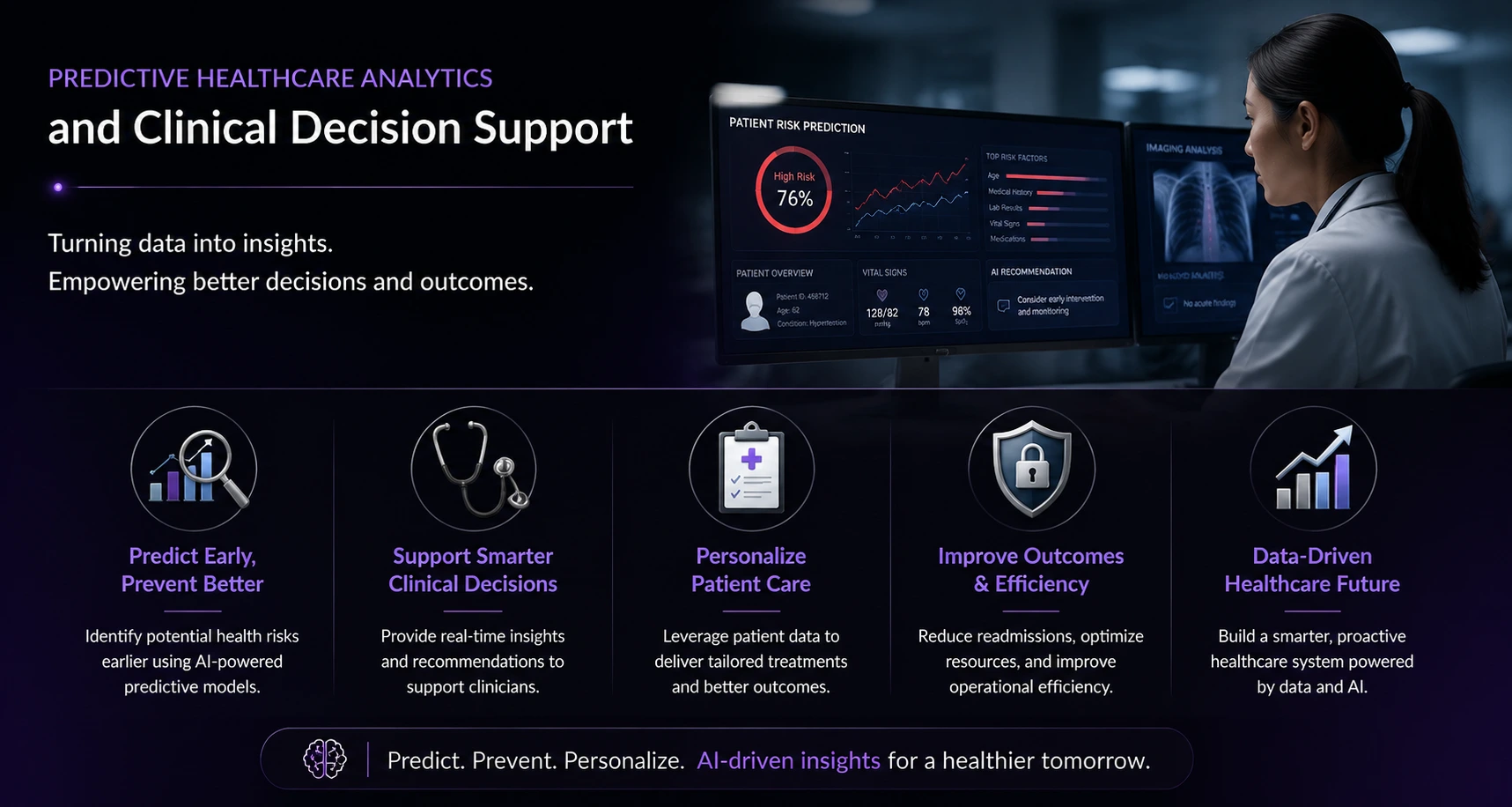
Predictive healthcare analytics are no longer research pilots, they are now part of the daily operations of hospitals. Synapxe’s models predict the severity of pneumonia for triage purposes, risk for complications in diabetes, and patients who are likely to be readmitted multiple times in a year, all of which are updated with predictive analytics solutions that hospitals now accept as a standard tool rather than novelty.
Clinical Decision Support – Embedded in EMR Workflows
Clinical decision support AI is increasingly embedded in EMR workflows, prompting physicians to use evidence-based dosing rather than autonomous instructions. A key to making machine learning in medical diagnosis reliable at cluster scale is ML pipeline development: a model trained on one hospital’s population might behave differently when deployed nationwide, and validating on local, multiethnic data distinguishes a workable clinical tool from a promising prototype.
AI Patient Monitoring and AI-Assisted Patient Care
Monitoring of patients by artificial intelligence is moving out of the intensive care unit into the regular wards of hospitals and into homes. Early warning systems detect deterioration of vital signs before a code event occurs . Remote monitoring programs monitor diabetic, hypertensive and post-surgical patients between visits. PEACH, the perioperative AI helper from Singapore General Hospital, helps physicians triage pre-operative patients against hundreds of pages of guidelines, apparently saving hundreds of doctor hours a year.
This is a clear example of AI-assisted patient care reducing nursing and clinician workload and not replacing judgment. And it’s very much like how enterprise AI assistants are built for other regulated industries: narrow scope, clear escalation paths, and a human in the loop for anything significant. As these systems expand, AI automation systems that take on boring administrative and follow-up tasks allow physicians to do more high-value work without sacrificing their diagnostic authority.
AI Voice Agents for Connected Patient Care
Healthcare AI extends beyond diagnosis to patient communication and care coordination. Platforms like Maica, Techfyte’s AI voice agent solution, help healthcare providers automate appointment scheduling, medication reminders, patient follow-ups, and routine inquiries through natural voice interactions in multiple languages. Integrated with CRM (Zoho, Hubspot, etc.) and healthcare workflows, AI voice agents reduce administrative burden, improve patient engagement, and enable clinicians to focus on delivering better care.
Regulatory Framework: HSA, MOH Guidelines, and AI Safety
In Singapore, AI-based diagnostic software is treated as a medical device by the Health Sciences Authority. The registration, quality management, and post-market monitoring criteria for machine learning systems are outlined in its life cycle guidelines for software medical devices and AI-SaMD. In March 2026, MOH and HSA issued a refreshed AI in Healthcare Guidelines, known as AIHGle 2.0, which clarified the responsibilities of developers, deploying hospitals and clinicians, as well as expectations for transparency and risk mitigation. The full framework can be accessed on MOH’s regulatory policy page.
The PDPA is an independent regulator of data privacy which specifies how patient records may be aggregated, de-identified and used to train models across hospital clusters. But the constraint is also why multi-hospital model training in Singapore is increasingly taking a federated approach, rather than centralizing raw records in one location – an approach more formally known as federated learning; so that patient data does not have to leave its originating institution, with anomaly detection layered on top to detect model drift before it impacts patient safety. Regulators also have higher expectations for automated retraining pipelines that can refresh models with new population data without full re-validation cycles. The governance around when and how retraining triggers a new regulatory submission is still evolving under HSA’s framework.
Building AI Diagnostic Systems: Technology Stack and Partnerships
The HSA lifecycle approach addresses all governance steps for deploying a hospital-grade diagnostic AI system, including data intake and labeling, model training and clinical validation, model deployment and serving, and ongoing monitoring. More complex diagnostic workflows increasingly rely on AI agent development that coordinate triage, documentation, and follow-up actions that previously required distinct point solutions, each handled by a narrowly scoped agent rather than a single monolithic model trying to do it all at once.
Multi-Agent Orchestration and Clinical NLP
This technique scales even further when processes span multiple departments and data sources, in which case multi-agent orchestration is required to keep handoffs auditable, rather than distributed across disconnected tools without a shared audit trail of what happened at each stage. When deciding whether to build or partner for this type of stack, hospitals often look to external vendors to custom LLM development for clinical note summarization. National platforms such as NEHR will also be integrated and not stand-alone silos. In some deployments for security-sensitive use-cases such as patient identification verification or audit log integrity, AI and blockchain solutions are being explored to create tamper-proof recordings of model decisions and clinical overrides.
Concluding Note
In Singapore, AI programs for public healthcare have progressed from pilot research to operational deployments in imaging, predictive analytics, decision support and patient monitoring, and Synapxe’s unified infrastructure has paved the way for cluster-wide adoption. The regulatory clarity from the HSA and MOH, along with the data from projects like SiDRP, gives a functional framework for vendors and hospital IT leaders, not an unclear one. As AI diagnostic systems Singapore mature with human supervision, the expectation is that AI-assisted diagnosis will change from the exception to a documented, audited part of standard care.
Frequently Asked Questions
1. How are AI diagnostic systems Singapore being deployed in public hospitals?
AI diagnostic systems Singapore is implemented via Synapxe, the national HealthTech agency serving NHG, SingHealth and NUHS clusters. Validated models for pneumonia triage, readmission prediction and drug safety monitoring are deployed across all public hospitals at the same time, not one hospital at a time.
2. What role does AI medical imaging play in Singapore’s healthcare system?
Singapore’s most mature diagnostic application for AI is medical imaging. AIM.SG platform helps radiologists to triage urgent cases, while SELENA+ system pre-screens retinal photographs for diabetic retinopathy with accuracy comparable to that of trained human graders across polyclinics.
3. How does predictive healthcare analytics support clinical decision-making?
Models for predictive analytics (pneumonia severity, diabetic complications, readmission risk) Artificial intelligence for clinical decision support embedded in EMR workflows guide clinicians through evidence-based pathways. Machine Learning for Medical Diagnosis on Data from a Multi-Ethnic Population of Patients in Singapore.
4. What is Singapore’s regulatory framework for AI diagnostic tools?
The Health Sciences Authority (HSA) has classified artificial intelligence (AI) diagnostic software as a medical device, and has issued guidelines on the lifecycle of these products, including registration and post-market surveillance. In March 2026, MOH and HSA published AIHGle 2.0, which clarified accountability between developers, hospitals and clinicians. The PDPA governs the aggregation of patient data to train models.
5. How does AI-assisted patient care reduce clinician workload?
AI patient monitoring identifies deterioration of vital signs in wards and remotely monitors chronic disease patients. Singapore General Hospital’s PEACH chatbot saves hundreds of hours of doctor time each year triaging pre-operative patients against clinical guidelines, but a human is always in the loop for consequential decisions.
Ready to Build an AI Healthcare Solution?
Partner with AI development experts to create secure, scalable, and compliant healthcare AI systems.
