



Key Takeaways
- Successful commodity tokenization starts with the underlying asset, making fungibility, standardized grading, and reliable custody infrastructure essential prerequisites before blockchain development begins.
- Physical custody, smart contracts, and compliance must be designed together, with redemption logic, audited reserves, price oracles, and supply chain verification ensuring every token is backed by real-world invenitory.
- A structured, compliance-first development process: from asset selection and custody partnerships to audits and secondary market enablement, minimizes regulatory and operational risks.
- Development costs range from the low-to-mid six figures for single-commodity platforms to seven figures for multi-commodity, multi-jurisdiction solutions, with custody integration and audit requirements being the largest cost drivers.
- Platforms built with institutional-grade custody, regulatory compliance, and cross-border trading capabilities will be best positioned to capitalize on the growing adoption of tokenized commodities in 2026 and beyond.
Introduction
Gold bars, crude oil barrels, and wheat bushels are not interchangeable problems. Building a blockchain platform for tokenized commodities means solving physical custody, quality grading, and settlement before a single smart contract is deployed. Each commodity class carries its own handling rules: vaulted bullion, siloed grain, or pipeline-metered crude all demand different verification infrastructure. This guide walks through commodity selection, platform architecture, custody design, the development process, required features, regulatory considerations, and realistic cost ranges for building a working platform in 2026.
What Commodities Make Sense to Tokenize – Asset Selection Criteria
Fungibility drives feasibility. Gold and crude oil tokenize more naturally than heterogeneous agricultural goods because a bar or barrel of a given grade is interchangeable with any other of the same grade, while wheat quality varies by moisture, protein content, and harvest conditions. Existing grading standards reduce friction considerably: bullion custodians reference the LBMA Good Delivery standard, metals markets lean on exchange-defined specifications, and grains rely on USDA grade certificates.
Storage infrastructure also determines what is practical – vaulted gold, siloed grain, and pipeline-metered oil each require distinct custody models. A tokenized commodities platform for bullion looks very different from one built for soft commodities, and both differ sharply from real estate tokenization, where the underlying asset is immovable rather than fungible and storable. Institutional demand is following the assets that solve fungibility first: the World Economic Forum notes that enterprise-grade tokenization deployment is accelerating fastest where fractional, programmable representations of an asset can be verified and traded with minimal friction.
Platform Architecture – Custody, Token Standards, and Smart Contracts
Physical custody integration sits at the center of the architecture: audited vaults, digitized warehouse receipts, and IoT sensors verifying storage conditions all need to feed on-chain records before a token can be trusted. Token standard selection matters too – permissioned frameworks like ERC-3643 embed compliance directly into transfer logic, which is useful for commodity tokens restricted to eligible investors.
Smart Contract Design for Physical Commodities
Smart contracts must issue tokens only against verified inventory and support redemption mechanics for physical delivery, not just balance transfers. Oracle integration for real-time spot price feeds and custody audit verification keeps token value anchored to the physical asset. This is where smart contract development for commodities diverges from other tokenized assets: redemption logic, storage fee accrual, and physical settlement triggers add complexity that a typical security token doesn’t need, which is why institutional custody integration has to be designed alongside the contracts rather than bolted on afterward. Adding supply chain traceability to the custody layer gives investors verifiable proof that the commodity exists, is stored under specified conditions, and hasn’t been double-pledged – a requirement institutional buyers increasingly treat as non-negotiable.
The Development Process – From Commodity Selection to Live Platform
The Seven-Step Build Sequence
- Commodity and jurisdiction selection: which physical asset, which regulatory regime
- Custody and warehousing: partner selection, audit rights, insurance coverage
- Regulatory-compliant token design: disclosure terms, investor eligibility, settlement rights
- Smart contract and platform development: issuance, trading, redemption logic
- Independent smart contract audit: critical where physical delivery disputes can arise
- Investor onboarding and compliance reporting: KYC, accreditation, risk disclosures
- Secondary marketplace enablement and cross-border distribution
Why Sequencing Matters
Each stage is built on top of the previous one. Going straight to regulatory-compliant token design for speed reasons almost always leads to expensive rework when counsel reviews the terms of the disclosure. The development of commodity tokenization platforms also relies heavily on securing custody and warehousing partnerships early on as token issuance cannot legally happen until reserves are verified to be held. Because of this, a careful smart contract audit before launch is even more important here than other tokenization projects, as a flaw affecting redemption logic could lead to physical delivery problems rather than simply an on-chain accounting error. When the investor onboarding process is launched, it should include commodity-specific risk disclosures beyond standard KYC and compliance reporting should monitor custody audit results and reserve ratios, not just transaction activity.
Key Features a Tokenized Commodities Platform Must Have
1. Asset Backing and Price Integrity
Real-time asset backing verification means tokens are backed 1:1 with audited physical inventories, with price oracles ensuring accurate net asset value calculations for secondary market trading. The mechanics of physical delivery and redemption need clear rules about when the holder wants the actual commodity rather than the token.
2. Yield, Storage, and Market Access
Storage and yield management are also important; some systems subtract storage fees from the token value, while others charge separately and pass on the loan yield. Recent gold-backed token launches underscore the fact that yields are becoming a differentiator, with issuers placing physical gold in lending arrangements and paying interest to token holders after expenses. white-label tokenization reduces the cost and time to market for established commodity companies to join the industry. Rather than reinventing the wheel, it is built on top of custody integrations, Oracle connections and compliance modules, all of which have already been vetted by legal and technical teams. Once the tokens are live, the existence of a viable secondary marketplace and the cross-border distribution capabilities will determine whether the platform can attract liquidity or remain a static issuance platform with little investor interest.
Regulatory Landscape – Commodity Tokenization Across Jurisdictions
In the United States, a tokenized commodity could be subject to derivatives regulation, as well as securities law, depending on the design and marketing of the token. The recent CFTC guidance on tokenized collateral clarifies the application of the existing derivatives laws, but the distinction between a tokenized commodity and a security-like instrument is based on the attributes of each structure. The FCA and ESMA are tackling similar issues in the UK and EU crypto regimes where a commodity-backed token is considered a security.
UAE and Singapore have positioned themselves as particularly advantageous jurisdictions for development of commodity tokenization platforms, with more established licensing pathways for asset-backed digital instruments. Disclosure requirements in different jurisdictions are based on common concepts such as demonstrated reserves, regular custody audits and clearly defined redemption rights. Choosing a commodity tokenization platform development company that has real regulatory experience affects how fast a platform can launch in a given market. A partner that has already been through CFTC, FCA or VARA commodity-token questions has reusable compliance architecture, not learning on your timeline.
Cost to Build a Blockchain Platform for Tokenized Commodities
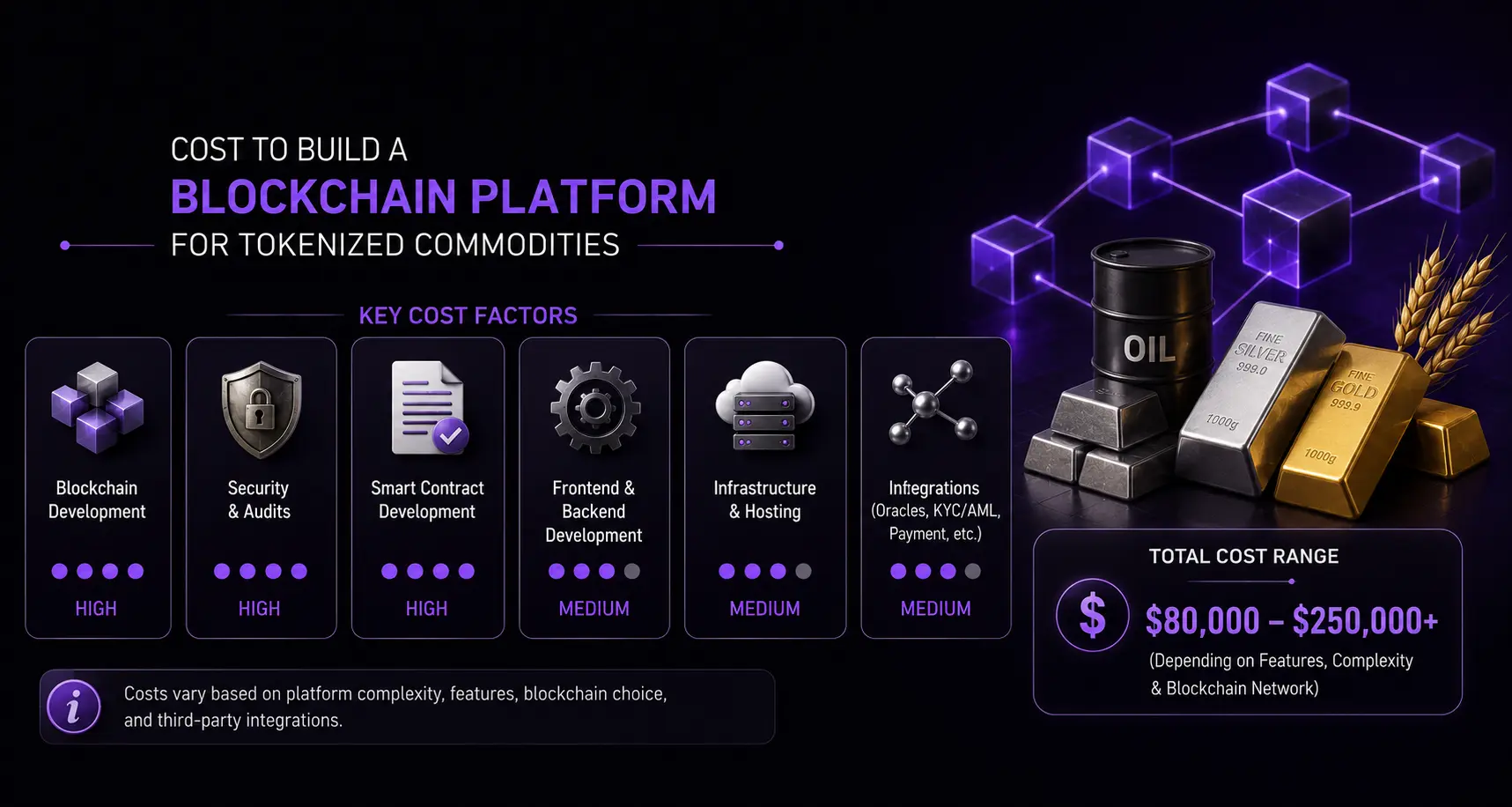
The costs are split into custody integration, smart contract development, compliance tooling, third-party auditing and marketplace functionality. A single commodity platform with basic redemption will cost in the low to mid six figures, whereas a multi-commodity platform that allows for physical delivery in multiple jurisdictions can cost from mid six to seven figures, driven in large part by the complexity of custody, the depth of audits and IoT integration for storage verification.
What Drives Cost Variation
But the broader cost patterns for asset tokenization apply here as well. Commodities have custodial and grading costs that securities-style tokenization does not. The most important cost variable is whether custody infrastructure needs to be built or can be sourced from an existing audited provider. White-label solutions can bring these numbers down significantly by leveraging existing custody integrations and audited contract frameworks versus building from scratch. Custody audit fees, Oracle subscriptions, compliance staffing, smart contract maintenance, etc. These should be recurring line items and not one time launch charges.
Concluding Note
Tokenized commodities succeed or fail based on the non-blockchain aspects of custody verification, quality grading, regulatory disclosure, etc. The platforms that are gaining traction in 2026 treat off-chain infrastructure as the product itself, rather than a compliance afterthought pasted on to a smart contract. Firms that build a blockchain platform for tokenized commodities today, with custody and compliance built in from the start, will be in a better position when institutional adoption of commodity tokenization picks up speed.
Frequently Asked Questions
1. What makes a commodity suitable for a blockchain platform for tokenized commodities?
Fungibility makes things possible: gold and crude oil are naturally tokenizable because you can swap out a bar or a barrel of a given grade. Today , standards like the LBMA for bullion or the USDA for grains minimize friction . Before they can issue tokens , infrastructure for storage has to be built .
2. How does commodities tokenization differ from real estate or equity tokenization?
Securities tokenization lacks physical custody, quality grading and storage verification that commodities tokenization provides. Tokens must have 1:1 ratio with audited physical inventory and smart contracts must handle physical redemption logic and storage charge accrual.
3. What are the key steps in commodity tokenization platform development?
The seven processes are Commodity and jurisdiction selection Custodial partnerships Regulatory compliant token design Smart contract development Independent audit Investor onboarding with compliance reporting Secondary marketplace with cross border distribution Custody must be set up early, as tokens cannot be produced until reserves have been validated.
4. How much does it cost to build a tokenized commodities platform?
A single-commodity platform is in the low to mid six figures. A multi-commodity platform with cross-jurisdictional physical delivery costs in the mid six to seven figures. The biggest variable cost is whether custody infrastructure is built or bought from an existing audited supplier.
5. How do I choose a commodity tokenization platform development company?
Find a partner who has real regulatory experience in the CFTC, FCA or VARA commodity-token regimes. Completed review of custody integrations with audited providers and the smart contract audit history for physical asset-backed tokens with redemption logic.
