



Key Takeaways
- WebX Asia 2026 reflects Japan’s transition from blockchain experimentation to enterprise-scale adoption, with tokenization, DeFi, gaming, and AI emerging as the event’s dominant themes.
- Japan’s regulatory clarity and strong institutional participation are accelerating production-grade blockchain deployments, positioning the country as a leading Web3 market in Asia.
- Tokenized real-world assets, regulated DeFi infrastructure, and blockchain gaming are expected to drive the next wave of commercial innovation, supported by established enterprises and public blockchain networks.
- AI and blockchain convergence is creating new opportunities in decentralized AI, autonomous agents, verifiable computation, and enterprise workflow automation across multiple industries.
- For startups and enterprises, WebX Asia serves as a strategic gateway into Japan’s regulated blockchain ecosystem, offering valuable opportunities for partnerships, investment, and market expansion.
Introduction
WebX has become the WebX Asia’s blockchain conference, a barometer among developers, investors and politicians in the region, and the 2026 edition comes at an important moment for Japan’s Web3 agenda. Regulatory clarity, greater corporate blockchain deployment and a purposeful government push have made Japan Asia’s most closely watched blockchain industry this year. This preview considers five categories of innovation that will probably set the agenda; tokenized assets, DeFi infrastructure, gaming and NFTs, AI-blockchain convergence and corporate adoption, and what they mean for entrepreneurs and enterprises watching the region.
About WebX Asia: Asia’s Premier Blockchain Conference
CoinPost, the largest crypto and Web3 media outlet in Japan, will be holding WebX on July 13-14, 2026 at The Prince Park Tower Tokyo. Last year’s event drew more than 14,000 people and generated over 170 side events throughout the city. The 2026 program is set to exceed that, with confirmed speakers including Uniswap Labs founder Hayden Adams and Animoca Brands co-founder Yat Siu. Already on the official WebX Asia agenda are presentations from Mitsubishi UFJ Financial Group, Mizuho Financial Group and JPX Market Innovation, a testament to how far the conference has come from crypto-native programming to institutional finance. This shift is exactly why this Tokyo meeting has become less a trade fair and more a barometer of regional opinion.
Why Japan Was Selected for WebX; Regulatory Clarity and Corporate Adoption
Japan’s Financial Services Agency has been working since 2026 to reclassify crypto assets to fall under the Financial Instruments and Exchange Act instead of the older Payment Services Act, bringing disclosure and insider trading rules closer in line to securities law. Why was this done? The FSA’s own review of cryptoasset regulatory systems explains. Major organizations have followed suit: Sony’s Soneium Layer 2, NTT Digital’s settlement work, Mitsubishi UFJ’s Progmat tokenization platform and Nomura’s Laser Digital subsidiary are all considered true production infrastructure, not side projects.
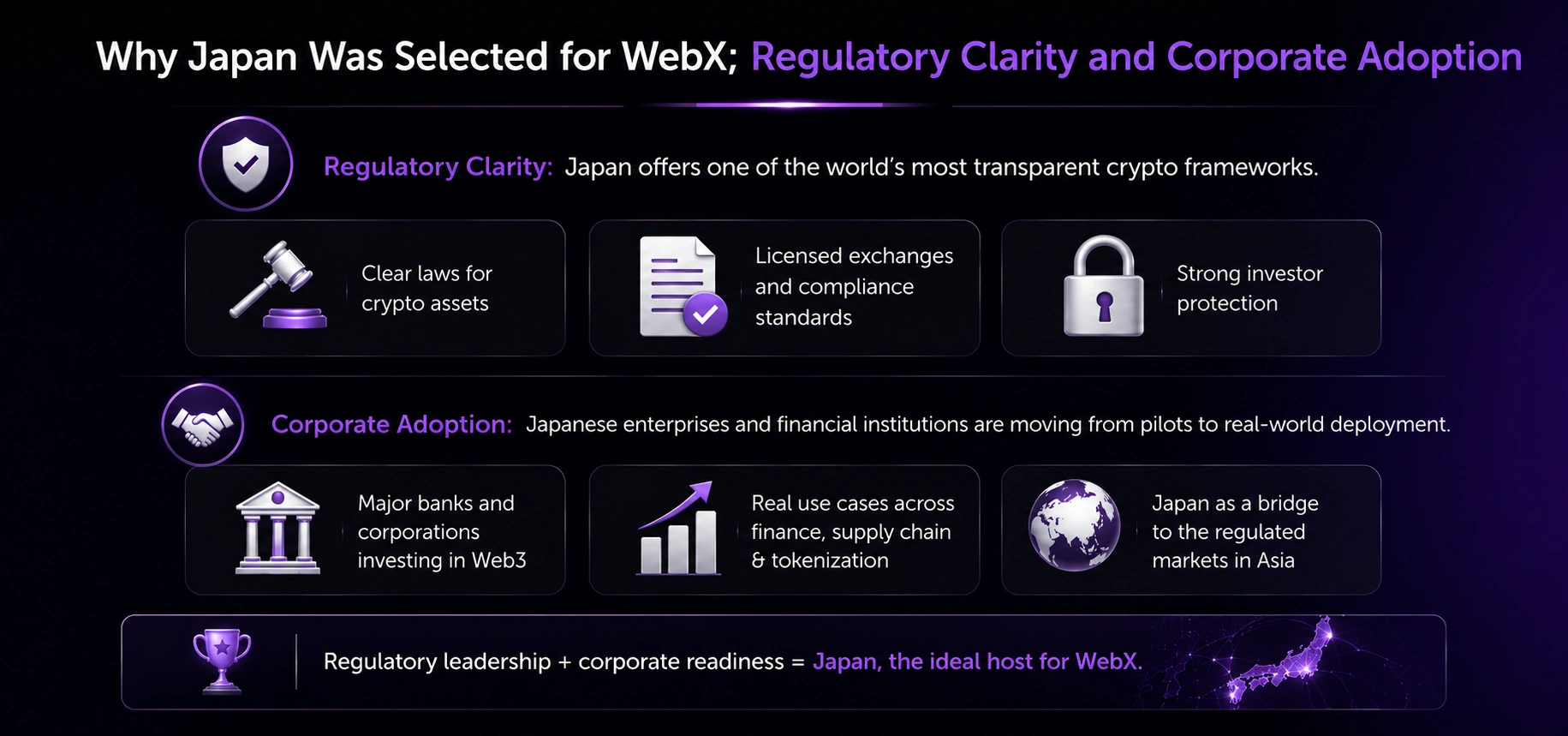
Japan’s blend of clear regulations, deep capital pools, strong IP ownership and a retail crypto market established in 2017 distinguishes it from Singapore’s financial-hub stance and the UAE’s innovation-sandbox strategy. The environment has made enterprise blockchain adoption a national priority rather than a niche experiment, with companies moving from R&D to production deployment faster than any other Asian country.
Tokenized Assets: Real Estate, Commodities, and Beyond
Japan has been one of the first to adopt tokenized assets, with the legal framework for trust-structure security tokens in place since around 2020, and the most visible example being MUFG’s Progmat platform which now accounts for around 63% of Japan’s security token issuance. Progmat is moving more than $2 billion of tokenized corporate bonds and real estate from Corda to a public Avalanche chain. MUFG’s ¥22.4 billion Osaka Dojimahama Tower deal in March underscores the growth in single deals.
Real Estate and Commodity Tokenization at WebX 2026
Recent reporting on Progmat’s roadmap identified tokenized stocks as the next target, with a working group exploring tokenized government bond repo settlement. There will also be sessions on tokenization of commodities such as gold, metals and agricultural supply chains, as well as talks on cross-border tokenization corridors linking Japan with Southeast Asian markets. For businesses looking to enter, having an experienced RWA tokenization platform development partner who is well versed in Japan’s trust-structure framework can go a long way in reducing the regulatory learning curve.
Crypto Infrastructure and DeFi Platforms
Japan’s exchange ecosystem, including bitFlyer, Coincheck and SBI VC Trade, operates more like regulated infrastructure than speculative venues, and it is this foundation that makes DeFi staking platforms possible under the amended Payment Services Act. Japanese compliance requirements are expected to be a recurring theme for institutional custody solutions, as the staking yield is only worthwhile if custody is in accordance with FSA segregation regulations.
Regulated DeFi and Cross-Chain Liquidity
The same clarity in compliance that paved the way for staking is now being extended to on-chain trading platforms, and regulated decentralized exchanges are expected to receive similar scrutiny. Likely topics include blockchain financial services that connect domestic liquidity to global markets and cross-chain infrastructure to connect Japanese exchange liquidity to larger DeFi pools, particularly given Progmat’s own transition to EVM-compatible public chains for settlement.
Web3 Gaming and NFT Platforms
Very few markets can claim the structural advantage that Japan’s gaming industry provides in Web3. Square Enix has already released its game Symbiogenesis on Sony’s Soneium Layer 2, which has more than 3 million registered accounts, while Bandai Namco and Sega have announced similar blockchain gaming projects. NFT platforms are likely to move past static items to incorporate gaming assets, event ticketing, and loyalty programs tied to Japanese intellectual property at WebX 2026.
With Soneium’s ecosystem expanding, it is expected to become a place for discussions on DAO governance models for anime, idol culture, and entertainment franchise fan groups and creator economies. Japan’s unique combination of globally renowned IP, along with a domestic gaming market worth more than $27 billion a year, puts it ahead of any other state that is unlikely to easily match.
AI-Powered Blockchain Applications
The convergence of AI and blockchain is expected to be one of the most popular tracks with topics such as decentralized AI training, verifiable inference, and tokenized compute markets. Several talks will likely be on Japanese AI and blockchain technologies, from agent platforms to decentralized data marketplaces. This convergence is particularly relevant to manufacturing and enterprise blockchain use cases, where autonomous agents are increasingly relying on smart contract development. It governs a workflow coordinated by DAOs without constant human intervention, given Japan’s existing strength in robotics and industrial automation.
Impact on Startups, Enterprises, and the Future of Blockchain in Asia
WebX 2026 is a platform for entrepreneurs to raise funds and collaborate, with the access to the regulatory sandbox being increasingly debated on-site as the FIEA reclassification date draws nearer. Enterprise participants will likely be less interested in pilots and more interested in production deployment, following Japan’s blockchain market growth trajectory. Analysts expect a more than 10x increase by 2030 as enterprise blockchain, cryptocurrency infrastructure and Web3 applications all mature in tandem.
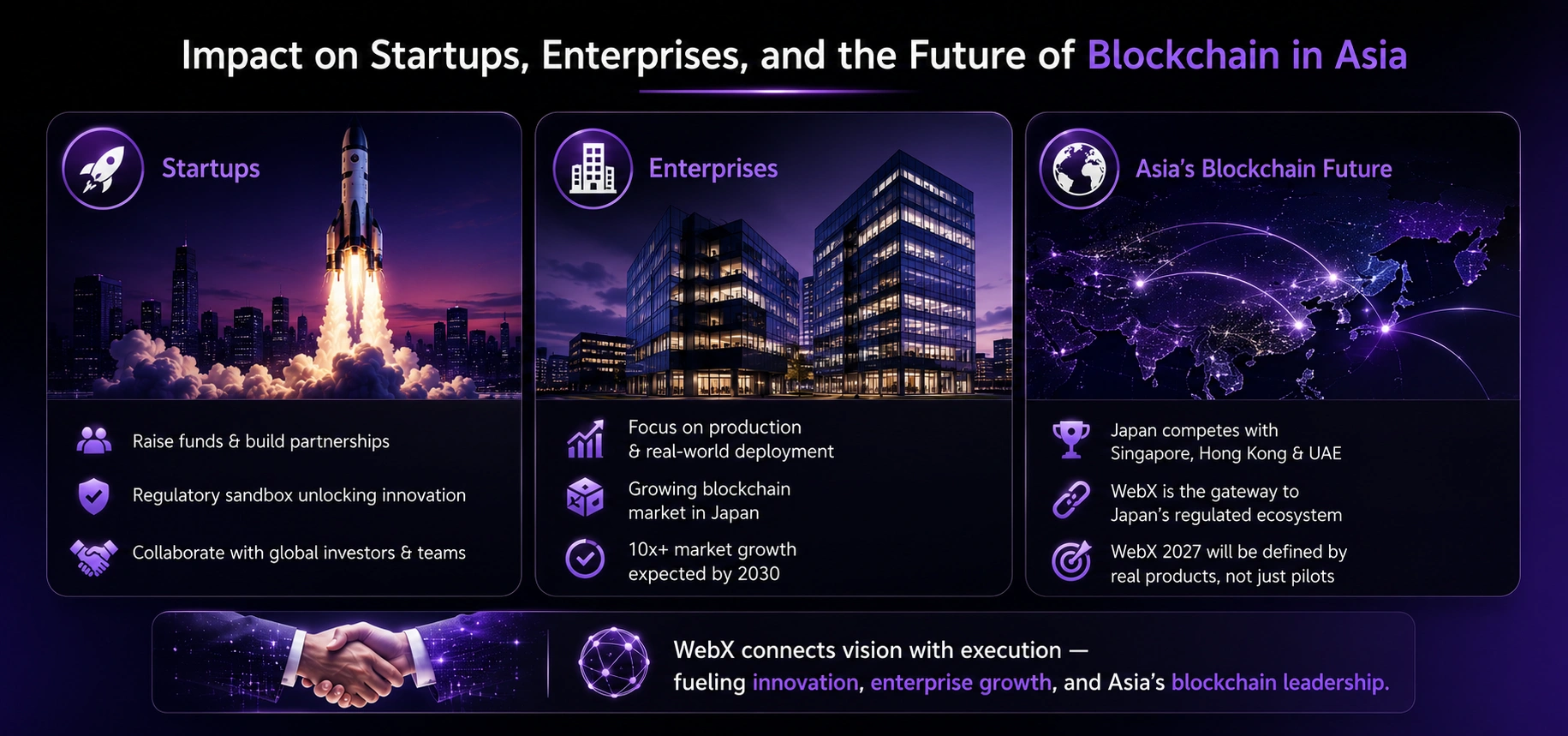
Japan’s mix of deep capital and corporate scale is arguably unrivaled, but that trajectory puts Japan’s position in the broader Asia Pacific blockchain landscape in constant competition with Singapore, Hong Kong and the UAE. For multinational teams, crossing into Japan’s regulated ecosystem is increasingly starting with links made at WebX, making the conference a more realistic entry point than just an industry gathering. Most likely WebX 2027 will be measured by how many of this year’s pilot announcements – from Progmat’s tokenized stocks to Soneium’s gaming ecosystem – have become live products.
Concluding Note
WebX Asia 2026 highlights Japan’s shift from cautious experimentation to production-grade blockchain adoption in tokenization, DeFi, gaming and AI convergence. Progmat’s $2 billion migration and Soneium’s millions of users are a testament to Japan’s rare combination of legal clarity and real-life business engagement, a model other Asian economies are studying keenly. For those wondering where the WebX Asia blockchain conference will go next, this year’s presentations gave the clearest indication to date of what production blockchain in Asia will look like.
Frequently Asked Questions
1. What is the WebX Asia blockchain conference and why does it matter?
CoinPost is the home of Asia’s leading blockchain conference, WebX, held annually in Tokyo. The 2026 edition is set for July 13-14 at the Prince Park Tower in Tokyo, with an anticipated crowd of around 14,000. It has become a barometer of Asian blockchain mood, with sessions dominated by institutional finance rather than crypto-native programming.
2. Why was Japan selected as the host country for WebX Asia?
Japan is unrivaled in Asia in terms of regulatory certainty, with the FSA reclassifying crypto assets as financial instruments under the Financial Instruments and Exchange Act in 2026. Major firms like Sony, NTT Digital, MUFG and Nomura view blockchain as production infrastructure. Japan is different from Singapore and the UAE because it has clear regulations, large pools of capital, strong IP and a mature retail crypto space.
3. What tokenized asset innovations are expected at WebX Asia 2026?
MUFG’s Progmat platform holds 63% of the security token market in Japan and will lead the way in showcasing tokenized assets. Progmat is moving $2 billion in tokenized real estate and bonds to Avalanche, with tokenized stocks coming soon. Plans also include sessions on commodity tokenization and cross-border corridors linking Japan and Southeast Asian markets.
4. How is Japan’s gaming industry shaping Web3 innovation?
Japan’s game industry offers unmatched IP and a $27 billion domestic market to benefit Web3. Sony’s Soneium Layer 2, which now has more than 3 million accounts, has received Symbiogenesis from Square Enix. At WebX 2026, NFT platforms will probably focus on gaming assets, event ticketing and loyalty programs inspired by Japanese anime and entertainment franchises.
5. What does WebX Asia 2026 mean for startups and enterprises?
WebX provides a forum for entrepreneurs to raise financing and collaborate. Access to regulatory sandboxes is a topic that is often discussed on site. Enterprise attendees are moving from pilots to production deployments. Japan’s blockchain market is projected to increase tenfold by 2030, and multinational teams are increasingly turning to WebX as a practical on-ramp into Japan’s regulated ecosystem.
