



Key Takeaways
- Multi-chain wallets have become the standard for Web3, enabling users to manage assets across multiple blockchains through a unified interface while abstracting network complexity.
- Security architecture is the foundation of successful wallet development, with custody models, MPC key management, secure key storage, and comprehensive audits playing a critical role in protecting digital assets.
- Development costs range from the low-to-mid five figures for an MVP to well into six figures for enterprise-grade wallets, with chain support, DeFi integrations, custody requirements, and audit scope driving the budget.
- A phased roadmap: from a 3–5 chain MVP to a fully featured enterprise wallet with 15+ chains, MPC, and compliance capabilities, offers the most practical path to market.
- Choosing an experienced wallet development partner with production deployments, audited multi-chain infrastructure, and proven security expertise is essential for building a scalable, secure, and future-ready wallet platform.
Introduction
Most crypto users now hold assets across Ethereum, Solana, Bitcoin, and a few L2s, so a single-chain wallet is no longer competitive. Multi-chain wallet development solves that fragmentation but introduces real complexity around key management, chain compatibility, and security. This guide covers the architecture, technology stack, cost ranges, and timeline from MVP to enterprise deployment.
Core Architecture of a Multi-Chain Wallet
A multi-chain wallet needs a unified account model that hides the fact that every chain has its own address format, signature method and fee market. Most implementations use hierarchical deterministic derivation according to the BIP-32, BIP-39, and BIP-44 standards, so you have a single seed phrase that generates independent key trees per chain, not a separate seed per chain. It’s worth reading the official BIP-44 specification, as minor deviations in the derivation path will break cross-wallet compatibility.
Custody Models: Custodial, Non-Custodial, and MPC
Teams then choose a custody model. The private keys are stored on company infrastructure in a fully custodial system. In exchange for losing control, the user gets faster support and account recovery if they lose access. A non-custodial wallet takes the opposite approach, giving full ownership of the keys to the user, and shifting the burden of recovery to the user rather than the platform, which is far more appropriate for retail, privacy-conscious users than institutions. Key-splitting is a middle ground between the two extremes, where an MPC wallet shares signing authority across many independent parties, ensuring that no single device or server ever has the entire private key.
Chain Abstraction: Hiding Complexity from Users
And on top of all of this is chain abstraction which allows a user to sign once and keep one balance while cross network routing is abstracted behind the interface. Techfyte’s chain abstraction work is specifically targeted at this layer. The premise is simple, a user shouldn’t have to worry about what chain their assets are on, just that they can send, receive and transact seamlessly regardless of the underlying network.
Technology Stack: Blockchain Networks, SDKs, and Security
Much of the engineering effort is spent on network support. EVM chains like Ethereum, Polygon, BNB Chain, etc. share tooling through ethers.js and viem: see Ethereum’s developer documentation for the current landscape of SDKs; but Solana needs its own integration to web3.js and Cosmos or Polkadot introduce entirely different ecosystems. WalletConnect and Web3Auth are popular ways to create a consistent connection layer for all of them.
Security Architecture and Key Management
Key management via secure enclave storage, MPC splitting, optional social recovery. Every new chain comes with more bridge contracts and signing flow, increasing the attack surface. That’s why a smart contract audit that includes each integration point is far more important here than it would be on a single-chain build. The OWASP Smart Contract Top 10 is a solid, regularly updated baseline checklist to scope that review before you hire an outside auditor. For organizations that don’t want to start from scratch, an embedded wallet SDK can compress months of integration into a single setup, so they can focus on their product layer rather than chain compatibility.
Key Features of a Multi-Chain Wallet Platform
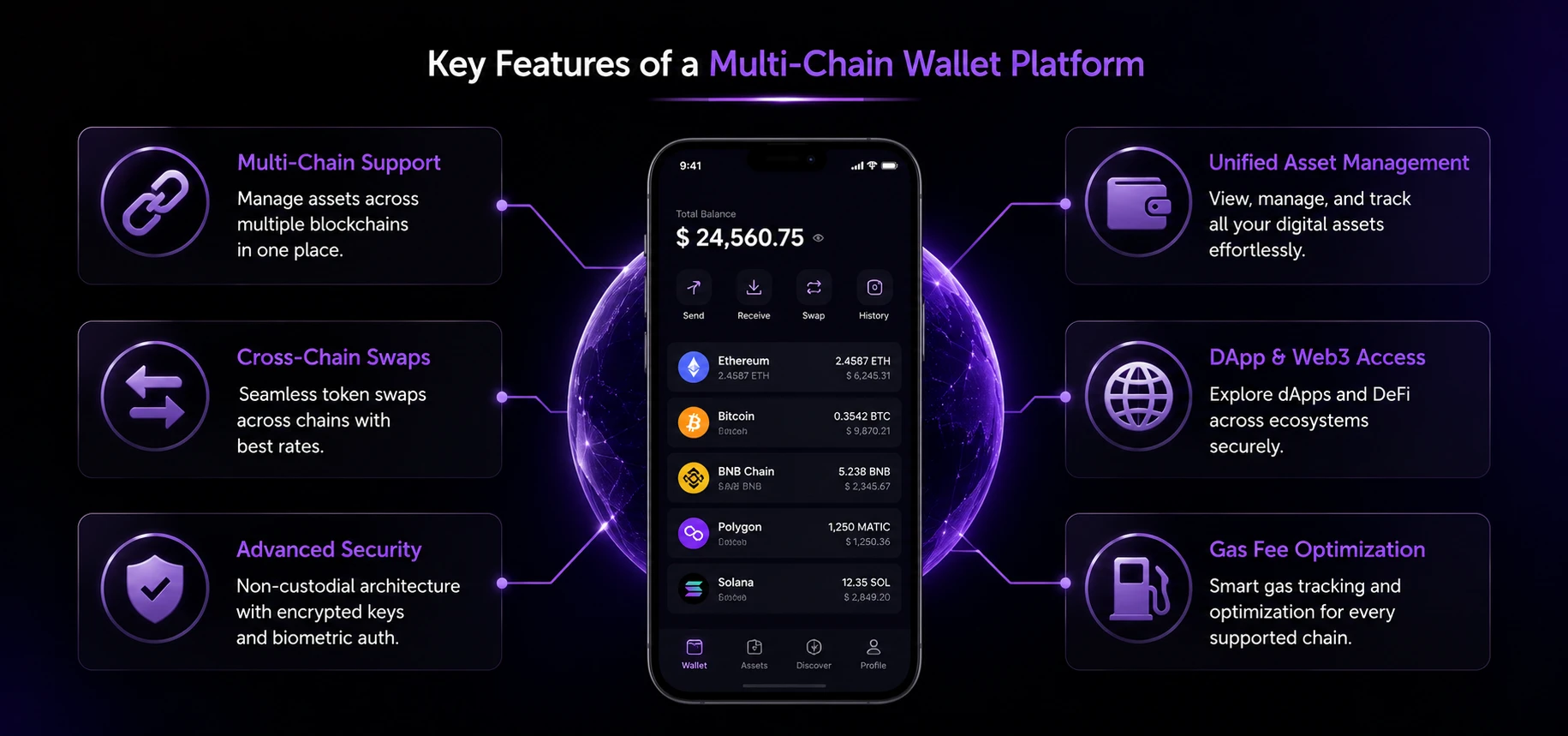
Users want to see a single balance view across all chains, not a separate tab for each network, and cross-chain swaps should happen within the wallet, not send users to an external bridge site.
- The development of multi-currency wallets fundamentally requires fiat on/off ramp and stablecoin support across networks.
- Native staking, lending & liquidity access without leaving the app
- Unified management of NFTs and tokens across chains with notifications for transactions, gas prices and your portfolio.
DeFi-integrated wallet that natively perform swaps and staking typically differentiate a daily-use platform from a dormant storage tool. But none of these capabilities work without correct pricing feeds and reliable routing, which are totally dependent on good cross-chain infrastructure behind the interface.
Multi-Chain Wallet App: Mobile, Web, and Browser Extension
Native iOS and Android offer the best access to secure enclave hardware. React Native or Flutter reduce cross-platform build time at some cost to integration. Browser extensions have the same backend functionality, but a different attack surface, as elevated page permissions make them a popular phishing target.
The most common friction points users face on any multi-chain wallet software, regardless of platform, are gas estimation across chains and network-switching UX. Some teams are working toward a broader Web3 super app approach that combines wallet, swap and dApp browser functions into one screen. This raises the bar significantly for design, QA and longer-term maintenance versus a narrower, single purpose wallet product built around a single core transaction flow and a much smaller feature set. Others license a white-label wallet and build their own feature layer on top.
Cost to Build a Multi-Chain Crypto Wallet
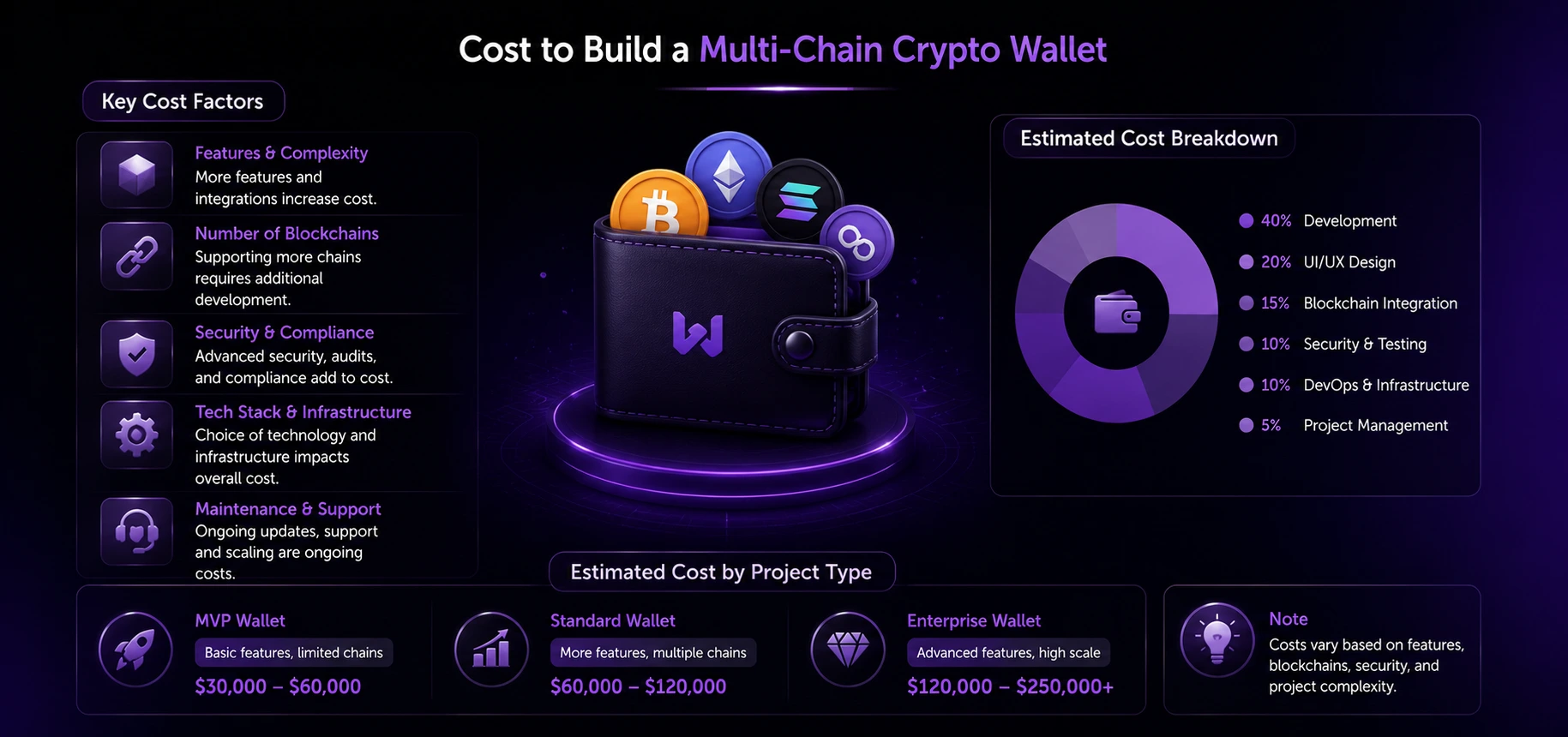
The costs are divided into categories of architecture, integrations, contract work, audits, and UI/UX. For a rough illustrative range, an MVP covering three to five EVM chains with basic send/receive typically costs in the low to mid five figures, while an enterprise wallet with fifteen or more chains, institutional custody, and a full audit cycle can cost well into six figures.
Chain count, custodian model, depth of DeFi, and audit scope are major cost drivers. Gas optimization adds to the engineering effort but reduces user friction in the long run, while disciplined smart contract development shrinks the audit surface and surfaces integration concerns before they reach an external reviewer. The build versus license conundrum is rarely settled for long. Grand View Research estimates the market at tens of billions of dollars, growing at a CAGR of over 25% through the early 2030s. A good crypto wallet development partner guides founders to make these decisions before they embark on a construction path that may outlive their needs within a year.
Timeline: From MVP to Enterprise Wallet
An MVP phase is two to three months and consists of three to five EVM chains with basic send/receive on a custodial or non-custodial paradigm. The four to six month growth phase includes support for Solana and Cosmos, DeFi integrations and in-wallet swaps.
The enterprise phase is 7-12 months and includes institutional custody wallet, MPC key management, compliance reporting and 15+ chains. These timescales are often extended by custom integrations and audit cycles. A multi cryptocurrency wallet development company with pre-built chain modules can accelerate each phase by reusing audited integrations instead of building from scratch.
Choosing a Multi-Chain Wallet Development Partner
Look for a partner with live production wallets on multiple chains, a documented audit history and real MPC and custodial experience, not just surface familiarity. Ask them how they do their security review. Is it in-house, outsourced, or a combination? Get details on their chain roadmap. The best partners offer battle-tested re-usable multi-chain crypto wallet development modules to help you avoid building each integration from scratch on your timeline.
The Bybit event, where attackers attacked a multisig signature interface instead of the underlying contract logic, is a reminder that wallet security goes beyond the contract layer and into the infrastructure a signer trusts; the technical postmortem is worth reading in its entirety. A good partner should explain how they would have detected something like this and that should be done before you sign a contract, not after a security incident exposes the gap.
Concluding Note
Multi-chain capability is no longer a differentiator, customers expect to move assets between networks without concern for the underlying technology. The winning platforms invest from the outset in security architecture and chain abstraction, not as a retrofit. The cost of getting multi-chain wallet development right now is much cheaper than fixing it later when real money is on the line. The teams that treat wallet infrastructure as a long-term product investment, not a one-off construct, will be the ones that people trust with their assets.
Frequently Asked Questions
1. What is multi-chain wallet development and why is it important?
Multi-chain wallet development results in wallets that can hold assets from Ethereum, Solana, Bitcoin, and L2s all in one interface. In an era of multiple networks, single-chain wallets aren’t an option anymore. The challenge is to deal with key derivation, chain compatibility and security in networks with different address formats and fee markets.
2. What custody models are available for a multi-chain wallet?
Custodial wallets, where the private keys are stored on the platform, non-custodial wallets, where users own their own keys, and MPC wallets, where signing power is distributed among multiple parties, so that no one device owns a full key. Custodial is for institutions that need help recovering, non-custodial is for privacy-minded retail customers, and MPC is the middle ground with distributed security.
3. How much does multi chain crypto wallet development cost?
The price of an MVP with 3 to 5 EVM chains and basic send/receive functionality is often in the low to mid five figures. A business wallet with 15+ chains, institutional custody and full audit cycles can easily be six figures. The most important cost drivers are chain count, custodial model, depth of DeFi integration and security audit scope.
4. What is the timeline from MVP to enterprise multi-chain wallet?
MVP phase is 2-3 months with basic send/receive on EVM chains. Expansion phase of 4-6 months with Solana, Cosmos, DeFi integrations & in-wallet swaps. The enterprise phase lasts seven to twelve months and incorporates institutional custody, MPC, compliance reporting and fifteen or more chains.
5. How do I choose a multi cryptocurrency wallet development company?
Look for production wallets that are live on multiple chains, have a documented audit history and real MPC and custodial competence. Ask whether the security review is in-house, outsourced, or both. The Bybit incident highlighted that wallet security is not only about contract logic but also about signature infrastructure. A reputable partner should be able to explain how their approach would detect similar attack routes.
