



Key Takeaways
- Advanced Regulatory Framework: Dubai combines legal recognition of tokenized property ownership with blockchain-integrated land registry infrastructure.
- Three Regulatory Authorities: A compliant platform requires coordination between VARA, DLD, and RERA for licensing, registration, valuation, and investor protection.
- Compliance-First Development: KYC/AML, investor classification, custody audits, property revaluations, and regulatory reporting must be built into the platform from day one.
- Development Cost: Costs may range from a few hundred thousand dirhams for a single-property pilot to seven figures for an enterprise-grade platform.
- Experienced Development Partner: A team experienced in VARA licensing, DLD integrations, and production-grade tokenization can reduce regulatory risk and time to market.
Introduction
Dubai is the first jurisdiction in the world to register tokenized property deeds directly with its land department, turning a regulatory pilot into working infrastructure. Understanding Dubai property tokenization regulations means understanding three separate authorities operating at once: the Virtual Assets Regulatory Authority (VARA), the Dubai Land Department (DLD), and the Real Estate Regulatory Agency (RERA). Each governs a different layer of the transaction, and none substitutes for the other two.
This guide covers the licensing pathway, compliance duties, platform development, and realistic cost ranges for entering the Dubai property tokenization market in 2026.
The Regulatory Framework: VARA, DLD, and RERA
DLD issues the Property Token Ownership Certificate, a record carrying legal weight comparable to a conventional title deed. It links each token directly to the underlying land registry.
Its Real Estate Tokenization Project, built with VARA, the Central Bank of the UAE, and the Dubai Future Foundation, has already synchronized blockchain settlement with official records through platforms operating in its sandbox.
How the Three Authorities Work Together
VARA governs the platform side. Any firm facilitating the buying, selling, or transferring of property tokens needs a Broker-Dealer license. Tokens backed by real property fall under VARA’s Asset-Referenced Virtual Assets classification.
RERA, a regulatory arm of DLD, handles property valuation, pricing verification, and investor disclosure before a unit is tokenized. Its role is detailed on the RERA portal.
Together, these three bodies anchor real estate tokenization regulations across the UAE, although the DLD registry link remains specific to Dubai. Building on blockchain infrastructure that can synchronize with official registries separates operational platforms from experimental ones.
Property Tokenization License Dubai: What You Need and What It Costs
VARA provides the licensing pathway for property tokenization platforms in Dubai. Becoming a Broker-Dealer is a two-step process:
- Initial Disclosure: Submit a disclosure questionnaire to Dubai Economy and Tourism or the relevant free-zone authority.
- Full Licensing: Receive approval to incorporate and complete the full VASP license application.
The journey from filing to operational approval can take several months. Capital requirements may range from AED 400,000 to AED 600,000 depending on custody arrangements. Businesses must also budget for application and annual supervision fees. These recurring costs are important for firms managing broader fintech compliance obligations.
This process operates alongside DLD registration. Every property uploaded to a platform requires independent approval, while RERA must certify its valuation before listing.
Dubai is more complex to administer than a single-regulator market because fees and approvals are layered across all three authorities. However, the system gives investors legal certainty backed by an official registry. DLD explains this framework on its tokenization service page.
Dubai Property Tokenization Compliance: Investor Protection and Ongoing Obligations
Platforms need to classify investors correctly. Retail investors may participate at modest minimum thresholds, while larger structured offerings may require qualified-investor treatment.
Before a sale begins, platforms must disclose:
- Property valuation and supporting documentation.
- Investment and ownership risks.
- Token economics and distribution terms.
- Redemption, transfer, and exit conditions.
Getting the underlying regulatory-compliant token design right from the beginning can prevent expensive changes later.
Compliance obligations continue after onboarding. Custody requires periodic audits, properties need scheduled revaluations, and investors require ongoing reports covering rental distributions and ownership changes.
Investor onboarding and compliance reporting should operate as continuous infrastructure aligned with VARA’s licensing rulebooks.
Property Tokenization Platform Development Dubai: Technology and Features
A compliant property tokenization platform needs four connected components:
- Token Issuance Engine: Creates and manages fractional property tokens and ownership records.
- Investor Interface: Supports onboarding, portfolio tracking, documents, payments, and distributions.
- Compliance Layer: Handles KYC/AML, eligibility checks, transfer controls, and reporting.
- Custody Integration: Secures investor assets and connects regulated custody workflows.
These modules must connect seamlessly with DLD’s registry and VARA’s reporting requirements. Dubai’s registry integration differs from generic tokenization because tokens are connected to an official land database rather than existing only on-chain.
Smart contract development supports fractional ownership, automated rental distributions, lock-in periods, and secondary trading without unnecessary manual intermediaries.
Build vs. White-Label for Dubai Market Entry
The UAE’s investor base is smartphone-first, making mobile user experience critical to adoption. Early demand has largely come through app-based onboarding, as Ledger Insights noted when the first DLD-backed platform went live.
Teams must choose between a custom build and a white-label platform. White-label tokenization can reduce time to market, but only when the vendor’s compliance and secondary marketplace tooling maps to DLD and VARA requirements. Platforms targeting larger allocators also need reliable institutional custody.
Property Tokenization Platform Cost Dubai: Budgeting for 2026
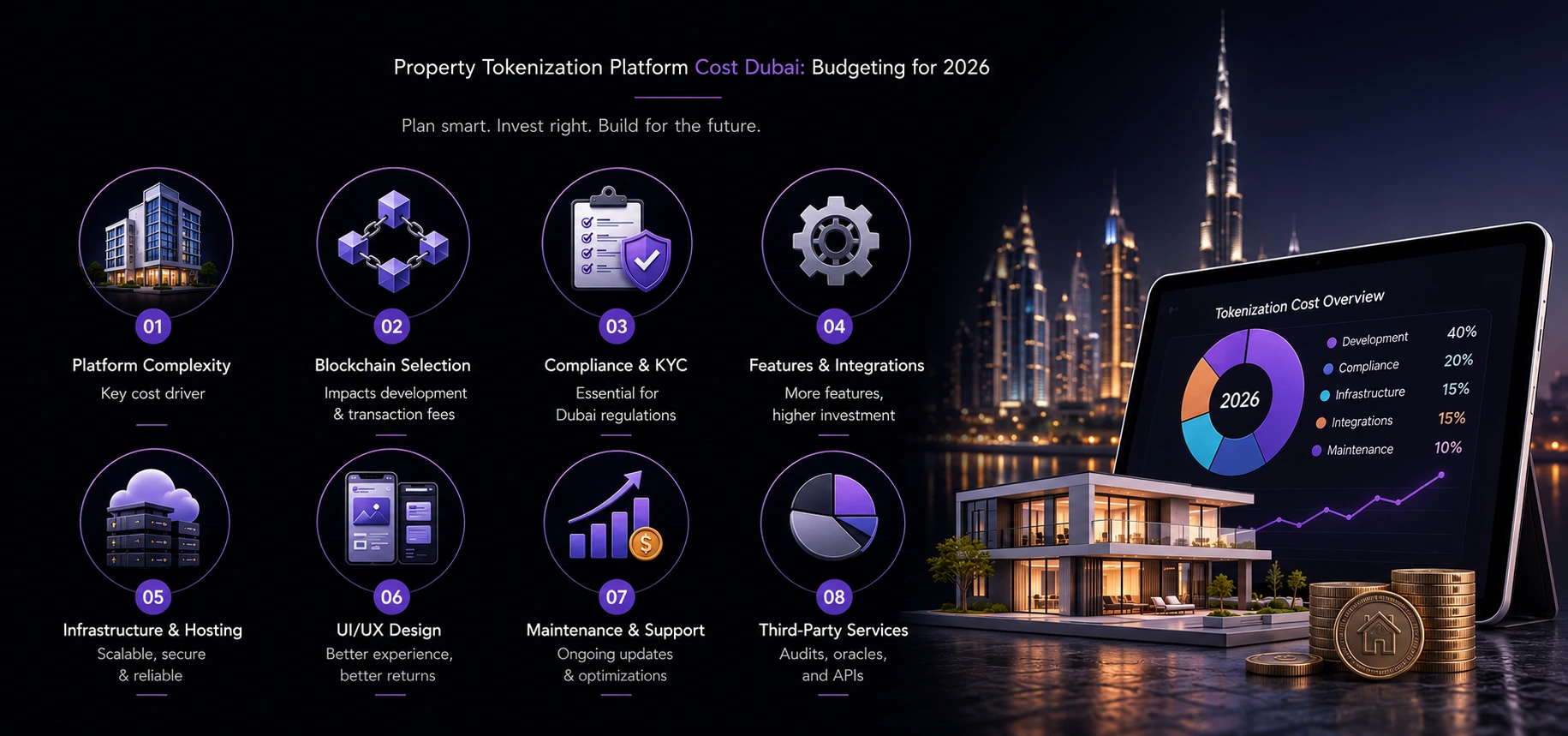
A Dubai property tokenization budget should include separate line items for:
- VARA licensing and capital reserves.
- DLD registration for each property.
- Compliance, identity verification, and KYC tooling.
- Core platform and application development.
- Custody and wallet infrastructure.
- Security testing and smart contract audit work.
| Platform Scope | Typical Cost Range | Common Inclusions |
| Single-Property Pilot | A few hundred thousand AED | Existing infrastructure, basic onboarding, token issuance, and limited integrations |
| Multi-Property Platform | Seven figures or more | Marketplace, custody, compliance automation, advanced reporting, and cross-border capabilities |
A platform supporting multiple properties, its own secondary marketplace, custody, and cross-border distribution can easily reach seven figures when licensing and legal structuring are included. These figures are broad estimates rather than fixed quotations.
Scale is a major cost driver. Important factors include the number of properties, investor volume, in-house versus outsourced custody, integrations, and international distribution plans.
Ongoing costs are equally important. These include license renewals, compliance staff, property revaluation cycles, security updates, and repeat audits after material platform changes.
A white-label build is often cheaper initially, but it may reduce control over the compliance stack. Broader asset tokenization cost patterns are similar, although Dubai’s multi-regulator structure creates additional coordination overhead.
Choosing a Property Tokenization Development Company Dubai
Choose a development partner based on relevant regulatory and technical experience rather than general blockchain capability.
Look for:
- Proven VARA license experience.
- A history of DLD system and registry integration.
- Smart contracts deployed in production, not only on testnets.
- Established custody and compliance partners.
- Arabic-language compliance and investor documentation support.
- Post-launch regulatory, security, and platform maintenance.
Local experience matters because regulatory relationships, Arabic-language documentation, and knowledge of DLD registry APIs can accelerate clearance for property and other asset tokenization implementations.
Before signing a contract, ask how many property tokenizations the team has completed, who its custody partners are, and what post-launch compliance support includes once properties begin generating rental income.
A Dubai-focused development firm with proven deployments and a broader RWA tokenization platform practice can reduce regulatory risk more effectively than a vendor treating tokenization as a generic add-on.
Concluding Note
Dubai’s regulatory framework for property tokenization is among the most mature globally. However, businesses must coordinate VARA, DLD, and RERA requirements simultaneously rather than dealing with a single gatekeeper.
Successful platforms treat compliance as core infrastructure, not as something added shortly before launch. Licensing, registry integration, investor onboarding, custody, smart contracts, reporting, and security must work as one connected system.
Frequently Asked Questions
1. What are Dubai property tokenization regulations and which authorities govern them?
Dubai’s property tokenization framework involves three authorities. VARA licenses the platform through a Broker-Dealer license. DLD issues the Property Token Ownership Certificate and connects tokens with the land registry. RERA oversees property valuation and investor disclosures. A compliant platform must satisfy all three authorities.
2. How do I obtain a property tokenization license in Dubai?
The licensing pathway starts with a VARA Broker-Dealer application. It includes an initial disclosure questionnaire, approval to incorporate, and the full VASP licensing process. Capital requirements may range from AED 400,000 to AED 600,000. DLD registration and RERA valuation proceed alongside platform licensing, and every property requires separate clearance.
3. What does Dubai property tokenization compliance require after launch?
Post-launch compliance includes KYC/AML checks, investor classification, segregated client funds, custody audits, recurring property valuations, and ongoing reporting covering rental income and ownership changes.
4. How much does a property tokenization platform cost in Dubai in 2026?
A single-property pilot built on existing infrastructure may cost a few hundred thousand dirhams. A multi-property platform with a secondary marketplace, custody, and cross-border distribution can cost seven figures or more. Final costs depend on licensing, registration, compliance, platform scope, integrations, and security audits.
5. How do I choose a property tokenization development company in Dubai?
Look for experience with VARA licensing, DLD integration, production-ready smart contracts, regulated custody, and post-launch compliance. Local knowledge and Arabic-language documentation support can also reduce approval delays and operational risk.
