



Key Takeaways
- Core Healthcare Infrastructure: AI patient scheduling is becoming essential healthcare infrastructure in Saudi Arabia, helping hospitals reduce wait times, improve resource utilization, and support the Kingdom’s Vision 2030 digital transformation goals.
- Smarter Appointment Management: Predictive scheduling, no-show risk scoring, and real-time rescheduling help hospitals optimize clinician availability, maximize appointment capacity, and improve patient flow across large healthcare networks.
- Integrated AI Architecture: Successful deployments rely on deep integration with HIS, EMR, and national health platforms, supported by Arabic-language AI, custom LLMs, multi-agent orchestration, and federated learning architectures.
- Compliance and Governance: Compliance with Saudi PDPL, MOH guidelines, and AI governance frameworks requires secure data handling, model transparency, continuous monitoring, and auditable decision-making.
- Foundation for Smart Hospitals: As smart hospitals evolve, AI scheduling will extend beyond appointment management to support predictive care, hospital command centers, and AI-powered patient engagement across the Kingdom.
Introduction
Hospitals in Saudi Arabia are under different pressures compared to most healthcare systems. Vision 2030 has boosted capacity and patient numbers across the Kingdom, and administrators can no longer manage this growth with paper-based lines or first-generation digital booking technologies.
AI patient scheduling software has progressed from a pilot project to operational infrastructure in MOH digital projects, the SEHA Virtual Hospital network, and a growing number of smart hospital deployments nationally. In this blog, we examine how the system works, what Saudi hospitals monitor after deployment, the technology stack behind it, and the legislative barriers to adoption.
Saudi Arabia’s Healthcare Transformation: Vision 2030 and the Digital Mandate
Saudi Vision 2030 healthcare objectives include greater private-sector involvement, increased hospital bed capacity, and a digital-first patient experience across the Kingdom. The Health Sector Transformation Program seeks to improve healthcare access and quality by strengthening primary care, hospital services, emergency response, and digital transformation.
The Ministry of Health’s digital efforts now extend to almost every touchpoint between patients and providers. The most visible example is SEHA Virtual Hospital, which the Ministry of Health says has been recognized by Guinness World Records as the world’s largest virtual healthcare provider, connecting more than 240 hospitals through algorithmic triage.
Digital health transformation in Saudi Arabia is gaining speed, and hospital IT leaders increasingly treat scheduling automation as foundational AI agent development work. It must integrate with triage and referral systems at the national level as part of a broader category of AI healthcare solutions designed around how Saudi hospitals operate.
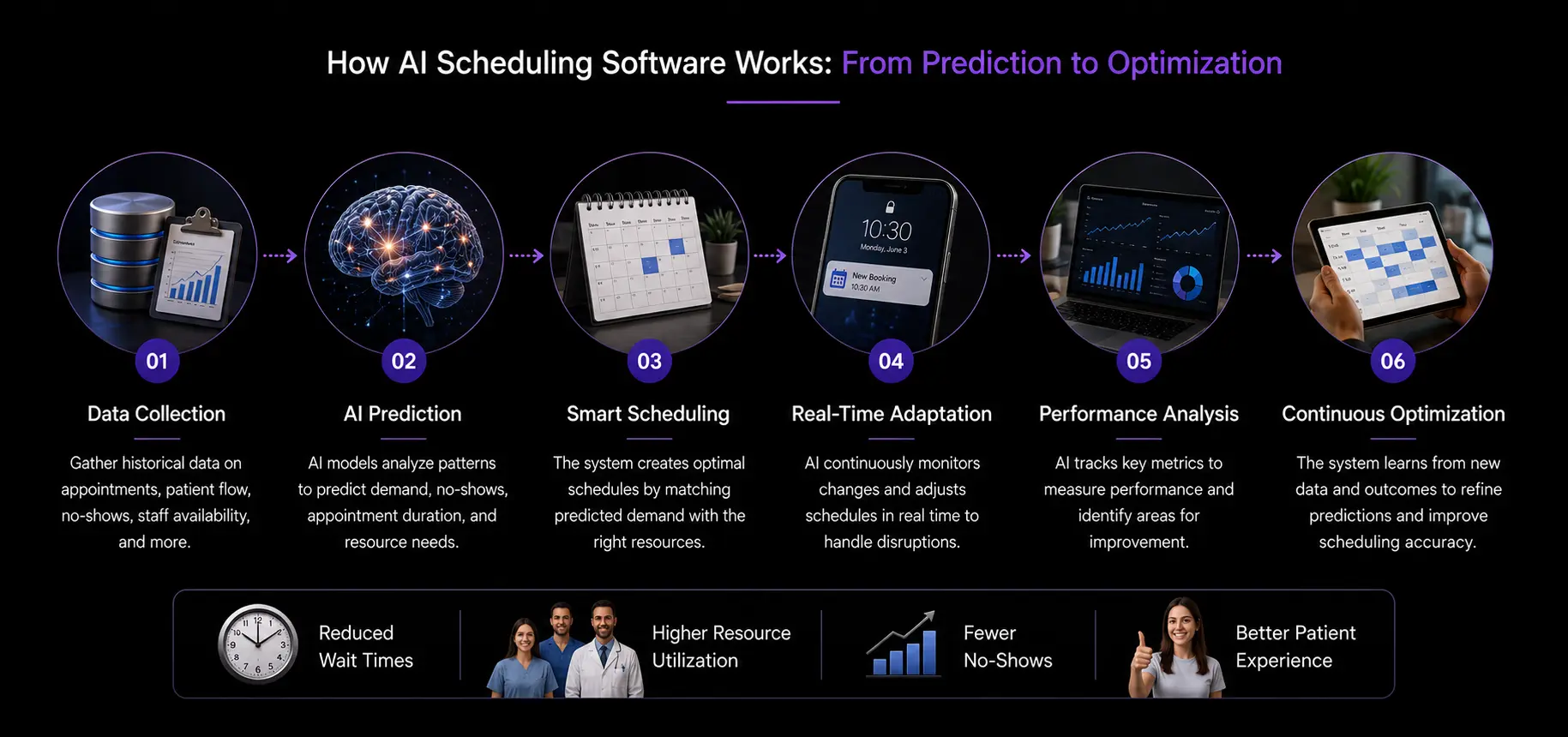
How AI Scheduling Software Works: From Prediction to Optimization
AI scheduling uses multiple layers of prediction rather than a single algorithm. Appointment-demand forecasting estimates how many patients a specialty may receive during the coming week based on seasonal trends and historical clinic data. Doctor-availability prediction evaluates clinician schedules and expected consultation lengths to prevent overbooking.
No-Show Risk Scoring and Real-Time Rescheduling
A retrospective cohort study published in BMC Health Services Research found that an AI-assisted scheduling and triage tool significantly decreased patient wait times and outpatient procedure costs compared with traditional booking.
Patient no-show risk scores identify appointments that a patient is statistically unlikely to attend. The system uses anomaly detection algorithms to identify bookings that deviate from a patient’s normal attendance pattern, allowing hospitals to offer the slot to someone on the waiting list before it goes unused.
Real-time rescheduling automatically backfills the queue within minutes of a cancellation. AI clinical workflow optimization can use the same engine to improve staff rostering and room allocation across the department.
Hospital Operational Impact: Wait Times, Resource Allocation, and Patient Flow
Measurable outcomes make this technology defensible to hospital boards, not merely attractive to IT teams. Research on AI adoption across GCC smart hospitals notes that the SEHA network’s scale, spanning more than 220 facilities, depends on automated coordination at this level.
Saudi hospitals typically track the following operational metrics after deploying AI scheduling:
- Average Patient Wait Time: Predictive booking helps patients arrive closer to their appointment time instead of waiting in a physical queue. Algorithmic triage can also direct patients to the appropriate specialist before they arrive, reducing front-desk bottlenecks.
- Clinic Utilization Rate: AI coordinates appointment length, clinician pace, and room capacity to reduce idle slots and increase the number of patients served without adding clinician hours.
- Resource-to-Acuity Matching: Healthcare resources are allocated by matching patient acuity with clinician seniority. Complex patients can be assigned to specialists, while routine follow-ups can be handled by junior clinicians. Much of this coordination can run through the same AI automation systems used for reminders and intake forms.
- Staff Overtime Reduction: Reduced idle time, faster cancellation backfilling, and better asset utilization help clinicians finish closer to schedule and reduce avoidable overtime.
AI-Powered Patient Management: Beyond Scheduling to Predictive Care
Scheduling is not simply an administrative task. It is a key component of a larger predictive ecosystem. Predictive healthcare analytics can identify patients who need proactive follow-up based on visit history or chronic-condition markers before their condition worsens.
AI-powered patient management feeds these insights directly into the booking engine. The same predictive analytics solutions that estimate individual patient risk can forecast seasonal demand surges, allowing hospitals to staff clinics in advance.
SEHA Virtual Hospital also demonstrates how automated appointment scheduling can combine primary care, specialist referrals, and diagnostic testing into one coordinated process. This requires disciplined ML pipeline development designed for Saudi population health data because demand patterns and no-show rates differ from datasets generated by other healthcare systems.
Technology Stack: Building AI Scheduling for Saudi Hospitals
Deployment begins with integrating data from existing hospital information systems and electronic medical records. It may also require connections to national platforms such as Sehhaty so scheduling decisions remain aligned with the patient’s complete record.
Model development often combines supervised learning for demand prediction with natural language processing for patient-intent classification. Arabic-language interactions require special attention because phrasing differs by region. Custom LLM development enables more natural voice- and text-based appointment scheduling in Arabic.
Multi-Agent Orchestration, Deployment, and Federated Learning
In large hospital networks, multi-agent orchestration is increasingly used to manage complex referrals across primary, secondary, and tertiary care. Rather than relying on one system to perform every task, separate agents can handle triage, specialist matching, and appointment confirmation sequentially.
Decisions about on-premise versus cloud infrastructure must account for Saudi data-residency rules. These requirements influence the model deployment architecture before model training begins.
Federated learning allows multiple hospitals to train shared scheduling models without consolidating patient data in one central location. This architecture is particularly relevant for multi-hospital networks such as SEHA.
Voice AI: The Next Layer in Patient Access
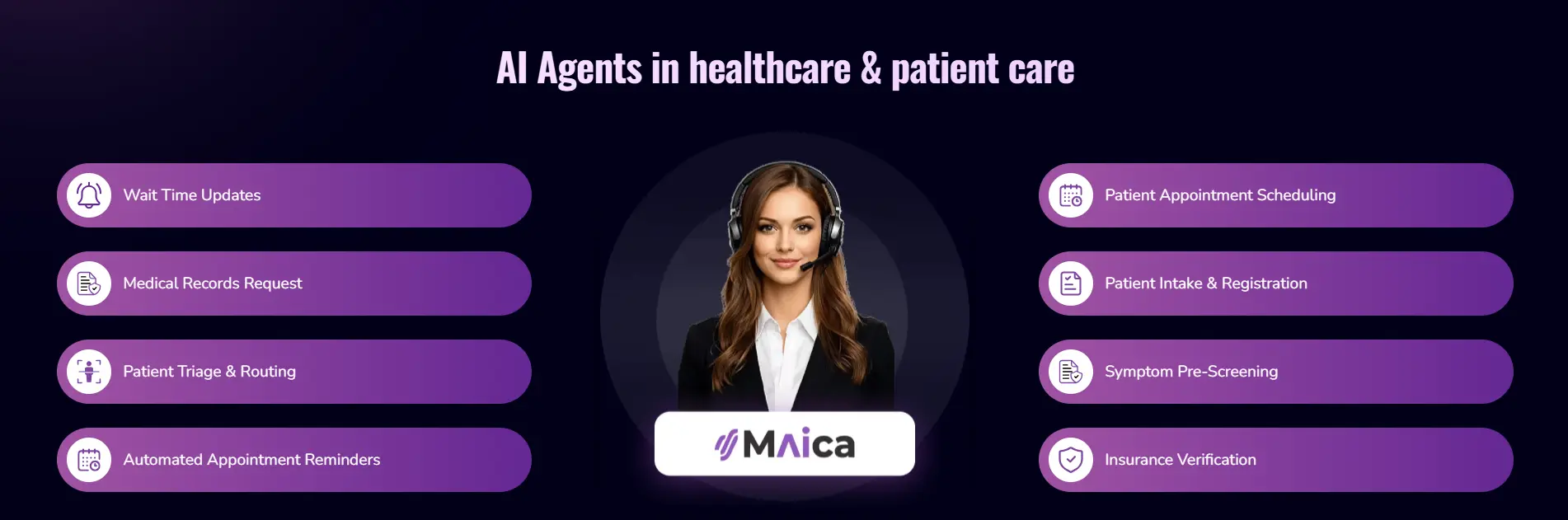
Beyond text-based scheduling and chatbots, voice-enabled AI agents are becoming a practical front-end for Saudi hospitals managing high call volumes. Maica, Techfyte’s voice agent platform, handles patient inquiries, appointment booking, and multilingual support across phone and web channels with near-human latency; capabilities that apply directly to hospital scheduling workflows where patients still prefer calling over using an app. While Maica serves multiple industries including education and retail and e-commerce, its healthcare application is particularly relevant here: automating appointment confirmation calls, answering frequently asked questions about clinic hours and preparation instructions, and routing complex inquiries to the right department without patients waiting on hold.
Maica also integrates directly with existing CRM systems, logging every patient interaction: calls, bookings, confirmations, and follow-ups, into the hospital’s patient management platform so that scheduling data flows into the same system clinicians and administrators already use rather than sitting in a separate voice silo. For Saudi hospitals implementing AI scheduling, a voice layer that connects with both the booking engine and the CRM closes the gap between patients who self-serve online and those who pick up the phone.
Regulatory Alignment: MOH Guidelines, Data Privacy, and AI Governance
The Health Sector Transformation Program defines the digital-health standards suppliers must address, while the Personal Data Protection Law governs how patient data can be processed and used to train AI systems.
Saudi Arabia’s PDPL strengthens protections for sensitive categories such as health data. Certification, secure data handling, and documented controls are becoming important factors when hospitals assess whether an AI system meets local requirements.
AI Governance, Sandbox Testing, and Model Maintenance
If a scheduling algorithm unintentionally deprioritizes a group of patients, the issue becomes both clinical and regulatory. Model explainability, bias monitoring, human oversight, and auditable decision-making are therefore becoming standard requirements before production deployment.
Automated retraining keeps models current as referral patterns change and new hospitals join the network. Saudi healthcare innovation sandboxes allow emerging technologies to be tested under controlled conditions before wider implementation. SEHA Virtual Hospital also functions as an incubator for AI, IoT, biotechnology, and related health innovations.
The Future: AI Scheduling as the Backbone of Smart Hospitals
AI scheduling is increasingly becoming a connecting layer for hospital command centers and real-time operational dashboards rather than a standalone booking system. Demand-prediction models originally built for appointment scheduling can also help hospitals plan capacity and deploy staff.
Enterprise AI assistants are beginning to reduce clinicians’ administrative burden by processing documents and handling routine queries that previously consumed time better spent on patient care.
As regulatory scrutiny of automated healthcare decisions grows, AI and blockchain can work together to create immutable audit trails for scheduling decisions. Hospitals may need to retain records showing who was prioritized, who was placed on a waitlist, and the reasoning behind each decision.
Neuro-symbolic AI, which combines clinical guidelines with machine learning, can help hospitals produce scheduling rationales that are easier to explain to patients, clinicians, and regulators.
Conclusion
AI scheduling in Saudi healthcare is one of the fastest-return AI applications. It can reduce patient wait times, improve resource utilization, and support Vision 2030’s digital-health ambitions.
Hospitals implementing AI patient scheduling software today are building the operational foundation that smart hospitals across the Kingdom will depend on as demand increases.
The strongest solutions will combine predictive scheduling, Arabic-language interfaces, HIS and EMR integration, secure deployment, continuous model monitoring, and compliance-focused governance. Together, these capabilities can transform scheduling from a basic booking function into an intelligent patient-flow system.
Frequently Asked Questions
1. How does AI patient scheduling software reduce hospital wait times in Saudi Arabia?
AI patient scheduling software optimizes appointment slots in real time by predicting demand, doctor availability, and no-show risk. Algorithmic triage directs patients to the appropriate specialist before arrival, while automated rescheduling fills cancelled slots quickly. Together, these capabilities reduce waiting and improve clinic utilization.
2. How does Saudi Vision 2030 healthcare support AI adoption in hospitals?
Saudi Vision 2030’s Health Sector Transformation Program promotes a digital-first patient experience and improved healthcare access. Ministry of Health initiatives, national digital platforms, and the expansion of SEHA Virtual Hospital make AI-enabled coordination an important part of the Kingdom’s healthcare transformation.
3. What operational metrics do Saudi hospitals track after deploying AI scheduling?
Hospitals commonly track average patient wait time, clinic utilization, resource-to-acuity alignment, cancellation backfill rates, and staff overtime. These metrics show whether AI scheduling is improving patient flow and hospital operational efficiency.
4. What technology stack is required for AI scheduling in Saudi hospitals?
The stack typically includes HIS and EMR integration, demand-forecasting models, Arabic-language NLP, custom LLMs for voice and text interactions, multi-agent orchestration for referrals, secure model deployment, and federated learning for cross-hospital model training.
5. How does Maica support voice-based patient scheduling in Saudi healthcare?
Maica handles patient questions, appointment booking, confirmations, and multilingual support across phone and web channels. It can answer common questions, automate reminder calls, and route complex cases to the correct department, helping hospitals serve patients who prefer voice-based access.
