



Key Takeaways
- The UAE has become one of the world’s leading markets for crypto payment gateways, supported by a maturing regulatory framework from VARA, the UAE Central Bank, ADGM, and federal authorities.
- Selecting the right payment gateway requires evaluating licensing, settlement infrastructure, blockchain support, security, and integration capabilities, rather than focusing solely on transaction fees.
- Licensed exchanges, fintech infrastructure providers, and custom development companies each serve different business needs, from merchant checkout solutions to enterprise treasury and cross-border settlements.
- Compliance is a competitive advantage, with successful providers offering built-in KYC/AML, stablecoin settlement, institutional custody, sanctions screening, and multi-chain payment support.
- Businesses should choose a gateway partner that aligns with their long-term roadmap, balancing regulatory expertise, technical scalability, and seamless integration with existing e-commerce and financial systems.
Introduction
As VARA and the UAE Central Bank finalize a maturing regulatory framework, e-commerce merchants and fintech founders across the Emirates are actively evaluating crypto payment gateway development companies to accept digital assets alongside traditional cards. A crypto payment gateway sits between a merchant’s checkout and the blockchain, converting incoming crypto or stablecoins into fiat (or vice versa), settling funds to a merchant account, and processing the underlying blockchain transaction securely. With Dubai and Abu Dhabi positioning themselves as global virtual-asset hubs, the market has attracted both established regional fintechs and newer specialists. This guide profiles ten UAE-based providers building crypto payment infrastructure in 2026, spanning licensed exchanges, embedded-payments APIs, and bank-grade stablecoin rails, along with what to weigh before choosing one for your own checkout or treasury stack.
What to Look for in a Crypto Payment Gateway Provider
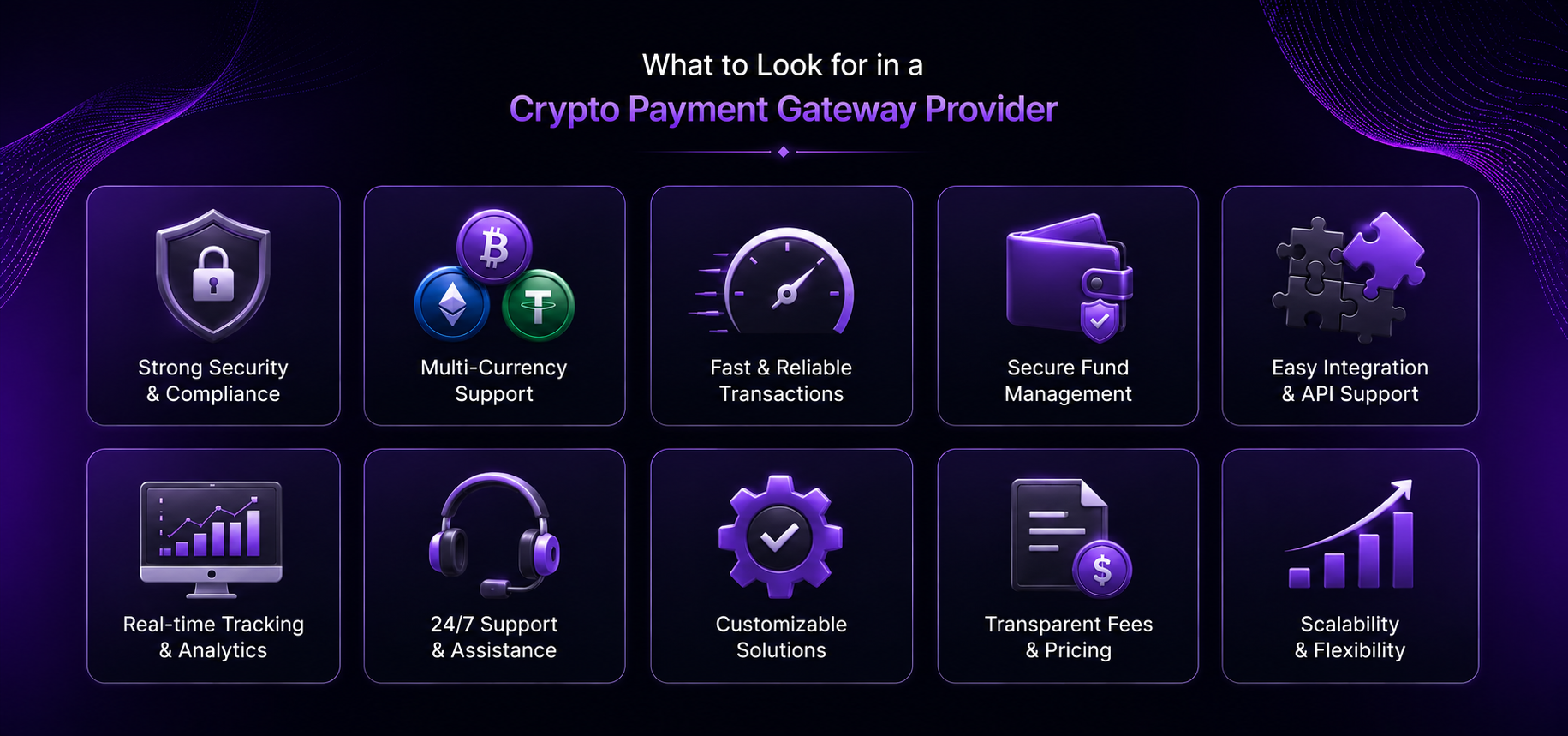
Regulatory compliance comes first: a provider should hold, or operate under, a VARA license or UAE Central Bank payment service provider authorization, since unlicensed crypto payment activity is prohibited onshore. Technical capability matters next — check which blockchains and stablecoins are supported, how quickly transactions settle, and whether fiat conversion happens automatically at checkout. Security posture is equally important, since a checkout handling live customer funds cannot afford weak controls; ask whether the provider has undergone independent smart contract audit, holds certifications aligned with PCI DSS standards for card-adjacent flows, and uses institutional-grade key management. Integration ease varies too: mature providers publish clear API documentation and plugins for Shopify, WooCommerce, and Magento, so developers can go live without rebuilding checkout from scratch. Weigh crypto payment gateway development cost against transaction fees, settlement currency options, and support responsiveness — the best crypto payment gateway providers differentiate less on price and more on compliance depth, settlement reliability, and how transparently they disclose licensing status.
The 10 Companies
1. Techfyte
Techfyte provides end-to-end cryptocurrency payment gateway development services for businesses in UAE and globally, with a custom checkout infrastructure that allows for multi-chain settlement on major networks and stablecoins. We are a crypto payment gateway development company with deep UAE regulatory expertise that helps businesses launch compliant payment gateways based on the volume of transactions, checkout stack, and industry vertical (from e-commerce plugins to full treasury with fiat settlement rails).
Searching for a Company to Develop Your Crypto Payment Gateway?
2. Pyypl
Pyypl is a MENA-focused fintech offering a multi-currency digital wallet, prepaid Visa cards, and cross-border payment rails, with crypto-funded top-ups available through partner wallets like Trust Wallet. Based in Abu Dhabi’s ADGM, the company holds PCI DSS V4.0 certification and a Visa Principal Membership, and has processed transactions for more than a million users. Its UAE registration and payment infrastructure make it a practical on-ramp for merchants adding crypto acceptance alongside traditional card processing.
3. CoinMENA
CoinMENA holds a VARA broker-dealer license and operates as a Sharia-compliant digital asset exchange, giving UAE clients instant AED deposits and withdrawals. Its 2025 partnership with UAE digital bank Zand links customer bank accounts directly to CoinMENA wallets for fiat-to-crypto and stablecoin conversion, while BitGo custody backs institutional holdings with substantial cold-storage insurance. Based in Dubai with direct UAE bank integrations, CoinMENA provides a regulated bridge between traditional finance and digital asset payments.
4. BitOasis
Founded in 2015, BitOasis was the Middle East’s first regulated crypto exchange and now holds a full VARA VASP license. Headquartered in Dubai, it supports AED deposits and withdrawals through local banks, offers an OTC desk for high-volume transactions, and trades more than 70 digital assets. CoinDCX acquired the platform in 2024, extending its distribution across MENA while maintaining its UAE-based operations and licensing.
5. Fuze Finance
Fuze pairs a VARA broker-dealer license with a UAE Central Bank Retail Payment Services and Card Schemes license, letting banks, fintechs, and merchants embed crypto trading, custody, and payment collection through a single API. Dubai-based and dual-licensed, its stack supports stablecoin development for settlement, virtual IBANs, and card payments for regulated businesses, positioning Fuze as a single infrastructure layer for both crypto and fiat rails.
6. Rain
Rain is licensed by the Central Bank of Bahrain and has a Financial Services Permission from Abu Dhabi Global Market. It caters to traders and enterprises in the Gulf. The ADGM-registered exchange is also known for its zero-fee spot trading and stablecoin-linked Visa card products, giving UAE retailers a locally permitted on- and off-ramp for accepting crypto payments.
7. Fasset
Fasset is a broker-dealer licensed by the VARA and concentrates on practical digital asset applications such as tokenized commodities, precious metals and stablecoins. Its licensing model connects GCC markets with remittance corridors in Indonesia, Malaysia, Bangladesh and Pakistan and is well suited for platforms requiring cross-border settlement and acceptance of crypto payments.
8. MidChains
MidChains is an Abu Dhabi Global Market-approved digital asset exchange backed by Mubadala. It was created to provide regulated custody and trading infrastructure to institutional and retail clients across the UAE. Based in Abu Dhabi and backed by sovereign-linked backing, it offers merchants and payment integrators a well-capitalised settlement partner for AED and stablecoin transactions.
9. M2
M2 is a virtual asset platform based in Abu Dhabi with full licensing by VARA and an ADGM Financial Services Permission. They provide institutional and retail crypto trading and regulated custody infrastructure. It has integrated a fiat on/off-ramp for enterprises to accept cryptocurrency payments, with settlement backed by ADGM-licensed custody. Being regulated in both Dubai and Abu Dhabi makes M2 one of the few providers able to operate in all of the UAE without further licensing.
10. Crypto.com (Foris DAX Middle East)
Crypto.com’s UAE business has a VARA license and will be the first VASP to receive a Stored Value Facilities license from the UAE Central Bank in 2026. Onboarded users can utilize virtual assets for government fees with a Dubai-registered company and new cryptocurrency payment integrations with Emirates Airlines and Dubai Duty Free are on the horizon. This makes it the largest globally scaled provider with dedicated licensing in the UAE.
Crypto Payment Gateway UAE: Regulatory Landscape in 2026
VARA licenses virtual asset activity in Dubai in categories such as exchange, broker-dealer, custody and payments and remittance services, while the UAE Central Bank’s Payment Token Services Regulation oversees dirham-referenced stablecoins and payment tokens countrywide. UAE providers’ crypto payment gateways require the appropriate VARA license or CBUAE authorization before processing customer cash and algorithmic stablecoins and privacy tokens are explicitly prohibited from being used as payment. The federal Capital Market Authority has also added oversight to VARA and ADGM since January 2026. So a crypto payment gateway in the UAE serving multiple emirates has to navigate the licensing requirements of the mainland, free-zone and federal authorities. Also, it must not assume that one approval means the entire country is covered. This structure is important for merchants to validate that a provider’s fintech solutions include local settlement, sanctions screening and AML monitoring, as opposed to a generic global compliance template designed for a different jurisdiction altogether. It is also interesting to consider how the regulatory compliance criteria of a provider apply to any stablecoin design used for settlement, since the PTSR handles fiat-referenced tokens differently than generic virtual assets.
Need a Payment Gateway Built Around Your Business Model?
How to Choose the Right Crypto Payment Gateway Provider
Your transaction profile dictates the kind of provider you’ll need: B2B settlement at high volumes favors providers with strong liquidity and OTC support, while consumer checkout needs fast on-chain confirmation and stablecoin conversion. Is an off-the-shelf gateway sufficient, or does your roadmap require a dedicated crypto exchange development tailored to your product, rather than a generic template attached to an existing checkout process.
However, some organizations need a branded venue on which they can allow their own users to trade and for these a white-label exchange may be preferable to a simple payment plug-in. Be sure you understand the custody model, conversion spreads, chargeback management and SLA commitments before you sign. If you are running cross-chains, ensure the supplier supports multi-chain wallets as limited chain coverage can quietly deter customers with assets on networks not recognized by the gateway. Add to this check at the provider’s cross-chain liquidity access as these factors influence the settlement speed and the assets range clients can pay for.
Concluding Note
The regulatory clarity from VARA and the Central Bank is pushing crypto payment gateways out of the early-adopter novelty and into the mainstream merchant infrastructure, with providers ranging from licensed exchanges to bank-grade stablecoin issuers. Market data shows this trend is most pronounced in smaller, every-day merchant transactions. Your transaction volume, regulatory needs, settlement currencies supported, and how well the gateway integrates with your existing checkout and treasury systems will all determine the right partner. Choosing the right Crypto Payment Gateway Development Companies in UAE requires merchants to look for a balance between technical expertise and regulatory compliance, which is the most reliable path to a successful deployment.
Frequently Asked Questions
1. What are crypto payment gateway development companies in the UAE?
These crypto payment gateway development companies build checkout infrastructure for retailers to accept digital materials along with regular payments. UAE-based services, like Techfyte and Fuze Finance, use the licensing of VARA or Central Bank to enable multi-chain settlement, stablecoin conversion and fiat off-ramp integration for transaction compliance.
2. How do I choose a crypto payment gateway UAE provider?
Check out the provider’s VARA license or authorization from the UAE Central Bank to make sure that it is compliant with regulations. Think support for blockchains, settlement speeds, fiat conversion options and integrations with platforms like Shopify and WooCommerce. The top-cryptocurrency payment gateway companies compete based on the depth of compliance, the reliability of settlement not on price alone.
3. What is the crypto payment gateway development cost in 2026?
In 2026, the development cost of a cryptocurrency payment gateway is contingent on the supporting blockchains, custody mechanism, fiat conversion requirements, and regulatory scope. Out-of-the-box gateway integrations are cheaper than building custom and supporting multiple chains for some checkout stacks. Smart contract auditing and regulatory compliance also adds to the price.
4. What regulations apply to a crypto payment gateway in the UAE?
Rules for crypto payment gateway in UAE Crypto payment gateways in the UAE need to get a VARA license (Dubai) or ADGM Financial Services Permission (Abu Dhabi) and get approval from the UAE Central Bank under the Payment Token Services Regulation. Since January 2026, the federal Capital Market Authority has introduced another layer of control, and providers operating across different emirates have to reconcile mainland, free zone and federal rules.
5. What crypto payment gateway development services should I look for?
Essential crypto payment gateway development services include multi-chain wallet support, stablecoin settlement, fiat on/off-ramp integration, and API documentation for major e-commerce platforms. For custom needs, look for providers offering white-label exchange development, cross-chain liquidity access, and post-launch compliance support tailored to UAE regulatory requirements.
Ready to Develop Your Own Crypto Payment Gateway?
