



Key Takeaways
- Increasing concerns around asset ownership, exchange risks, and centralized control are driving users toward self custodial crypto wallets in the USA for greater financial independence.
- The rise of tokenized real-world assets (RWAs), including U.S. equities and other financial instruments, is creating new opportunities for blockchain-based investment and ownership.
- Self-custody is expected to play a key role in connecting traditional finance with Web3 through stablecoins, decentralized applications, and on-chain financial services.
- Users and businesses need secure wallet solutions that balance ownership, ease of use, regulatory requirements, and strong asset protection.
Introduction
Concerns regarding managing digital assets through centralized platforms have been persisting over the years. Account restrictions, security breaches and limited access to global investment opportunities are driving a shift towards self custodial crypto wallets.
The rise of tokenized real-world assets, stablecoins and Web3 is opening new opportunities to access U.S. financial markets without relying on traditional financial intermediaries. Custodial wallet development is evolving from simple crypto storage tools into gateways for on-chain investing and decentralized finance.
In this blog, you’ll learn how non custodial/self-custodial wallets work, why they’re gaining traction, and how they’re changing access to U.S. markets.
What Are Self-Custodial Crypto Wallets?
The self-custodial crypto wallet is a digital wallet that provides total control over your cryptocurrencies by enabling the management of private keys. Private keys are cryptographic codes that serve as an identity verification system that authorizes transactions. In addition, during the process of setting up your wallet, the user is issued with a seed phrase (or recovery phrase).
Unlike the custodial wallets crypto, in custodial wallet development, the users do not have a third party in charge of their private keys. This implies that only the owner has access to and controls his/her funds. On the other hand, it places a responsibility of secure storage of the recovery phrase on the user since its loss means permanent loss of access.
The well-known crypto principle, “Not your keys, not your crypto.” implies owing of private keys help gain financial autonomy. It improves privacy and enables direct access to decentralized applications, tokenized assets and a broad Web3 ecosystem.
Take Control of Wallet Security with the Right Infrastructure
Self-Custodial vs. Custodial Wallets Crypto: What’s the Difference?
Choosing between self custodial crypto wallets and custodial wallets crypto depends on how much control, convenience, and responsibility you’re comfortable with. While both allow users to store and manage digital assets, they differ significantly in ownership, security, and access to blockchain-based services.
| Feature | Self-Custodial Wallets | Custodial Wallets |
|---|---|---|
| Private Keys | Controlled by the user | Managed by the provider |
| Asset Ownership | Full ownership | Provider controls access |
| Recovery | Via seed phrase only | Password/account recovery available |
| Security | User secures assets | Provider manages security |
| User Responsibility | High | Low |
| Access to DeFi | Direct access | Often limited or unavailable |
| Use Cases | Ideal for users seeking complete ownership, DeFi participation, and long-term asset control. | Suitable for beginners, active traders, and users who prefer account recovery and managed security. |
Why Self-Custodial Wallets Are Becoming the Gateway to USA Markets
Self custodial crypto wallets in the USA are becoming increasingly popular and are changing the way people access the financial market. Apart from the storage of cryptocurrencies, self custodial wallets have become able to allow eligible users to store and manage tokenized RWAs, including U.S. stocks and ETFs, on blockchain.
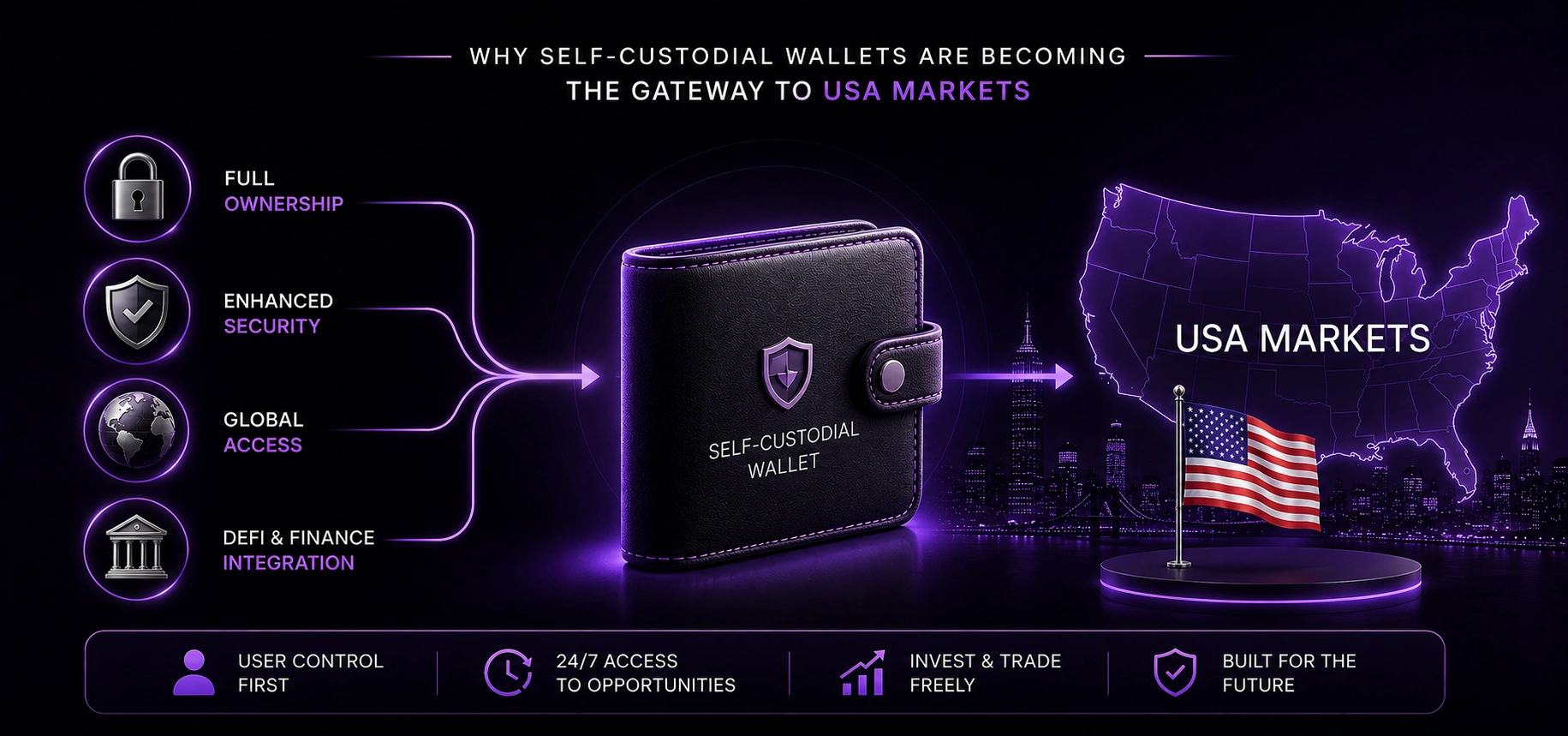
With the combination of stablecoin payments and Web3 technology, self custody wallets minimize the need for traditional intermediaries while ensuring that users have ownership of their digital assets.
The increasing trend towards tokenization means that self custody is becoming a realistic approach to finance. Compliance-focused token design also helps ensure that blockchain-based assets can support investor protection, transfer controls, and market requirements.
Key Trends Driving This Shift
- Tokenized U.S. Stocks & ETFs: Investors get exposure to certain US stocks and exchange-traded funds can be attained via tokenized assets built on blockchain.
- Rise of Real-World Assets (RWAs): Financial assets such as equities, bonds, and real estate are being tokenized, thus extending blockchain application beyond cryptocurrencies.
- Stablecoin-Based Settlements: US based stablecoins allow quick and cheap payments irrespective of geographical borders without using banking systems.
- On-Chain Asset Ownership: Self-custody wallets provide users an opportunity to own and control their tokens without transferring the management of private keys to anyone else.
- Greater Global Accessibility: Web3 infrastructure allows eligible investors across the world to have access to tokenized US financial instruments via blockchain-compliant platforms.
- Growing Tokenization Platforms: Platforms such as Dinari demonstrate how tokenized securities can connect traditional financial markets with blockchain technology, illustrating the broader shift toward on-chain investing.
Key Factors Driving Adoption of Self Custodial Crypto Wallets in USA
The adoption of self custodial crypto wallets in the USA is being driven by changing user expectations around ownership, accessibility, and financial control. As blockchain infrastructure matures, users are increasingly exploring wallets that provide direct access to digital assets, decentralized applications, and tokenized financial products.
1. Greater Control Over Digital Assets
Self-custodial wallets enable users to hold their own private keys, giving them control over their digital assets.
2. Reduced Counterparty Risk
Users become increasingly aware of various risks associated with the use of third parties for the custody of their digital assets. Self-custody helps to minimize risks related to platform failure, restrictions on user accounts, and other similar risks.
3. Access to DeFi and Web3
Self-custodial wallets are gateways to decentralized finance (DeFi), non-fungible tokens (NFTs), and Web3 platforms. It allows users to interact with blockchain applications directly without the need for any permission from intermediaries.
4. Stablecoin-Based Transactions
Stablecoins help to facilitate faster and more efficient digital value transfers. The use of stablecoins payment infrastructure in blockchain transactions helps in global payments and trading.
5. Growing Interest in Tokenized Assets
The growing popularity of tokenized real-world assets (RWAs), including equities, is generating demand for ownership through blockchain technology.
Security Considerations When Using Self-Custodial Crypto Wallets
While self custodial crypto wallets provide greater ownership and control, they also require users to take responsibility for protecting their digital assets. Since users manage their own private keys, following strong security practices is essential to reduce risks such as theft, loss, or unauthorized access.
1. Seed Phrase Protection
A seed phrase is the key backup for a self-custodial wallet and needs to be kept offline at all times. It is essential not to disclose any seed phrases and not to keep them in unsecure locations such as email clients and cloud storages.
2. Hardware Wallets
Hardware wallets can be an extra security measure that allows users to keep private keys offline. Hardware wallets are preferred by crypto owners who want an additional level of security from online risks.
3. Phishing Prevention
Fraudulent websites, wallet browser extensions, and phishing scams are very common forms of attacks. Users have to double-check all information and never provide their wallets on unverified webpages.
4. Smart Contract Approvals
When interacting with DeFi applications, users should carefully review transaction permissions and token approvals. Smart contract audits enabling removing unnecessary approvals can help reduce exposure to malicious contracts.
5. Device Security & Backups
Keeping devices updated, using strong passwords, and enabling security features can protect wallet access. Maintaining secure offline backups ensures recovery options are available if a device is lost or damaged.
Challenges and Limitations of Self-Custody
While self custodial crypto wallets offer ownership and control, they also introduce new responsibilities for users. Unlike custodial wallets, where providers may offer account recovery options, self-custody requires users to manage their own security credentials.
This model provides independence but comes with challenges related to asset protection, technical understanding, and regulatory awareness. Users need to follow proper security practices and understand how wallet management works before handling significant digital assets.
Key Challenges of Self-Custody
- Lost Recovery Phrase: Losing the seed phrase can result in permanent loss of access to wallet assets.
- No Password Reset: Users cannot rely on a third party to recover forgotten wallet credentials.
- User Responsibility: Security, backups, and transaction approvals are entirely managed by the wallet owner.
- Learning Curve: New users may need time to understand private keys, networks, and blockchain transactions.
- Regulatory Considerations: Evolving crypto regulations may impact how self-custody solutions are used across different markets.
Turn Wallet Complexity into a Secure, Scalable Product
Conclusion
Although self custodial crypto wallets in the USA provide more control and ownership of the wallet by the user, there are also new obligations that come along with it. Unlike custodial wallets, where providers may offer account recovery options, self-custody requires users to manage their own security credentials.
Custodial wallet development enables exchanges, fintech platforms, and Web3 businesses to create wallets where private keys and security controls are managed through enterprise-grade infrastructure. A reliable custodial wallet development company like Techfyte helps businesses implement features such as transaction monitoring, access controls, encryption, and compliance-focused security measures.
For platforms managing large user bases, building secure custodial wallets for crypto platforms requires a balance between convenience, security, and regulatory requirements.
Frequently Asked Questions
1. What is a self-custodial crypto wallet?
A self custodial crypto wallet is a digital wallet that allows users to store and manage cryptocurrencies while controlling their own private keys. Unlike custodial wallets crypto solutions, no third party holds your assets or recovery credentials. Users have full ownership but are also responsible for securing their seed phrase and wallet access.
2. Are self-custodial wallets safer than custodial wallets?
Self custodial crypto wallets can provide stronger ownership and reduce third-party risks, such as exchange failures or account restrictions. However, to secure custodial wallets for crypto platforms rely on expert providers like Techfyte essential to handle seed phrase storage, hardware wallets, and increase transaction awareness. Custodial wallets may offer convenience but require trusting a service provider.
3. Can I invest in tokenized U.S. assets with a self-custodial wallet?
Yes, eligible users can access certain tokenized U.S. assets through blockchain platforms that support self-custody. These assets may include tokenized stocks, ETFs, and other real-world assets (RWAs).
4. What happens if I lose my recovery phrase?
If you lose your recovery phrase, you may permanently lose access to your self custodial crypto wallet and its assets. Since no company controls your private keys, there is usually no password reset or recovery option. Secure offline backups are essential for protecting wallet access.
5. Why are self-custodial wallets becoming popular in the U.S.?
Self custodial crypto wallets are gaining popularity in the U.S. because they provide direct ownership, access to Web3 applications, and participation in emerging tokenized markets. Users are increasingly exploring alternatives to traditional custody models while using stablecoins, DeFi wallet platforms, and blockchain-based financial services.
Ready to Build a Secure Crypto Wallet Platform?
