

logo
wordpress_new
  • AI
    EXPLORE AI & ML
    • A AI Development
    • P Predictive Intelligence
    • A AI Infrastructure
    • R Research & Agents
    Contact us →
    AI Development End-to-end AI development and deployment services Custom LLM Development Business-trained large language models tailored to your domain Enterprise AI Assistants Intelligent chatbots and copilots for customer support and internal operations AI Content Automation Systems Automated content creation and curation powered by AI
    Predictive Analytics & Forecasting Forecast trends and outcomes with ML models Fraud Detection AI-based anomaly detection for financial security Anomaly Detection Systems Identify outliers and unusual patterns in real-time
    ML Pipeline Development End-to-end MLOps for training and deployment AI Deployment & Model Serving Scalable inference infrastructure for real-time predictions Automated Retraining Continuous model improvement with drift detection
    Neuro-Symbolic AI Hybrid systems combining neural networks with logical reasoning Federated Learning Distributed training while preserving data privacy AI Agent Infrastructure Multi-agent systems for complex task automation AI Agent Systems Cutting-edge AI systems and agent infrastructure Multi-Agent Orchestration Coordinated agent networks for parallel problem-solving Complex Decision Support Collaborative agent systems for complex problem-solving
  • Blockchain
    EXPLORE BLOCKCHAIN
    • B Blockchain
    • B Blockchain Frameworks
    • L Layer 1 & Layer 2
    • S Smart Contracts
    • E Enterprise Blockchain
    Contact us →
    Blockchain Development Engineer secure, decentralized digital ledgers Chain Abstraction Seamless multi-chain interactions for end users DePIN Development Decentralized physical infrastructure networks Quantum-Resistant Cryptography Future-proof blockchain security against quantum threats
    Polkadot Para chains Launch interoperable, custom-built blockchains Cosmos SDK blockchain Create sovereign, interconnected app chains Avalanche Subnet Custom validator sets for enterprise blockchains Polygon zkEVM Zero-knowledge rollups with EVM compatibility OP Stack Optimistic rollup frameworks for Ethereum scaling
    Cardano Research-driven proof-of-stake blockchain with peer-reviewed protocols Solana High-speed blockchain with proof-of-history for sub-second finality Aptos Move-based Layer 1 with parallel execution for enhanced throughput Polkadot Multi-chain network enabling cross-chain interoperability and shared security Ethereum Leading smart contract platform with the largest developer ecosystem BSC High-performance EVM-compatible blockchain with low transaction costs SUI Next-generation Move-based blockchain optimized for horizontal scaling Hedera Hashgraph consensus network for enterprise-grade distributed applications Hyperledger Modular enterprise blockchain frameworks for permissioned networks
    Formal Verification Mathematical proof of smart contract correctness Gas Optimization Minimize transaction costs through efficient code Cross-Chain Smart Contract Interoperable smart contracts across multiple chains Smart Contract Development Secure and optimized smart contract engineering Smart Contract Audits Independent security audits for production-ready smart contracts.
    Supply Chain and Logistics End-to-end traceability and logistics management Carbon Credit Platform Streamline carbon credit issuance and trading. Financial Services & FinTech Payment rails, settlement, and digital assets Blockchain Voting Systems Secure, transparent, and tamper-proof digital voting solutions Blockchain Governance Frameworks Secure governance systems for blockchain enterprises
  • Assets Tokenization
    EXPLORE ASSETS TOKENIZATION
    • A Assets Tokenization
    • T Token Infrastructure
    • F Fractional Ownership
    Contact us →
    Asset Tokenization Convert physical assets into digital tokens RWA Tokenization Platform Development Build compliant platforms for asset tokenization. Real Estate Tokenization Fractionalize property ownership via blockchain Carbon Credit Tokenization Transparently track and trade emissions Tokenized Bonds & Equities Security tokens representing company shares and debt instruments Commodity Tokenization Gold, silver, oil, and physical goods on blockchain Renewable Energy Certificates Tokenized green energy credits and renewable certificates White-Label Tokenization Customizable token issuance platform for any asset class
    Token Standards Engineering ERC-3643, ERC-1400, and custom token standards Regulatory-Compliant Token Design SEC-compliant security tokens with built-in regulations Cross-Border Distribution Multi-jurisdiction token issuance and distribution Institutional Custody Systems Enterprise-grade custody solutions for tokenized assets Compliance Reporting Modules Automated regulatory reporting and audit trails
    Investor Onboarding & Compliance KYC/AML verification and accredited investor workflows Dividend Distribution Automation Smart contract-based revenue sharing and payouts Secondary Marketplace Enablements Liquidity solutions for fractional ownership tokens Custody Integrations Integration with institutional custody providers
  • Web3
    EXPLORE WEB3 SOLUTIONS
    • W Web3 Solutions
    • D DeFi
    • E Exchanges
    • W Wallets
    • N NFTs & Digital Asset
    • D DAO & Governance
    • C Coin Development
    • D Digital Banking
    Contact us →
    Web3 App Development Customizable Web3 application development with modular components
    DEX & AMMs Decentralized exchanges with automated market makers DeFi Staking Deploy secure liquidity-earning protocols Lending & Borrowing Peer-to-peer lending protocols with collateral management Yield Farming Liquidity mining and yield optimization strategies DeFi Lottery Decentralized lottery systems with transparent prize distribution Synthetic Assets On-chain derivatives and synthetic exposure Cross-Chain Liquidity Unified liquidity across multiple blockchains
    Crypto Currency Exchange Custom crypto exchanges for seamless trading. Derivatives Exchange Futures, options, and perpetual contracts Spot Exchange Buy and sell crypto instantly at live market prices Margin Exchange Trade crypto with leverage using borrowed funds Prediction Marketplace Decentralized prediction markets with transparent outcomes P2P Exchange Peer-to-peer trading with escrow and dispute resolution Hybrid Exchange Combined CEX performance with DEX custody Order Matching Engine High-performance trading engine development White-Label Exchange Customizable turnkey exchange solutions Liquidity Management Market making and liquidity aggregation systems
    Crypto Wallet Development Secure and scalable wallets for digital asset management Multi-Chain Wallets Support for multiple blockchain networks in one wallet Web3 Super App All-in-one wallet, browser, and dApp platform Non-Custodial Wallets Complete control of digital assets with self-managed private keys. AI Crypto Wallets Intelligent wallet solutions powered by artificial intelligence DeFi-Integrated Wallets Built-in access to DeFi protocols and dApps MPC Wallets Multi-party computation for enhanced security White-Label Wallets Customizable wallet solutions for enterprises Embedded Wallet SDKs White-label wallet infrastructure for apps Institutional Custody Enterprise-grade custody with compliance features
    NFT Marketplace Full-featured marketplace for digital collectibles Dynamic NFTs Evolving metadata based on external conditions NFT Development Custom NFT creation and deployment services Utility NFT Platforms NFTs with real-world benefits and access rights
    DAO Infrastructure Infrastructure for creating and managing decentralized autonomous organizations Treasury Management Secure and transparent management of DAO treasuries
    Coin Development Custom cryptocurrency development services ICO Development End-to-end development and deployment of initial coin offerings Stablecoin Development Design and launch of stablecoins with various collateralization models Launchpad Development Comprehensive launchpad development and deployment services Token Development Custom token development tailored to your specific requirements
    Digital Banking Banking services built on blockchain technology White-Label NeoBank Customizable banking platform for enterprises BaaS Development Blockchain-as-a-Service development and deployment P2P Lending Peer-to-peer lending platforms on blockchain Stable-coin Remittance Platform Secure and fast cross-border payments using stablecoins Crypto Card Solutions Physical and digital payment cards for blockchain transactions Payment Gateways Integrated payment processing solutions for blockchain transactions
  • AI x Blockchain
    Explore Convergence
    • A AI x Blockchain Solutions
    • A AI-Enhanced
    • V Verified AI
    • E Economic Agents
    • A Autonomous Organizations
    Contact us →
    AI x Blockchain Solutions Intelligent blockchain systems powered by AI
    AI-Based Smart Contract Generation Automated contract creation using large language models Predictive Gas Optimization AI-driven transaction cost minimization
    On-Chain AI Training Logs Immutable record of model training processes Verifiable Inference Cryptographic proof of AI model outputs
    AI Trading Agents Autonomous trading bots with on-chain execution AI Portfolio Managers Self-adjusting investment strategies powered by ML Self-Optimizing DeFi Yield strategies that adapt to market conditions
    Algorithmic Governance AI-assisted DAO decision making AI Resource Allocation Intelligent distribution of computational and financial resources
  • Company
    • About Us
    • Blogs
Live Demos Get In Touch
Telegram
WhatsApp

Table of Contents

  • Key Takeaways
  • Introduction
  • Why Stablecoin Payment Platforms Are Becoming Enterprise Priorities
  • Core Components of Stablecoin Payment Platform Development
    • 1. Merchant Dashboard
    • 2. Wallet Integration
    • 3. Payment Gateway
    • 4. Settlement Engine
    • 5. Compliance Layer
    • 6. API Infrastructure
  • Step-by-Step Process to Build a Stablecoin Payment Platform
    • Step 1: Define Business Objectives
    • Step 2: Select Blockchain Networks
    • Step 3: Build Secure Payment Infrastructure
    • Step 4: Integrate Compliance and Risk Controls
    • Step 5: Develop Merchant APIs
    • Step 6: Test Before Production
  • Security Considerations for Enterprise Stablecoin Payment Solutions
  • Business Benefits of Stablecoin Payment Solutions
  • Choosing the Right Stablecoin Development Company
  • Conclusion
  • Frequently Asked Questions
    • 1. What is stablecoin payment platform development?
    • 2. How do stablecoin payment solutions benefit enterprise businesses?
    • 3. What features should a stablecoin payment platform include?
    • 4. How long does stablecoin payment platform development take?
    • 5. Can businesses settle stablecoin payments in fiat currency?
    • 6. Why should businesses work with a stablecoin development company?

How Businesses Can Launch a Stablecoin Payment Platform Like RedotPay

Posted on August 7, 2026 by Deepak Dutta
Facebook X LinkedIn
How Businesses Can Launch a Stablecoin Payment Platform Like RedotPay

Key Takeaways

  • Payment Trends: Stablecoins are driving faster, low-cost, and transparent global payments for enterprises.
  • Key Features: Wallet integration, payment gateways, compliance, APIs, and secure settlements are essential.
  • Market Demand: Fintech, ecommerce, SaaS, and global businesses are rapidly adopting stablecoin payment solutions.
  • Use Cases: Ideal for cross-border payments, merchant checkouts, subscriptions, B2B transactions, and digital marketplaces.

Introduction

Traditional cross-border distribution systems often struggle with high transaction costs, lengthy settlement cycles, and fragmented banking networks. Stablecoins have evolved from being a niche cryptocurrency product into an important part of modern payment infrastructure solutions.

Platforms like RedotPay demonstrate how blockchain technology can be illustrated into a familiar payment experience. Instead of requiring merchants to understand wallets, private keys or blockchain networks, this platform abstracts these complexities while allowing customers to pay using supported stablecoins.

Businesses considering digital payment innovation, the opportunity extends beyond accepting crypto payments. It involves building a scalable payment platform that integrates compliance, settlement, APIs, merchant management and security into a unified platform.

In this blog explore about the essential components of stablecoin payment platform development and technical considerations required to build enterprise-grade payment infrastructure.

Why Stablecoin Payment Platforms Are Becoming Enterprise Priorities

Businesses are increasingly operating across multiple jurisdictions, currencies and banking systems. Traditional payment rails can introduce delays, reconciliation challenges and significant transaction fees, especially for international commerce.

Conventional payment channels may present issues such as delays, difficulties with reconciliation, and considerable transaction costs for cross-border commerce.

Payment platforms based on stablecoins help to resolve most of those inefficiencies because it enables near real-time money transfer and ensures price stability by fiat-pegged digital assets.

As regulations continue to mature across several jurisdictions, stablecoin infrastructure is becoming an increasingly viable option for fintech companies, marketplaces, SaaS providers, and multinational businesses seeking more efficient payment systems.

Ready to Launch a Stablecoin Payment Platform Like RedotPay?

Book Free Expert Consultation

Core Components of Stablecoin Payment Platform Development

Launching a production-ready payment platform requires much more than integrating a blockchain wallet. Enterprise-grade stablecoin payment platform development involves multiple interconnected systems that work together to deliver secure and reliable payment experiences.

1. Merchant Dashboard

The merchant dashboard serves as the operational control panel where businesses can manage transactions, create invoices, perform reconciliations, process refunds, analyze payments, and set user privileges. An enterprise-level dashboard must also support role-based access and complete audit trails.

2. Wallet Integration

The payment system must be able to work with different wallet providers but still offer an easy checkout process. This means that wallet integration allows customers to authenticate payments from their preferred crypto wallets without having the merchants deal with cryptocurrencies.

Supporting blockchain networks improves the payment system making it accessible and less dependent on one ecosystem.

3. Payment Gateway

The payment gateway validates the transaction, initiates payment request, blockchain confirmation checking and payment status update in real-time. The robust gateway system also manages transaction retries, expiry rules, webhooks, and merchant callbacks. A gateway system acts as the backbone of the entire payment infrastructure solution.

4. Settlement Engine

Settlement is one of the key components. The system needs to automatically process incoming payments, facilitate asset conversion, if needed, and settle merchants as per set business logic.

Firms can decide between crypto settlements, fiat settlements, or a combination of both, based on regulatory compliance and business preferences.

5. Compliance Layer

Compliance cannot be treated as an afterthought. Enterprise payment systems will normally include KYC, KYB, AML screening, sanctions screening, transaction risk assessment, and blockchain wallet validation prior to conducting any payments.

A robust compliance regulatory model ensures businesses work in a responsible manner and reduce their risks.

6. API Infrastructure

Modern businesses expect that the APIs must be able to connect with ERP systems, accounting applications, CRM systems, e-commerce platforms, and their customized workflows.

An ideal API must be capable of creating payments, sending settlements, performing refunds, webhook events, authentications, report generation, and reconciliation, among other features.

Need a Secure, Scalable Stablecoin Payment Solution?

Book a Free Scoping Call

Step-by-Step Process to Build a Stablecoin Payment Platform

Building a successful platform requires balancing technology, compliance, and business strategy rather than focusing solely on blockchain development.
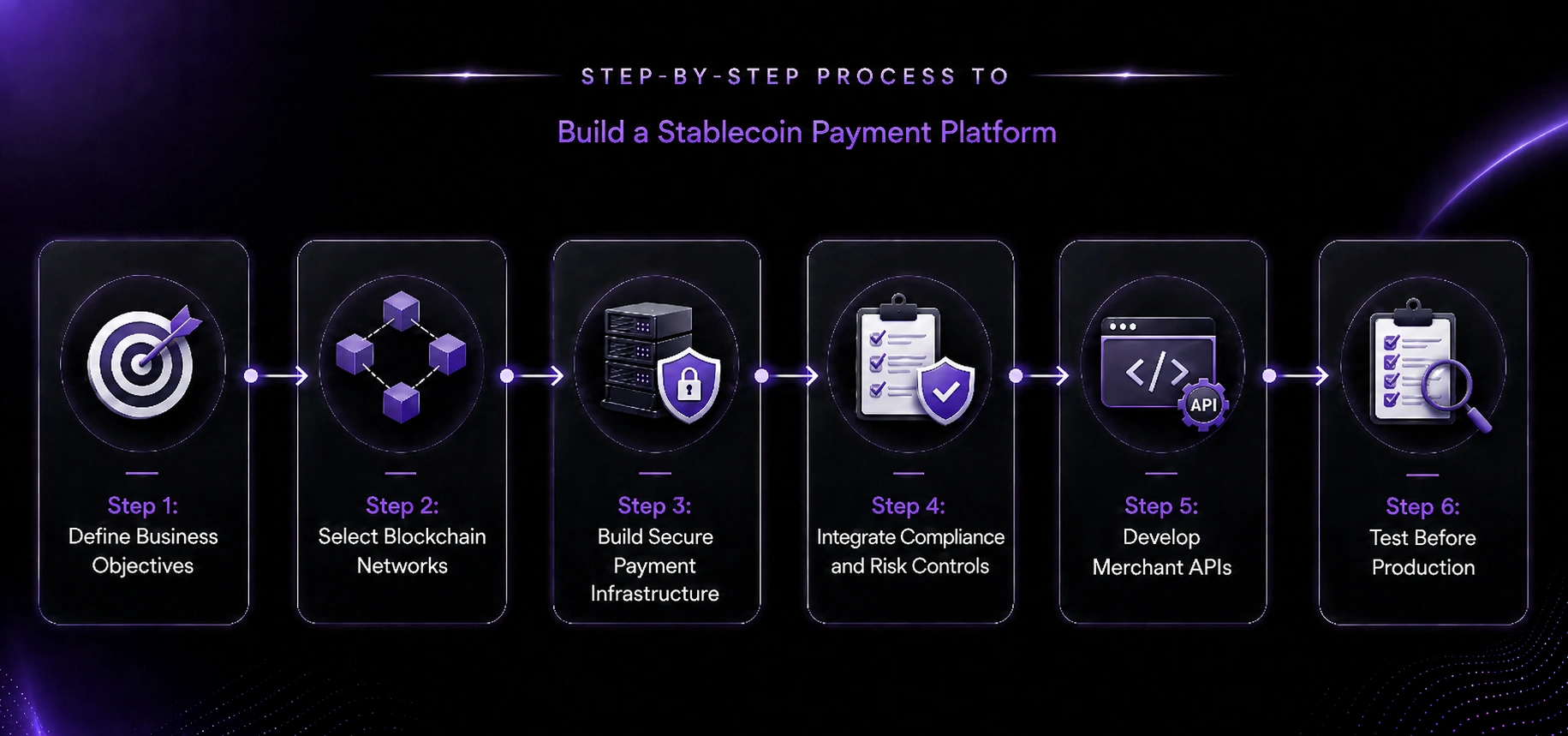
Step-by-Step Process to Build a Stablecoin Payment Platform_

Step 1: Define Business Objectives

The first step is identifying the platform’s primary purpose.

Some businesses prefer cross-border trade, while some may have goals like B2B payments, digital marketplaces, subscriptions and billing services, or treasury management solutions.

Step 2: Select Blockchain Networks

The choice of blockchain infrastructure will depend on factors such as fees for transactions, speed of settlements, maturity of the ecosystem, and adoption by enterprises.

Many businesses are working with several blockchain infrastructures for increased resilience and giving their customers flexibility in choosing payment systems.

Step 3: Build Secure Payment Infrastructure

A reliable payment infrastructure solution encompasses transaction orchestration, payment routing, blockchain monitoring, merchant management, settlements, notifications, and operations dashboards.

Instead of implementing individual modules separately, it would be wise to develop the system as a scalable microservices infrastructure to be able to accommodate growing transaction volumes.

Step 4: Integrate Compliance and Risk Controls

Compliance solutions need to be implemented all throughout the payment process instead of just at onboarding.

Risk scoring, suspicious transactions monitoring, sanctions checks, and identification procedures need to be integrated into the payment process itself.

Step 5: Develop Merchant APIs

Developers need reliable APIs with complete documentation and webhook capabilities.

Merchant APIs have to make it easier for businesses to initiate payments, verify orders, settle their accounts, manage subscriptions, and create reports using secure digital signatures or tokenized assets.

Step 6: Test Before Production

Enterprise payment platforms need thorough testing for its functionality, security, and performance before going live.

This includes testing blockchain transactions, accurate settlements, reliability of APIs, penetration testing, disaster recovery, and scalability.

Security Considerations for Enterprise Stablecoin Payment Solutions

Security is a fundamental aspect of every financial system. Sensitive data must be encrypted during its transfer as well as storage. Authentication must be done through multi-factor verification, role-based permissions, and cryptographic request signing.

Infrastructure should continuously monitor for abnormal transaction behavior, unauthorized access attempts, and operational anomalies. Disaster recovery, redundant infrastructure, key management, and constant vulnerability assessment is essential to provide service availability.

Since payments involve financial transactions, security becomes an operational function and not a mere implementation task.

Business Benefits of Stablecoin Payment Solutions

If implemented properly, stablecoin payment systems bring operational advantages in addition to payments processing.

Businesses will be able to optimize settlement times, streamline cross-border payments, cut down on intermediary costs, enhance payment transparency, and build financial processes on top of a programmable system.

Moreover, the platforms built using stablecoins will also enhance global availability by providing access to clients in territories where banking might not be available or affordable.

As blockchain technology evolves, businesses become more flexible in creating payment systems that seamlessly integrate with digital commerce ecosystems.

Turn Stablecoins into a Faster Global Payment Experience

Discuss Your Payment Platform

Choosing the Right Stablecoin Development Company

Techfyte is the ideal partner for businesses looking for a stablecoin development company. We demonstrate expertise in payment architecture, blockchain integration, enterprise architecture and security, API engineering, regulatory compliance and cloud-native infrastructure.

  • Technical capabilities beyond blockchain development
  • Strong portfolio of building scalable financial systems
  • Provides quality assurance and testing services
  • Delivers comprehensive stablecoin development services
  • AI risk and fraud detection solutions

Conclusion

Enterprise adoption of stablecoins is no longer driven solely by interest in blockchain technology. The need for faster settlements, lower operational costs, improved transparency and modern payment infrastructure solutions has increased the demand for global digital commerce.

The development of a platform like RedotPay is not possible through implementing only stablecoin transactions. One needs to create a safe environment, where the merchant management, payment processing via API, settlements, compliance, and security can operate smoothly.

With the ongoing modernization of the financial processes, companies have the possibility to invest in stablecoin development services. Enterprise partnering with the right partner, Techfyte can build a payment platform that is scalable and future-proof.

Frequently Asked Questions

1. What is stablecoin payment platform development?

Stablecoin payment platform development is the process of building a digital payment system that enables businesses to accept, process, settle, and manage payments made using stablecoins such as USDT, USDC, or other fiat-backed digital assets. The development components include merchant onboarding, payment gateways, wallet integration, settlement engines, APIs, security, and regulatory compliance features.

2. How do stablecoin payment solutions benefit enterprise businesses?

Stablecoin payment solutions help enterprises reduce cross-border payment costs, accelerate settlement times, improve transaction transparency, and automate payment workflows. It also acts as a bridge for global customers while minimizing cost associated with traditional cryptocurrencies.

3. What features should a stablecoin payment platform include?

An enterprise-grade stablecoin payment platform should include secure wallet integration, merchant dashboards, payment APIs, automated settlement, multi-chain support, KYC/KYB verification, AML monitoring, webhook notifications, reporting tools, and enterprise-level security controls such as encryption and role-based access management.

4. How long does stablecoin payment platform development take?

The development timeline depends on the platform’s complexity, integrations, and compliance requirements. A minimum viable product (MVP) may take 3–5 months, while a fully customized enterprise payment platform with advanced security, regulatory compliance, and multi-chain support typically requires 6–12 months.

5. Can businesses settle stablecoin payments in fiat currency?

Yes. Many modern stablecoin payment platforms support automatic conversion of stablecoins into fiat currencies before settlement.

6. Why should businesses work with a stablecoin development company?

An experienced stablecoin development company provides expertise in blockchain architecture, payment infrastructure, compliance implementation, API development, and enterprise security. This helps businesses build scalable, secure, and regulation-ready payment platforms while reducing development risks and accelerating time to market.

Ready to Build Your Enterprise Stablecoin Payment Platform?

Talk to Our Stablecoin Experts

Posted in BlockchainTagged Business Benefits of Stablecoin Payment Solutions, Choosing the Right Stablecoin Development Company, Core Components of Stablecoin Payment Platform Development, How Businesses Can Launch a Stablecoin Payment Platform, How Businesses Can Launch a Stablecoin Payment Platform Like RedotPay, Launch a Stablecoin Payment Platform Like RedotPay, Security Considerations for Enterprise Stablecoin Payment Solutions, Step-by-Step Process to Build a Stablecoin Payment Platform, Why Stablecoin Payment Platforms Are Becoming Enterprise Priorities

Author :

Deepak Dutta

Deepak Dutta

Senior Technical Content Writer

Deepak Dutta is a tech-focused content strategist and writer with 9+ years of experience, including 5+ years in blockchain, Web3, and AI content. He specializes in creating clear, engaging, and SEO-driven content that simplifies complex technologies and helps tech brands build authority and audience trust.

LinkedIn
View all posts →
TECHFYTE
techfyte

Quick Links

  • Home
  • AI Development
  • Web3 Development
  • Blockchain
  • Asset Tokenization
  • AI x Blockchain Solutions
  • Contact-us

Connect

Sales

Email sales@techfyte.com
Phone +971 50 293 1801

Our Offices

Location UAE

DSO IFZA, IFZA Properties, Dubai Silicon Oasis, Dubai, UAE

Phone +971 50 293 1801

Location INDIA

F-273, Phase 8B, Industrial Area, Sector 74, Sahibzada Ajit Singh Nagar, Punjab 160071

Phone +91 172 311 3789

Follow Us

Stay connected and follow us on social media for the latest updates, insights, and innovations.

LinkedIn Twitter Facebook Instagram

© 2026 Techfyte Innovations. All rights reserved. Powered by ChicMic Studios | Privacy Policy | Terms of Service

Let's build something great.

Tell us about your idea. Our team will get back to you with a tailored proposal.

Start a conversation

icon Your Idea Is Fully Protected By Our Non Disclosure Agreement (NDA).