



Key Takeaways
- A basic stablecoin payment infrastructure platform costs approximately $70,000–$120,000.
- Advanced institutional platforms with AI risk intelligence and global liquidity routing may exceed $500,000.
- Compliance, security audits, banking integrations, and liquidity management are the largest cost drivers.
- Main use cases for stablecoins are digital payments, most prominently cross-border payments.
Introduction
Global businesses seek faster, transparent and cost-efficient cross-border distribution channels, resulting in increased demand for secure stablecoin-based payment infrastructure. Stablecoins have evolved beyond digital assets for peer-to-peer transfers to become a core settlement layer for modern payment ecosystems.
Unlike standalone tokens, stablecoin platform integrates blockchain networks with banking systems, compliance automation, payment routing and enterprise-grade security to support real-world financial operations.
In this blog, explore the cost to build a stablecoin payment infrastructure solution and factors affecting it.
What is a Stablecoin Payment Infrastructure Platform?
A stablecoin payment infrastructure platform is a financial technology framework that enables businesses to process, manage, and settle digital payments using stablecoins while seamlessly integrating with traditional financial systems. The global stablecoin supply hit a value milestone of nearly 292.75 billion U.S. dollars by July 2026.
It serves as the underlying infrastructure that connects blockchain-based settlements with banking networks, compliance systems and enterprise payment operations. According to the research, compared to overall market size of cryptocurrencies, stablecoins take upto 15% of global cryptocurrency market.
A modern stablecoin payment infrastructure solution typically allows businesses to:
- Accept stablecoin payments from customers and partners.
- Facilitate near real-time blockchain settlement on various networks.
- Convert stablecoins to fiat currencies using built-in on and off-ramps.
- Coordinate treasury management and liquidity management across various payment rails.
- Automate compliance workflows, including KYC, AML, sanctions checking, and transaction monitoring.
- Connect to banks, payment gateways, ERP systems, and accounting systems for financial transactions.
Average Cost to Develop a Stablecoin Payment Infrastructure Platform in 2026
The cost to develop a stablecoin payment infrastructure platform in 2026 typically ranges between $70,000 and $300,000+, while enterprise-grade solutions with advanced compliance, multi-chain support, and AI-based risk management may exceed $500,000.
| Platform Type | Estimated Cost | Suitable For |
|---|---|---|
| MVP Platform | $70,000–$120,000 | Startups testing payment use cases |
| Production Platform | $130,000–$220,000 | Fintech companies |
| Enterprise SaaS Platform | $220,000–$300,000+ | Banks and payment providers |
| Institutional Infrastructure | $500,000+ | Global financial platforms |
Get Your Stablecoin Platform Budget Estimate
Cost Breakdown of Building a Secure Stablecoin-Based Payment Infrastructure
Developing a secure stablecoin-based payment infrastructure involves multiple interconnected components that ensure reliable payment processing, regulatory compliance, and enterprise-grade security. Each layer contributes differently to the overall investment based on its complexity, scalability requirements, and integration effort.
1) Payment Engine and Ledger Development
Estimated Cost: ($25,000–$65,000)
The payment engine is the operational core of the platform, responsible for double-entry ledger management, transaction processing, reconciliation, settlement tracking, and payment routing. Its cost varies with the complexity of transaction workflows, scalability, and accounting requirements, as enterprises need financial-grade ledger systems rather than blockchain records alone.
2) Smart Contract Development and Blockchain Integration
Estimated Cost: ($15,000–$50,000)
Smart contracts development automates stablecoin transfers, escrow services, treasury operations, and settlement logic across blockchain networks. Development costs increase with custom business logic, multi-chain compatibility, and the need for comprehensive third-party security audits to mitigate vulnerabilities.
3) Security Audits and Infrastructure Protection
Estimated Cost: ($25,000–$100,000+)
Security investments cover smart contract audits, penetration testing, wallet security, key management, and continuous infrastructure monitoring. Costs rise depending on the platform’s security requirements, regulatory expectations, and the number of blockchain networks and digital assets being protected.
4) API Layer and Enterprise Integrations
Estimated Cost: ($30,000–$100,000)
A commercial stablecoin payment infrastructure solution requires robust APIs to integrate with payment gateways, banking systems, ERP platforms, accounting software, and merchant applications. Integration costs depend on the number of third-party systems, API complexity, and the level of interoperability required for enterprise operations.
5) AI-Based Risk and Compliance Intelligence
Estimated Cost: ($40,000–$80,000)
AI-powered risk engines strengthen fraud detection, transaction monitoring, wallet risk scoring, and anomaly detection by analyzing payment activity in real time. Development costs increase with the sophistication of machine learning models, compliance automation, and the volume of transactions the platform must monitor.
Factors That Influence Stablecoin Payment Infrastructure Development Cost
The development cost of a stablecoin payment infrastructure solution depends on several technical, operational, and regulatory factors. The following variables have the greatest impact on the overall project budget:
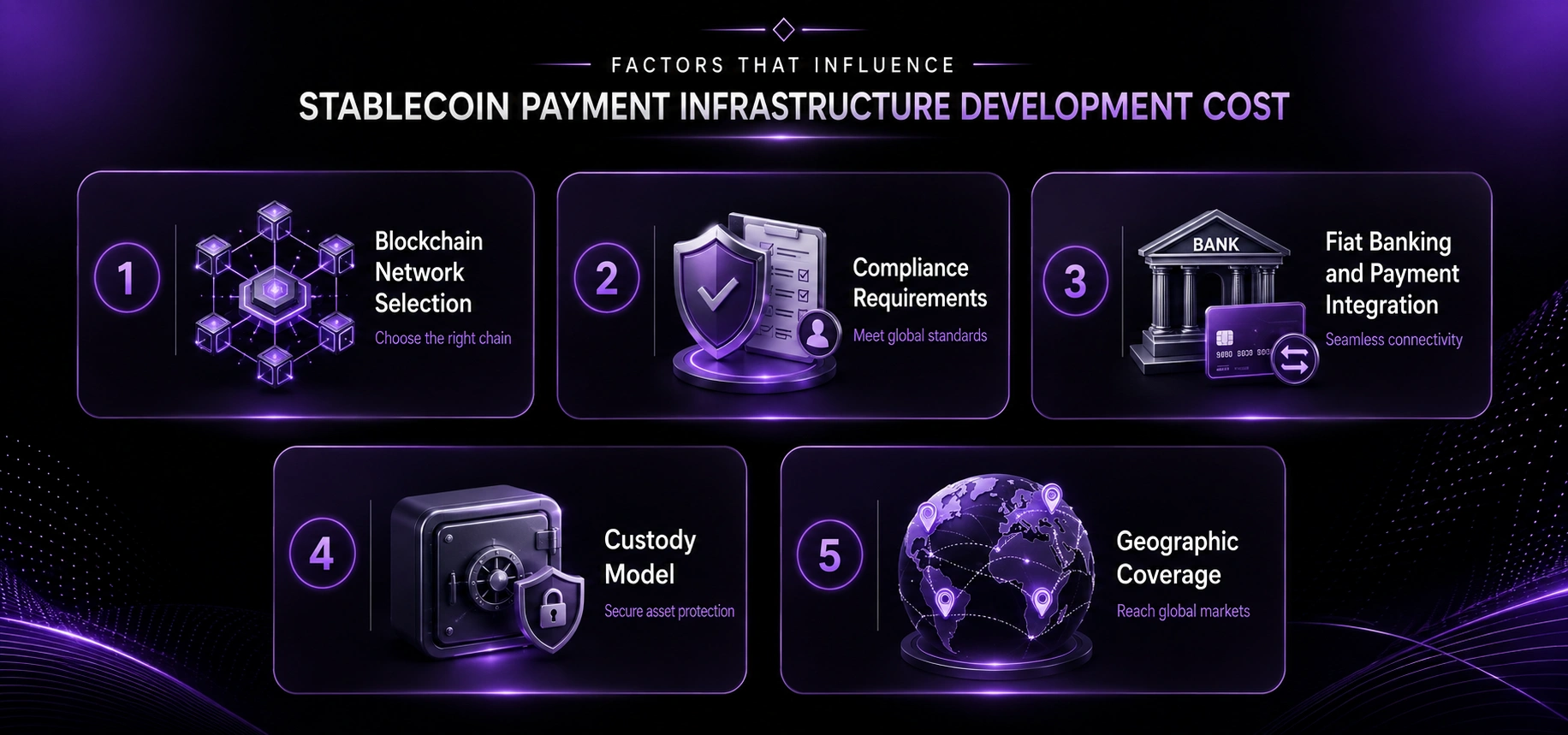
1. Blockchain Network Selection
- Single-chain deployments are generally less expensive than multi-chain architectures.
- Costs vary depending on support for Ethereum, Polygon, Solana, or Layer-2 networks.
- Multi-chain interoperability requires additional development, testing, and maintenance.
2. Compliance Requirements
- Implementing KYC/KYB, AML monitoring, sanctions screening, and Travel Rule compliance increases development effort.
- Maintaining compliance reporting modules for audit-ready tokenized assets and adapting to regulations such as MiCA and evolving U.S. stablecoin regulations adds ongoing engineering and compliance costs.
3. Fiat Banking and Payment Integration
- Connecting with bank accounts, payment gateways, and FX providers requires secure API integrations.
- Supporting liquidity partners and fiat on/off ramps increases infrastructure complexity and integration costs.
4. Custody Model
- Third-party custody reduces initial development costs by leveraging existing custody providers.
- Self-custody infrastructure requires advanced wallet security, key management, and engineering investment.
5. Geographic Coverage
- Expanding into multiple countries requires support for additional payment rails and local currencies.
- Each new market introduces regulatory, compliance, and banking integration requirements, increasing overall development costs.
Development Roadmap for a Stablecoin Payment Infrastructure Platform
Organizations planning stablecoin infrastructure development should evaluate long-term scalability, compliance readiness, and security architecture rather than focusing only on initial development cost. Below is the development approach that is followed for the cost-efficient process.
Phase 1: MVP Development
Focuses on validating the product with core capabilities, including single-blockchain support, stablecoin payment processing, wallet integration, and basic KYC/AML compliance. This phase establishes a functional foundation for initial users and pilot deployments.
Phase 2: Production Infrastructure
Expands the platform with multi-chain routing, fiat on/off ramps, enterprise APIs, automated compliance workflows, and improved scalability. The goal is to support commercial operations with secure, reliable, and compliant payment processing.
Phase 3: Enterprise Platform
Transforms the platform into enterprise-grade infrastructure by introducing multi-tenancy, global liquidity routing, AI-powered risk monitoring, and high-availability architecture capable of supporting large-scale financial institutions and international payment networks.
Launch Your Stablecoin Payment Infrastructure Fast
Technology Stack Required for Stablecoin Payment Infrastructure
| Layer | Technologies |
|---|---|
| Blockchain | Ethereum, Polygon, Solana |
| Smart Contracts | Solidity, Rust |
| Backend | Node.js, Go, Java |
| Database | PostgreSQL, Redis |
| APIs | REST, GraphQL |
| Security | HSM, MPC wallets |
| Compliance | KYC, AML engines |
Ongoing Maintenance Costs After Launch
Launching a stablecoin payment infrastructure platform is only the beginning. To ensure long-term performance, security, and regulatory compliance, organizations must budget for recurring operational and maintenance expenses.
1. Infrastructure ($500–$5,000+/Month)
Recurring infrastructure costs cover cloud hosting, blockchain node services, databases, monitoring tools, and backup systems. Monthly expenses vary based on transaction volume, supported blockchain networks, and platform scalability requirements.
2. Platform Maintenance (15–25% of Initial Development Cost Annually)
Regular maintenance includes blockchain protocol upgrades, security patches, bug fixes, performance optimization, and compatibility updates. Allocating 15–25% of the initial development cost each year helps keep the platform secure and operational.
3. Compliance Operations (Ongoing cost)
Compliance requires continuous investment in transaction monitoring, audit log management, regulatory reporting, sanctions screening, and updates to KYC/AML workflows. These ongoing activities help the platform remain compliant with evolving financial regulations and industry standards.
Develop a Cost-Efficient Stablecoin Infrastructure Architecture With Techfyte
Choose the right Stablecoin development company to build a secure, scalable and regulation-ready payment infrastructure. Techfyte is the ideal technology partner with proven expertise in blockchain engineering, financial systems and enterprise integrations.
We focus on developing stablecoin payment infrastructure by combining blockchain development with payment architecture, compliance integration and security best practice to support enterprise-grade financial applications.
- Years of technical expertise
- Robust security standards
- Financial infrastructure knowledge
- Enterprise-ready solutions
- Transparent communication
- 24*7 support
Frequently Asked Questions
1. How much does it cost to develop a stablecoin payment infrastructure platform in 2026?
A stablecoin payment infrastructure platform generally costs between $70,000 and $300,000+, depending on features, compliance requirements, blockchain support, and enterprise complexity.
2. What is the most expensive part of building stablecoin payment infrastructure?
The highest costs usually come from compliance systems, banking integrations, security audits, liquidity management, and enterprise scalability requirements.
3. How long does it take to build a stablecoin payment platform?
An MVP may take 3 to 6 months, while a full enterprise-grade platform can require 12 months or longer.
4. Can businesses use existing stablecoin infrastructure providers instead of building from scratch?
Yes. Stablecoin payment infrastructure providers can reduce development time by offering APIs, compliance tools, custody solutions, and blockchain connectivity.
5. Does a stablecoin payment platform require regulatory compliance?
Yes. Platforms handling payments generally require identity verification, AML monitoring, AI fraud detection system, transaction screening, and regulatory reporting capabilities.
6. How does stablecoin remittance platform development help cross-border payments?
Stablecoin remittance platform development enables businesses to build blockchain-based money transfer systems that support faster settlements, reduced transaction costs, automated compliance, and integration with fiat payment networks.
See Your Stablecoin Payment Infrastructure in Action
