



Key Takeaways
- Perpetual DEXs are becoming the preferred platform for leveraged decentralized crypto trading.
- Choosing the right architecture impacts scalability, security, and development costs.
- Funding engines, liquidation systems, and insurance funds are essential platform components.
- Multi-chain support and optimized gas costs improve trader experience and retention.
- Security audits and continuous monitoring are critical for derivatives platforms.
- Development costs vary based on architecture, supported markets, and audit scope.
- Experienced perpetual DEX developers reduce technical risks and accelerate time to market.
Introduction
Decentralized derivatives are no longer a side project at DeFi, they have become the primary venue for leveraged crypto trading. Hyperliquid has become one of the top perpetual venues in the world, centralized or not, with on-chain perpetual futures volume growing about eight-fold from January 2024 to January 2026. For founders and exchange operators watching this trend, perpetual DEX development has moved from a speculative play to a critical infrastructure decision. This article explains how perpetual DEXs are taking volume from spot markets, the architecture that enables them, the features traders are looking for, and the cost of building one by 2026.
What Are Perpetual DEXs And Why They’re Dominating Volume
Traders can hold leveraged long or short positions in perpetual futures contracts without any expiration date. This is different from normal futures that expire on a set date, while the contract remains open forever and longs and shorts pay each other a periodic funding rate to keep the contract price close to spot. If perpetuals trade above spot, longs pay shorts and vice versa . This is a self correcting process and they never have to settle . That’s why perpetual DEXs are taking volume away from spot markets:
Capabilities spot DEXs cannot offer: A spot DEX alone is no longer good enough for serious traders as leverage, shorting, and continuous exposure are simply not possible on a spot-only venue. A perpetual futures trading dex platform gives traders the same toolkit as centralized derivatives desks, but without the custodial risk.
Volume growth that has overtaken spot: The average monthly trading volume of the top 12 perpetual DEXs surged to around $611.6 billion in 2026, up from $531.7 billion last year, according to CoinGecko’s State of Crypto Perpetuals Report 2026. Other market data shows that Hyperliquid is clearing more volume per month than the top five DEXs combined, a gap that would have been unthinkable two years ago.
Three protocols, three architectural paths: dYdX’s v4 chain gave birth to the fully decentralized order-book concept. GMX made pooled liquidity perpetuals popular. Hyperliquid built an on-chain order book on a custom layer 1. They both took different routes to the same destination: derivatives trading that replicates the performance of centralized exchanges, but without the need for a centralized custodian.
Core Architecture of a Perpetual DEX
Every perpetual DEX must handle the same fundamental problem: how to price a contract without an underlying settlement. Three architectural models have arisen, and the decision between them influences everything from engineering complexity to audit scope. Here’s how they compare.
1. vAMM, Pooled Liquidity, and Order Book Models
The virtual AMM (vAMM) paradigm, pioneered by early protocols, simulates a constant-product curve in the absence of real reserves; it rapidly bootstraps a market but exposes liquidity sources if trader positions become uneven. Pooled-liquidity models, popularized by GMX, replace the vAMM with a true multi-asset pool that takes the opposing side of every trade and prices positions using an oracle rather than an internal curve. dYdX and Hyperliquid use order-book models, which replicate centralized exchange matching directly on-chain or on a specialized validator set.
This is a meaningfully different build than typical DEX development work, because a perpetual platform also needs a funding rate engine, a liquidation engine, and often an insurance fund to absorb bad debt when liquidations lag price moves. Hyperliquid’s own documentation describes funding as the average premium between the contract’s impact price and its oracle price, sampled every five seconds and settled hourly – a design intended to keep the perpetual price anchored to spot without relying on a single external feed.
2. Matching Engine, Liquidity, and Governance
Underneath all three models is a matching engine capable of processing order flow with low latency while not being the bottleneck that limits the number of markets a platform can feasibly handle at once. That engine must hand off cleanly to a separate layer in charge of capital, because matching an order and pricing the capital behind it are two distinct challenges that fail in different ways when stressed. A dedicated liquidity management layer rebalances pool exposure, monitors open interest by market, and feeds the risk engine that initiates liquidations. Governance often governs fee distributions among liquidity providers, stakeholders, and a protocol treasury, as well as characteristics such as maximum leverage and funding caps per market.
Build a High-Performance Perpetual DEX with Advanced Trading Infrastructure
Key Features of a Perpetual DEX Platform
Traders migrating from centralized desks expect a specific feature set, and new permanent DEXs typically lose retention when any of these features are missing.
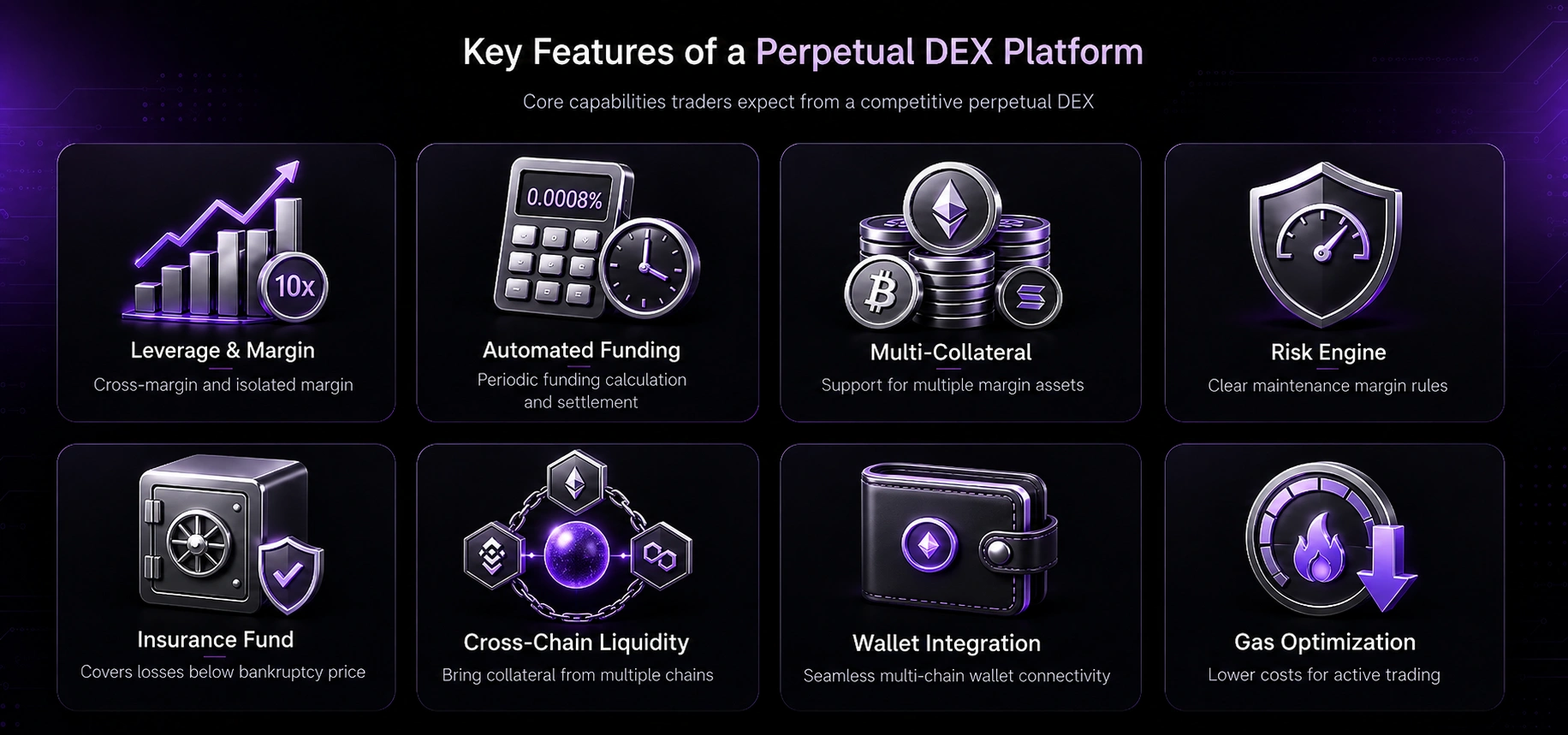
Here’s what makes a competitive platform:
- Leverage and margin management, encompassing both cross-margin and isolated-margin types.
- Automated funding rate calculation and payment at a predetermined interval.
- Multi-collateral support ensures that traders are not limited to a single margin asset.
- A liquidation and risk engine with clearly defined maintenance margin levels
- Insurance-fund logic absorbs liquidations that settle below the bankruptcy price.
Cross-Chain Liquidity, Wallet Integration, and Gas Optimization
Multi-chain reach is becoming as crucial as the trade engine itself. Traders expect to bring collateral from the chain on which they already own assets, rather than manually bridging before each position they open, implying that cross-chain liquidity aggregation is no longer an optional feature for a competitive platform. That expectation extends beyond collateral routing to the wallet layer itself, since putting traders through a single-chain connect flow creates a friction point that gradually pulls traffic back toward centralized venues. With multi-chain wallet connectivity, traders may connect from whichever network they already use. GMX’s own documentation, for example, describes execution against Oracle index prices with a unified account balance that can be used across supported networks, rather than forcing traders to bridge manually before each trade, which is a useful reference for how Oracle-based pricing replaces a vAMM curve in practice.
None of this matters if transaction fees undermine the trading experience. Every liquidation check, financing settlement, and position update touches the chain, hence gas optimization in the contract layer has a direct impact on a platform’s ability to offer high-frequency strategies at a fair cost.
The Perpetual DEX Development Process
Building a perpetual DEX differs significantly from building a spot exchange. The following are the seven stages that take a perpetuals platform from concept to mainnet:
Step 1: Architecture Selection
Choose the pricing model (vAMM, pooled liquidity, or order book) because it influences practically every downstream engineering decision. Each model has a unique cost, complexity, and risk profile that influences the overall build.
Step 2: Pricing and Funding Rate Logic
Create the basic pricing mechanism and financing rate engine that maintain contract prices tied to spot. This layer controls how positions are valued and how financing payments are distributed between longs and shorts at each settlement period.
Step 3: Liquidation Engine and Insurance Fund
Create a liquidation engine that closes under-collateralized positions and an insurance fund to absorb bad debt when liquidations lag price movements. These are the safety rails that keep cascading losses from spreading throughout the platform.
Step 4: Risk Parameters Per Market
Set maximum leverage, margin tiers, and open-interest caps for each market. These characteristics define the platform’s risk per asset and have a direct impact on trader experience and protocol solvency.
Step 5: Smart Contract Development and Testing
Smart contract development for a perpetuals platform entails far more risk than a spot swap agreement. Positions, collateral, and leverage are all part of the same state machine; a single logic fault can cascade through all open positions rather than just one trade. Testing must cover edge scenarios such as simultaneous liquidations and large financing swings, which takes longer than testing a stateless swap contract.
Step 6: Frontend, Wallet Integration, and Testnet Simulation
Only after the trading core is stable does front-end and wallet integration work begin. Testnet simulation follows under adversarial conditions – oracle lag, thin liquidity, and cascading liquidations all need stress-testing before mainnet.
Step 7: Independent Audit and Mainnet Deployment
A dedicated smart contract audit process, ideally with multiple independent businesses assessing the liquidation and funding logic independently, occurs prior to mainnet deployment rather than later. dYdX’s migration from a hybrid v3 architecture to its fully decentralized v4 chain serves as a useful reference point: the team rebuilt the order book and matching engine as an in-memory, validator-run system rather than retrofitting existing contracts, as CoinDesk reported when the v4 codebase was open-sourced.
Cost to Build a Perpetual DEX in 2026
The cost estimates below are indicative and not quotes, and will vary depending on chain support, audit depth and markets opened on day one.
- Core smart contracts (position management, funding logic, liquidation engine): roughly $60,000-$150,000.
- Oracle integration and price-feed redundancy: $15,000-$40,000.
- Front-end trading interface with real-time order book or pool visualization: $40,000-$90,000.
- Security audits, typically requiring at least two independent firms for a derivatives platform: $30,000-$80,000+.
A production-ready perpetual DEX typically costs $150K-$400K, tho multi-chain deployments with extensive audit coverage can be higher.
Cost drivers worth flagging: The pricing strategy (pooled liquidity generally costs less than full on-chain order book), chains supported at launch, leverage tiers and markets launched on day one, and scope of audit. Teams with a more limited timeframe or budget may opt for a white-label exchange foundation instead of a fully custom build, sacrificing some flexibility for a faster path to a live market, which can be more important than a fully bespoke design when a competitor is already live in the same niche. Others are somewhere in between, blending off-chain elements with on-chain settlement, rather than fully committing to one side or the other. This is achieved through a hybrid exchange that combines an off-chain matching layer with an on-chain settlement to manage cost and delay without the requirement to develop a full custom order-book.
Launch a Secure Multi-Chain Perpetual Trading Platform for Institutional and Retail Users
Security and Risk Management
Perpetual DEXs pose significantly more risk than spot venues because leverage magnifies the financial impact of any bug, and the attack surface includes economic exploits that do not require a code vulnerability at all, such as funding-rate manipulation, Oracle price manipulation, and liquidation cascades caused by thin order books. OWASP’s Smart Contract Top 10 for 2026 rated business-logic vulnerabilities second, indicating that protocol-level design defects now account for more real-world losses in DeFi than basic coding faults like reentrancy.
A serious audit scope includes the liquidation engine under excessive volatility, the funding-rate formula’s resistance to manipulation, and the insurance fund’s solvency under cascade liquidations, rather than a line-by-line inspection. Continuous post-launch monitoring of open interest concentration, funding anomalies, and oracle deviation generally detects problems before they cause losses.
Choosing a Perpetual DEX Development Partner
The track record is more important here than in most Web3 engagements since derivatives platforms fail in expensive and public ways. A genuine Perpetual dex development company should demonstrate funding-rate and liquidation-engine work completed, rather than merely basic DeFi experience. A Decentralized Exchange Development company that has simply constructed spot AMMs is not always qualified to design a liquidation engine or insurance fund.
Before committing, founders considering DEX Development services should ask pointed questions: What price strategy do they advocate for your target audiences, and why? How do they stress-test the liquidation engine before mainnet? Who audits the contracts, and what is their scope? How is the insurance fund capitalized if it depletes during a period of high volatility? Vague responses are a cue to continue evaluating.
Concluding Note
Perpetual DEXs have evolved from a specialized experiment to a fundamental component of how cryptocurrency trades, and this trend shows no signs of slowing as protocols decrease the performance gap with centralized venues. Getting the design, finance mechanics, and risk engine right the first time is more important here than in virtually any other Web3 project. For teams assessing perpetual DEX development, the platforms that succeed in 2026 will be those that tackled security and liquidation design as first-class challenges from the start, rather than an afterthought added just before launch. The gap between perpetual and spot volumes is likely to expand as institutional traders seek the leverage and hedging capabilities that derivatives may provide.
Frequently Asked Questions
1. What is perpetual DEX development?
Perpetual DEX development creates decentralized exchanges for perpetual futures contracts, which are leveraged products with no expiry date and use a financing rate mechanism to remain tied to spot prices. Perpetual platforms, as opposed to spot DEX constructions, require a funding rate engine, a liquidation engine, and an insurance fund. Between January 2024 and January 2026, perpetual futures volume increased by around eightfold.
2. How do perpetual DEXs differ from spot DEXs?
A spot DEX only allows you to purchase and sell assets at the current market price. A perpetual futures trading dex platform enables leverage, shorting, and continual exposure via funding rate methods. Perpetual DEXs also require liquidation engines, insurance funds, and risk management infrastructure, which spot venues do not need. Hyperliquid is now clearing more monthly volume than the top five DEXs combined.
3. What are the three architectural models for perpetual DEXs?
The three models are virtual AMM (vAMM), which simulates a constant-product curve without real reserves, pooled liquidity, which uses a real multi-asset pool with oracle-based pricing (GMX), and order book models, which replicate centralized exchange matching on-chain (dYdX and Hyperliquid). Each has a varied cost, complexity, and risk profile.
4. How much does it cost to build a perpetual DEX in 2026?
A production-ready perpetual DEX typically costs between $150,000 and $400,000. Core smart contracts cost between $60,000 and $150,000, Oracle integration between $15,000 and $40,000, frontend $40,000 to $90,000, and security audits between $30,000 and $80,000 or more. Multi-chain deployments with extensive audit coverage may exceed these thresholds. Pooled liquidity models are often less expensive than full on-chain order books.
5. How do I choose a Perpetual DEX development company?
A genuine Perpetual DEX development company should be able to demonstrate funding-rate and liquidation-engine work completed, rather than merely generic DeFi experience. A Decentralized Exchange Development business that has only created spot AMMs is unqualified to construct a liquidation engine. Ask specific questions concerning pricing model recommendations, stress-testing methodology, audit partners, and insurance fund capitalization.
6. Why is security more critical for perpetual DEXs than spot DEXs?
Perpetual DEXs pose a higher risk because leverage magnifies the financial effect of any defect. The attack surface includes economic exploits that do not require code vulnerabilities, such as funding-rate manipulation, Oracle price manipulation, and liquidation cascades. OWASP’s 2026 Smart Contract Top 10 rated business-logic vulnerabilities second, indicating that protocol-level design errors currently account for the majority of real-world DeFi losses.
Ready to Build a Secure, High-Performance Perpetual DEX?
