



Key Takeaways
- A blockchain-based voting system combines blockchain, smart contracts, cryptography, voter authentication, and digital voting interfaces.
- The cost of a blockchain voting system depends on factors such as voter population, blockchain architecture, privacy requirements, security testing, authentication, and deployment complexity.
- Advanced technologies such as zero-knowledge proofs, anonymous credentials, and homomorphic encryption can support privacy-preserving voting.
- Smart contracts can automate election rules such as eligibility checks, voting periods, and duplicate-vote prevention.
Introduction
Blockchain technology is being explored for electronic voting because it can provide a distributed and auditable record of transactions. A blockchain-based voting system combines blockchain networks with smart contracts, cryptography, voter authentication, and digital voting interfaces.
However, blockchain alone does not guarantee secure or anonymous elections. A reliable blockchain voting system must also address voter eligibility, ballot privacy, duplicate voting, authentication, security, accessibility, and result verification.
This guide covers the key features, architecture, technologies, development process, security considerations, challenges, and cost factors involved in building a blockchain-based electronic voting system.
What Is a Blockchain-Based Voting System?
A blockchain-based voting system is an electronic voting platform that uses blockchain technology to record and verify election-related transactions or cryptographically protected ballots.
Instead of relying entirely on a centralized database, the blockchain can provide a distributed and tamper-resistant record. Smart contracts can also automate predefined election rules, such as eligibility checks, voting periods, and duplicate-vote prevention.
A complete blockchain voting system may include:
- Voter registration
- Voter authentication
- Eligibility verification
- Digital voting
- Smart contracts
- Blockchain infrastructure
- Cryptographic privacy mechanisms
- Vote verification
- Result tallying
- Election auditing
How Does Blockchain Voting Work?
The exact workflow depends on the election design, but a typical system involves several stages.
1. Voter Registration
Eligible voters are registered before an election. The registration process establishes whether an individual is permitted to participate. Sensitive identity information should generally not be placed directly on a public blockchain.
2. Voter Authentication
The system verifies the voter’s identity or eligibility using appropriate authentication mechanisms. Depending on the use case, this can involve digital credentials, institutional identity systems, or multi-factor authentication.
3. Ballot Casting
After authentication, the voter accesses the digital ballot and selects the preferred candidate or option. The system should ensure that the ballot is created and submitted according to the election’s privacy and integrity requirements.
4. Smart Contract Validation
Smart contracts can enforce predefined election rules, including voting periods, eligibility conditions, and restrictions against duplicate submissions.
5. Blockchain Recording
Relevant transactions, cryptographic commitments, or other election records can be recorded on the blockchain. The exact information stored on-chain should be carefully designed because blockchain data can be persistent and publicly observable depending on the network.
6. Vote Verification and Counting
The election system processes valid ballots and produces the final result. A properly designed system should provide appropriate mechanisms for verifying that the tally corresponds to valid votes.
Design a Secure Blockchain Voting System for Your Use Case
Key Features of a Blockchain Voting System
1. Secure Voter Authentication
Voter authentication ensures that only authorized participants can access an election.
Potential authentication methods include:
- Digital identity
- Multi-factor authentication
- Institutional identity systems
- Cryptographic credentials
- Decentralized identity mechanisms
Authentication should be designed separately from ballot secrecy so that proving voter eligibility does not reveal the voter’s choice.
2. Voter Eligibility Verification
A blockchain voting platform needs to determine whether a person is eligible to participate in a particular election.
Eligibility information can be maintained through an identity or registration system, while the blockchain can receive only the information required to validate voting eligibility.
3. Smart Contract-Based Voting
Smart contracts can automate election rules and reduce reliance on manual administrative processes.
Typical smart contract functions may include:
- Creating an election
- Registering candidates
- Defining the voting period
- Validating voting credentials
- Preventing duplicate voting
- Closing an election
- Supporting result verification
Smart contracts should be thoroughly tested and independently audited before being used in a high-stakes election.
4. Voter Privacy and Ballot Secrecy
Privacy is one of the most important challenges in blockchain voting. Simply storing a hashed voter ID or blockchain wallet address does not automatically make a voter anonymous. Blockchain transactions and metadata may potentially be correlated with external information.
Privacy-preserving approaches can include:
- Zero-knowledge proofs
- Anonymous credentials
- Homomorphic encryption
- Cryptographic commitments
- Mix networks
The appropriate approach depends on the election’s security and privacy requirements.
5. Duplicate Vote Prevention
A blockchain voting system needs to prevent an eligible voter from submitting more than the permitted number of ballots.
A simple prototype may associate a voting status with an account. Production systems require stronger mechanisms because a blockchain account does not necessarily represent one real-world individual.
6. Transparent and Auditable Records
Blockchain can provide a persistent record that can support election auditing. However, transparency must be carefully balanced with ballot secrecy. An auditable system should allow election integrity to be checked without exposing an individual voter’s choice.
7. Verifiable Election Results
A robust voting platform should provide mechanisms to verify relevant aspects of the election, including ballot inclusion, vote integrity, and tally correctness. The verification process should not compromise voter privacy.
Blockchain Voting System Architecture
A blockchain voting system normally consists of several interconnected components and requires carefully planned blockchain development across the identity, application, smart contract, and verification layers.
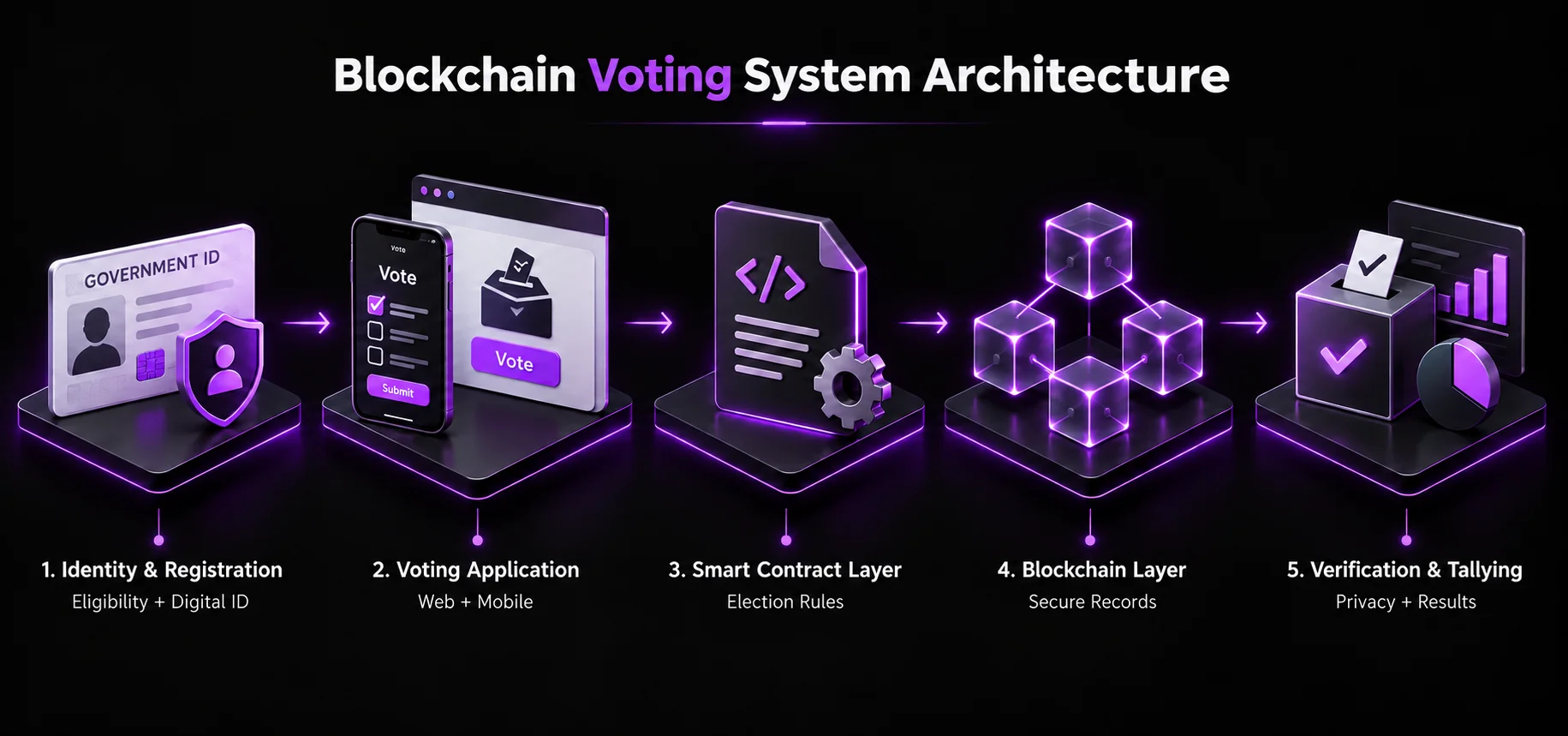
1. Identity and Registration Layer
This layer manages voter registration and eligibility information.
It may integrate with:
- Government identity systems
- University or institutional databases
- Digital identity providers
- Decentralized identity systems
2. Voting Application
The voting application provides the user interface through which voters authenticate and cast their ballots. A web or mobile application may be used depending on the target users and deployment environment.
3. Smart Contract Layer
Smart contracts implement predefined election rules and interact with the blockchain network. The contract design should minimize unnecessary on-chain data and carefully control administrative privileges.
4. Blockchain Layer
The blockchain stores transactions or cryptographic records associated with the election. Depending on the use case, developers may consider public blockchains, Layer-2 networks, or permissioned blockchain platforms.
5. Verification and Tallying Layer
This component processes valid ballots and supports election-result verification. Its design depends heavily on whether the election uses encrypted ballots, zero-knowledge proofs, homomorphic encryption, or another privacy-preserving mechanism.
Technologies Used to Build a Blockchain Voting System
The technology stack depends on the election requirements and desired security model.
1. Blockchain Platforms
Potential choices include:
- Ethereum-compatible networks
- Layer-2 blockchain networks
- Hyperledger-based permissioned networks
- Other enterprise or specialized blockchain platforms
2. Smart Contract Development
Common tools and technologies include:
- Solidity
- Hardhat
- Foundry
- OpenZeppelin libraries
3. Frontend Development
The voting interface can be developed using technologies such as:
4. Backend Development
Depending on the architecture, backend services can use:
5. Database
A conventional database may still be required for information that should not be stored directly on the blockchain, including application metadata and sensitive administrative information.
This creates a hybrid architecture in which blockchain is used for selected election records rather than acting as the entire application database.
Blockchain Voting System Development Process
Step 1: Define Election Requirements
Before selecting a blockchain platform, define:
- Voter eligibility rules
- Election type
- Number of voters
- Voting method
- Ballot privacy requirements
- Authentication requirements
- Result-verification requirements
- Accessibility requirements
- Legal and regulatory requirements
Step 2: Design the System Architecture
Determine how the identity system, voting application, cryptographic layer, smart contracts, blockchain, database, and result-verification mechanisms will interact. Privacy and security should be incorporated into the architecture from the beginning.
Step 3: Develop Smart Contracts
Implement the election rules using carefully designed smart contracts.
The development process should include:
- Unit testing
- Integration testing
- Access-control testing
- Security testing
- Gas and performance analysis
- Independent code review
Step 4: Develop the Voting Application
The application should provide voters with a simple and accessible interface.
Important considerations include:
- Clear ballot presentation
- Secure authentication
- Mobile compatibility
- Accessibility
- Error handling
- Transaction confirmation
- Voter guidance
Step 5: Implement Privacy and Cryptography
Select appropriate cryptographic mechanisms based on the required privacy model. Avoid assuming that hashing alone provides voter anonymity.
Step 6: Test the Voting System
Testing should cover the complete system rather than only the smart contract.
Important testing areas include:
- Functional testing
- Smart contract testing
- Security testing
- Privacy testing
- Load testing
- Usability testing
- Accessibility testing
- Failure and recovery testing
Step 7: Conduct Security Audits
Security reviews should examine smart contracts, application code, authentication, cryptographic protocols, infrastructure, and access controls.
Step 8: Deploy and Monitor
After deployment, the system should be monitored for availability, security incidents, authentication failures, suspicious transactions, and infrastructure problems.
Security Considerations for Blockchain Voting
1. Smart Contract Security
A vulnerable smart contract can affect election integrity even when the underlying blockchain is functioning correctly.
2. Voter Device Security
Blockchain cannot prevent malware on a voter’s device from interfering with the voting process before a transaction reaches the blockchain.
3. Identity and Credential Security
Compromised credentials can allow unauthorized access, making secure authentication and credential management essential.
4. Ballot Privacy
Election systems must prevent unauthorized parties from connecting a voter with their selected candidate or ballot.
5. Denial-of-Service Protection
The voting platform must remain available during the election period and have appropriate resilience against service disruption.
6. Key Management
Cryptographic keys need secure generation, storage, recovery, rotation, and revocation procedures.
7. Coercion Resistance
A voting system should consider whether voters can be forced to reveal or prove their choices. This is a significant consideration for remote electronic voting.
Advantages of Blockchain-Based Voting
Blockchain-based voting can offer several potential advantages when appropriately designed:
- Tamper-resistant election records
- Distributed record keeping
- Automated election rules
- Improved auditability
- Transparent transaction verification
- Reduced dependence on a single database
- Potentially verifiable vote records
Challenges of Blockchain-Based Voting
1. Scalability
Large elections can generate significant transaction and infrastructure requirements. The selected blockchain architecture must support the expected number of voters and election transactions.
2. Privacy
Public blockchain records can create privacy challenges because transactions may remain permanently available.
3. Security
Security vulnerabilities can exist in the frontend, backend, identity system, smart contracts, cryptographic protocols, and voter devices.
4. Usability
Voters should not need specialist blockchain knowledge to participate in an election.
5. Regulatory Requirements
Election systems may need to comply with applicable requirements for privacy, accessibility, identity verification, record keeping, and election auditing.
6. System Recovery
A complete voting platform needs procedures for technical failures, compromised credentials, infrastructure outages, and other unexpected incidents.
How Much Does It Cost to Build a Blockchain Voting System?
The cost of developing a blockchain voting system depends on its scope, voter population, security requirements, blockchain architecture, and deployment environment. On an average it ranges from $25K for a basic DAO voting structure to $150K+ for an enterprise level system.
1. A basic prototype may require:
- Smart contract development
- Basic voting interface
- Development blockchain
- Simple authentication
- Basic testing
2. A larger production system may require:
- Secure identity infrastructure
- Advanced cryptographic protocols
- Smart contract audits
- Penetration testing
- High-availability infrastructure
- Accessibility testing
- Monitoring and incident response
- Compliance and legal review
- Long-term maintenance
For this reason, a generic development-cost figure should be treated only as an estimate. A meaningful budget requires the project’s functional and security requirements to be defined first.
Get a Clear Estimate for Your Blockchain Voting System
Blockchain Voting vs Traditional Electronic Voting
| Factor | Traditional Electronic Voting | Blockchain-Based Voting |
| Data storage | Centralized or distributed database | Blockchain or hybrid architecture |
| Record verification | Depends on system design | Blockchain can provide persistent records |
| Smart contracts | Usually not used | Can automate election rules |
| Auditability | Depends on implementation | Can support transaction-level auditing |
| Voter privacy | Depends on architecture | Requires dedicated privacy mechanisms |
| Authentication | Usually external identity system | Can integrate with identity and cryptographic systems |
| Scalability | Depends on infrastructure | Depends on blockchain architecture |
| Security | Depends on complete system | Depends on blockchain, application, identity, and cryptography |
Future of Blockchain-Based Electronic Voting
Future development of blockchain voting systems is likely to focus on combining distributed ledgers with privacy-preserving cryptography.
Important areas include:
- Zero-knowledge proofs
- Anonymous credentials
- Decentralized identity
- Homomorphic encryption
- Verifiable computation
- Privacy-preserving vote tallying
- Layer-2 blockchain technology
- End-to-end verifiable voting
Conclusion
A blockchain-based voting system combines blockchain technology with voter authentication, smart contracts, cryptography, digital voting interfaces, and election verification mechanisms.
Blockchain can provide an auditable and tamper-resistant infrastructure layer, but it does not independently guarantee voter anonymity, ballot secrecy, secure authentication, or accurate election results.
A reliable blockchain voting system built with Techfyte can help design a complete election infrastructure, with security, privacy, usability, accessibility, scalability, and verification considered throughout the development process.
Frequently Asked Questions
1. What is a blockchain-based voting system?
A blockchain-based voting system is an electronic voting platform that uses blockchain technology to record and verify election-related transactions or cryptographically protected ballots. It can provide an auditable record while using additional technologies for authentication, privacy, and vote verification.
2. Is blockchain voting secure?
Blockchain can provide tamper-resistant records, but it does not automatically make an election secure. A secure blockchain voting system also needs strong authentication, ballot privacy, secure smart contracts, protected voter devices, cryptographic safeguards, and appropriate auditing.
3. Does blockchain voting provide voter anonymity?
Not automatically. Public blockchain transactions can potentially be associated with accounts and other metadata. Voter anonymity requires dedicated privacy mechanisms such as anonymous credentials, zero-knowledge proofs, cryptographic commitments, or other privacy-preserving techniques.
4. What are smart contracts used for in blockchain voting?
Smart contracts can automate predefined election rules, including election timing, eligibility checks, duplicate-vote prevention, candidate management, and other voting processes.
5. How much does it cost to develop a blockchain voting system?
The cost of developing a blockchain voting system varies according to the number of voters, voting features, blockchain architecture, authentication requirements, privacy mechanisms, security testing, and deployment requirements. A basic prototype range $25K and a production-grade election platform range $150K+ depending on substantially different development requirements and costs.
6. How long does it take to develop a blockchain voting system?
Development time depends on the system’s scope and security requirements. A basic prototype can be developed considerably faster than a production system requiring advanced cryptography, identity integration, security audits, accessibility testing, scalability testing, and independent verification.
7. What programming languages are used for blockchain voting systems?
Solidity is commonly used for smart contracts on Ethereum-compatible networks. Other parts of the system may use JavaScript or TypeScript for frontend and backend development, along with languages such as Python, Java, or Go depending on the architecture.
8. Can blockchain voting be used for elections?
Blockchain technology can be used as part of an electronic voting architecture, but suitability depends on the election’s requirements, applicable regulations, security model, privacy requirements, and independent verification. A blockchain ledger by itself is not a complete election system.
9. What are the benefits of a blockchain voting system?
Potential benefits include persistent election records, automated rules through smart contracts, distributed record keeping, and support for auditability and verification. These benefits depend on how the overall voting system is designed and implemented.
Explore a Secure and Scalable Blockchain Voting Solution
