Secure DeFi-Integrated Wallet Development for Finance
We help fintechs and enterprises launch secure multi chain wallets with strong key management, carefully audited smart contracts, and clean system architecture. The result is a wallet your users can trust and your teams can scale with confidence.
- Non custodial by design
- Built for multi chain
- Security first architecture











What is DeFi-Integrated Wallet Development?
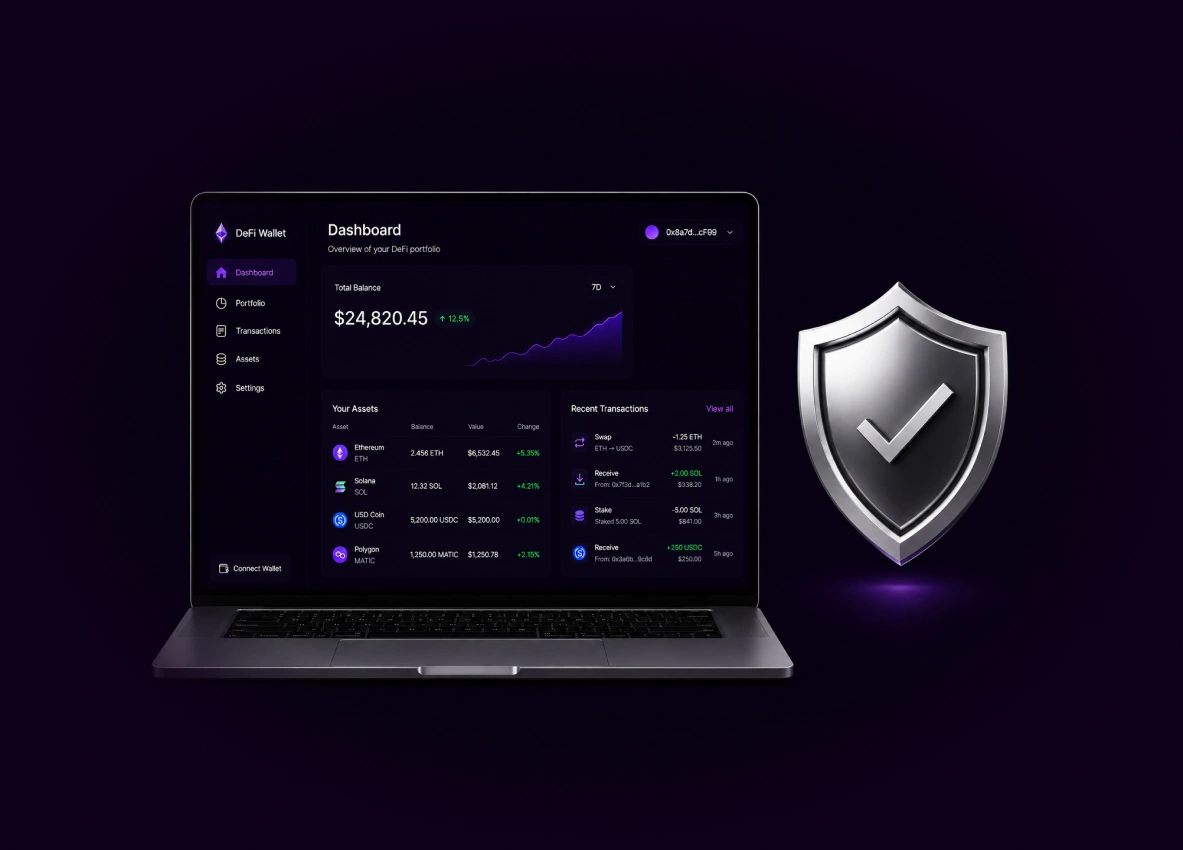
A DeFi-integrated wallet changes how users interact with digital finance. Instead of acting like a basic crypto wallet that only sends, receives, or holds assets, it allows users to engage directly with decentralized finance features from a single interface. Through smart contract interaction, users can move beyond simple transfers and take part in on-chain activity without relying on external custodians or manual workflows. This approach also supports dApp browser access and WalletConnect integration, along with multi-chain wallet architecture for cross-network execution, making it easier to connect with DeFi protocols while keeping control of assets. As a self-custody wallet, it becomes an active entry point into decentralized finance rather than a passive storage tool. For businesses, this creates new ways to deliver financial products, retain users, and stay relevant as Web3 adoption accelerates.
- Direct protocol access
- On chain interaction
- User owned control
Why Are DeFi-Integrated Wallets Important for Businesses?
DeFi-integrated wallets sit at the center of how users experience digital finance. They are where value moves, actions happen, and trust is formed. When this layer belongs to your platform, you decide how users interact with DeFi instead of relying on external tools that limit flexibility and insight. Ownership of the wallet layer changes how teams operate. Product updates happen faster, user behavior is easier to understand, and new features can be introduced without breaking existing flows. As decentralized finance grows more complex, having direct control over the wallet experience helps businesses stay adaptable, competitive, and closely aligned with user expectations.

Product Ownership Advantage
Owning the wallet experience lets businesses shape user journeys, reduce dependency risks, and align product strategy with long term goals.

Faster Innovation Cycles
Direct control enables quicker iteration, smoother rollouts, and faster response to changing market and user demands.

Scalable Market Reach
Multi chain capability allows products to expand across ecosystems while supporting growth without technical bottlenecks.

Long Term Trust Building
A consistent wallet experience builds confidence by delivering reliability, transparency, and steady value over time.
Plan your DeFi Wallet Approach
Talk to Our EngineersBenefits of DeFi-Integrated Wallet Development
DeFi wallet development shapes how products balance user ownership, system flexibility, and operational control, giving businesses room to grow without rebuilding core infrastructure.

Non Custodial Control
A non-custodial crypto wallet gives users full asset ownership while businesses avoid custody risks and maintain regulatory flexibility.

Multi Chain Support
Multi-chain wallet support enables seamless asset management across networks, helping products serve broader markets without locking users into ecosystems.

DeFi Protocol Aggregation
DeFi protocol aggregation allows users to access swaps, lending, and staking from one interface, reducing friction and improving engagement.

White Label Readiness
A white label DeFi wallet solution allows faster launches with branding control, product customization, and easier alignment with internal requirements.

Enterprise Grade Security
Enterprise DeFi wallet development ensures scalable, reliable infrastructure for production systems, while AI wallets enable adaptive risk detection and transaction intelligence.

Security Focused Architecture
Secure DeFi wallet development prioritizes audits, hardened systems, and risk controls to protect assets while maintaining long term platform trust.
How DeFi-Integrated Wallets Work?
DeFi wallets handle routing, signing, and contract execution in the background, keeping interactions smooth while users focus on simple, uninterrupted DeFi experiences.
dApp Connections
Wallets establish secure sessions with decentralized applications by relaying signed requests through blockchain nodes without ever sharing private keys externally.
Contract Execution
User actions are translated into smart contract calls, simulated first, then approved and broadcast on-chain for deterministic execution across networks.
Multi-Chain Logic
Multi-chain wallets route transactions to the correct network by managing chain identifiers, RPC endpoints, and asset standards internally at scale.
Signing Flow
All transactions are signed locally on user devices, ensuring cryptographic proof of intent without exposing sensitive credentials anywhere during execution.
WalletConnect Sessions
WalletConnect creates temporary, encrypted communication channels allowing external dApps to request approvals while wallets retain full control over session lifecycles.
Embedded Browsers
Built-in dApp browsers load protocol interfaces directly inside wallets, reducing context switching and simplifying complex DeFi interactions for everyday users.
Our DeFi Wallet Development Services
As a DeFi wallet development company, we design and build secure, scalable wallet solutions that support real-world DeFi use cases across ecosystems.

Custom DeFi Wallet Development
Build tailored wallets aligned with your product flow, security needs, and user experience without relying on rigid templates or limitations.

White Label DeFi Wallet Development
Launch quickly using customizable wallet infrastructure that supports branding, feature configuration, and flexible deployment across multiple platforms efficiently.

DeFi Wallet Integration Services
Integrate DeFi protocols, APIs, and blockchain networks into existing platforms to enable secure transactions, staking, swaps, and seamless on-chain interactions.

DeFi Mobile Wallet Development
Develop mobile-first wallet applications with intuitive interfaces, secure key management, and smooth performance for everyday decentralized finance usage.

DeFi Web Wallet Development
Create browser-based wallets that connect users directly with decentralized applications while maintaining security, speed, and consistent multi-chain compatibility support.

Multi Chain DeFi Wallet Development
Enable cross-chain asset management with unified access, transaction routing, and support for multiple blockchain ecosystems within a single wallet interface.

Non Custodial DeFi Wallet Development
Build wallets ensuring users retain full ownership of private keys while interacting securely with decentralized finance protocols and applications.

Enterprise DeFi Wallet Development
Design enterprise-grade wallet systems with scalable architecture, high reliability, compliance readiness, and performance for large-scale financial operations.
DeFi Wallet Security & Auditing
Strengthen wallet systems through smart contract audits, vulnerability checks, and security frameworks designed to reduce risks and protect user assets.
DeFi-Integrated Wallet Development Solutions by Use Cases
DeFi-integrated wallet development solutions cover multiple real-world use cases, enabling secure, scalable, and multi-chain wallet experiences across different product and infrastructure needs.

Trading Wallet Systems
Build wallets optimized for high-frequency trading with fast execution, real-time pricing, and seamless token swapping across decentralized exchanges.
- Low-latency transaction routing
- Integrated DEX aggregation
- Real-time price feeds

Staking & Yield Wallets
Enable wallets that support staking, liquidity provision, and yield farming directly within the interface using secure smart contract interactions.
- Automated staking workflows
- Multi-pool yield access
- Reward tracking engine
Multi-Chain Wallet Infrastructure
Develop wallets that operate across multiple blockchain networks with unified asset visibility and seamless cross-chain transaction handling.
- Cross-chain asset mapping
- Unified wallet dashboard
- RPC orchestration layer

Enterprise Custody Alternatives
Create non-custodial enterprise wallet systems that replace traditional custody models while maintaining compliance-ready security controls and auditability.
- Private key isolation
- Policy-based approvals
- Audit trail logging

DeFi Aggregation Platforms
Build wallets that aggregate multiple DeFi protocols into a single interface for lending, borrowing, swapping, and liquidity management.
- Protocol API integration
- Unified DeFi dashboard
- Smart routing engine

Embedded Wallet SDKs
Provide SDK-based wallet infrastructure for embedding DeFi wallet functionality directly into existing apps and fintech platforms.
- Modular SDK components
- White-label integration support
- Secure signing APIs
Web3 Wallet
A next-generation Web3 wallet infrastructure that simplifies blockchain interactions through seamless onboarding, secure key management, and intuitive transaction experiences.
- Passwordless wallet onboarding
- Simplified key management
- Seamless cross-chain transactions

Industries Powering Growth With DeFi Wallets
DeFi-integrated wallet development is used by organizations that need secure digital asset infrastructure and scalable blockchain-based financial systems.

Fintech Companies
Fintech firms use wallet systems to build secure digital asset products and enable access to decentralized financial services across modern financial ecosystems and platforms for better user experiences and product scalability.
- Faster product innovation
- Improved user experience
- Strong engagement flow

Banking Sector
Banks use blockchain wallet infrastructure to explore digital asset capabilities while maintaining compliance, governance, and secure financial operations across regulated banking environments.
- Regulatory alignment
- Secure system integration
- Controlled innovation

Insurance Industry
Insurance companies explore blockchain wallet infrastructure to improve claims processing, financial transparency, and secure digital asset management within regulated frameworks.
- Transparent claim systems
- Secure financial records
- Process automation support

Enterprise Technology Sector
Enterprise technology organizations deploy wallet infrastructure to support blockchain integration, internal asset systems, and secure digital financial operations at scale.
- Scalable architecture
- System interoperability
- Secure enterprise operations
Fintech Companies
Fintech firms use wallet systems to build secure digital asset products and enable access to decentralized financial services across modern financial ecosystems and platforms for better user experiences and product scalability.
- Faster product innovation
- Improved user experience
- Strong engagement flow
Banking Sector
Banks use blockchain wallet infrastructure to explore digital asset capabilities while maintaining compliance, governance, and secure financial operations across regulated banking environments.
- Regulatory alignment
- Secure system integration
- Controlled innovation
Insurance Industry
Insurance companies explore blockchain wallet infrastructure to improve claims processing, financial transparency, and secure digital asset management within regulated frameworks.
- Transparent claim systems
- Secure financial records
- Process automation support
Enterprise Technology Sector
Enterprise technology organizations deploy wallet infrastructure to support blockchain integration, internal asset systems, and secure digital financial operations at scale.
- Scalable architecture
- System interoperability
- Secure enterprise operations
Transform Industry Finance With Wallets
Connect With TeamDeFi Wallet Development Workflow
Building a DeFi wallet is less about steps on paper and more about making aligned technical decisions that hold up under real network pressure, user behavior, and security constraints.

Product Constraints Definition
The process begins by translating business goals into technical constraints such as transaction limits, custody model, compliance boundaries, and supported blockchain environments. This prevents misalignment during later development stages.
Architecture & Tradeoff Planning
Instead of jumping into build mode, core decisions are made around scalability, latency tolerance, key management models, and integration depth. Every choice here directly impacts long-term stability and operational cost.


Execution & Controlled Release
The system is implemented in incremental phases where components are validated under real network conditions. Deployment is treated as a controlled rollout, followed by continuous refinement based on live system behavior.
Why Choose Us as DeFi Wallet Development Company?
Techfyte works on wallet engineering that prioritizes real usage pressure, ensuring systems remain stable, adaptable, and dependable as DeFi environments evolve.

Built Around Real Security Needs
We design wallets around real attack patterns and production risks, implementing MPC-based key management where advanced security is required.

Native Multi-Chain Thinking
Instead of adding chains later, we structure wallets to operate across multiple networks from the start, keeping performance and user experience consistent as ecosystems expand.

Engineering-Led Custom Builds
Every wallet is shaped around product logic and technical constraints together, so teams get flexibility without compromising stability or long-term scalability.