




Key Takeaways
- DeFi development companies now build far more than dApps, offering lending protocols, DEXs, staking platforms, wallets, and cross-chain financial ecosystems.
- Security, smart contract audits, and compliance readiness are critical factors when selecting a DeFi development partner in 2026.
- Cross-chain interoperability has become a major focus, helping users and liquidity move seamlessly across multiple blockchain networks.
- Leading DeFi firms combine blockchain engineering, tokenomics, UI/UX design, and liquidity architecture to create scalable products.
- Development costs vary based on complexity, security requirements, blockchain selection, integrations, and customization needs.
- The future of DeFi is shifting toward institutional-grade platforms that prioritize scalability, regulatory alignment, and user-friendly experiences.
Introduction
A DeFi development company is a blockchain technology partner that builds decentralized finance platforms, smart contracts, wallets, lending protocols, staking systems, DEXs, and cross-chain financial applications without relying on traditional intermediaries. As businesses search for the Top 10 DeFi Development Companies in 2026, the focus has shifted from basic dApp creation to secure, scalable, and institutional-grade DeFi architecture. Modern DeFi products now require specialized smart contract development for DeFi, robust token economics, risk controls, interoperability, liquidity engineering, and regulatory-aware design. Choosing a specialized DeFi development company is critical for startups, fintech firms, Web3 ventures, and enterprises entering decentralized finance. This list helps businesses navigate the complex DeFi development ecosystem, from decentralized exchange development and yield farming platforms to compliance & audit for DeFi apps.
What Is a DeFi Development Company?
A DeFi development company is a specialized blockchain engineering firm that designs, builds, audits, and deploys decentralized financial products. These teams are made up of decentralized finance application developers, smart contract engineers, blockchain architects, tokenomics specialists, UI/UX designers, and security experts who create the infrastructure behind the open financial system.
Their role goes far beyond writing code. Core DeFi protocol development services may include smart contract development for DeFi, wallet integration, staking mechanisms, lending and borrowing platforms, liquidity pools, DAO governance systems, DeFi platform UI/UX design, and decentralized exchange development. More advanced teams also work on yield farming & liquidity protocols dev, risk management logic, oracle integration, token engineering, cross-chain messaging, and automated market maker models.
In 2026, the strongest DeFi companies are not just building isolated dApps. They are developing interoperable, cross-chain DeFi solutions that can operate across multiple blockchain ecosystems while maintaining security, usability, and liquidity efficiency. This makes a specialized DeFi development partner essential for startups, fintech firms, crypto-native businesses, and enterprises entering decentralized finance. For businesses evaluating the wider decentralized finance landscape, resources such as DefiLlama’s DeFi dashboard can help validate protocol categories, total value locked, chain activity, and market direction.
Why Hiring a Top DeFi Developer Matters
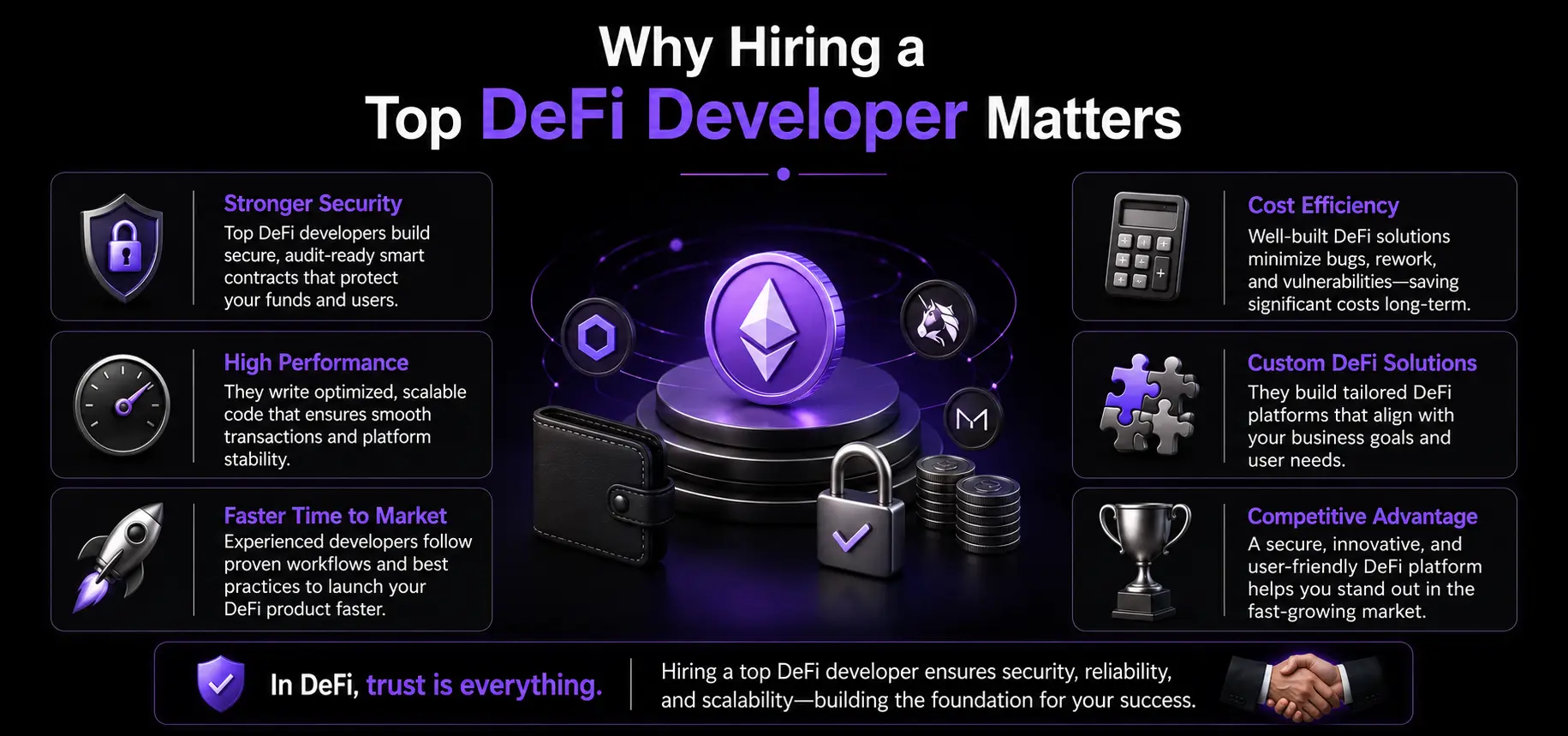
Decentralized finance is no longer a testing ground, and the need of employing a leading DeFi development business is vital. DeFi platforms have a large amount of digital asset value. Sophisticated financial processes are used. DeFi platforms attract institutional users looking for reliability, security, transparency and institutional-grade DeFi infrastructure.
A good DeFi development partner helps organizations design useful and strong products. It encompasses secure smart contract development for DeFi, resilient liquidity architecture, gas-efficient execution, scalable back-end systems, user-friendly UI/UX design for the DeFi platform, and reliable integrations with wallets, bridges, oracles, analytics tools, and compliance frameworks.
Blockchain interoperability is especially critical in decentralized finance (DeFi) in 2026. Users and liquidity are distributed over multiple chains. Therefore, good products typically need cross-chain DeFi solutions that link assets, protocols, and users without creating any unwanted friction. Companies that want to learn about the advancements in cross-chain communications, programmable token transfers and interoperability architecture for DeFi applications can refer to the Chainlink CCIP documentation.
It is life or death, between a top-tier DeFi corporation and a rookie team. A badly drafted contract, inadequate audit procedures or improper bridge integration might expose a project to exploitation, loss of liquidity, reputational damage and regulatory risk. For DeFi companies, a tailored secure build from an expert team will be the sound foundation for ongoing growth. Top Decentralized Ai platform to Watch in 2026 .
Criteria for Ranking the Best DeFi Companies
We examined each organization in this Top 10 DeFi Development Companies List for 2026 using a practical business-focused methodology. The point is to demonstrate to firms that they’re able to handle significant DeFi products rather than simply basic prototypes of blockchains.
The main ranking factors are:
-
-
- Expertise in 2026-era blockchain technologies, including zero-knowledge proofs, account abstraction, modular blockchain infrastructure, and advanced wallet experiences.
-
- Proven track record of building safe smart contracts for DeFi like staking, lending, decentralized exchange (DEX), decentralized autonomous organization (DAO), liquidity, and token-based systems.
- End-to-end delivery covering UI/UX designing, backend engineering, implementation, testing, maintenance, DeFi apps compliance and audit.
- Good grasp on blockchain interoperability with DeFi. Capability to provide cross-chain DeFi solutions.
- Global client feedback and delivery reliability, especially in US, Europe, MENA and new Web3 markets.
- Leading the way in institutional-grade DeFi architecture, security-first product design and scalable protocol engineering.
The ranking put a lot of emphasis on security and compliance as DeFi products are operating in high-value situations where the quality of code directly impacts user assets. Teams with competence in formal verification, smart contract audits and regulatory-compliant blockchain architecture, will be less exposed to technical and operational risk. External sources such Ethereum’s smart contract security guidance and ConsenSys best practices emphasize audit readiness and secure design as crucial selection factors.
Top 10 DeFi Development Companies in 2026
1. Techfyte
Techfyte is a perfect choice if you are a firm looking for a full-service DeFi protocol development service that can do it all from product design and smart contract development for DeFi to front-end engineering, wallet integration and post-launch optimization. Its main advantage in 2026 is the ability to combine a solid protocol architecture with UI/UX design of DeFi platforms that makes complex solutions more understandable and usable for clients. This is super important for yield farming & liquidity protocol dev, as clear dashboards, risk visibility, reward flows and transaction recommendations can directly impact user retention.
2. ChicMic Studios
ChicMic Studios is a premier DeFi and blockchain development company building custom Web3 platforms, crypto wallets, smart contracts, and scalable decentralized applications. In 2026 DeFi strength will be in offering business ready solutions for demands of startups and corporations like staking platforms, DeFi wallets, tokenized ecosystems, decentralized exchange modules and cross chain DeFi solutions. The company is best suitable for organizations that require fast product development, clean UI/UX design of DeFi platform, reliable smart contract development of DeFi without overloading the launch process.
3. Consensys
Consensys is a global leader in the Ethereum and Defi ecosystem, with deep connections to MetaMask, Infura, Linea and enterprise blockchain infrastructure. Consensys for 2026 is particularly relevant to institutional-grade DeFi architecture, wallet infrastructure, developer tooling & compliance & audit for DeFi apps through Consensys Diligence. It’s good at helping big DeFi projects build on top of battle-tested Ethereum infrastructure, while aligning security, scalability and regulatory readiness.”
Antier Solutions is a top DeFi development company with a strong footprint in Asia, MENA and enterprise blockchain space. It provides white label decentralized exchange development, crypto banking infrastructure, staking platforms and innovative cross-chain DeFi solutions to companies wishing to launch in the market earlier in 2026. Antier has been the preferred alternative for corporations looking for configurable DeFi products that can be developed around liquidity models, token utility, wallet flows and multi-chain asset support.
5. Alchemy
Alchemy is a key technical partner for DeFi teams building scalable apps as a leading blockchain infrastructure and node provider. DeFi protocol development services, developer APIs, account abstraction tooling, smart wallet infrastructure, analytics, and DeFi blockchain interoperability 2026 has a good correlation with it. Alchemy is not a traditional agency, but rather the technical infrastructure that decentralized finance application developers use to build reliable, high-performance applications across many chains.
6. Infinite Block Tech
Infinite Block Tech is a fast-growing DeFi development company making token-powered financial platforms, staking systems, and liquidity-focused Web3 applications. 2026 Yield farming & liquidity protocols dev, automated reward distribution logic, next-gen DeFi platform UI/UX design, cross-chain wallet integrations, industry leader Its development strategy is perfect for entrepreneurs who want to launch DeFi products with great visual usability, gamified financial flows, and scalable liquidity mechanisms.
7. Leeway Hertz
LeewayHertz is a trusted blockchain and AI development company with extensive experience in developing enterprise-grade DeFi products for startups, fintechs and large enterprises. Its unique strength in 2026 is its building of custom decentralized finance application developer hubs that combine the smart contract creation for DeFi with AI-driven risk assessment, fraud detection, liquidity forecasts and automated decision systems. This is especially critical for LeewayHertz in the case of companies that are building lending protocols, synthetic asset platforms, and DeFi products that need smart risk modelling.
8. Suffescom Solutions
Suffescom Solutions is known for rapid prototyping and quick deployment cycles, offering business-ready DeFi product development to companies looking to enter the market quickly. 2026: Building decentralized exchanges with built-in compliance & audit for DeFi application modules. Helping projects to establish trading, swapping, staking & liquidity solutions with tighter operational controls. The company is particularly suitable for founders looking for MVP to market execution without losing track of security, user onboarding or multi-chain support. It is an attractive alternative for organizations looking to target rapidly emerging areas for crypto adoption and provides regional dominance in MENA and APAC.
9. OpenZeppelin
OpenZeppelin is a global standard in smart contract security, secure libraries, audits, and blockchain developer tooling. Today, the company has evolved from providing standard audit support to building institutional grade DeFi architecture, protocol security design, access control frameworks, governance tooling and infrastructure that steers safe smart contract building for DeFi. OpenZeppelin is globally recognized as the trusted partner for teams that need security-first DeFi architecture from the very beginning of their development journey.
10. Rapid Innovation
Rapid Innovation is gaining steam to build cross-chain DeFi solutions, bridging liquidity, assets and user activity across multiple blockchains ecosystems. Blockchain interoperability will be DeFi’s biggest advantage in 2026, particularly for fintech companies that want to aggregate fragmented liquidity across EVM chains, Layer 2 networks and nascent modular blockchain ecosystems. The company’s strategy is well-suited to DeFi aggregators, cross-chain lending platforms, liquidity routing engines and financial applications connected to wallets.
Quick Comparison Table
| Company | Key 2026 Specialization | Primary Region(s) | Notable Service |
|---|---|---|---|
| Techfyte | End-to-end DeFi protocol development with product-led UI/UX | US, Europe | DeFi protocol development services and smart contract development for DeFi |
| ChicMic Studios | Agile DeFi product development with wallet, staking, and cross-chain capabilities | Asia, US, Europe, MENA | DeFi wallet development, smart contracts, staking platforms, and dApps |
| Consensys | Institutional-grade Ethereum and DeFi infrastructure | US, Global | MetaMask, Infura, Diligence, compliance & audit for DeFi apps |
| Antier Solutions | White-label DeFi and enterprise cross-chain platforms | Asia, MENA | Decentralized exchange development and cross-chain DeFi solutions |
| Alchemy | DeFi infrastructure, APIs, and interoperability tooling | North America, Global | Blockchain APIs, account abstraction, and developer infrastructure |
| Infinite Block Tech | Liquidity-driven DeFi products and UX-focused platforms | Europe, Asia | Yield farming & liquidity protocols dev |
| LeewayHertz | AI-integrated DeFi architecture and risk intelligence | US, Middle East | AI-powered smart contract development for DeFi |
| Suffescom Solutions | Rapid DEX prototyping with compliance-ready modules | MENA, APAC | Decentralized exchange development with audit support |
| OpenZeppelin | Security-first institutional DeFi architecture | Global | Smart contract audits, secure libraries, and developer tooling |
| Rapid Innovation | Cross-chain liquidity and interoperability systems | Europe, US | Cross-chain DeFi solutions and liquidity routing |
How to Choose the Right DeFi Development Partner
In 2026, selecting the right DeFi development partner goes beyond simply verifying if a team can write smart contracts. Top partners are experienced in product strategy, liquidity design, institutional-grade DeFi architecture, risk management, wallet transaction, blockchain choice and long-term protocol scalability. They should offer full-service DeFi protocol development including discovery, architecture, launch, audits, monitoring, and ongoing optimization.
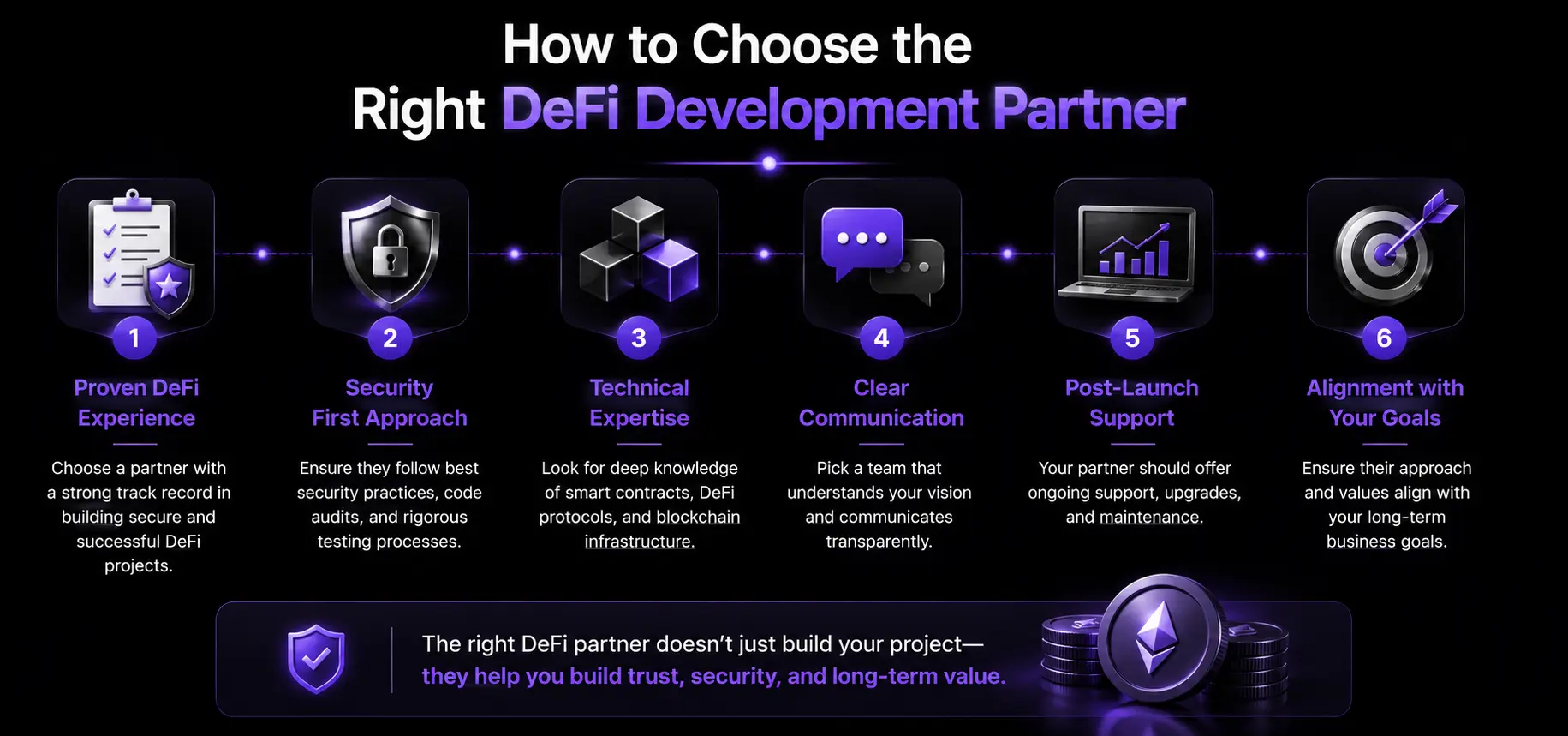
A pragmatic selection framework consists of:
- Identify your core product and technology needs.
Are you building a decentralized exchange (DEX), lending protocol, staking platform, yield aggregator, decentralized finance wallet, or cross-chain liquidity? Then, choose the blockchain networks, wallet integrations, oracle systems, token standards, and compliance standards required.
- Check their DeFi portfolio respectively.
Evaluate the company’s experience in delivering similar projects, particularly in the areas of smart contract development for DeFi, decentralized exchange development, liquidity automation, and blockchain interoperability within the DeFi ecosystem.
- Highlight security, audits and compliance readiness.
Ask about the team’s approach to threat modeling, test coverage, formal verification, third party audits, upgradeability, and compliance and audit processes for DeFi applications. Security needs to be built into the process from the beginning, not tacked on just before launch.
- Assess ongoing support and strategic vision.
DeFi solutions need oversight, upgrades, liquidity changes, governance tweaks and feature iterations post-deployment. A trusted partner should be able to explain our known approach to DeFi development and show their continued support for projects after the first launch.
DeFi Project Cost Estimation Guide
Cost of DeFi Development in 2026: The cost depends on the project’s size, security requirements, tech stack, location, and customization level. A basic fork of a decentralized exchange development project is usually less complicated, but a custom protocol with complex smart contract development for DeFi, yield farming, liquidity protocols, cross-chain DeFi solutions, and customized DeFi platform UI/UX design needs more experience. US and European teams can be expensive for institutional-grade DeFi architecture, but MENA and APAC teams are usually competitively priced. The most accurate estimate is made after features, hazards, integrations and audit requirements have been delineated.
Common DeFi Development Challenges and Solutions
DeFi projects in 2026 face three major challenges: interoperability, usability, and compliance.
- Challenge: To facilitate smooth cross-chain interoperability in the realm of decentralized finance (DeFi).
- Solution: Collaborate with engineers experienced in bridging, liquidity routing and cross-chain messaging protocols.
- Challenge: Design user-friendly interfaces for complex logic.
- Solution: Partner with UI/UX design specialists in the DeFi space to improve the user experience for swaps, staking, yield dashboards and wallets, while keeping self-custody.
- Challenge: Adjusting to shifts in multinational regulations.
- Solution: DeFi apps should pick a team with deep compliance and audit experience early on.
Future of DeFi Development in 2026
DeFi development is on track to be widely accepted financially by 2026 and will require institutional-grade DeFi architecture for banks, fintechs, asset managers and regulated Web3 companies. Cross-chain DeFi is rising, allowing users to easily access many chains through wallets, assets and liquidity networks.
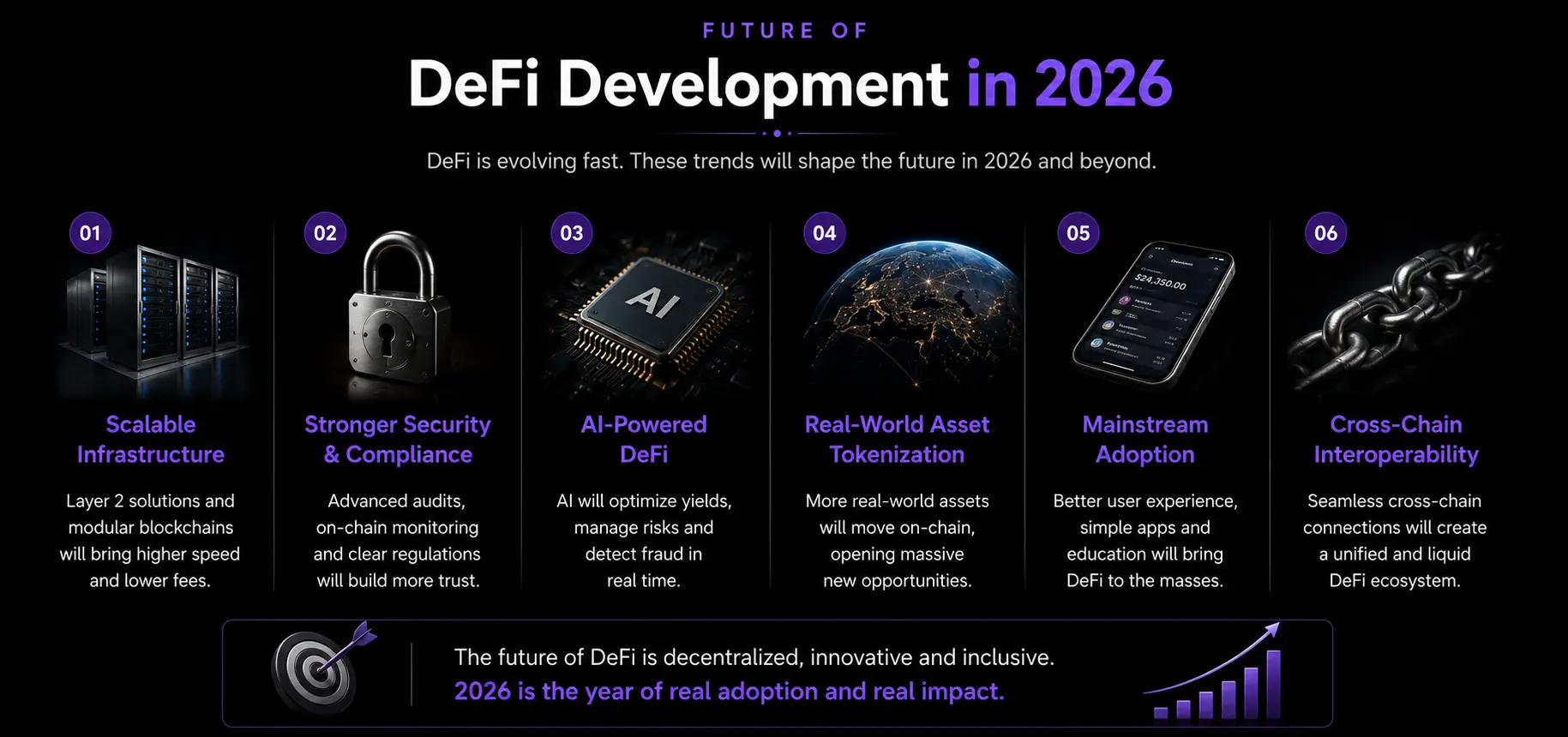
While the US and Europe are building the legislative framework, MENA and APAC are emerging as important hubs for DeFi innovation and user development. You will need custom DeFi platform UI/UX design, regional compliance know-how, and scalable architecture here. The best decentralized finance app developers of the future will make DeFi just as reliable and easy-to-use as traditional online banking.
Concluding Note
DeFi in 2026 is a huge potential in financial technology but success is not as simple as installing a smart contract or duplicating an existing platform. Strong architecture, efficient token mechanisms, user friendly navigation, cross chain functionality, liquidity management and compliance oriented development are the key features that enterprises need from day one. Please choose the best partner among the Top 10 DeFi Development Companies in 2026 to speed up the progress and minimize technical and operational risks for startups, fintech companies and enterprises. If you are thinking of developing a DeFi platform, now is the right time to reach out to a team that understands the technology and the working of the market.
Frequently Asked Questions
1. What services do DeFi development companies offer?
They help to build things such as smart contracts, DEX, staking platforms, loan protocols, DeFi wallets, coin systems, audits and UI/UX design.
2. How much does DeFi development cost?
All these have different pricing based on different features, blockchain networks, smart contracts, UI/UX needs, security audits and if the company needs cross-chain DeFi solutions.
3. Why choose a ranked DeFi development company?
A top rated company means more experience, better security and better ways to offer great DeFi platforms.
4. What tech stack is common in DeFi development?
Some of the popular tools include: Optimism, Ethereum, Polygon, Solana, Arbitrum, Ethers.js, Web3.js, Chainlink, The Graph, Wallet SDKs.
5. How long does it take to build a DeFi platform?
It takes months before you have an MVP for a simple DeFi still. A custom DEX, loan platform, or cross-chain process could take more time due to testing and verification.
6. Are audits essential for DeFi protocols?
Yes. Audits can uncover bugs in smart contracts, issues with access controls, Oracle risks, and logical errors. This is done before users lose their money.
7. Can DeFi developers help with UX/UI design?
In fact, good DeFi coders also do UI/UX design for the platform! This helps people to use wallet flows, staking, swaps, dashboards and risk signs easily.
8. What types of DeFi products can be built?
Companies can develop DEXs, staking services, lending apps, yield aggregators, liquidity pools, DeFi wallets, DAO platforms, and cross-chain DeFi apps.
9. What are cross-chain DeFi solutions and why are they important in 2026?
Cross-chain DeFi solutions can connect assets and cash across multiple blockchains. This makes them more compatible, easier for users to access and better use of capital.
10. What is institutional-grade DeFi architecture?
Institutional-grade DeFi architecture is constructing DeFi systems that are secure, scalable, auditable, compliant-ready, and business dependable.
