



Key Takeaways
- Blockchain supply chain development can cost $60,000 to $250,000+ in 2026.
- Key applications of blockchain in supply chain management include food traceability, pharmaceutical tracking, logistics documentation, IoT shipment monitoring, product authentication, and ESG tracking.
- Supply chains are moving toward permissioned networks, IoT-connected blockchain systems, smart-contract automation, hybrid architectures, AI-powered analytics, and stronger interoperability.
- Techfyte is one of the enterprise blockchain app development companies in 2026 helping businesses explore blockchain supply chain solutions.
Introduction
Modern enterprise blockchain supply chain solutions rarely run on a single system. It involves independent parties, including suppliers, manufacturers, logistics providers, distributors, retailers and regulators. Each party uses different platforms to record the same product journey. This approach creates data gaps, duplicate records, manual reconciliation, and limited visibility into where a product came from or who handled it.
Blockchain use cases in supply chain management address this problem by creating a shared, tamper-evident record that authorised participants can access. It also makes traceability easier and reduces disputes between trading partners.
This blog post guides on real-world use cases of blockchain in supply chain management. Also explore how much it costs to develop a blockchain supply chain solution in 2026.
How Blockchain Works in Supply Chain Management
Blockchain acts as a shared digital record between supply chain participants. Blockchain development solutions reconcile the records and allow authorised participants to record and verify important supply chain events on the same network. Below is the working process of blockchain in supply chain management.
Step 1: Record the Supply Chain Event
When a supplier ships raw materials, a transaction is created. The record can include details such as the product ID, quantity, timestamp, location, and shipment status.
Step 2: Validate the Transaction
The transaction is shared with participating nodes, which are computers connected to the blockchain network. The network uses a consensus mechanism to validate whether the transaction meets the agreed rules.
Step 3: Add the Record to the Blockchain
Once validated, the transaction is added to the ledger. Cryptographic hashing links the record to previous blocks and makes unauthorized changes easier to detect.
Step 4: Share the Updated Record
Authorised participants can view the information they have permission to access. This creates a common record of product movements and ownership transfers.
Step 5: Automate Actions with Smart Contracts
Smart contracts can execute predefined actions when specific conditions are met. For example, payment can be triggered after a verified delivery.
Build a Blockchain Supply Chain Solution
Real-Life Blockchain Use Cases in Supply Chain Management
Use of blockchain in organizations enables sharing and verification of the same information at one place. The technology connects product events, ownership transfers, shipment records and certifications into common, tamper-evident history.
Here are some of the practical blockchain use cases in supply chain management
1) Food Provenance and Traceability
Blockchain can help businesses trace food from the farm to the retailer. Each stage can add a verified record, making it easier to identify where a product came from and which batches may be affected during a recall.
Typical functions performed:
- Record farm and supplier details
- Assign unique batch IDs
- Record processing events
- Add shipment timestamps
- Track custody transfers
- Store product and certification data
- Trace products during recalls
- Provide authorised parties with provenance data
2) Pharmaceutical Supply Chain Tracking
Pharmaceutical supply chains need strong product identification and traceability. Blockchain can connect a medicine’s digital identity with its manufacturer, batch, movement, and custody history. This can support counterfeit detection and faster product recalls.
Typical functions performed:
- Create unique product or batch IDs
- Record manufacturer information
- Track custody transfers
- Record distribution events
- Verify product history
- Support counterfeit detection
- Maintain recall records
- Control access through permissions
- Use digital signatures for transaction verification
- Automate selected workflows with smart contracts
3) Logistics and Freight Documentation
Logistics involves multiple parties, including carriers, freight forwarders, customs authorities, brokers, and buyers. Each may maintain different versions of shipment and delivery information. A shared blockchain record can reduce reconciliation between these systems.
Typical functions performed:
- Record shipment creation
- Track shipment milestones
- Store document references
- Record bills of lading
- Track customs events
- Record delivery confirmations
- Track ownership or custody changes
- Reduce duplicate data entry
- Trigger smart-contract conditions
- Connect with transport management systems through APIs
4) IoT-Based Shipment Monitoring
IoT sensors can capture real-world conditions during transportation. Blockchain can then record important sensor events and make them available to authorised supply-chain participants.
Typical functions performed:
- Monitor temperature
- Track humidity
- Record location
- Detect shocks or impacts
- Monitor container conditions
- Create timestamped events
- Trigger alerts
- Verify delivery conditions
- Trigger smart-contract actions
- Store hashes of sensor data
5) High-Value Goods and Product Authenticity
Luxury goods, electronics, diamonds, apparel, and other high-value products can benefit from digital product identities. Blockchain can create a traceable history from manufacturing to distribution and ownership.
Typical functions performed:
- Create a digital product identity
- Record product origin
- Store manufacturing events
- Record ownership transfers
- Track distribution history
- Store certification references
- Verify product provenance
- Support authenticity checks
- Record resale or transfer events
6) Carbon and ESG Supply Chain Tracking
Blockchain can provide an auditable record for emissions data, sustainability claims, supplier information, and tokenised environmental assets. It can help different parties work from a consistent history of reported ESG events.
Typical functions performed:
- Record emissions data
- Track supplier sustainability information
- Record environmental certifications
- Track carbon credits
- Record credit ownership transfers
- Create timestamps for ESG events
- Maintain an audit trail
- Support reporting and verification workflows
- Reduce the risk of duplicate records
What Does It Cost to Develop a Blockchain Supply Chain Solution in 2026?
The cost to develop a blockchain supply chain solution varies and depends on the project’s scope, blockchain architecture, number of participants, system integrations, smart-contract complexity, security requirements and compliance needs.
The average cost ranges from $60,000 to $250,000+. However, the final cost depends on ERP or WMS integration, (IoT) Internet of things connectivity, smart contracts, analytics, permissioned access, and ongoing maintenance. Each additional component increases development effort.
| Project Type | Estimated Development Cost | Typical Scope |
|---|---|---|
| Basic MVP / Tracking Application | $60,000–$90,000 | Product tracking, basic smart contracts, simple dashboard, single blockchain network |
| Mid-Range Enterprise Solution | $90,000–$160,000 | ERP/WMS integration, IoT connectivity, permissioned access, automated workflows |
| Complex Multi-Tier Platform | $160,000–$250,000+ | Multi-organisation network, deep legacy integration, advanced smart contracts, analytics, interoperability, and compliance |
Discuss Your Blockchain Project Cost
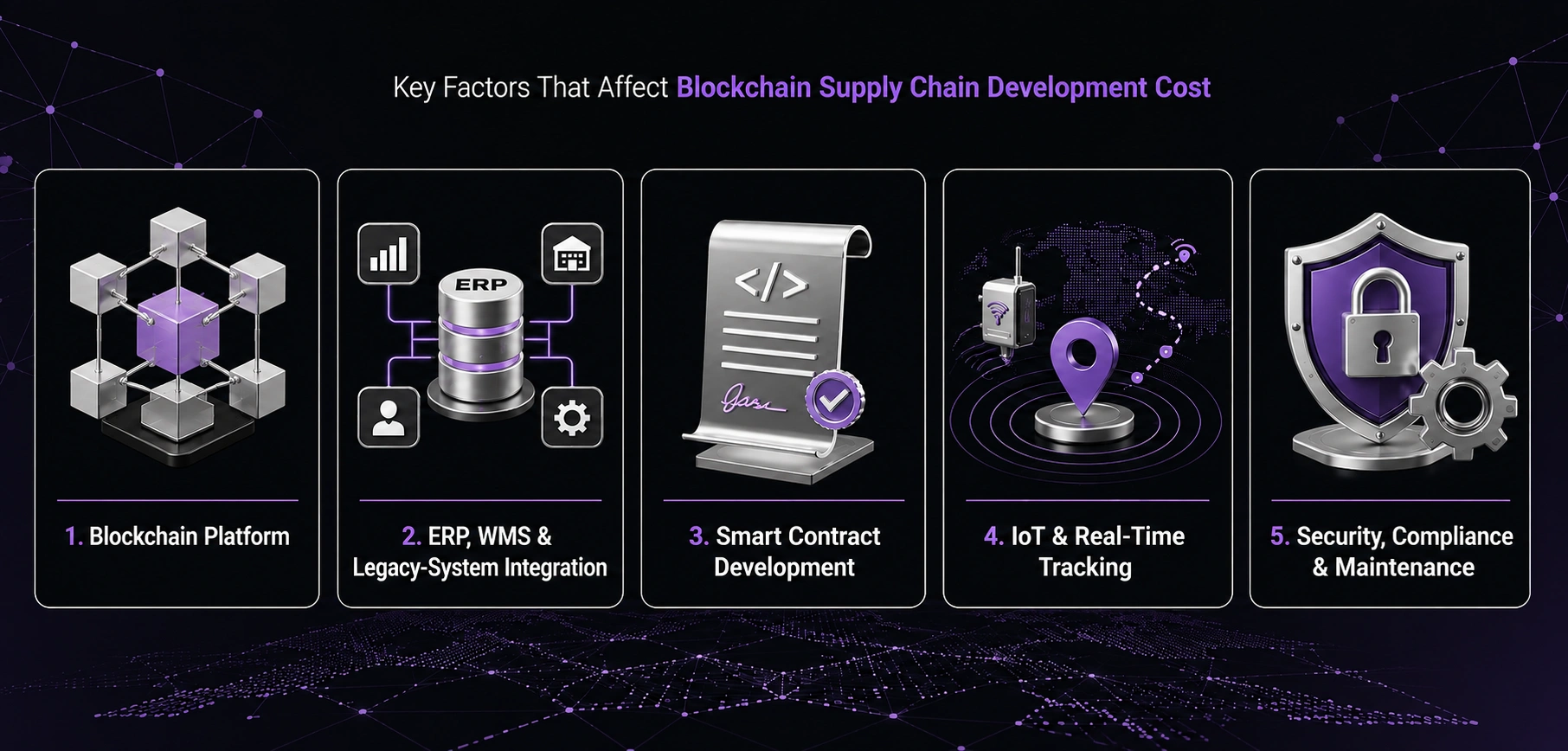
Key Factors That Affect Blockchain Supply Chain Development Cost
1) Blockchain Platform
The decision between public networks such as Ethereum Layer 2 and permissioned platforms such as Hyperledger Fabric or Corda has an impact on overall architecture and costs. It affects transaction costs, privacy, governance, scalability, infrastructure, and development complexity.
2) ERP, WMS and Legacy-System Integration
Blockchain is typically used alongside existing ERP, WMS, TMS, CRM, and supplier systems rather than replacing them. Connecting these systems via APIs and middleware can necessitate extensive development and testing, particularly when working with older software.
3) Smart Contract Development
Smart contract development automates processes including payment releases, approvals, delivery verification, and ownership transfers. More sophisticated business logic, access restrictions, and various contracts raise development and testing expenses, while security audits add an additional cost.
4) IoT and Real-Time Tracking
Connecting IoT sensors incurs additional expenditures for devices, connectivity, gateways, data processing, authentication, and storage. Temperature, location, humidity, and other real-time data may necessitate an off-chain storage layer before significant events or hashes are published on the blockchain.
5) Security, Compliance and Maintenance
Blockchain solutions require more than just the initial building process. Smart-contract audits, penetration testing, key management, infrastructure monitoring, regulatory compliance controls, upgrades, and continuing technical support significantly increase the total cost of ownership.
Blockchain Supply Chain Architecture: A Typical Technical Stack
A blockchain supply chain solution usually combines blockchain with existing business systems, APIs, IoT devices, databases, and application interfaces. A hybrid architecture is common because not all data should be stored directly on-chain. Large documents, sensor streams, and analytics data are generally better kept in off-chain storage, while the blockchain stores key transactions, hashes, timestamps, and verification records.
| Technology Layer | Common Technologies | What It Is Used For |
|---|---|---|
| User Interface | React, Angular, Flutter, React Native | Web and mobile dashboards for suppliers, logistics teams, retailers, and administrators |
| API & Integration Layer | Node.js, Python, Java, REST APIs, GraphQL | Connects blockchain with ERP, WMS, TMS, CRM, and supplier systems |
| Smart Contracts | Solidity, Chaincode, Corda Contracts | Automates payments, approvals, ownership transfers, and business rules |
| Blockchain Network | Ethereum Layer 2, Hyperledger Fabric, Corda | Records and verifies supply-chain transactions across participants |
| IoT Layer | AWS IoT, Azure IoT, MQTT, edge gateways | Captures temperature, location, humidity, and other shipment data |
| Off-Chain Storage | PostgreSQL, MongoDB, AWS S3, IPFS | Stores large documents, sensor data, images, and detailed records |
| Data & Analytics | Python, Power BI, Tableau, ML platforms | Analyses supply-chain events, performance, anomalies, and trends |
| Security & Identity | PKI, OAuth 2.0, IAM, digital signatures | Manages user identity, permissions, authentication, and transaction security |
When Should a Business Use Blockchain for Supply Chain Management?
Blockchain is most useful when a supply chain involves multiple organisations that need to share trusted records. It can improve traceability, reduce manual reconciliation, and create a verifiable history of transactions. However, it should not be introduced simply because it is a newer technology.
Blockchain is a good fit for businesses when:
- Multiple organisations share data: Suppliers, manufacturers, logistics providers, and retailers need access to a common record.
- Trust is a challenge: Participants do not want one organisation to have complete control over shared data.
- Traceability is critical: Businesses need to track a product’s origin, movement, ownership, or custody.
- Data integrity matters: Records need to be tamper-evident and auditable.
- Reconciliation is costly: Teams spend significant time comparing records between different systems.
- Workflows can be automated: Smart contracts can trigger payments, approvals, or other actions when predefined conditions are met.
Final Thoughts
Blockchain is beyond theoretical use in supply chains. Blockchain use cases in supply chain management includes product traceability, logistics documentation, IoT based monitoring and pharmaceutical tracking.
If you’re planning to build these systems, rely on Techfyte, a blockchain supply chain development company. They focus on building these systems that require more than just selecting a blockchain network. Integration with ERP, IoT platforms, security controls and existing workflows also have an impact on complexity and cost.
FAQs
1. What are the top blockchain use cases in supply chain management?
Key blockchain use cases in supply chain management include food traceability, pharmaceutical tracking, logistics, product authentication, IoT monitoring, and carbon tracking.
2. How does blockchain improve traceability for food supply chains?
Blockchain records product batches, origins, processing events, shipments, and custody transfers on a shared ledger. It creates a traceable product history and can help businesses identify affected products faster during recalls.
3. Which companies are leading blockchain adoption in supply chain management?
Walmart, IBM, BMW, and Techfyte are associated with notable blockchain supply-chain initiatives. Their applications include food traceability, supply-chain transparency, raw-material provenance, and logistics documentation.
4. Which types of blockchain platforms are best suited for enterprise supply chain visibility?
Permissioned platforms such as Hyperledger Fabric and Corda are commonly suited to enterprise supply chains. They provide controlled access, participant identity, privacy, and governance while supporting shared transaction records.
5. Which companies offer blockchain solutions for pharmaceutical supply chain compliance?
Techfyte, IBM and Chronicled are among the companies offering blockchain-based pharmaceutical supply-chain solutions. The platforms support product verification, traceability, data sharing, and compliance-related workflows.
6. What is the average cost to develop a blockchain-based supply chain solution?
The cost to develop a blockchain based supply chain solution at Techfyte ranges from $60,000 to $250,000+ depending on requirements. Factors like ERP integration, IoT, smart contracts, security, compliance, and maintenance can significantly increase the final cost.
7. Can I get a cost estimate for a custom blockchain supply chain app from development firms?
Yes. Firms such as Techfyte provide an evaluated cost for custom blockchain development requirements and estimates.
8. How much do enterprise-level blockchain supply chain platforms typically cost to implement?
The cost to implement enterprise-level blockchain supply chain to platforms ranges $100,000 to $250,000+, depending on scope and integrations. It also involves the cost of IoT, ERP integration, smart contracts, and blockchain compliance requirements solutions.
Ready to Build a Transparent, Connected Supply Chain?
