



Key Takeaways
- Smart contract development covers architecture, coding, security audits, deployment, upgrades, and ongoing lifecycle management.
- Security requires automated scanning, manual exploit analysis, formal verification, and recurring audits throughout the contract lifecycle.
- Development costs vary widely based on contract complexity, audit depth, chain support, gas optimization, and verification requirements.
- Testing should include unit, integration, fuzzing, and invariant testing before contracts move from testnet to mainnet.
- Upgradeability, multisig controls, timelocks, governance, and cross-chain coordination help manage post-deployment risks.
- The right provider should demonstrate production deployments, strong audit practices, technical depth, documented processes, and reliable post-launch incident support.
Introduction
Smart contracts now secure billions of dollars in DeFi liquidity, tokenized real-world assets, and enterprise blockchain workflows, and a single overlooked vulnerability can drain a treasury in minutes. Unlike traditional software, deployed contract code is often immutable and there is no central authority to reverse a bad transaction. That makes choosing the right smart contract development services partner one of the highest-stakes technical decisions a CTO or founder makes. This guide covers what the services include, non-negotiable security practices, realistic costs, deployment practices, and how to evaluate providers.
What Smart Contract Development Services Actually Cover
A full-scope engagement spans four phases: architecture, development, security, and maintenance. Architecture covers tokenomics design, access control, and secure smart contract architecture decisions made before any code is written. Development is the actual Solidity or Rust implementation, unit testing, gas optimization, and staged deployment, following patterns laid out in Ethereum’s official development documentation. Security work, including smart contract audit services and formal verification, should run in parallel with development rather than as an afterthought, and many subtle exploits trace back to language-level misunderstandings of how Solidity handles integer overflow or storage layout, which is why experienced teams keep the Solidity language reference close throughout implementation, not just at kickoff.
Maintenance covers smart contract lifecycle management; upgrades, monitoring, and incident response after launch. Scope varies by project type: a DeFi protocol needs different depth than a tokenized asset or an internal enterprise system.
Security: The Non-Negotiable Layer of Smart Contract Development
For customers security is the most important factor to consider. Code is public and often immutable, which means attackers have all the time in the world to find holes and defenders have one shot to get it right.
1. Vulnerability Scanning, Security Frameworks, and Formal Verification
Smart contract vulnerability scanning should be done with both automated tools like Slither and Mythril as well as manual review of economic attack paths instead of just syntactic issues. An established supplier builds against proven Web3 security frameworks and references resources such as the SWC Registry and the OWASP Smart Contract Top 10 to remove known types of attack such as reentrancy and oracle manipulation. Formal verification is a mathematical proof that the logic of the contract matches its specification, which is used for high-value deployments rather than relying on testing to cover all edge cases.
2. Audit Timing and Depth: What to Ask Providers
Find out when in the timeline smart contract audit engagements take place. A rigorous provider assessment should be performed before deployment, after each major upgrade, and regularly for actively managed protocols; not just at launch and then never again. There is also a big difference between a simple automated scan and a thorough evaluation that involves economic modelling, access control mapping and manual exploit simulation by a firm with a pedigree like Trail of Bits.
Smart Contract Development Cost: What Drives Pricing in 2026
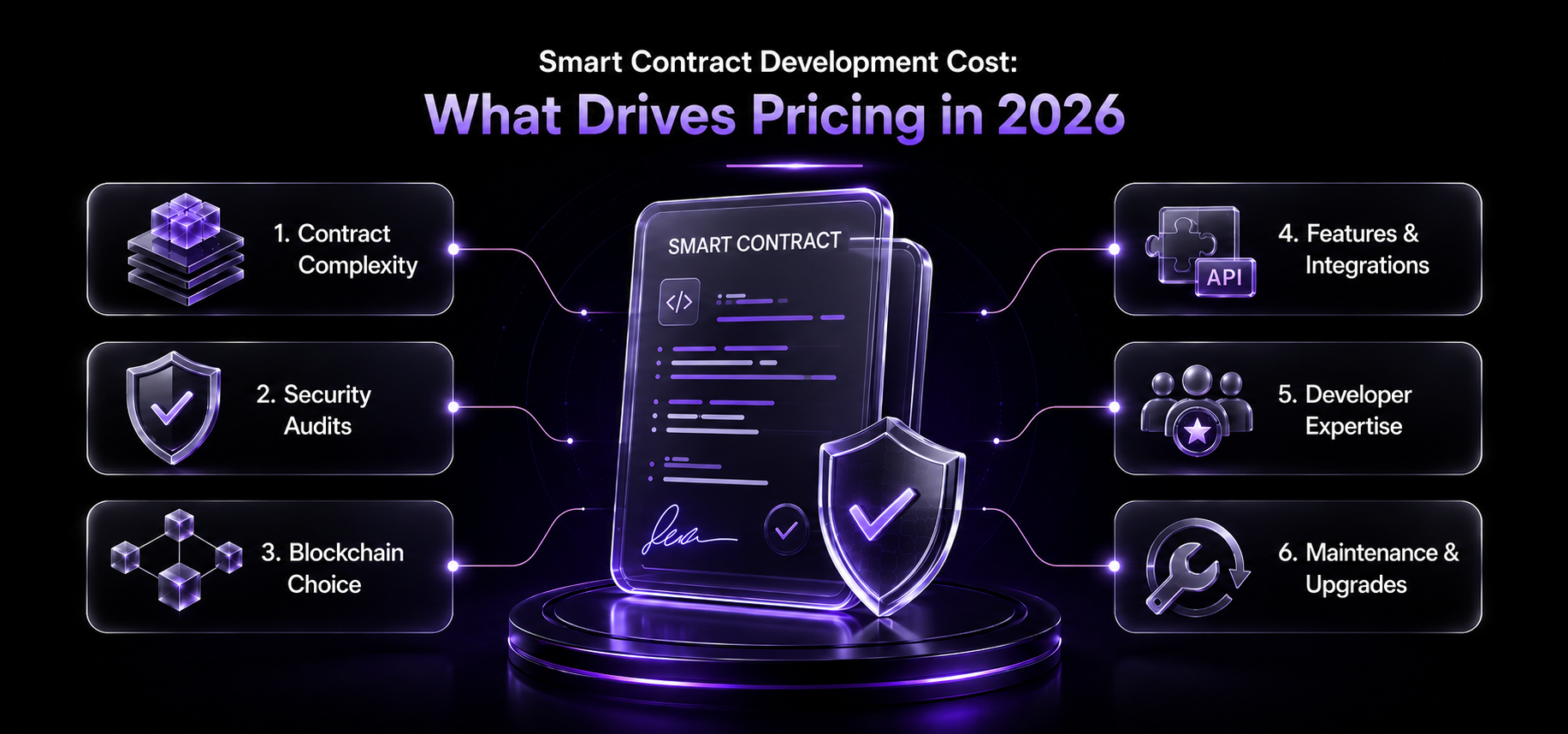
Smart Contract Development Cost Factors Number of contracts, audit depth, support required for chains and scope of gas optimization Contract complexity These are illustrative estimates only and a serious quote should be scoped against your actual specification and not a generic range.Especially as independent research on smart contract exploits shows skipped or shallow security work is the common thread behind major losses.
1. Illustrative Cost Tiers by Project Scope
As a rough guide, a simple token contract with a light audit is low five figures. Multi-contract DeFi protocols with a full review typically fall in the mid-five to low-six figures. Formal verification multi-chain enterprise systems can reach six figures. The cost also depends on your team’s location, whether you hire freelancers, in-house business blockchain developers, or a specialized firm. The Solidity development cost depends on the language environment. EVM based projects have a larger talent pool and more sophisticated tooling. Rust or Move engineers are more expensive because they are more scarce.
2. Why Cheap Development Costs More in the Long Run
Gas optimization smart contracts have an initial cost to develop but reduce the cost of operation that users pay on each contract transaction for the lifetime of the contract. The cheapest price is not always the cheapest solution. Missing an audit often turns into an emergency fix, re-audit, or exploit down the line. For protocols that secure substantial value the cost of a thorough security study is a fraction of what a single exploit would drain from the protocol in minutes.
Smart Contract Deployment Best Practices: From Testnet to Mainnet
We have to run unit tests, integration tests, fuzzing and invariant testing before we can deploy it to mainnet. Smart contract deployment best practices include a systematic multi-stage strategy to find flaws before they can be exploited.
1. Testing and Upgradeability: The Pre-Launch Foundation
Upgradeability mechanisms like proxy contracts or the diamond standard and control mechanisms like multisig and timelocks ensure that the protocol cannot be fully controlled by a single party. All source code verification on block explorers, constructor parameter validation and access control roles review should be done before mainnet deployment, not rushed in the final hours before launch.
2. Governance and Cross-Chain Coordination
Good blockchain governance determines who can trigger an emergency pause, and when an upgrade can happen. That structure is a lot more important when a project runs across many networks, since coordinating a pause across chains during an incident is much harder than pausing a single deployment. That’s where cross-chain smart contracts get dicey, because a bug on one chain can impact assets sent to another before the fix is out.
Smart Contract Lifecycle Management: Beyond Deployment
Launch isn’t the end of a smart contract’s life, it’s the middle. Smart contracts are managed through their entire lifecycle with continuous real-time monitoring, a written incident response plan, a bug bounty program, and a clear process for deploying upgrades without rushing changes under pressure.
Provider tooling is increasingly a mix of AI and blockchain to detect anomalies. Strange transaction patterns and gas spikes are caught early before it becomes a drained pool. Good monitoring shortens the time from the start of an exploit to the start of a response, often the difference between a controlled event and a total loss. Bring in audited libraries like OpenZeppelin’s contract standards and that cuts down on the amount of bespoke, un-reviewed code a team has to maintain long after launch. This is especially important to companies that do not have a large internal security function.
None of this monitoring and tooling work replaces dedicated compliance planning ahead of time for regulated assets, before a single token moves. Regulatory-compliant token design introduces lifetime requirements around transfer limitations, reporting and key management that a generic maintenance plan will not address on its own.
How to Evaluate Smart Contract Development Services Providers
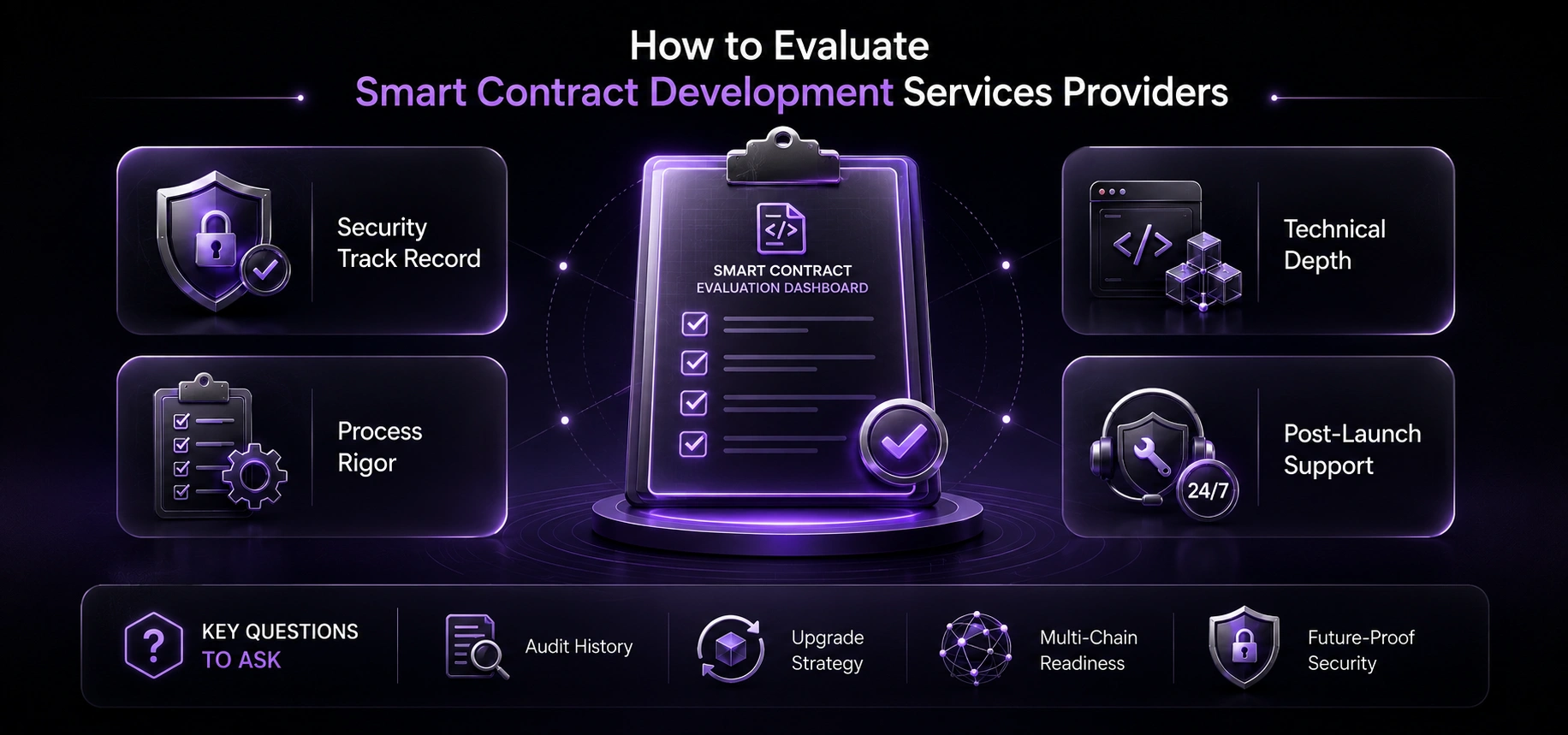
Structure your evaluation, don’t make a sales pitch. Use these criteria to judge any provider:
1. The Four-Point Evaluation Checklist
- Security track record: Audit record, disclosure processes and historical exploits.
- Technical depth: Solidity or Rust knowledge, gas optimization skills, real-world experience deploying live DeFi protocols (not just testnet examples).
- Process rigor: Test methodology, Documented standards, Documented deployment checklist.
- Post-launch support: coverage tracking, update process and incident response SLAs.
2. Questions Most Buyers Skip
If you are looking at more than one network on your roadmap, ask about audit history, their upgradeability strategy and whether they have real chain abstraction experience. Another topic worth mentioning, and that most buyers completely ignore on vendor calls is: For a protocol that is supposed to be of great value for 10+ years, the crypto assumptions that seem secure today may not be secure for the whole working life of the contract. Are they already considering quantum-resistant cryptography or do they see it as a problem for the future?
Decentralized App (dApp) Development
The smart contract is the backend logic, but users interact with it through a frontend, through Web3.js or ethers.js, wallet integration and usually a subgraph for indexing on-chain data. Decentralized app (dApp) development is the full product built around that layer, not the contract alone.
Most vendors who offer smart contract development also offer the whole stack, because the contract and frontend decisions inform each other. Financial services projects tend to have more stringent compliance and integration requirements than a consumer app, from wallet-layer KYC hooks to reporting requirements that most gaming or social dApps never have to worry about. These requirements are seldom discovered until integration testing is well underway. This is the case with most other enterprise blockchain engagements and should set the tone for team and schedule.
Concluding Note
Smart contract security is not something you bolt on afterwards, it’s the foundation that everything else is built on, from the very first architecture decision, to monitoring dashboard 6 months after launch. The right smart contract development services partner means solid architecture, thorough audits, honest cost estimates and a true lifecycle management plan so your project stays robust long beyond launch day. As DeFi, tokenization, and enterprise blockchain continue to mature, developers will look to the providers who take security as an ongoing discipline, not a one-off checkpoint, for the next generation of on-chain value.
Frequently Asked Questions
1. What services are included in smart contract development?
Services for smart contract development: architecture (tokenomics, access control), development (Solidity/Rust coding, gas optimization, testing), security (audit, formal verification, vulnerability scanning) and maintenance (upgrades, monitoring, incident response). Scope varies on project type – DeFi protocols have different depth than tokenization or corporate systems.
2. How much does smart contract development cost in 2026?
A light audit on a basic token contract will cost five digits. The multi-contract DeFi full review methodology is for mid 5 to low 6 figures. A multi-chain enterprise system with formal verification can easily cost over $100,000. Cost is a function of complexity, audit depth, chain support and gas optimization requirements.
3. What are smart contract security best practices?
Use automatic tools such as Slither and Mythril combined with manual review of economic attack vectors. Build on Web3 security frameworks like SWC Registry and OWASP Smart Contract Top 10. Formal verification provides mathematical guarantee of correctness of mission critical applications. Audits on deployment, on post-upgrade and on a recurring basis.
4. Why is an audit necessary before deployment?
Smart contract code is open and generally immutable: attackers have infinite time to probe for vulnerabilities while defenders have exactly one chance to deploy correctly. If you skip an audit, it will come back to bite you as an emergency remedy, a re-audit or a total loss. Complete audits of the providers before deployment, after upgrades and regularly
5. Can smart contracts be updated after deployment?
Yes, with upgradeability patterns such as proxy contracts or the diamond standard, with multisig control and timelocks to prevent unbridled power. Blockchain governance is about who has the power to initiate upgrades and emergency pauses. Cross-chain deployments are more difficult, as a vulnerability on one chain can compromise assets bridged to another.
6. What tools are used for smart contract testing?
Testing includes unit tests, integration tests, fuzzing and invariant testing. Tools like Slither and Mythril are automated to detect common vulnerabilities. Manual review includes economic attack vectors. Libraries such as OpenZeppelin that have been audited cut down on custom, unreviewed code. Verification of source code on block explorers guarantees that the code being distributed is identical to the code that was audited.
7. Should I hire freelance or enterprise blockchain developers?
Freelancers cost less initially, but rarely provide the same level of security, audit history or post-launch help as a dedicated firm. Enterprise blockchain engineers bring process rigour, standards for documentation, incident response SLAs and production deployment experience. When you want to lock down some serious value you want to go with a company that has a proven track record of security.
8. Which blockchain should be chosen?
Ethereum has the deepest liquidity and the best tooling. Layer 2s like Base and Polygon reduce gas fees but still offer EVM compatibility. Solana provides high throughput for high frequency applications. Pricing is a concern, cross chain reach is important to your users and your project has liquidity demands, it really depends.
