



Key Takeaways
- Stablecoin payment infrastructure combines wallets, APIs, settlement, FX, treasury, compliance, and reconciliation.
- Stablecoins can shorten cross-border settlement, but they do not remove licensing or regulatory obligations.
- High-volume platforms need a double-entry ledger, exception queues, monitoring, and clear service-level controls.
- Merchants need reliable checkout, refunds, reporting, and predictable settlement, not just on-chain transfers.
- Treasury design should include liquidity buffers, exposure limits, and daily reconciliation across chains and banks.
- Start with a narrow MVP, prove one corridor, then scale with multi-chain routing and stronger controls.
Introduction
Cross-border merchants are losing money because of gaps between payment legs. FX spreads can be layered on top of intermediary fees and card and correspondent-banking rails can take days to settle. They also give data that finance teams have trouble matching to orders. At high volume, these delays saturate working capital and make reconciliation a daily cost center that increases with each new corridor.
Stablecoins offer a separate settlement layer for merchants and their providers, with transparent on-chain records, near-continuous transfers and fewer intermediaries. Teams that build stablecoin payment infrastructure have the potential to shorten settlement windows and reach merchants that are underserved by banking networks. Stablecoins don’t do away with licensing, liquidity, fraud, FX or reconciliation work; they just move it somewhere else. This guide is focused on the architecture, compliance controls, and scaling decisions that matter when you have real merchant volume.
Build a Better Cross-Border Payment Experience
What Is Stablecoin Payment Infrastructure?
The full stack of stablecoin payment infrastructure allows a business to accept, convert, settle and report on stablecoin payments. A full featured stablecoin payment infrastructure platform includes crypto wallets, payment APIs, acceptance flows, conversion, settlement, compliance, treasury and reporting. A stablecoin payments infrastructure solution is a platform tailored for a specific use case such as merchant acquiring, marketplace reimbursements or multi-currency supplier settlement.
More Than a Token Integration
The easy part is to wrap a token transfer in an API call. The more difficult tasks are ledgering, approvals, exception management & regulator ready records. Think of the build as fintech infrastructure and run it to the same operating standards as a card processor. Chain or token choice is as critical as uptime targets, dispute resolution and even explicit service-level commitments.
Why Stablecoins Fit Cross-Border Merchant Payments
Stablecoins are ideal for cross-border merchant payments because they can transfer value on networks that are open around the clock, and settle without a chain of correspondent banks. This can result in more efficient access to funds and more transparent transaction records for merchants operating in different time zones. The match is real but based on the stablecoin’s regulation, issuance and conversion at either end.
1. Operational Benefits of Stablecoin Payments
- Settlement speed
- 24/7 transfer
- Fewer intermediaries
- Global reach
- Programmable payments
Programmable payments allow a platform to pay a merchant, a marketplace fee, and a tax account all in one transaction. This structure can help to audit the settlements when combined with a public record of the transactions. You still need to have a ledger and policy layer that is under your administrators’ control.
2. Practical Limits and Risks
Merchants continue to price products in local currency, although a stablecoin may deviate from its peg. Liquidity depth varies by corridor and fiat off-ramp availability depends on local regulations and banking partners. The BIS CPMI report on stablecoins in cross-border payments says the benefits of such use depend on sound regulation and design. Teams building out cross-border payment channels should think of speed as a skill.
Core Architecture to Build Stablecoin Payment Infrastructure at High Volume
A high volume stack works best with clear layers with explicit covenants between them. It enables separation so that a chain, a custody provider or an FX partner can be swapped out without rewriting the merchant-facing code. The table below is a starting point for each layer, showing its purpose and typical components, but not a rigid blueprint for all licensing models or regions.
| Layer | Function | Key Components |
|---|---|---|
| Payment API | Create and manage payment intents | Authentication, idempotency keys, webhooks, SDKs |
| Checkout | Capture payer intent | Hosted page, QR codes, deep links, wallet connect |
| Wallet infrastructure | Generate and control deposit addresses | Address derivation, custody or MPC, sweeping |
| Blockchain settlement | Confirm on-chain transfers | RPC providers, confirmation tracking, event indexing |
| FX and conversion | Convert stablecoin to local fiat | Liquidity providers, rate quotes, spread rules |
| Treasury | Hold and rebalance funds | Liquidity buffers, exposure limits, approvals |
| Compliance | Screen people and flows | KYC/KYB, sanctions screening, monitoring |
| Reconciliation | Match chain, ledger, and bank records | Double-entry ledger, exception queues |
| Monitoring | Detect failures early | Metrics, alerts, audit logs |
Many teams leverage an existing gateway, rather than building one from scratch. If you are already running bank rails or cards, then crypto payment gateway development can increase stablecoin acceptance behind your existing merchant API. Maintain the ledger as the single source of truth, as chain state alone cannot describe merchant balances, fees, or refunds. Set service levels for each layer from the beginning including retry policies for the API, wallet and settlement layers.
Payment Acceptance and Merchant Experience
Merchants judge a payment system on the degree to which it disrupts their workflow. Acceptance should be intuitive: a standard checkout process, an API, open statuses and reports that finance experts can use. The merchant layer should abstract chain details, but still show confirmation state, fees, and settlement currency in terms support teams can understand. Stablecoin rails change what happens on the other side of the screen.
1. Payment Acceptance Options
Provide a hosted payment page to speed up onboarding and a direct API for merchants who want to maintain full control. QR codes and deep links are great for mobile payers who keep their money in wallet apps. Webhooks should be called for each state change (detected, confirmed, settled) with idempotent retries.
2. Refunds, Pricing, and Reporting
Given the irreversible nature of on-chain transfers, it is important to identify the source of funds for refunds and the currency in which they will be issued. In multi-currency pricing the rate used should be locked in for a short period of time and should be recorded. A stablecoin remittance platform pattern can be reused by platforms that pay out to sellers for disbursal as well. A merchant dashboard with payments, fees, and payouts also reduces support burden and speeds up onboarding.
Stablecoin Settlement, Treasury, and Liquidity
Settlement is the time when stablecoin systems either prove their worth or reveal their weaknesses. Funds are delivered on-chain quickly, but merchants usually require local currency in their bank account. Treasury design connects these two worlds through on- and off-ramps, liquidity buffers, and conversion rules. Each hand-off requires an owner and a limit.
1. Settlement Finality and Confirmation Rules
In the Ethereum developer documentation on transactions, they describe the lifecycle of a transfer before it is considered settled. Each chain has a different definition of finality. Set confirmation thresholds per chain and amount and only credit merchants when the threshold is reached. The larger transfers justify the extra time it takes to wait. Make sure the confirmation depth used for each credit is documented so that it can be re-created in the event of an audit or dispute.
2. Liquidity Buffers and Treasury Controls
Keep fiat and stablecoin buffers for each payout corridor so that market liquidity doesn’t cause delays to settlements. Set limits on exposure to any single issuer, chain or banking partner. Daily reconciliation of ledger entries, bank statements and on-chain transfers. The queue breaks to a queue with a known owner. As fiat on and off ramps have their own cut-off times, settlement calendars per corridor need to be established to avoid the assumption that all banks behave like the chain.
Compliance, Security, and Risk Controls
Licensing requirements remain for stablecoins. Depending on the model, a platform may need authorization for money transmission, payment institutions or virtual asset service providers. Licensing, KYC/AML, sanctions, custody, and tax treatment all differ from one jurisdiction to another. So it’s better to include controls in the payment flow before launch and consult with legal counsel, rather than adding controls post-launch. Marketplaces and PSPs should also be checking if their partners have the licenses they rely on.
1. Compliance Controls for Every Transaction
- KYC/KYB and AML
- Sanctions screening
- Transaction monitoring
- Travel Rule data
- Audit trails
FATF guidance on virtual assets and VASPs emphasizes the need for AML controls, sanctions screening and Travel Rule data sharing. In the United States, FinCEN guidance on convertible virtual currency addresses how money transmission regulations might apply. Neither document is a substitute for local legal advice, and the rules in the EU, UK, Singapore, UAE and other countries differ from those in the United States.
2. Key Management and Smart-Contract Security
Use custody models that use hardware security modules or multiparty computation, with withdrawal limits and role-based approvals. Have the smart-contract code independently audited. Implement pause controls. Check token contracts against addresses published by the issuer (e.g. Circle’s developer documentation) and use fraud rules for velocity and mismatched payer data.
Prepare Your Stablecoin Platform for Higher Volume
Scaling for High-Volume Cross-Border Transactions
Scaling quickly and expensively makes weak assumptions stand out. A system that can manage hundreds of payments a day can break at thousands if it’s dependent on a single chain, a single node provider or manual reconciliation. Plan for throughput, fee volatility and partner outages from the outset and document how operators respond when something goes wrong.
1. Multi-Chain Routing and Chain Abstraction
Multi-chain routing lets you select networks according to each payment’s fee, speed and liquidity. Multi-chain payments are approved in a single checkout process as Chain abstraction can obfuscate those options for payers and merchants. Sponsored fees are a type of gas abstraction that removes the need for payers to hold native tokens. Document the reasoning for each routing rule used to choose a network, so that finance teams can explain fees and timing in the future.
2. Failure Handling and Observability
Add failover between RPC providers, rate limiting to protect APIs and batch outbound transfers when possible. Detects confirmation delays, failed transactions, webhook delivery and reconciliation breaks in one unified observability view. Create runbooks for depegs, chain halts and provider disruptions and practice them with the ops and support teams that will be executing them.
Cost and Build Approach
The cost varies depending on the licensing model, supported chains, custody approach, and level of compliance. Most teams start with a tight MVP and open up as volume and corridors dictate. Understanding the cost of developing the stablecoin payment infrastructure early helps to decide which projects to build, which assets to buy and what risks to take. Other ongoing costs such as audits, monitoring, compliance technology, liquidity partners and support should be in the same budget.
1. MVP to Enterprise Build Approach
Startups typically start with one or two chains, a hosted checkout, basic wallet management, a ledger and partner-led compliance for stablecoin payment infrastructure. An enterprise build has advanced monitoring, multi-chain routing, automated treasury, regional licensing support and high-availability operations. Pricing is very volatile. Scope to your regulatory model and corridors, not a generic estimate.” Plan to upgrade from MVP to enterprise using staged releases that leverage shared ledger and API contracts to avoid a costly rebuild later on.
How to Choose a Stablecoin Development Company
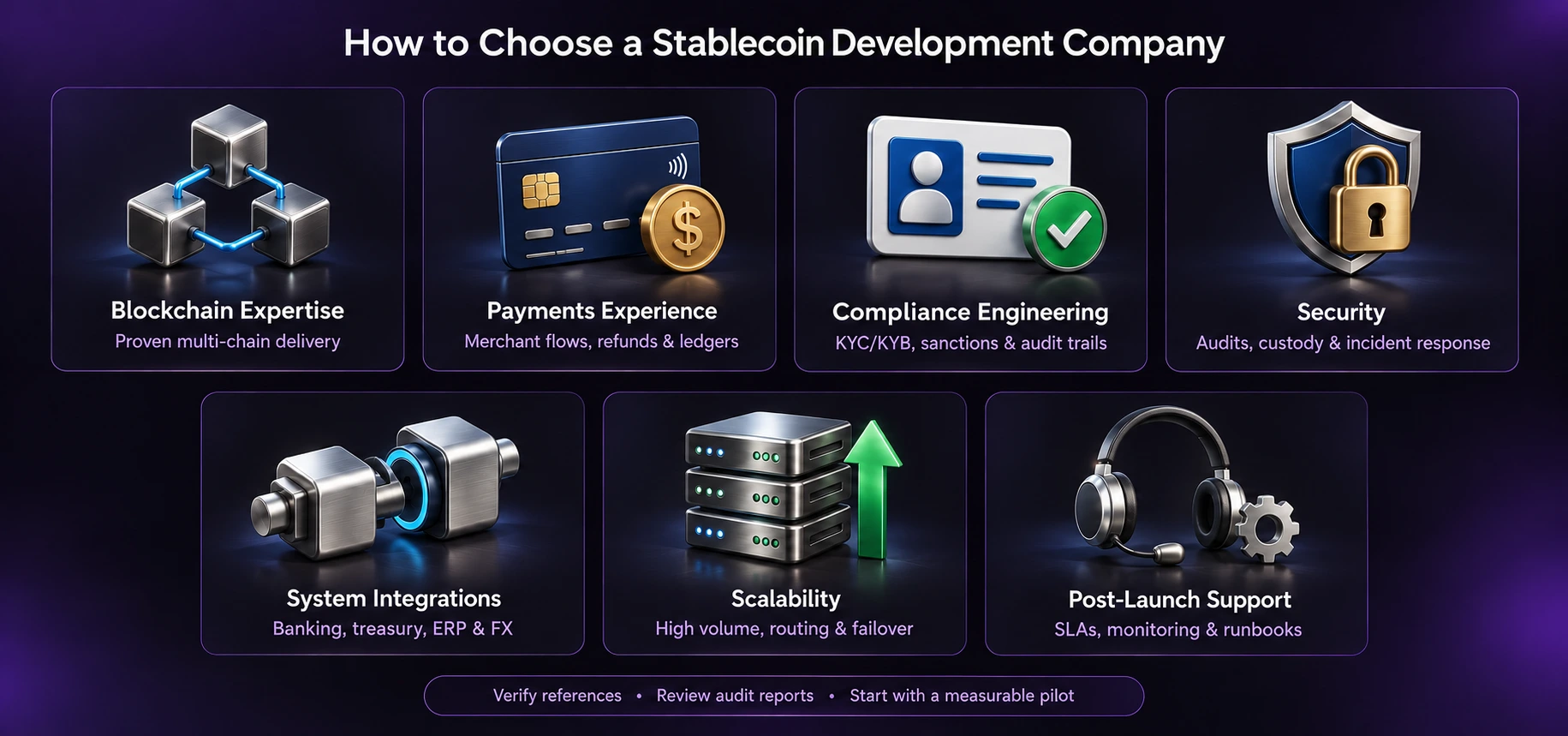
The right partner will reduce delivery risk, not just write contract code. Look for evidence of a team that has successfully built and deployed payment systems, knows regulatory constraints, and can provide post-launch platform support. The order of the questions tells you a huge amount about how the system works. A capable stablecoin development company will ask about your licensing model before suggesting a chain.
Vendor Evaluation Criteria
- Blockchain capabilities: Proven multi-chain and smart contract delivery.
- Payments experience: A solid grasp of merchant flows, reconciliation, refunds and ledgers.
- Compliance engineering: audit-trail design, sanctions, monitoring and KYC/KYB.
- Security: independent audits, custody controls, and incident response
- Integrations: Connect your treasury, banking, ERP and FX systems.
- Scalability: Failover, Multi-chain routing, High volume processing.
- Support: Operational run books, SLAs and post-launch monitoring.
If your team is looking for a partner to help with blockchain engineering and payment integration, or in-house builds and other specialized firms, Techfyte can be a good option to consider. When considering stablecoin development services, ask for references, audit reports and a clear delineation of who is responsible for compliance. Before you go into full construction, get a pilot scope with measurable milestones.
Build Stablecoin Payment Infrastructure with Techfyte
Techfyte helps fintechs, PSPs and enterprises to build secure stablecoin payment infrastructure. This is powered by payment APIs, wallet infrastructure, multi-chain settlement, compliance workflows and treasury tooling. Partner with Techfyte to find the right payment platform for your target corridors and volume.
Concluding Note
Stablecoins do have the potential to shorten settlement times and expand the reach of cross-border merchants, but this depends on careful construction of the surrounding system. Risks around licensing, liquidity, fraud, FX and reconciliation still exist and therefore successful platforms combine strong compliance and operational controls with an architecture that is transparent.
Or, consider building separate layers for APIs, wallets, settlement, conversion, treasury, and reconciliation to build stablecoin payment infrastructure that can withstand the rigors of high volume. Narrowly focused teams that test failure modes before launch and expand corridor by corridor with legal and security evaluations at each step are rewarded with secure, stablecoin-based payment infrastructures.
Frequently Asked Questions
1. What Is Stablecoin Payment Infrastructure?
Stablecoin payment infrastructure is a vast network of stablecoin transactions used to receive, convert, settle, reconcile and report stablecoin transactions. It includes wallets, blockchain settlement, FX conversion, treasury, compliance and reporting utilities and payment APIs.
2. How Do Stablecoins Help Cross-Border Merchant Payments?
Stablecoins could reduce reliance on correspondent-banking chains, allow for 24/7 transfers and create transparent transaction records. However, the benefits depend on the operational design, regulation, fiat ramps, and liquidity.
3. Do Stablecoin Payments Remove the Need for Licensing?
No. Depending on the jurisdiction and business model, a platform may still need money transmission, payment institution or VASP authorization. Licensing, KYC / AML, sanctions, custody and tax obligations vary from market to market and are subject to change.
4. What Components Does a Stablecoin Payment Platform Need?
A production platform needs payment APIs, checkout, wallet infrastructure, blockchain settlement, FX conversion, treasury controls, compliance screening, reconciliation, monitoring, and merchant reporting.
5. How Do Merchants Convert Stablecoins Into Local Currency?
Platforms use fiat on- and off-ramps, liquidity providers, and treasury buffers to convert stablecoins into local currency. Conversion timing, fees, and availability vary by corridor and banking partner.
Ready to Build Your Stablecoin Payment Infrastructure?
