
logo
wordpress_new
  • AI
    EXPLORE AI & ML
    • A AI Development
    • P Predictive Intelligence
    • A AI Infrastructure
    • R Research & Agents
    Contact us →
    AI Development End-to-end AI development and deployment services Custom LLM Development Business-trained large language models tailored to your domain Enterprise AI Assistants Intelligent chatbots and copilots for customer support and internal operations AI Content Automation Systems Automated content creation and curation powered by AI Generative AI Applications Development Build intelligent applications powered by generative AI.
    Predictive Analytics & Forecasting Forecast trends and outcomes with ML models Fraud Detection AI-based anomaly detection for financial security Anomaly Detection Systems Identify outliers and unusual patterns in real-time
    ML Pipeline Development End-to-end MLOps for training and deployment AI Deployment & Model Serving Scalable inference infrastructure for real-time predictions Automated Retraining Continuous model improvement with drift detection
    Neuro-Symbolic AI Hybrid systems combining neural networks with logical reasoning Federated Learning Distributed training while preserving data privacy AI Agent Infrastructure Multi-agent systems for complex task automation AI Agent Systems Cutting-edge AI systems and agent infrastructure Multi-Agent Orchestration Coordinated agent networks for parallel problem-solving Complex Decision Support Collaborative agent systems for complex problem-solving
  • Blockchain
    EXPLORE BLOCKCHAIN
    • B Blockchain
    • B Blockchain Frameworks
    • L Layer 1 & Layer 2
    • S Smart Contracts
    • E Enterprise Blockchain
    Contact us →
    Blockchain Development Engineer secure, decentralized digital ledgers Chain Abstraction Seamless multi-chain interactions for end users DePIN Development Decentralized physical infrastructure networks Quantum-Resistant Cryptography Future-proof blockchain security against quantum threats White Label Blockchain Solutions Launch customizable, market-ready blockchain platforms faster. Digital Identity Management Solutions Build secure, verifiable digital identity ecosystems.
    Polkadot Para chains Launch interoperable, custom-built blockchains Cosmos SDK blockchain Create sovereign, interconnected app chains Avalanche Subnet Custom validator sets for enterprise blockchains Polygon zkEVM Zero-knowledge rollups with EVM compatibility OP Stack Optimistic rollup frameworks for Ethereum scaling
    Cardano Research-driven proof-of-stake blockchain with peer-reviewed protocols Solana High-speed blockchain with proof-of-history for sub-second finality Aptos Move-based Layer 1 with parallel execution for enhanced throughput Polkadot Multi-chain network enabling cross-chain interoperability and shared security Ethereum Leading smart contract platform with the largest developer ecosystem BSC High-performance EVM-compatible blockchain with low transaction costs SUI Next-generation Move-based blockchain optimized for horizontal scaling Hedera Hashgraph consensus network for enterprise-grade distributed applications Hyperledger Modular enterprise blockchain frameworks for permissioned networks
    Formal Verification Mathematical proof of smart contract correctness Gas Optimization Minimize transaction costs through efficient code Cross-Chain Smart Contract Interoperable smart contracts across multiple chains Smart Contract Development Secure and optimized smart contract engineering Smart Contract Audits Independent security audits for production-ready smart contracts.
    Supply Chain and Logistics End-to-end traceability and logistics management Carbon Credit Platform Streamline carbon credit issuance and trading. Financial Services & FinTech Payment rails, settlement, and digital assets Blockchain Voting Systems Secure, transparent, and tamper-proof digital voting solutions Blockchain Governance Frameworks Secure governance systems for blockchain enterprises
  • Assets Tokenization
    EXPLORE ASSETS TOKENIZATION
    • A Assets Tokenization
    • T Token Infrastructure
    • F Fractional Ownership
    Contact us →
    Asset Tokenization Convert physical assets into digital tokens RWA Tokenization Platform Development Build compliant platforms for asset tokenization. Real Estate Tokenization Fractionalize property ownership via blockchain Carbon Credit Tokenization Transparently track and trade emissions Tokenized Bonds & Equities Security tokens representing company shares and debt instruments Commodity Tokenization Gold, silver, oil, and physical goods on blockchain Renewable Energy Certificates Tokenized green energy credits and renewable certificates White-Label Tokenization Customizable token issuance platform for any asset class
    Token Standards Engineering ERC-3643, ERC-1400, and custom token standards Regulatory-Compliant Token Design SEC-compliant security tokens with built-in regulations Cross-Border Distribution Multi-jurisdiction token issuance and distribution Institutional Custody Systems Enterprise-grade custody solutions for tokenized assets Compliance Reporting Modules Automated regulatory reporting and audit trails
    Investor Onboarding & Compliance KYC/AML verification and accredited investor workflows Dividend Distribution Automation Smart contract-based revenue sharing and payouts Secondary Marketplace Enablements Liquidity solutions for fractional ownership tokens Custody Integrations Integration with institutional custody providers
  • Web3
    EXPLORE WEB3 SOLUTIONS
    • W Web3 Solutions
    • D DeFi
    • E Exchanges
    • W Wallets
    • N NFTs & Digital Asset
    • D DAO & Governance
    • C Coin Development
    • D Digital Banking
    Contact us →
    Web3 App Development Customizable Web3 application development with modular components
    DEX & AMMs Decentralized exchanges with automated market makers DeFi Staking Deploy secure liquidity-earning protocols Lending & Borrowing Peer-to-peer lending protocols with collateral management Yield Farming Liquidity mining and yield optimization strategies DeFi Lottery Decentralized lottery systems with transparent prize distribution Synthetic Assets On-chain derivatives and synthetic exposure Cross-Chain Liquidity Unified liquidity across multiple blockchains
    Crypto Currency Exchange Custom crypto exchanges for seamless trading. Derivatives Exchange Futures, options, and perpetual contracts Spot Exchange Buy and sell crypto instantly at live market prices Margin Exchange Trade crypto with leverage using borrowed funds Prediction Marketplace Decentralized prediction markets with transparent outcomes P2P Exchange Peer-to-peer trading with escrow and dispute resolution Hybrid Exchange Combined CEX performance with DEX custody Order Matching Engine High-performance trading engine development White-Label Exchange Customizable turnkey exchange solutions Liquidity Management Market making and liquidity aggregation systems
    Crypto Wallet Development Secure and scalable wallets for digital asset management Multi-Chain Wallets Support for multiple blockchain networks in one wallet Web3 Super App All-in-one wallet, browser, and dApp platform Non-Custodial Wallets Complete control of digital assets with self-managed private keys. AI Crypto Wallets Intelligent wallet solutions powered by artificial intelligence DeFi-Integrated Wallets Built-in access to DeFi protocols and dApps MPC Wallets Multi-party computation for enhanced security White-Label Wallets Customizable wallet solutions for enterprises Embedded Wallet SDKs White-label wallet infrastructure for apps Institutional Custody Enterprise-grade custody with compliance features
    NFT Marketplace Full-featured marketplace for digital collectibles Dynamic NFTs Evolving metadata based on external conditions NFT Development Custom NFT creation and deployment services Utility NFT Platforms NFTs with real-world benefits and access rights
    DAO Infrastructure Infrastructure for creating and managing decentralized autonomous organizations Treasury Management Secure and transparent management of DAO treasuries
    Coin Development Custom cryptocurrency development services ICO Development End-to-end development and deployment of initial coin offerings Stablecoin Development Design and launch of stablecoins with various collateralization models Launchpad Development Comprehensive launchpad development and deployment services Token Development Custom token development tailored to your specific requirements
    Digital Banking Banking services built on blockchain technology White-Label NeoBank Customizable banking platform for enterprises BaaS Development Blockchain-as-a-Service development and deployment P2P Lending Peer-to-peer lending platforms on blockchain Stable-coin Remittance Platform Secure and fast cross-border payments using stablecoins Crypto Card Solutions Physical and digital payment cards for blockchain transactions Payment Gateways Integrated payment processing solutions for blockchain transactions
  • AI x Blockchain
    Explore Convergence
    • A AI x Blockchain Solutions
    • A AI-Enhanced
    • V Verified AI
    • E Economic Agents
    • A Autonomous Organizations
    Contact us →
    AI x Blockchain Solutions Intelligent blockchain systems powered by AI
    AI-Based Smart Contract Generation Automated contract creation using large language models Predictive Gas Optimization AI-driven transaction cost minimization
    On-Chain AI Training Logs Immutable record of model training processes Verifiable Inference Cryptographic proof of AI model outputs
    AI Trading Agents Autonomous trading bots with on-chain execution AI Portfolio Managers Self-adjusting investment strategies powered by ML Self-Optimizing DeFi Yield strategies that adapt to market conditions
    Algorithmic Governance AI-assisted DAO decision making AI Resource Allocation Intelligent distribution of computational and financial resources
  • Company
    • About Us
    • Blogs
Live Demos Get In Touch
Telegram
WhatsApp

Table of Contents

  • Key Takeaways
  • Introduction
  • What is a Prediction Market Platform Like Polymarket?
  • How Does a Polymarket-Style Prediction Market Work?
  • How Much Does It Cost to Build a Prediction Market Like Polymarket?
  • What Determines the Cost of Polymarket Prediction Market Platform Development?
    • 1. Smart Contract Development and Blockchain Integration – 20%
    • 2. Backend, Matching Engine, APIs and Real-Time Data – 25%
    • 3. Oracle and Market Resolution – 10%
    • 4. UI/UX and Trading Dashboard – 10%
    • 5. Security, KYC/AML and Compliance – 20%
    • 6. Liquidity and Market-Making – 15%
  • CLOB or AMM? The Trading Architecture Changes the Development Cost
    • CLOB: Order Book-Based Trading
    • AMM: Pool-Based Trading
  • How Much Does Polymarket Clone Software Development Cost by Feature?
  • Hidden Costs in Prediction Market Platform Development
  • Final Cost Estimate at Techfyte for Creating a Prediction Market Platform Like Polymarket
  • FAQs
    • 1. How much does it cost to create a prediction market platform like Polymarket?
    • 2. What factors affect the Polymarket clone development cost?
    • 3. How long does it take to build a prediction market platform like polymarket?
    • 4. What blockchain is best for a Polymarket-style platform?
    • 5. Do prediction markets need smart contracts?
    • 6. How does a prediction market resolve events?
    • 7. How much does a prediction market development company charge?

How Much Does It Cost to Create a Prediction Market Platform Like Polymarket?

Posted on August 14, 2026 by Deepak Dutta
Facebook X LinkedIn
How Much Does It Cost to Create a Prediction Market Platform Like Polymarket

Key Takeaways

  • Building a prediction market platform like Polymarket can range from $25,000 to $300,000+, depending on the required features, trading architecture, security, and scalability.
  • CLOB infrastructure, smart contracts, oracle-based resolution, backend systems, security, compliance, liquidity, and ongoing maintenance have the biggest impact on overall investment.
  • Businesses are inclined to create a prediction market platform like polymarket because of growing opportunities that offer reliable trading infrastructure, transparent market resolution, and scalable user experiences.
  • Techfyte is a reliable prediction market development company. They understand blockchain architecture, exchange infrastructure, smart-contract security, real-time trading, and compliance.


Introduction

With the right partner by your side, a prediction platform development company assists with developing reliable, cost-effective and scalable prediction market platforms like polymarket. The final cost depends less on blockchain itself and more on trading architecture, smart contracts, oracle-based resolution, security, compliance and scalability. According to research, Polymarket is at a volume of $9 billion as stated by April 2026.

Polymarket has captured 97% of onchain prediction market fees establishing its growing dominance. It has already generated $7.1 million in fees within the first week of Q2 2026. The rising demand also involves the need for building an exchange-like system where blockchain is one part of the technology stack.In this blog, explore the factors affecting Polymarket prediction market platform development and its cost.

What is a Prediction Market Platform Like Polymarket?

Prediction market platforms like Polymarket allows users to trade contracts based on outcome or real-world events. Markets cover sectors like politics, sports, economics, technology and other measurable events.

  • Users choose between YES/NO outcomes made for a defined event.
  • Each outcome has a price ranging from $0 to $1 representing the market’s probability.
  • Traders can buy or sell positions before the market is resolved, allowing them to manage positions as new information becomes available.
  • Oracle or defined resolution mechanism determines the winning outcome once the event concludes.
  • Winning positions are settled according to the market’s rules.

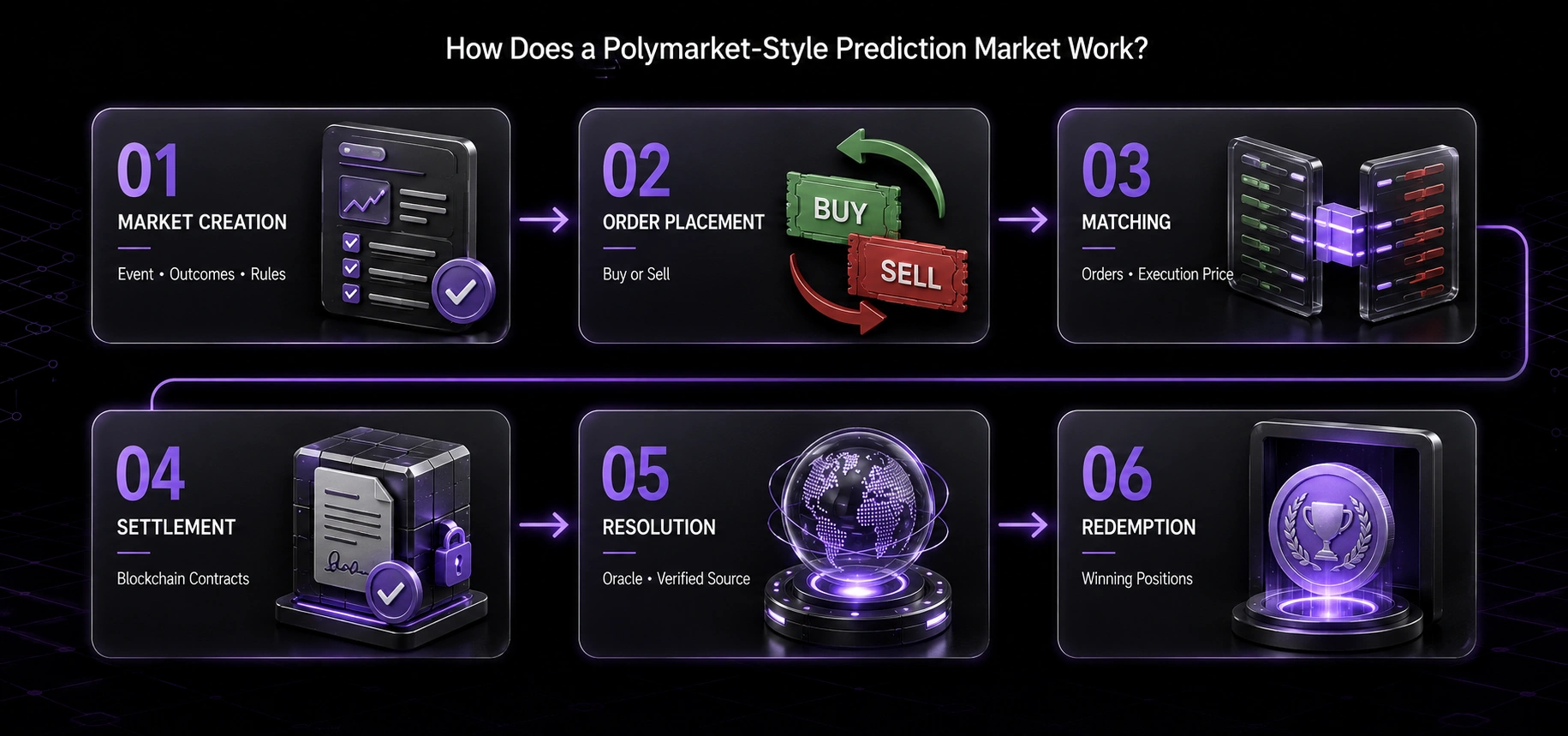
How Does a Polymarket-Style Prediction Market Work?
How Does a Polymarket-Style Prediction Market Work__
Step 1 – Market creation: An administrator defines the event, outcomes, closing time, and resolution rules.Step 2 – Order placement: Traders submit buy or sell orders through the platform.Step 3 – Matching: The matching engine pairs compatible orders and determines the execution price.Step 4 – Settlement: Completed trades are recorded and settled using blockchain-based contracts.Step 5 – Resolution: An oracle or predefined source determines the final outcome.Step 6 – Redemption: Winning positions can be redeemed according to the market’s settlement rules.

How Much Does It Cost to Build a Prediction Market Like Polymarket?

The cost of Polymarket clone development depends on business requirements. Factors like trading infrastructure, blockchain settlement, market-resolution system, and scalability. The average cost for polymarket clone software development ranges from $25,000 to $300,000.

Development Approach Approx. Cost Typical Scope
Prototype / Basic Clone $10K–$25K Basic markets, wallet, simple trading
MVP $25K–$50K Core trading, smart contracts, admin panel
Custom Commercial Platform $75K–$150K CLOB, oracle, APIs, security, analytics
Enterprise-Grade Platform $150K–$300K+ High scalability, advanced risk and compliance

Get a Clear Cost Estimate for Your Prediction Market Project

Get Your Development Estimate

What Determines the Cost of Polymarket Prediction Market Platform Development?

The cost of building a prediction market platform like Polymarket depends on the complexity of its trading, blockchain, security and operational infrastructure.

1. Smart Contract Development and Blockchain Integration – 20%

Smart contracts handle outcome positions, collateral, settlement, redemption, permissions, and other on-chain operations. Blockchain selection influences wallet compatibility, stablecoin support, liquidity, transaction throughput, and development difficulty. Gas optimization and contract architecture require additional engineering effort. Smart-contract development should also be kept separate from independent auditing, as an audit is a security assessment rather than part of the coding process.

2. Backend, Matching Engine, APIs and Real-Time Data – 25%

Since a Polymarket-style platform requires more than just standard Web3 APIs, the backend may have the most share. A CLOB and matching engine, REST APIs, WebSockets, order management, market data services, blockchain indexing, portfolio tracking, caching, rate limitation, and monitoring can all be necessary. Concurrency, low latency processing, data consistency, and fault tolerance all become more crucial as trading volume rises. The architecture of Polymarket illustrates how exchange infrastructure can be far more intricate than a simple blockchain application.

3. Oracle and Market Resolution – 10%

Prediction markets need a reliable mechanism to determine whether an event occurred and which outcome should be settled. This layer includes Oracle integration, resolution rules, outcome suggestions, dispute resolution, and final settlement. While political, sports, or real-world event markets may need more complex resolution logic and edge cases, simple price-based markets could require less work. Thus, development and testing expenses are directly impacted by the Oracle architecture selected.

4. UI/UX and Trading Dashboard – 10%

The frontend cost depends on how closely the platform resembles a professional trading terminal. The Polymarket-type frontend may have features such as market discovery, probability graphs, order books, bid ask, trading screens, open positions, balances, profit and loss, transaction history, wallet integration, and the market resolution status. The real-time synchronization with backend market data and blockchain transactions increases the complexity beyond that of a typical Web3 frontend.

5. Security, KYC/AML and Compliance – 20%

Security and compliance can represent a significant portion of the budget, particularly when the platform handles user funds. The security-related tasks might consist of conducting audits of the smart-contracts, penetration tests, securing APIs, key management, access management, AI detection of fraudulent activities, monitoring and incident response. The need for legal compliance requirements require KYC/AML checks, sanctions screening, age verification, geo-blocking, transaction monitoring, and regulatory reporting.

6. Liquidity and Market-Making – 15%

Development cost is not the same as liquidity capital. A technically complete prediction market can still struggle if markets have thin order books, wide spreads, or insufficient trading activity. Launch costs may therefore include initial market-making capital, professional market makers, inventory, spread incentives, and liquidity rewards. There is no universal monthly figure because the requirement depends on the number of markets, expected trading volume, target spreads, and market-making strategy. Unlike development, liquidity is primarily an ongoing operational expense.

Choose the Right Trading Architecture and Technology Stack

Talk to Our Prediction Market Experts

CLOB or AMM? The Trading Architecture Changes the Development Cost

The trading model is one of the biggest factors affecting the cost of Polymarket platform development. A prediction market can use a Central Limit Order Book (CLOB) or an Automated Market Maker (AMM), and the two require very different infrastructure.

CLOB: Order Book-Based Trading

A CLOB follows the flow: user to order book to matching engine to settlement. Users can place market or limit orders, view bid/ask prices, cancel orders, and receive partial fills. It requires an order-matching engine, persistent order management, WebSocket connections, and market-data services, making cryptocurrency exchange development closely related to the trading infrastructure required for a Polymarket-style platform.

AMM: Pool-Based Trading

An AMM uses liquidity pools and mathematical pricing algorithms rather than matching individual buyers and sellers. This can simplify the trading infrastructure, but requires pool management, pricing curves, liquidity incentives, and sufficient capital to maintain usable markets.For a prediction market platform like Polymarket, a CLOB generally requires more engineering and infrastructure investment. A platform that copies Polymarket’s interface is therefore much cheaper than one that develops its exchange-grade trading architecture.

How Much Does Polymarket Clone Software Development Cost by Feature?

The cost of Polymarket clone software development varies by the complexity of each technical layer. The following ranges provide a practical planning estimate for a custom platform.

Component Cost
UI/UX + Trading Dashboard $10K–$30K
Backend + APIs $20K–$40K
CLOB / Matching Engine $30K–$80K
Smart Contracts $20K–$50K
Oracle / Market Resolution $15K–$40K
Wallet / Payment Integration $5K–$20K
Security + Audit $15K–$50K+
Admin + Risk Management $10K–$25K

Hidden Costs in Prediction Market Platform Development

Beyond development, these six costs can significantly affect the total investment in a prediction market platform like Polymarket:

  1. Security & Audits – Smart-contract audits, penetration testing, and ongoing security monitoring.
  2.  Cloud & Infrastructure – Servers, databases, WebSockets, ndexing, storage, and scaling.
  3. Oracle & Data Services – Market data feeds, oracle services, and event-resolution infrastructure.
  4.  Compliance & Legal – KYC/AML tools, licensing, legal reviews, and jurisdiction-specific compliance.
  5.  Liquidity & Market Making – Initial liquidity, market-maker fees, inventory, and trading incentives.
  6. Maintenance & Third-Party Services – Bug fixes, upgrades, support, analytics, APIs, and other recurring subscriptions.

Final Cost Estimate at Techfyte for Creating a Prediction Market Platform Like Polymarket

The estimated cost to create a prediction market platform like Polymarket depends on architecture, infrastructure, security requirements and scalability. Techfyte lists blockchain development, smart contract auditing, prediction marketplaces, order-matching engines and crypto exchange development among its technology capabilities.

  • Basic version: ($25K–$50K) Core markets, wallet, basic trading, contracts, and admin.
  • Production Commercial Platform: ($75K–$150K) CLOB, APIs, oracle, security, analytics, and scalable infrastructure.
  • Advanced/Enterprise Platform: ($150K–$300K+) High-volume trading, advanced risk controls, compliance, and enterprise scalability.

FAQs

1. How much does it cost to create a prediction market platform like Polymarket?

To create prediction market platform like polymarket the cost ranges from $25,000 to $300,000+. However, development cost at Techfyte depends on the platform’s complexity.

2. What factors affect the Polymarket clone development cost?

Polymarket clone software development cost varies depending on features and architecture. Other factors affecting cost include wallets, markets, trading, and an admin panel. While advanced development solutions include CLOB infrastructure, real-time APIs, oracle integration, analytics, security, and compliance capabilities.

3. How long does it take to build a prediction market platform like polymarket?

A basic version of polymarket prediction market platform development takes around 3 to 4 months. However, an advanced platform requires 6 to 12 months. The timeline depends on smart-contract complexity, trading architecture, oracle integration, security testing, compliance requirements, and the number of markets and features being launched.

4. What blockchain is best for a Polymarket-style platform?

There is no single best blockchain for Polymarket platform development. However, Layer-2 networks for lower transaction costs and Ethereum ecosystem for compatibility. The choice should consider transaction costs, throughput, finality, stablecoin availability, wallet compatibility, liquidity, developer tooling, ecosystem maturity, and security.

5. Do prediction markets need smart contracts?

Smart contracts development is important for a decentralized market platform. However, prediction markets don’t need them. A centralized platform can manage functions off-chain. The architecture depends on the desired level of decentralization, custody, transparency, and regulatory requirements.

6. How does a prediction market resolve events?

A prediction market platform like Polymarket has resolution architecture which is particularly important. It resolves incorrect or ambiguous outcomes that can directly affect user positions and payouts. The process can involve outcome proposals, verification, disputes, and final settlement.

7. How much does a prediction market development company charge?

A prediction market development company like Techfyte charges between$25,000 to $300,000+, depending on the scope. The final costs are affected by custom CLOB development, smart contracts, oracle systems, security audits, compliance integrations, real-time infrastructure, and enterprise scalability.

Build a Secure, Scalable Polymarket-Style Platform

Start Your Prediction Market Project

Posted in UncategorizedTagged How Does a Polymarket-Style Prediction Market Work, How Much Does It Cost to Build a Prediction Market Like Polymarket, How Much Does It Cost to Create a Prediction Market Platform Like Polymarket, How Much Does Polymarket Clone Software Development Cost by Feature, What Determines the Cost of Polymarket Prediction Market Platform Development

Author :

Deepak Dutta

Deepak Dutta

Senior Technical Content Writer

Deepak Dutta is a tech-focused content strategist and writer with 9+ years of experience, including 5+ years in blockchain, Web3, and AI content. He specializes in creating clear, engaging, and SEO-driven content that simplifies complex technologies and helps tech brands build authority and audience trust.

LinkedIn
View all posts →
TECHFYTE
techfyte

Quick Links

  • Home
  • AI Development
  • Web3 Development
  • Blockchain
  • Asset Tokenization
  • AI x Blockchain Solutions
  • Contact-us

Connect

Sales

Email sales@techfyte.com
Phone +971 50 293 1801

Our Offices

Location UAE

DSO IFZA, IFZA Properties, Dubai Silicon Oasis, Dubai, UAE

Phone +971 50 293 1801

Location INDIA

F-273, Phase 8B, Industrial Area, Sector 74, Sahibzada Ajit Singh Nagar, Punjab 160071

Phone +91 172 311 3789

Follow Us

Stay connected and follow us on social media for the latest updates, insights, and innovations.

LinkedIn Twitter Facebook Instagram

© 2026 Techfyte Innovations. All rights reserved. Powered by ChicMic Studios | Privacy Policy | Terms of Service

Let's build something great.

Tell us about your idea. Our team will get back to you with a tailored proposal.

Start a conversation

icon Your Idea Is Fully Protected By Our Non Disclosure Agreement (NDA).