



Key Takeaways
- Blockchain AI market growth is estimated to grow from $0.7 billion to $2.38 billion by 2030, with a rate of 27.7% CAGR forecast.
- Fortune 500 companies are increasingly investing on blockchain initiatives with a round of 60% as of 2025.
- In the period of 2015 to 2025, Coinbase, Trust and Sweat reached roughly half a million downloads each in Q4 2023.
- Institutional crypto wallets require security, governance, compliance, and enterprise integrations beyond simple asset storage.
- Successful AI crypto wallet platform development depends on scalability, regulatory compliance, and advanced security technologies.
Introduction
The need for institutional crypto wallet arises because of the diversification into digital assets from conventional finance services. The institutions now need to explore ways to offer new products to their clients while navigating a constantly evolving regulation environment. Consequently, digital asset management will become increasingly integral to a financial institution rather than being a niche service.
Financial institutions need to carefully design security architecture, custody infrastructure, compliance process, and integrations with current bank systems. In this guide, explore the main components and development issues of crypto custody platform development.
What is an Institutional Crypto Wallet?
An institutional crypto wallet is a secured wallet management platform designed for banks, financial institutions, asset managers, and enterprises. Unlike a retail wallet, an institutional wallet incorporates custodial security, governance mechanisms, compliance monitoring, and multi-user access management to ensure safekeeping of digital assets.
One of the most important functions of an enterprise crypto wallet development is to help in providing crypto custody of the digital assets through secure storage, governance mechanism, disaster recovery plan, and continuous transaction monitoring.
Banks are increasingly venturing into the world of digital assets, and thus, an institutional crypto wallet can offer a secure and scalable infrastructure to handle their customer funds, treasuries, tokenized asset management, and other digital asset services.
Why Banks Need Institutional Crypto Custody in 2026
The rise of digital assets is revolutionizing the way banks and other financial institutions view asset management and custody. As the demand for cryptocurrencies, tokenized securities, and stablecoin payment solutions increases, there are growing demands for digital asset services that would be secure and in line with compliance. Institutional crypto custody has now become more than just an experiment in that regard.
Institutional crypto custody in 2026 allows banks to meet their clients’ needs, facilitate cross-border payments, handle tokenized assets, and create digital asset services safely and reliably.
- Digital asset demand
- Tokenized securities
- Stablecoins
- Cross-border payments
- Regulatory clarity
- Client expectations
Core Components of an Institutional Crypto Wallet Architecture
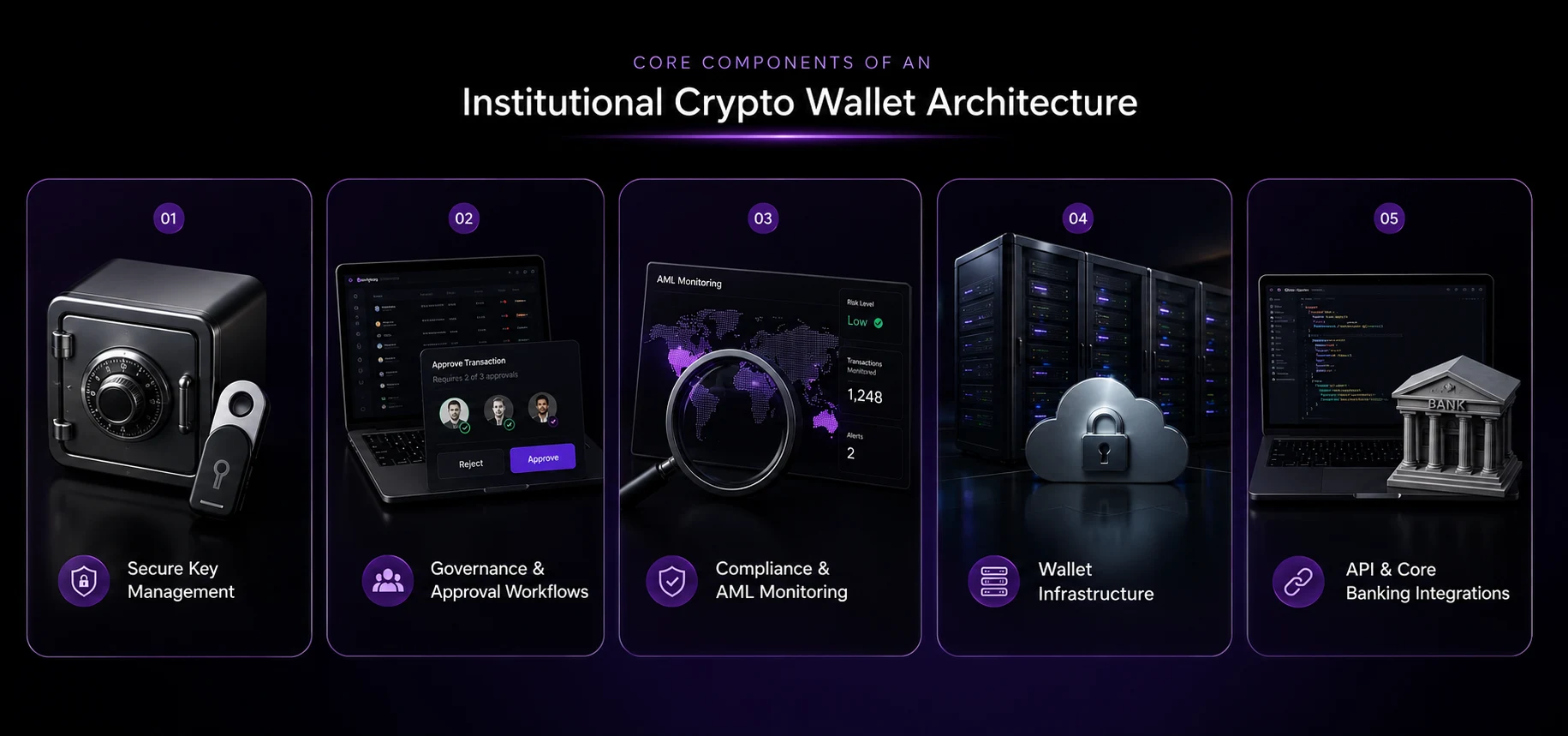
Building an institutional crypto wallet requires more than secure private key storage. Banks and financial institutions need an architecture that combines security, governance, compliance, and seamless integration with enterprise systems to support institutional-grade digital asset operations.
Secure Key Management
- Multi-Party Computation (MPC): By breaking down cryptographic processes between various participants, MPC wallet removes the necessity for having a single private key. As a result, there is less likelihood of a key breach and secure transaction signing can be achieved.
- Multi-Signature (Multi-Sig): Multi-Sig wallet needs confirmation from several users before executing a transaction, which increases the level of internal control and decreases the likelihood of making an unauthorized transfer.
- Hardware Security Modules (HSMs): HSMs are special pieces of hardware that securely create, store, and manage cryptographic keys. It is an extra safeguard for the valuable assets of an institution.
- Key Sharding: In key sharding, a cryptographic key is divided into several encrypted parts. In the event of disclosure of any part, it will not be possible for the attacker to rebuild the entire key.
Governance & Approval Workflows
- Multiple Approvals for Multi-User Transactions: The transactions at institutional level involve getting approval from many people before executing the transaction in order to avoid fraudulent activities and promote accountability between different departments.
- Transaction Limit: Setting up configurable limits for transactions will help in avoiding high value transfer transactions which may be made by fraudsters. Such limits are helpful for enforcing financial policies defined in advance.
- Permission Based on Roles: Users, who have different responsibilities like admin, treasuries, compliance, and audit, get permission based on their role.
- Policy Engine: This will help in enforcing business rules like limit, transaction restriction, and wallet policies using policy engine.
Compliance & AML Monitoring
- Anti Money Laundering (AML): Automatic AML checks help identify suspicious transactions and ensure compliance with financial regulations. Continuous monitoring limits the risk of becoming a victim of financial crimes.
- Know Your Transaction (KYT): KYT services analyze real-time blockchain transactions and identify potentially risky wallets. This helps in managing risks at a transactional level.
- Sanctions Check: The wallet needs to check its counterparties against the sanctions lists around the world. This will help avoid engaging in prohibited transactions and avoid regulatory fines.
- Risk Scoring & Audit Trails: Risk scoring is used to assign a risk score to the transaction using blockchain intelligence, whereas audit trails maintain an immutable history of all user actions.
Wallet Infrastructure
- Hot Wallets: These are internet connected wallets, which facilitate rapid transactions for withdrawal purposes of customers. However, due to their online nature, they need additional measures to be taken for protection against cyber threats.
- Warm Wallets: The warm wallets strike a balance between ease of access and protection. They provide limited exposure and facilitate liquidity and therefore are popularly used as intermediaries between hot and cold wallets.
- Cold Storage: Cold wallets store private keys completely offline and are therefore considered to be the best method for securing reserves over a long period of time.
- Segregating Treasury Reserves: Segregation of treasury reserves from operational wallets lowers the risk involved. It facilitates better management of assets.
API & Core Banking Integrations
- Core Banking Solutions: The integration of the institutional crypto wallet within the core banking system facilitates comprehensive account management and transaction processing.
- Trading Systems: Through the integration via APIs, the movement of digital assets between custody wallets and trading systems becomes possible, allowing for more efficient and speedy transactions.
- Treasury Management Solutions: The integration of treasury solutions enables you to monitor in real-time the liquidity and the status of your balances within the crypto ecosystem.
- ERP & Accounting Software: The integration of ERP software and accounting platforms ensures accurate financial reporting and auditability through automation.
Launch secure digital asset services
Institutional Crypto Wallet Development Process
Choose to partner with an enterprise blockchain app development company. They follow a structured and successful approach to meet demands for enterprise crypto wallet development. They assist in balancing security, regulatory compliance, and operational efficiency. Whether you’re building an in-house solution or investing in crypto custody platform development, following these key steps can help create a secure and scalable institutional wallet.
1. Define Business & Regulatory Requirements
Start by identifying your business objectives, target users, supported digital assets, and jurisdictions. Regulatory requirements such as AML, KYC, GDPR, and local digital asset regulations should be incorporated into the project from the outset.
2. Choose the Right Custody Model
Select a custody approach that aligns with your business model and risk appetite:
- Self-custody: The institution manages private keys and security infrastructure internally.
- Third-party custody: A regulated custodian manages digital assets on behalf of the institution.
- Hybrid custody: Combines in-house control with third-party custody services for added flexibility and resilience.
3. Develop the Wallet Architecture
Create an architecture that can handle hot, warm, and cold wallets, access controls by roles, approvals, and API integrations. It will also be able to handle any future blockchain networks and types of digital assets.
4. Implement Secure Key Management
Implement security technologies including Multi-Party Computation (MPC), multi-signature authentication, Hardware Security Module (HSM), and key backup encryption. Such technologies will help in securing private keys from any unauthorized access.
5. Develop the Transactions and Policy Engine
Create a transactions engine that will be able to handle the transfer of the digital assets, fees and blockchain operations. Create a policy engine that will approve the transactions based on the policies applied.
6. Ensure Compliance and Risk Monitoring
Ensure that there are compliance capabilities such as AML screening, KYT screening, sanctions screening, blockchain analysis, and audit logging built into your system. Continuous monitoring of transactions will assist in identifying suspicious behavior on the platform.
7. Perform Security Testing and Auditing
Perform an extensive audit on the security of the platform, which includes performing a penetration test, vulnerabilities assessment, smart contract auditing (if available), and infrastructural auditing. The audit should be performed to prevent any weakness that may exist prior to launching the platform.
8. Launch, Monitor, and Scale
Once the platform is launched, it is necessary to continue monitoring the performance of the wallets, transaction activity, and security incidents.
Essential Security & Compliance Features Every Institutional Crypto Wallet Needs
A secure institutional crypto wallet must combine advanced security controls with built-in compliance capabilities to protect digital assets and meet regulatory obligations. Modern crypto custody solutions should include the following essential features:
- Multi-Party Computation (MPC): Mitigates the risk of failure of cryptography at a single point as the cryptography process is distributed among several parties.
- Multi-Signature Authorization: Ensures that more than one authorized user must authorize a transaction before it can take place.
- Hardware Security Module (HSM) Support: Manages cryptographic keys in secure hardware to offer enterprise-level key management services.
- Role-Based Access Control (RBAC): Grants permissions according to the role of the user, thus providing employees access only to the processes they require.
- Audit Trails: Creates highly-detailed and tamper-proof logs of users’ actions and transactions to enable audits and investigations.
- Disaster Recovery & Backups: Safeguards the institution’s digital resources by means of backups and recovery solutions.
- Transaction Monitoring: Monitors transactions on the blockchain in order to detect any suspicious behavior.
- Policy Engine: Automates the process of approval of actions and transactions according to the established policies and limits.
- Address Allowlisting: Ensures that any transactions can be made only using the pre-approved wallet addresses.
- Compliance Reporting: Generates compliance reports for KYC/AML, sanctions check, transactions history, and other audit purposes.
Challenges Banks Face During Custodial Wallet Development
While custodial wallet development creates new opportunities for banks and financial institutions, it also presents several technical, operational, and regulatory challenges that must be carefully addressed.
- Regulatory Complexity: Banks have to deal with the changing regulations around digital assets, AML/KYC obligations, sanctions checks, and custody rules by region.
- Legacy Systems Integration: It takes a lot of engineering efforts to integrate crypto custody platforms into the existing banking and legacy systems.
- Multi-Chain Support: Running custom multi chain crypto wallet solutions implies interoperability and standardization as well as constant upgrades of the infrastructure.
- Security Risks: Institutions need to protect themselves from cyber attacks, insider threats, leakage of the private keys, and any other unauthorized transactions.
- Governance: There should be clear approval processes, access rights and policies to ensure accountability.
- Scalability: Wallet infrastructure should be able to support increasing transaction load and services.
Build Security-first Architecture for Crypto Wallet
Conclusion
Institutional crypto wallet is no longer a storage solution, it is a complete digital asset management system that enables secure custody, governance, transaction control and regulatory compliance. The increased adoption of digital assets by financial institutions, increases the need for secure, scalable and compliant infrastructure.
Build successful crypto wallet with Techfyte with advanced security measures, robust operational workflows, and seamless integration with existing financial systems. A crypto wallet development company focuses on prioritizing balance between technology, compliance and user experience.
FAQs
1. What is an institutional crypto wallet?
An institutional crypto wallet is a secure digital asset management solution designed for banks, financial institutions, asset managers and enterprises. It supports advanced features such as multi-user access, role-based permissions, Multi-Party Computation (MPC), compliance monitoring and audit trails.
2. What is institutional crypto custody?
The term Institutional crypto custody refers to the secure storage, management and protection of digital assets on behalf of financial institutions or their clients. It safeguards digital assets while ensuring institutions meet legal obligations, minimize operational risk and maintain trust with customers and stakeholders.
3. How is an institutional wallet different from a retail wallet?
The difference between retail wallet and institutional wallet depends on users. Retail wallets are designed for individual users, whereas institutional wallets include features such as multi-user approvals, role-based access control, compliance checks, audit logging and enterprise integrations.
4. How long does crypto custody platform development typically take?
The timeline for crypto custody platform development depends on the project’s scope, supported blockchain networks, compliance requirements and integration complexity. On an average a fully enterprise solution might require 9 to 12 months or longer depending on requirements.
5. What are the key features of an institutional crypto wallet?
The key features of institutional crypto wallet includes advanced security, compliance and governance features that are designed for financial institutions. Key features include Multi-Party Computation (MPC), multi-signature authorization, role-based access control, transaction monitoring and other operational features.
6. How does an institutional crypto wallet ensure asset security?
Institutional crypto wallet protects digital assets through multiple security layers, including MPC technology, HSM integration, multi-signature approvals, encryption, access controls, transaction monitoring and other security mechanisms.
7. What custody models are available for institutional crypto wallets?
Institutions have a choice between self-custody, third-party custody and hybrid custody models. Self-custody provides complete control over assets, third-party custody relies on specialized providers for asset protection, and hybrid custody combines institutional control with external security infrastructure.
8. Why do banks need crypto custody solutions?
Banks require crypto custody solutions that will allow them to safely hold crypto-assets without violating any regulations, security protocols, and other necessary conditions. They are required for banks to be able to offer crypto-assets and perform transactions on the blockchain platform.
9. What is the difference between crypto custody and a crypto wallet?
A crypto wallet enables users to store, send, and receive digital assets, while crypto custody involves the secure management and protection of those assets on behalf of individuals or institutions. Institutional custody wallet solutions add governance, compliance, monitoring, and security controls required by financial organizations.
Launch a Secure Crypto Wallet with Techfyte Experts
