



Key Takeaways
- Layer 2 blockchain development improves scalability by processing transactions off-chain while retaining Layer 1 security.
- Ethereum Layer 2 solutions help enterprises reduce gas fees, latency, and transaction bottlenecks at scale.
- ZK Rollups deliver instant finality and stronger privacy, while Optimistic Rollups offer broader EVM compatibility.
- Businesses across banking, gaming, logistics, and loyalty platforms are adopting Layer 2 for faster operations.
- A reliable Layer 2 blockchain development company should offer expertise in rollups, zkEVMs, DevSecOps, and security audits.
- Enterprise-ready L2 solutions support compliance requirements such as KYC/AML, permissioned validators, and auditability.
- Future innovations like Proto-danksharding, Layer 3 chains, and account abstraction will further accelerate enterprise blockchain adoption.
Introduction
Layer 2 blockchain development builds on top of current networks to speed up transactions, lower costs, and cut down on latency without lowering security. Businesses can get around the problems with standard blockchains by processing transactions off-chain and then anchoring them to Layer 1 on a regular basis. In particular, Ethereum Layer 2 scaling solutions offer fast processing, low gas fees, and reliable decentralization, which makes them perfect for big businesses to use.
Enterprise blockchain scaling solutions are a practical way for US-based businesses to become more efficient when they have to deal with the blockchain trilemma of scalability, security, and independence. Working with a Layer 2 blockchain development company guarantees custom architectures, smart contracts that work better, and ongoing help for operations that are very important to the business. This piece talks about how working with a Layer 2 blockchain development company can change how a business runs. Find out more about our enterprise blockchain development services.
What Is Layer 2 Blockchain Development?
Layer 2 blockchain development is the creation of secondary protocols on top of an existing Layer-1 blockchain (such as Ethereum) to increase transaction throughput and reduce fees without sacrificing the security of the base layer. Businesses can scale efficiently while maintaining trust in the underlying network.
It’s like putting it on your tab instead of paying for the drink separately. Layer 2 is a bar tab settled at the end. It is fast, efficient, and consolidated on the main ledger. Layer 1 is each payment settled immediately. It is slow and expensive.
Ethereum L2 smart contracts operate with the same logic as Layer 1 contracts, but in an off-chain or sidechain environment that offers higher throughput, lower fees, and faster confirmations. They are well suited for building a scalable Layer 2 dapp architecture. These blockchain scalability solutions provide a way for businesses to deploy high-performance apps while maintaining the main chain secure and intact.
Why Businesses Need L2 Scaling Solutions
Businesses have to deal with supply chain bottlenecks, high microtransaction costs and loyalty schemes that require instant finality. L2 solutions enable blockchain transaction optimization by performing transactions off-chain and anchoring results to L1, reducing the cost and increasing the speed of execution.
For US businesses, combining Layer 2 with permissioned validators and compliant bridges such as Polygon PoS & zkEVM can help meet KYC/AML and regulatory requirements. Layer 2 utility is evidenced by real-world adoption . Banking institutions explore private L2 instances for instant settlement . Starbucks Odyssey employs Polygon for efficient loyalty purchases.
These high-performance blockchain development frameworks provide scalable, secure and compliant infrastructure to help businesses grow blockchain applications without the roadblocks of high fees or hurdles.
Types of Layer 2 Blockchain Solutions
Layer 2 solutions leverage Ethereum to increase throughput and lower costs.
- ZK Rollups: Known as the gold standard, they combine transactions and produce Layer 1-verified cryptographic proofs. ZK rollups provide immediate finality, making them perfect for high-value DeFi and corporate transactions. For businesses that require safe, quick transactions, ZK rollup and optimistic rollup development are essential. To understand the cryptographic foundation behind this, read our deep-dive on zero-knowledge proofs and how they power blockchain privacy.
- Optimistic Rollups: Make the assumption that transactions are legitimate and settle disagreements by using fraud evidence during a challenge period. Although finality is delayed, they work well for general-purpose DApps and are largely EVM-compatible (OVM).
- State Channels: Ideal for frequent micro-transactions, these channels allow quick off-chain transactions between predetermined parties before settling on Layer 1.
- Plasma: For complex smart contracts, rollups are more flexible than hierarchical child chains like Plasma that are periodically attached to Layer 1.
- Sidechains: They are separate networks that operate in parallel to Ethereum and provide reduced fees and throughput. They are appropriate for specific enterprise applications since security is distinct from Layer 1.
- Validiums: Similar to ZK rollups, validiums store data on external availability layers off-chain. Low cost and high throughput, but with extra trust presumptions.
ZK Rollups vs. Optimistic Rollups
| Feature | ZK Rollups | Optimistic Rollups |
| Finality | Instant | Delayed (1–2 week challenge period) |
| Security Model | Cryptographic proofs (ZK-SNARKs/STARKs) | Fraud proofs (“innocent until proven guilty”) |
| EVM Compatibility | Improving (zkEVM) but complex | High (OVM) |
| Best Use Case | High-value DeFi, private enterprise transfers | General purpose DApps, social platforms |
| Development Complexity | High | Moderate |
Top Features of a Layer 2 Blockchain Development Company
Enterprise decision-makers looking for a partner must evaluate layer 2 blockchain development companies on certain important operational and technical parameters.
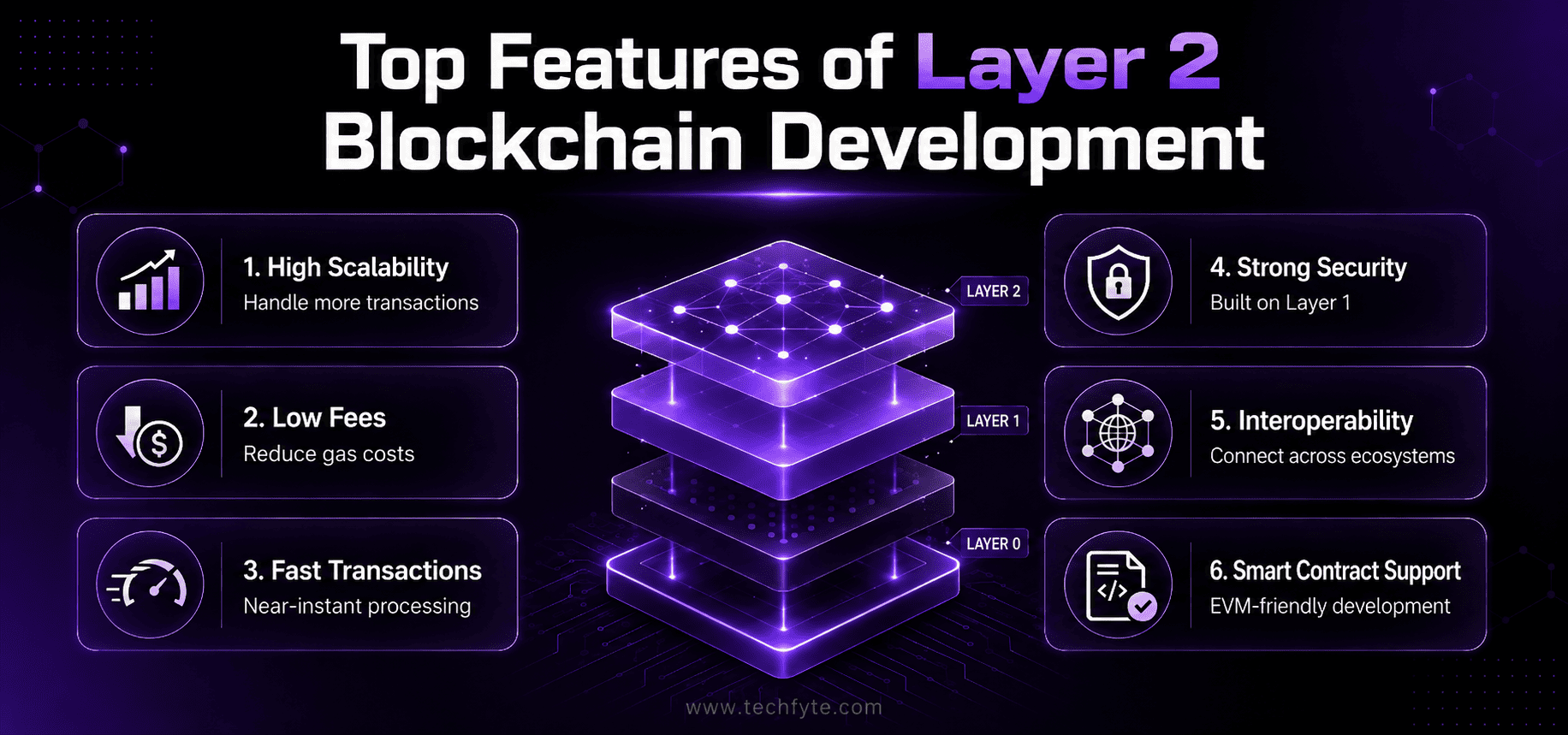
Here’s a checklist from a CTO’s point of view:
- Zero-Knowledge Cryptography Expertise: The team needs to have deep knowledge of ZK-SNARKs, ZK-STARKs, and other cryptographic proofs to allow for safe and scalable off-chain computation. Learn more about zero-knowledge technology by visiting Ethereum’s developer documentation.
- Demonstrated Layer 2 Deployment Experience: Look for experience in full layer 2 blockchain deployment, encompassing both ZK and Optimistic Rollups, from testnets to production.
- Modular Architecture Experience: Familiarity with modular frameworks like Celestia and Avail aids in effectively partitioning consensus, data availability, and execution layers and developing enterprise blockchain scaling solutions. Read more about modular blockchain concepts in Celestia Docs.
- Resilient DevOps and Sequencer Management: Sequencer uptime is crucial. A qualified partner will optimize performance, manage failover and monitoring for L2 networks.
- Enterprise-Grade Security Audits: Full network and smart contract audits ensure L2 DApp development services conform to operational and regulatory standards, minimizing risks before deployment. You can read about frameworks and standards at Consensys Smart Contract Best Practices.
Ethereum L2 Development Services
Techfyte delivers end-to-end Ethereum Layer 2 solutions to US businesses for high-performance execution, scalability and compliance.
- Custom Layer 2 DApp Architecture Design: We develop custom layer 2 dapp architecture that improves transaction throughput, cost efficiency, and integration with existing enterprise systems, aligned with enterprise workflows. This ensures that applications meet regulatory requirements and are ready for wide deployment.
- End-to-end L2 DApp Development Services: Our team offers full-cycle L2 DApp development services from design to production deployment. Our highest priorities are user experience, security and compatibility with Ethereum Layer 1. We deliver reliable solutions for supply chain, financial and loyalty applications.
- DevSecOps & Layer 2 Blockchain Deployment: We take care of the complete deployment of layer 2 blockchains, including DevSecOps pipelines, continuous monitoring and automated testing to guarantee the availability and operational security of the network. Deployment includes enterprise compliance such as KYC/AML and permissioned validators.
- Ethereum L2 Smart Contracts Development and Porting: Our developers create and deploy Ethereum L2 smart contracts that are optimized for Layer 2 execution and gas efficiency. Contracts comply with US enterprise governance and audit standards.
- High-Performance Blockchain Development Consulting Service: Techfyte provides strategic advice on high-performance blockchain development, helping businesses select the appropriate stack for L2 deployment. Our expertise in Arbitrum Orbit, OP Stack, zkSync Hyperchains and Polygon CDK means we can deliver safe, scalable and production-ready enterprise solutions. Explore our dedicated OP Stack development services and Polygon zkEVM solutions for enterprise deployment.
Our Ethereum L2 services enable businesses to utilize the full power of Layer 2 scaling while mitigating operational risk through tailored architecture, secure deployment and regulatory adherence.
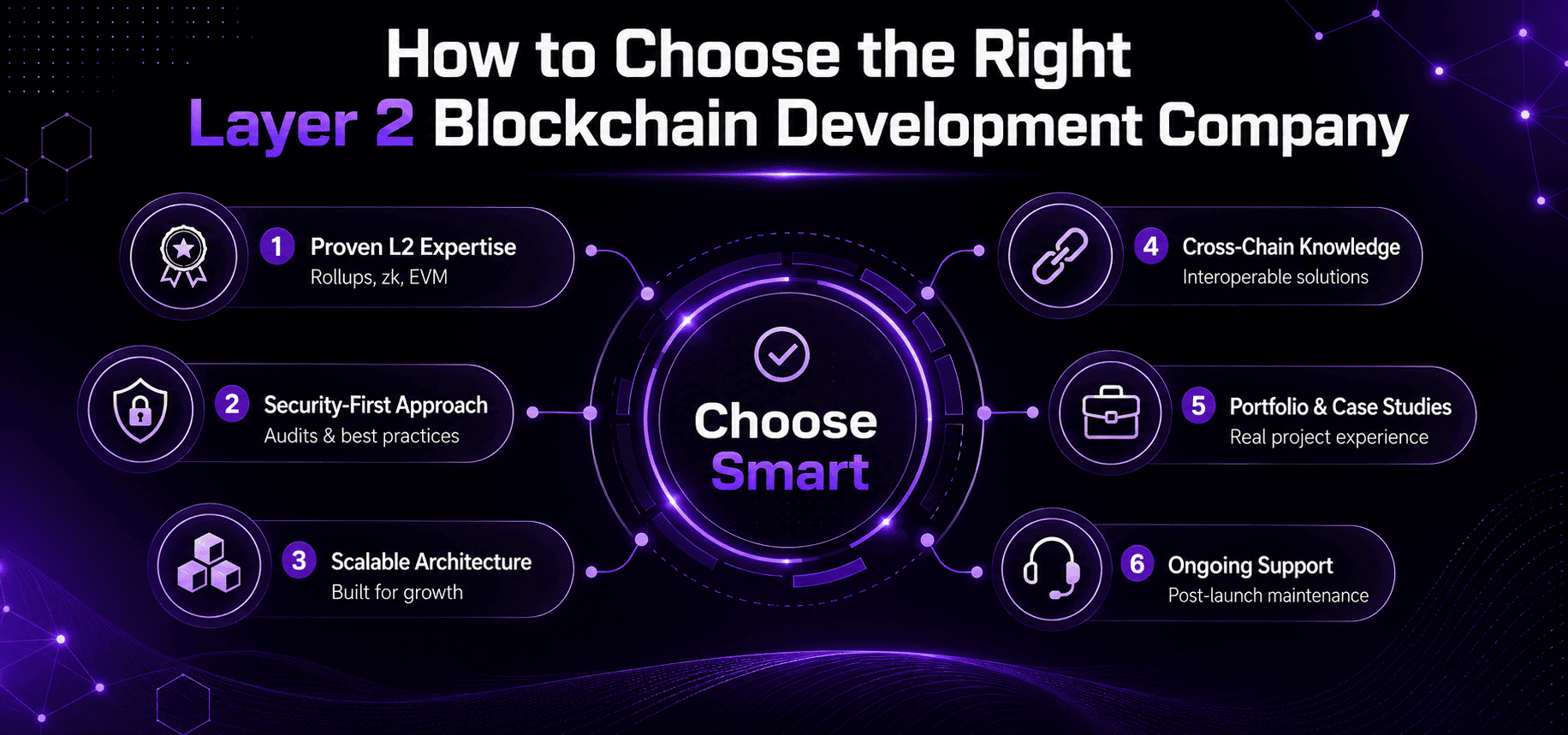
How to Choose the Right Layer 2 Blockchain Development Company
Choosing the right partner for Layer 2 projects can make or break enterprise blockchain strategy. Use this full evaluation guide to assess technical depth, compliance readiness and execution capabilities.
1. Understand Your Business Goals
Decide what you want from your L2 adoption: regulatory alignment, cross-chain interoperability, throughput, or cost reduction. Specific goals make it easier to compare vendors.
2. Pose Detailed Technical Questions
Bring specific questions to the table during review process:
- Are you an expert in optimistic rollups or ZK rollups?
- Do we have any examples of business blockchain scaling solutions that are delivering production-grade?
- How do you do failure recovery, availability and decentralizing the sequencer?
They help you to understand their operational maturity and architectural proficiency.
3. Evaluate Risk and Compliance Processes
Ensure the supplier is familiar with US enterprise standards including audit trails, permissioned validator models and KYC/AML tools. Working with a partner that has governance focused procedures helps to mitigate regulatory risk up front.
4. See the references and portfolio
Request enterprise case studies and performance results. This allows you to verify real results and successful blockchain scalability solutions that complement your industry.
5. Examine Industry Fit and Thought Leadership
Look for partners cited in research on high level enterprise adoption. For example, the Deloitte blockchain adoption insights show that businesses are increasingly interested in distributed ledger technology as they look for real-world applications of governance, scalability and interoperability.
Cost of Layer 2 Blockchain Development
To understand the cost of deploying a layer 2 blockchain, you have to think beyond fixed pricing. Businesses need to look at the different things that make up the total investment.
- Audit and Security Costs: Deep audits of off-chain execution levels, network protocols and smart contracts are essential. The cost depends on the number of contracts and the complexity of the L2 architecture.
- Integration Complexity: Integration cost for Layer 2 solutions to cross-chain networks, ERP systems, and existing enterprise infrastructure may be impacted. Greater complexity in integration increases development time and resource allocation.
- ZK Proof Generation Overhead: Generating zero-knowledge proofs for ZK Rollups requires a huge amount of computational power. Businesses should budget for the infrastructure to compute proofs efficiently, especially when a high volume of transaction throughput is needed.
- Sequencer and Gas Fee Model: Layer 1 gas fees are ongoing operational costs that include publishing transaction batches, uptime maintenance, and sequencer operation. With good sequencer management, these ongoing costs can be reduced. Our predictive gas optimization solutions help enterprises forecast and minimize ongoing Layer 1 settlement costs.
- Custom Rollup Development vs. Pre-Built Stack: Creating a custom ZK rollup and optimistic rollup from the ground up provides tailored performance and security at the cost of higher upfront costs. Deploying an app-chain using a pre-built stack (for example, Polygon CDK or Arbitrum Orbit) typically reduces upfront development and integration costs. Businesses need to find a balance between the level of customization and security required and scalability needs.
By categorizing costs across audit, integration, computational overhead and operations, decision-makers can match their budget to strategic objectives and get a realistic picture of investment for deployment of enterprise-grade layer 2 blockchain.
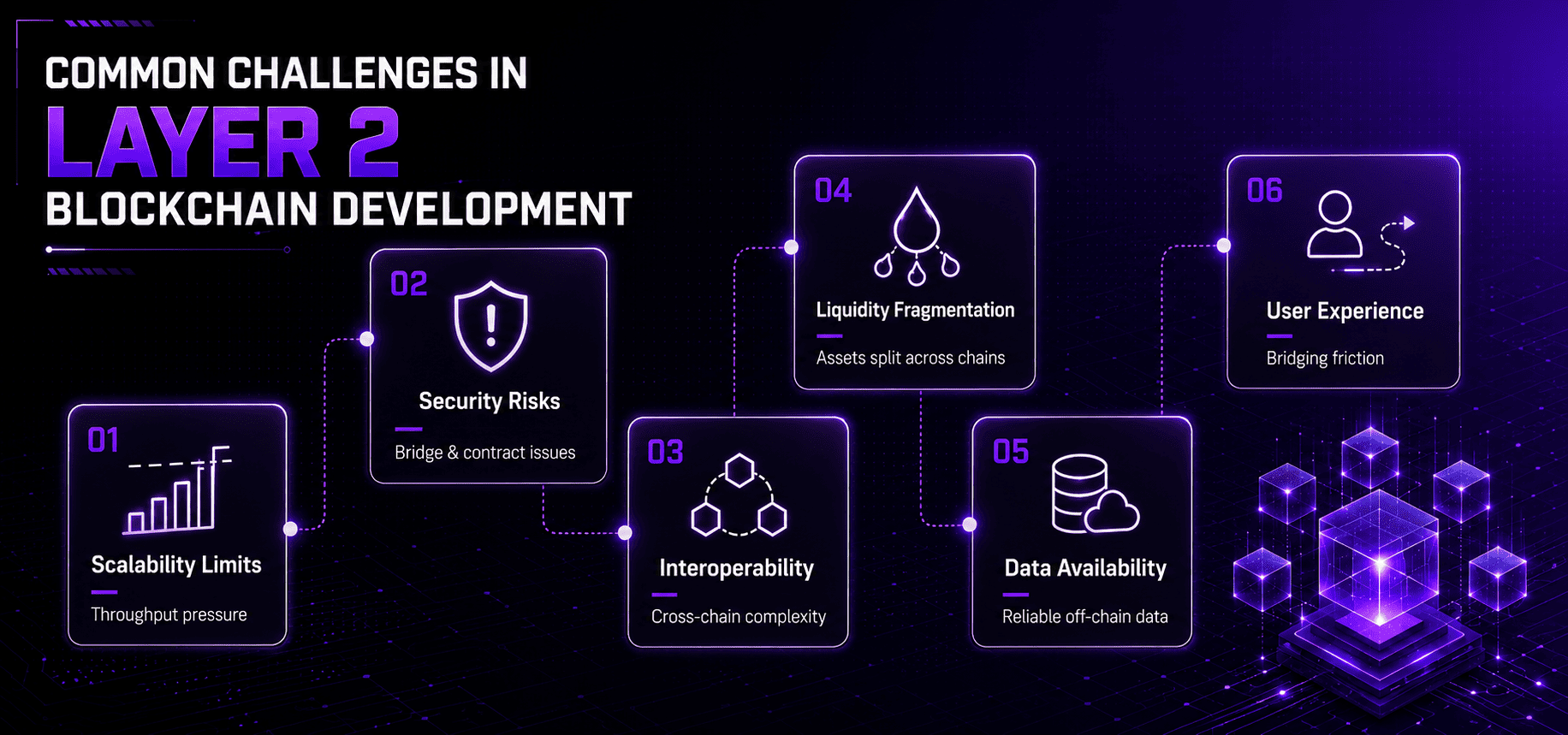
Common Challenges in Layer 2 Blockchain Development
Although enterprise-grade performance is provided by Ethereum Layer 2 scaling solutions, mature implementations must overcome a number of practical obstacles.
Composability Risks: Careful handling of sidechain and cross-rollup interactions is frequently necessary for Layer 2 networks. An expert layer 2 blockchain development firm guarantees smooth interoperability, enabling effective cross-protocol activities while preserving integrity for decentralized apps.
Liquidity Fragmentation: Distributing liquidity among several L2 networks may result in decreased effectiveness. As part of more comprehensive blockchain transaction optimization solutions, skilled teams employ cross-rollup bridges and aggregation mechanisms to preserve liquidity flow, enabling optimal trading, staking, and payments.
zkEVM Learning Curve: Complex proof creation is required to deploy zero-knowledge EVM-compatible solutions. Skilled developers reduce computational overhead and improve scalability by streamlining deployment with automated pipelines and reusable zkEVM templates.
Sequencer Centralization: For efficiency, many L2 networks begin with centralized sequencers, which raises security issues. To preserve performance while reducing single-point-of-failure concerns, seasoned development partners employ decentralization tactics, failover mechanisms, and monitoring.
Businesses may fully benefit from L2’s high throughput, cheap costs, and quick settlement while preserving strong security and scalability by proactively resolving these issues.
Case Studies: L2 Blockchain Solutions in Action
Tier‑1 US Bank – Permissioned ZK Rollup
For private interbank transfers, a well-known US bank implemented a permissioned ZK Rollup. The bank maintained compliance while achieving instant finality by utilizing blockchain transaction optimization. Using high-performance blockchain development techniques, the secure layer 2 dapp architecture enabled high-throughput transactions.
Supply Chain Logistics Firm – Optimistic Rollup
A logistics company reduced gas costs and increased transparency by switching to an Optimistic Rollup for its carbon credit marketplace. High-performance blockchain development for enterprise sustainability was demonstrated by the smooth interaction with reporting systems made possible by the modular layer 2 dapp architecture. Learn more about how we approach carbon credit tokenization for enterprise sustainability use cases.
US Gaming Studio – Layer 2 In-Game Economy
A gaming studio switched to Layer 2 for quick, low-cost microtransactions in its virtual economy. High-performance blockchain development in real-time gaming was demonstrated by the unique layer 2 dapp design, which guaranteed fluid gameplay while preserving Ethereum Layer 1 settlement integrity.
These examples show how US businesses use Layer 2 solutions to cut expenses, boost throughput, and uphold compliance in the areas of gaming, logistics, and banking.
Future of Layer 2 Blockchain Development
With advancements that will facilitate enterprise adoption, the development of Ethereum Layer 2 scaling solutions is quickening. In order to lower L2 data posting costs and increase throughput while maintaining security, Proto-danksharding (EIP‑4844) provides “blob” transactions.
Account abstraction on L2s improves usability for businesses and regulated workflows by streamlining wallets and enabling programmable transaction flows. By enabling validity proofs from several sources and facilitating corporate blockchain scaling solutions, multi-prover systems increase robustness.
The emergence of Layer 3 app-specific chains on top of L2 networks enables customized execution environments for supply chain, analytics, and gaming applications. These tailored chains maximize performance without compromising Layer 1 settlement security.
The Layer 2 ecosystem is still growing, according to L2Beat, with dozens of rollups securing substantial value and increasing transaction volumes. Investing in these cutting-edge L2 technologies for US businesses guarantees scalable, affordable, and secure installations while opening the door for widespread adoption.
Frequently Asked Questions
1. What is Layer 2 blockchain development?
Layer 2 blockchain development builds additional protocols on top of Layer 1 to increase throughput and reduce costs while still remaining secure.
2. Why is Layer 2 important for enterprises?
It enables enterprise blockchain scaling solutions, reducing transaction costs and supporting high-volume operations efficiently.
3. Which blockchains use Layer 2 solutions?
Ethereum is the main platform and Bitcoin uses the Lightning Network for fast microtransactions.
4. What services do Layer 2 blockchain development companies offer?
Services include Layer 2 blockchain deployment, Ethereum L2 Smart Contract generation/porting and L2 DApp development services.
5. How long does it take to develop Layer 2 blockchain solutions?
Timelines depend on complexity; specialized business rollups could take months, simple implementations could take weeks.
6. How much does L2 blockchain development cost?
Building a custom ZK rollup or optimistic rollup takes more resources than a pre-built stack. Costs include audits, integration, proof generation, and operational fees.
7. What is the difference between ZK rollups and Optimistic Rollups?
ZK Rollups provide instant finality via cryptographic proofs, while Optimistic Rollups have a challenge time. Choice of ZK rollup vs optimistic rollup development is dictated by security and speed needs.
8. Can Layer 2 solutions integrate with existing dApps?
Yes, a modular layer 2 dapp architecture enhances throughput and cuts down costs while allowing a smooth porting.
9. How do ZK rollups ensure data privacy for enterprises?
They use zero-knowledge proofs to verify transactions without disclosing private information.
10. What is the most adopted enterprise blockchain scaling solution?
The most popular are ZK and Optimistic Ethereum rollups, due to security, scalability and tooling support.
