



Key Takeaways
- P2P crypto exchanges enable direct user-to-user trading, eliminating intermediaries while leveraging escrow systems to improve transaction security and transparency.
- 2026 presents strong growth opportunities for P2P platforms due to rising crypto adoption, increasing demand for self-custody solutions, and expanding use in emerging markets.
- Core features such as automated escrow, KYC/AML compliance, multi-currency wallets, reputation systems, and dispute resolution are essential for building a secure and trusted marketplace.
- Successful P2P exchange development requires a structured approach, including regulatory research, architecture planning, wallet integration, security implementation, testing, and post-launch optimization.
- Modern P2P exchanges rely on scalable technologies like Node.js, React, Flutter, MPC wallets, multi-signature security, cloud-native infrastructure, and blockchain-based escrow mechanisms.
- Future-ready platforms will embrace AI-powered dispute resolution, cross-chain trading, decentralized identity (DID), and deeper integration with DeFi and tokenized asset ecosystems, creating new opportunities for growth and user engagement.
What Is a P2P Crypto Exchange & How It Works
A peer-to-peer (P2P) cryptocurrency exchange is a digital marketplace that facilitates direct cryptocurrency sales and purchases between individuals as opposed to a central trade desk. The platform connects buyers and sellers, establishes trade rules, provides payment options, and utilizes escrow to safeguard transactions. Understanding how these transactions work is important for startups that want to build a P2P crypto exchange.
Usually, the process starts with “Trade Offer Creation” where the seller lists the crypto, price, boundaries, and payment methods accepted. Next is “Trade Match” where a buyer selects an offer and starts the deal. If both sides agree the platform triggers an “Escrow Lock” through a smart-contract or an automated escrow system which holds the seller’s cryptocurrency. The buyer then confirms the payment through cash, bank transfer, UPI, card or other accepted method. Once the buyer has been verified, the trust releases the crypto.
A good peer-to-peer cryptocurrency exchange site will never hold users’ money for no reason. Conversely, escrow builds trust without full control, decreasing platform risk and increasing openness. The latest P2P trading trends suggest that safe, flexible and user-driven trading models are increasingly important for the growth of crypto exchanges.
Why Build a P2P Crypto Exchange in 2026
In 2026, the P2P coin exchange market will begin to grow in a new form. Things are getting better for entrepreneurs and new businesses with better regulations, more crypto adoption in developing countries and more people wanting self-custody solutions.” However, P2P platforms are a flexible and cheap way to get into the digital asset market unlike traditional exchanges that require a lot of liquidity and running costs.
1. Rapid growth in new markets
Countries in Africa, South East Asia and Latin America are still adopting cryptocurrencies very fast. P2P (peer-to-peer) systems are a good way to help financial markets that are not well served because they allow a lot of people to trade digital assets with each other. As Cointelegraph pointed out in their piece about P2P Adoption: peer-to-peer sharing is still a big piece of making crypto accessible on a global scale.
2. Mobile-first user demands
Today’s crypto users want to be able to trade quickly and easily on their phones. Mobile-first behavior lends itself naturally to P2P exchanges, which let users trade directly from their phones with digital wallets and local payment methods.
3. Reduced infrastructure and operating costs
P2P systems have less infrastructure to handle liquidity and hold assets than centralized exchanges. That makes it easier to run things, and means a new business can get started with less cash on hand.
4. Improved security through non-custodial escrow
Automated escrow systems protect deals without the platform holding users’ funds for long periods of time. This strategy reduces custody risk and builds trust between buyers and sellers.
5. Flexible local payment options
P2P exchanges can accept the payment methods that are popular in a certain area, including bank transfers, mobile money services, digital wallets and local payment platforms. This allows businesses to enter new markets and makes it easier for users to adopt new products. CoinDesk P2P Market Insights says localized payment experiences continue to drive growth of peer-to-peer trade.
Want to Launch Your Own P2P Crypto Exchange in 2026?
Core Features of a P2P Crypto Exchange
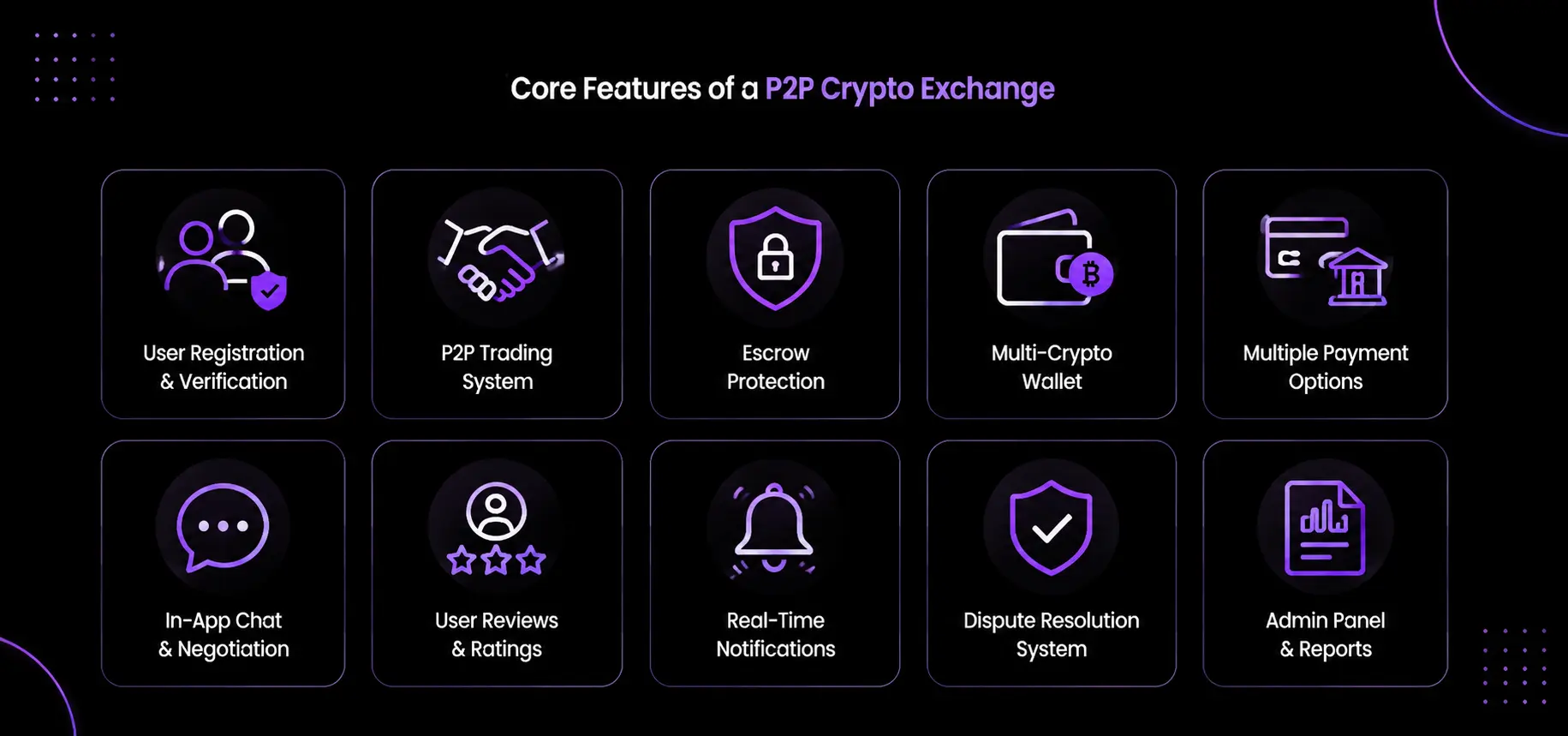
A P2P cryptocurrency exchange needs more than just a basic trade interface to be effective. Investopedia P2P Definition says that peer-to-peer systems allow users to do business directly with one another. But a crypto platform also needs security, compliance, payment freedom, and ways to build confidence.
1. Automated Escrow System
During the trade, the seller’s cryptocurrency is held in escrow by an automated system. Only released after proof of payment. This can be done either with smart contracts or secure backend code to protect both buyer and seller.
2. KYC/AML Compliance
With tiered KYC and AML verification, platforms can meet global compliance standards for 2026. This allows for easier onboarding of users according to their boundaries, location and transaction volume.
3. Multi-Currency Wallet Support
To have a strong exchange, it must support multiple currencies and have hot and cold wallets. Hot wallets are used for trading and cold wallets are used for safer long-term asset storage. Advanced platforms often integrate cross-chain liquidity aggregation to ensure seamless token swaps and better market depth.
4. User Reputation & Ratings
Completed trade history, trader ratings, reaction time and dispute records help users choose trustworthy counterparties and build trust in the marketplace.
5. Secure Payment Gateways
It is easier for people in different parts of the world to use the tool because it works with local bank transfers, mobile money, cards and e-wallets. Incorporating stablecoins provides price stability, as discussed in stablecoins as payment infrastructure
6. Dispute Resolution Mechanism
Late confirmations, fraud claims or payments that didn’t go through can be fixed by manual admin review or advanced AI trading integrations.
7. Admin & Analytics Dashboard
A real-time dashboard tracks users, trade volume, liquidity, revenue, Know Your Customer (KYC) status and any suspicious activity.
Step-by-Step Development Process
The development of a P2P exchange necessitates a well-structured plan that takes into account compliance, security, user experience and the ability to scale. An agile development process assists startups that want to build a peer-to-peer cryptocurrency exchange to reduce their launch risks while maintaining the platform’s flexibility for adapting to changes in the market and in the rules that govern it. Some modern P2P platforms may implement derivatives exchange modules for advanced trading strategies
1. Market & Regulatory Research
First, the target countries, user behavior, supported assets, licensing requirements, KYC and AML policies, and local payment preferences need to be identified.
2. Architecture Design & Tech Stack Finalization
The team makes the decision on the platform design, the blockchain networks, the database structure, the APIs, the wallet model, the hosting setup and the security framework.
3. Escrow & Smart Contract Development
During trades, developers lock up crypto using smart contracts or backend escrow logic and unlock funds after payment proof.
4. Wallet Integration & Security Layers
Now there are multi-currency wallets, hot and cold storage, encryption, two-factor authentication (2FA), controls for withdrawals and tracking tools.
5. Payment Gateway Connection
The exchange is built with local banking, mobile money, e-wallets and fiat payment rails built in, so it can support trade in different regions.
6. Front-end & Back-end Development
We use agile sprints to develop user dashboards, trade flows, admin panels, dispute modules, APIs, alerts, database systems, etc.
7. Testing, KYC/AML Setup & Smart Contract Audits
Platform security and compliance are ensured by QA testing, penetration testing, KYC vendor setup, AML screening and smart contract verification.
8. Mainnet Launch & Post-Launch Optimization
Once the platform is installed, it is monitored for speed, liquidity, user activity, disputes and security events. According to TechCrunch Blockchain Development Trends, blockchain businesses need to keep evolving to keep up with the rules, the market and the users’ trust standards.
Understand the impact of blockchain development on your business and partner with a trusted P2P crypto exchange development company to ensure a safe launch.
Technology & Stack Recommendations
To scale, a P2P cryptocurrency exchange needs a stack that can handle a high volume of transactions, keep wallet operations secure, and provide end users with quick experiences across the board. Node.js is a good server language to build API driven systems Go and Rust are great for building high-throughput trading engines, escrow logic, and performance-critical modules.
On the front-end you can use React or Next.js to drive a responsive web trading interface. Flutter is the best way to build cross platform mobile apps with unified user interfaces and faster release cycles. PostgreSQL is more suitable for core data such as users, trades, Know Your Customer (KYC) status, and transaction records. While Redis can handle caching, sessions and faster order matching.
To remove single points of failure, wallet security should be built on top of MPC wallets and multi-sig wallets. Ethereum Blockchain Development can support smart contracts, escrow flows and token-based transactions for blockchain functions. So cross-chain liquidity aggregation helps to make assets across chains more available.
Infrastructure should be cloud-native, leveraging AWS and Kubernetes for auto-scaling, fault tolerance and release automation. The security stack should include 2FA, end-to-end data encryption, SIEM monitoring, and smart contract guidelines based on OpenZeppelin Security Practices.
For secure transactions and enhanced privacy in your P2P exchange, consider implementing Zero-Knowledge Proofs.
Development Costs & Timeline
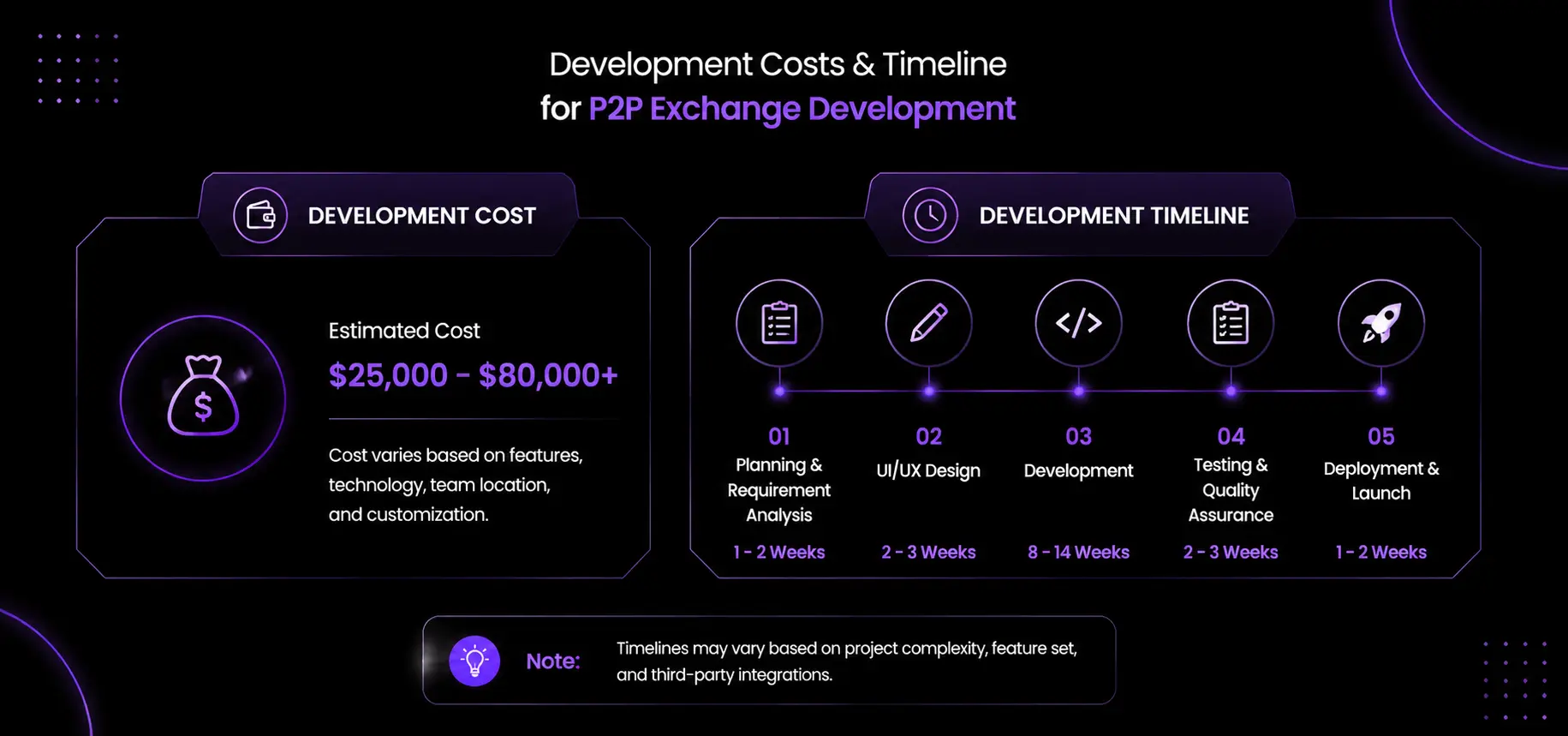
The cost and duration of a peer-to-peer cryptocurrency trade are influenced by the platform’s features, security requirements, regulatory compliance, and growth objectives. MVPs help startups test their business plan quickly, but enterprise-grade exchanges require more investment in infrastructure, security, and multi-chain support. Understanding these steps can help founders make better decisions around budgets and launch plans.
1. MVP Exchange
- It comes with simple Know Your Customer (KYC) verification, an escrow system and the ability to manage users.
- Good for companies wanting to test the market quickly.
- The least expensive way to build something.
- Normally it takes 3-4 months to build something.
2. Mid-Range Exchange
- This package includes custom UI/UX, better escrow processes, multiple payment options, analytics dashboards and advanced compliance features.
- Made for businesses looking to increase their user base and make their website stand out.
- Requires a moderate level of input compared to MVP solutions.
- It usually takes 6-9 months to make something.
3. Enterprise-Grade Exchange
- Large amount of transactions processing, multiple chains, advanced liquidity management, institutional-grade security, automation by AI.
- Great for large sites wanting to grow quickly.
- Needs a lot of money spent on technology and facilities.
- Normal time for growth is 12 months or more.
According to Statista Crypto Market Data, the global crypto market is still developing, and thus requires scalable exchange systems.
Want to Know the Cost and Timeline to Build Your P2P Crypto Exchange?
Challenges & How to Overcome Them
Running a peer-to-peer cryptocurrency exchange can be complex, but all of the risks can be mitigated with the right design, compliance planning and security strategy. Cointelegraph’s Risk Analysis says crypto platforms will have to strike a balance between new ideas and strong risk controls to maintain user trust in the long term.
1. Liquidity Issues
Low liquidity can make it more difficult for people to complete trades, and can hurt their trust. If you’re part of a stablecoin development community, have liquidity partnerships, market maker APIs or stable trading pairs, you can fix this problem.
2. Fraud Detection
Platform risks can involve fraudulent payments, charge-backs and unusual account activity. AI analytics can monitor deals in real time, spot odd behavior and identify high-risk users before disputes escalate.
3. Regulatory Compliance
KYC, AML and reporting are different in different jurisdictions, so P2P marketplaces need to adapt to those rules. Modular suites for KYC/AML can customize the verification steps depending on the area, level of the user, and number of transactions.
4. Scalability
The slower speed can make the user experience worse with more trades. Microservices architecture, elastic clouds and well-designed APIs enable platforms to scale rapidly. Thinking about infrastructure in the same way is also good for nearby DeFi goods, such as yield farming platforms.
Future Trends in P2P Exchange Development
It’ll come down to how easy they are to use, how automated they are, and how well they play with other systems that use crypto. The next wave of crypto adoption will likely be driven by mobile-first platforms. This is particularly the case in developing markets where smartphones are the main way of accessing digital money. The growth of BYDFi P2P Trends will continue to be driven by user-centric and localized trading experience.
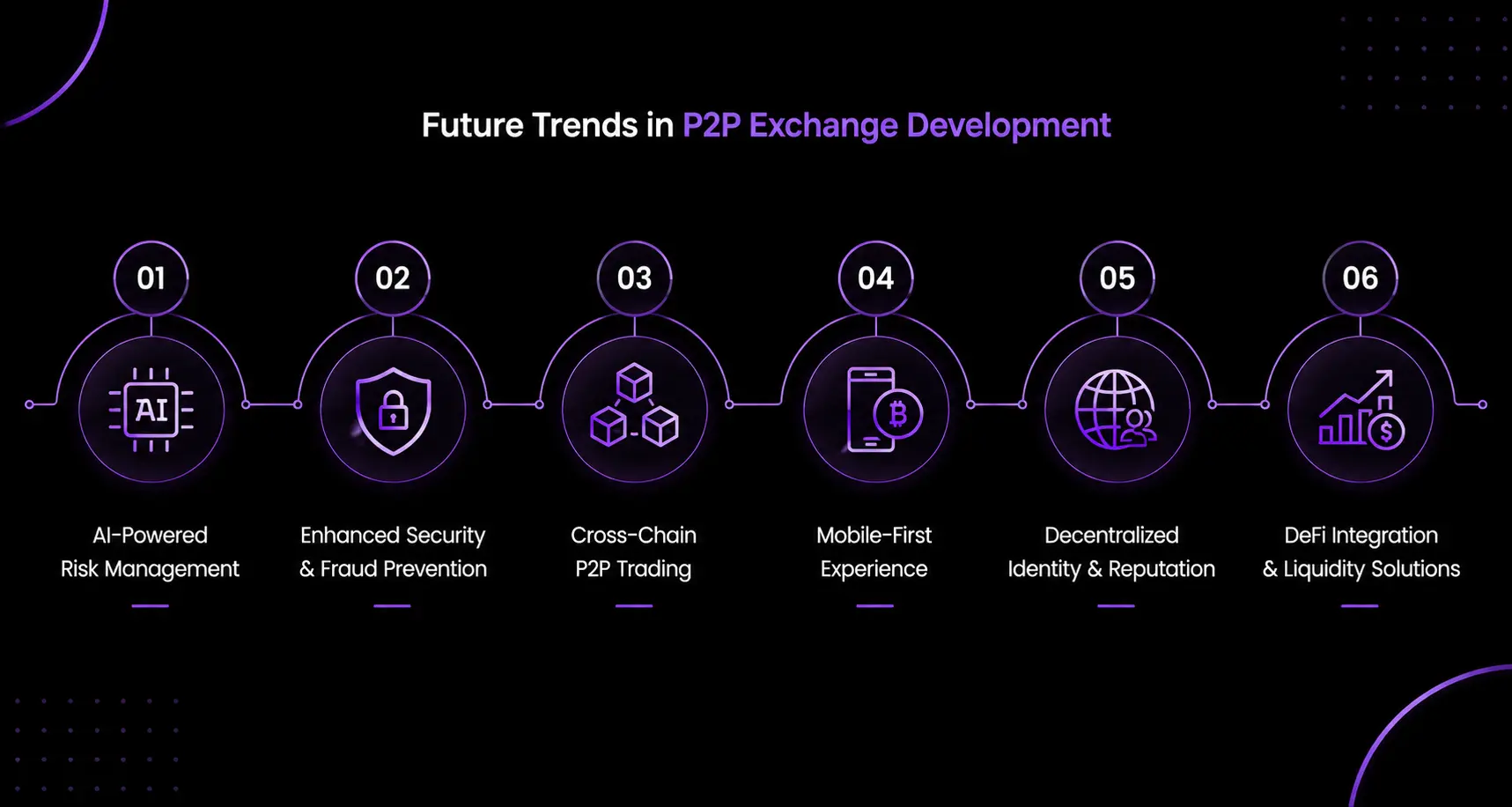
AI-powered arbitration is shaping up to be a potent tool to slow down manual dispute resolution, leading to quicker and more precise trade settlements. Lastly, cross-chain P2P trading will allow users to trade assets across networks without the need for wrapped tokens. Increasingly, systems will be hybrids, mixing centralized exchange liquidity with P2P flexibility.
Another big movement is the use of decentralized identity (DID) systems to enable privacy-preserving KYC in a compliant way. These new features will strengthen the ties between P2P exchanges and other blockchain services like DeFi lending & borrowing and RWA tokenization services. This will let P2P trades have a bigger role in the wider Web3 ecosystem.
Concluding Note
To build a peer-to-peer cryptocurrency exchange in 2026, investing in the technology is only part of the equation. It’s also an opportunity to enable more people to access money, serve the needs of a growing market and build lasting digital asset businesses. Success takes three things: good guardrails, a scalable infrastructure, and playing by the rules. By combining these with a user-centric trading experience, businesses can build trading platforms that stay competitive as the crypto landscape evolves.
Ready to sell? Explore our P2P crypto exchange development services and let Techfyte help you launch your own secure, scalable, and compliant P2P crypto exchange.
Frequently Asked Questions (FAQ)
1. What is a P2P crypto exchange?
Buyers and sellers are directly exchanging cryptocurrencies on a P2P exchange. The platform also offers escrow and payment options and can help with disputes and security to make deals safer.
2. What is the P2P crypto exchange development process?
Development process Market research Regulatory planning UI/UX design Escrow Wallet Payment gateway KYC/AML Testing Smart contract audits Launch Each phase ensures the platform is safe, scalable and ready for users.
3. What is the cost of P2P crypto exchange development?
Features, design complexity, wallet support, security layers, regulatory needs, and custom/white-label solutions all affect the cost. MVPs are cheaper, while enterprise platforms are more expensive due to multi-chain support, liquidity tools and more security.
4. What is the difference between P2P and OTC trading?
In P2P trading, a marketplace enables buyers and sellers to select offers, payment methods, and terms of trade. OTC trading is to be used for large private deals by volume through brokers or institutional desks.
5. How does escrow protect users in a P2P crypto exchange?
The seller’s coin is escrowed until the buyer pays and the transaction is verified. This prevents vendors from cashing in coins early and buyers from paying without assets.
6. How long does it take to build a P2P exchange from scratch vs. a white-label solution?
Custom P2P exchange takes from 3 to 9 months depending on features, compliance, wallet support, and payment connectors. White-label solutions can be implemented faster as the basic exchange infrastructure is already in place. Techfyte’s P2P crypto exchange development services can help you choose the best solution.
7. Are P2P crypto exchanges legal in 2026?
P2P exchanges could be legal if they respect local laws. Typical are KYC, AML, transaction monitoring, licensing and user risk measures.
8. How does Techfyte ensure compliance for P2P exchange platforms?
Techfyte’s compliance-ready platforms offer modular KYC/AML workflows, transaction monitoring, user verification stages and admin controls. This allows businesses to adapt trade to different countries and regulations.
9. What payment methods can a P2P crypto exchange support?
P2P crypto exchanges allow bank transfers, UPI, mobile money, e-wallets, cards and local payment gateways. Payment mix is target market and user behavior specific.
10. Can a P2P crypto exchange support multiple cryptocurrencies?
P2P exchanges can support Bitcoin, Ethereum, stablecoins and other altcoins with wallet infrastructure and blockchain integration. Multiple currencies mean more freedom and trading opportunities for the users.
Launch a Secure and Scalable P2P Crypto Exchange with Techfyte
