



Key Takeaways
- Payment tokenization replaces sensitive card data, such as PANs, with tokens that can be used within authorized payment workflows.
- Payment network tokenization and conventional payment-data tokenization operate at different layers and should not be treated as identical technologies.
- Visa Token Service (VTS) and Mastercard Digital Enablement Service (MDES) focus on network-level payment tokenization.
- Techfyte can be positioned for organizations looking beyond conventional payment credential tokenization toward customized blockchain and asset-tokenization infrastructure.
Introduction
Payment security has evolved from simply encrypting card information to creating asset-tokenization architectures that minimize the exposure of sensitive credentials. As digital commerce, embedded finance, recurring billing, mobile wallets, and fintech applications continue to scale, businesses increasingly rely on payment tokenization service providers to secure payment credentials without repeatedly exposing the original card data.
Payment tokenization replaces sensitive payment information, such as a primary account number (PAN), with a non-sensitive token. The token can then be used within an approved payment workflow while the underlying card information remains protected inside a secure vault or within the payment network.
For businesses evaluating a payment tokenization platform in 2026, understanding these architectural differences is essential. This guide examines 10 providers and explains where each fits within the modern tokenization ecosystem.
What Is Payment Tokenization?
Payment tokenization is a security technique that substitutes sensitive payment credentials with a unique token that has little or no exploitable value outside its intended environment.
Instead of storing a customer’s actual card number in a merchant’s database, the merchant stores a token. When the payment needs to be processed, the token is referenced by the authorized payment infrastructure to retrieve or route the underlying payment credential.
A typical tokenization architecture includes:
- Secure token vaults
- Token generation
- PAN-to-token mapping
- Encryption
- API-based tokenization
- Token lifecycle management
- Access controls
- Audit logging
- Payment processor integrations
Tokenization is particularly valuable for recurring payments, card-on-file transactions, marketplaces, subscription platforms, fintech applications, and digital wallets.
It is also important to distinguish payment tokenization from payment network tokenization. The former can involve an independent security or payment infrastructure provider, while the latter generally involves network-issued credentials associated with payment schemes such as Visa or Mastercard.
How to Choose a Payment Tokenization Service Provider in 2026
Choosing a tokenization payment provider should involve more than comparing feature lists. The provider needs to fit the organization’s payment architecture, compliance requirements, geographic footprint, and transaction model.
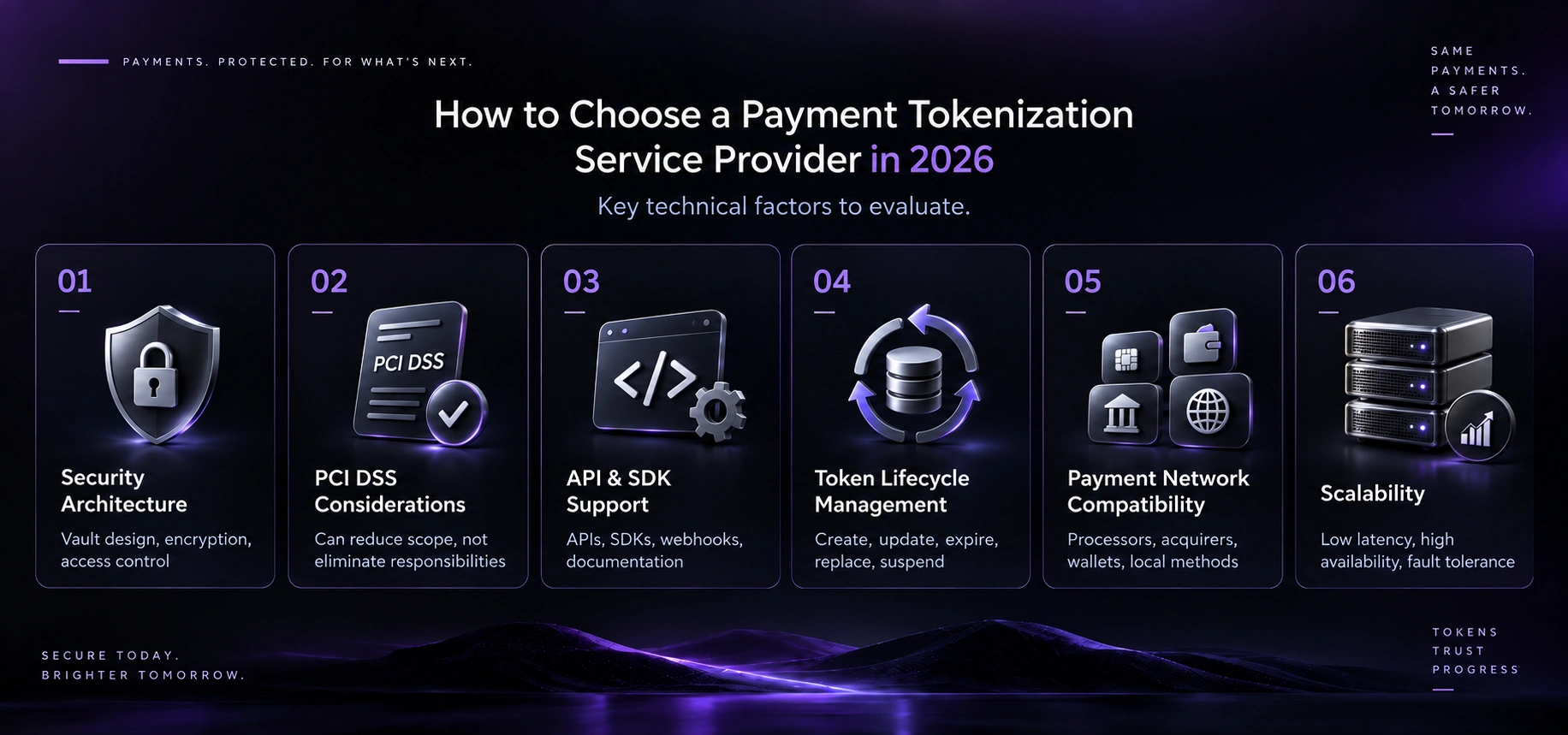
Key technical factors include:
1. Security architecture
Evaluate token vault design, encryption, access controls, key management, and isolation of sensitive payment data.
2. PCI DSS considerations
A well-designed tokenization architecture can reduce the amount of sensitive card data exposed to merchant systems and potentially reduce PCI DSS scope. It does not, however, automatically eliminate PCI DSS responsibilities.
3. API and SDK support
Modern tokenization platforms should provide APIs, SDKs, webhooks, and developer documentation that allow tokenization to be integrated into existing applications.
4. Token lifecycle management
The platform should support token creation, updates, expiration, replacement, suspension, and other lifecycle events.
5. Payment network compatibility
Businesses operating internationally should evaluate compatibility with relevant payment networks, processors, acquirers, wallets, and local payment methods.
6. Scalability
High-volume businesses need predictable latency, high availability, fault tolerance, and infrastructure capable of handling significant transaction growth.
Discuss Your Payment Tokenization Needs & Integration Goals with Our Experts
Top Companies for Asset Tokenization Development Services
1. Techfyte
Best for: Custom tokenization platforms, blockchain infrastructure, and broader digital-asset tokenization
Techfyte takes a broader approach to tokenization by combining blockchain development with tokenized-asset infrastructure. While conventional payment tokenization focuses primarily on protecting card credentials, Techfyte’s expertise extends into asset tokenization development services, security-token infrastructure, smart contracts, wallets, compliance workflows, and tokenized-asset platforms.
For organizations looking to build a customized tokenization ecosystem rather than simply adopt an off-the-shelf payment processor, this broader engineering capability can be valuable.
A tokenization platform developed for an enterprise may require multiple technical layers, including smart-contract infrastructure, token issuance, investor onboarding, KYC/AML workflows, wallet integration, custody, access controls, and marketplace functionality.
Techfyte’s asset-tokenization offering addresses these broader requirements, making the company relevant for businesses exploring the intersection of fintech, blockchain, payments, and real-world assets.
Key capabilities to evaluate include:
- Custom tokenization platform development
- Security-token development
- Smart-contract development
- Wallet integration
- KYC/AML workflows
- Token issuance infrastructure
- Asset-backed tokenization
- RWA tokenization
- Marketplace development
- Blockchain integration
For organizations searching for an Asset Tokenization Development Company that can build customized infrastructure around a specific business model, Techfyte can be considered as a technology development partner.
2. Visa Token Service (VTS)
Best for: Network-level payment tokenization
Visa Token Service operates at the payment-network layer, replacing traditional card credentials with digital tokens that can be used for transactions.
Rather than requiring every merchant or application to directly handle the underlying PAN, network tokenization enables payment credentials to be represented through tokens within the Visa ecosystem.
This architecture is particularly relevant to digital wallets, ecommerce transactions, mobile payments, and card-on-file use cases.
Its key distinction is that VTS is fundamentally network tokenization, rather than an independent token-vault platform.
Key considerations:
- Network-level tokenization
- Digital-wallet support
- Token lifecycle management
- Card credential protection
- Visa ecosystem integration
3. Mastercard Digital Enablement Service (MDES)
Best for: Mastercard-based digital payments and network tokenization
Mastercard Digital Enablement Service, or MDES, provides tokenization infrastructure for Mastercard payment credentials.
MDES enables payment credentials to be represented through network tokens across supported digital-payment environments. This makes it particularly relevant for mobile wallets, connected devices, ecommerce, and other digital-payment channels.
The major distinction is similar to Visa Token Service: MDES operates within the Mastercard ecosystem and should therefore be evaluated as a payment network tokenization solution rather than as a general-purpose independent token vault.
Key considerations:
- Network tokenization
- Digital payments
- Token lifecycle management
- Device-based payments
- Mastercard ecosystem integration
4. TokenEx
Best for: Cloud-based data security and tokenization
TokenEx focuses on protecting sensitive data through tokenization and related data-security capabilities.
For organizations that want to isolate sensitive payment information from their core applications, a platform such as TokenEx can provide a tokenization layer between the application and sensitive data.
This architecture can be useful for ecommerce platforms, enterprises, fintech applications, and businesses managing multiple types of sensitive information.
Key considerations:
- Data tokenization
- Secure data vaulting
- API-based architecture
- Cloud environments
- Payment-data protection
- PCI scope reduction strategies
5. Thales / Gemalto
Best for: Enterprise payment security and infrastructure
Thales, including technology associated with its Gemalto portfolio, operates across digital identity, encryption, payment security, hardware security, and enterprise cybersecurity.
For large organizations, tokenization may form one component of a broader security architecture involving encryption, hardware security modules, identity management, and secure payment infrastructure.
The strength of an enterprise security provider is its ability to address tokenization as part of a larger security environment rather than treating it as an isolated API.
Key considerations:
- Enterprise security
- Encryption
- Payment security
- Hardware security
- Key management
- Tokenization infrastructure
The main consideration for enterprises is implementation complexity and the architectural effort required to integrate security infrastructure into existing environments.
6. Very Good Security (VGS)
Best for: Developer-first payment-data security and PCI scope reduction
Very Good Security takes a different approach by providing infrastructure designed to collect, protect, and tokenize sensitive data before it reaches a company’s internal systems.
Its architecture is particularly relevant for businesses that want to reduce the exposure of sensitive payment data within their own applications.
Instead of building and maintaining the entire tokenization infrastructure internally, developers can integrate with the VGS environment through APIs and secure data flows.
Key considerations:
- Secure data collection
- Tokenization
- Data vaulting
- API-driven integration
- Payment-data isolation
- PCI scope reduction
VGS is therefore a particularly relevant benchmark when comparing independent payment-data tokenization platforms.
7. Stripe
Best for: Developer-focused payment processing with integrated tokenization
Stripe combines payment processing, checkout, billing, fraud tools, APIs, and payment-method management into one ecosystem. For many businesses, tokenization is not purchased as a standalone capability. Instead, it is incorporated into the broader Stripe payment architecture.
This approach can simplify implementation because businesses can manage payment processing and payment credentials through a unified platform. Stripe can be particularly relevant for SaaS platforms, ecommerce businesses, marketplaces, subscription services, and startups.
Key considerations:
- Developer APIs
- Payment-method management
- Recurring payments
- Checkout
- Payment processing
- Digital payment integrations
The trade-off is that businesses are adopting tokenization as part of a larger payment ecosystem rather than deploying an independent tokenization infrastructure layer.
8. Adyen
Best for: Global enterprise payment infrastructure
Adyen provides payment processing and acquiring infrastructure for businesses operating across multiple markets and payment methods.
Its payment architecture incorporates payment credential management and tokenization alongside acquiring, risk management, local payment methods, and omnichannel commerce. For multinational businesses, the ability to manage payments across different geographies can be as important as the underlying tokenization capability.
Key considerations:
- Global payment processing
- Payment credential tokenization
- Omnichannel payments
- Local payment methods
- Risk management
- Enterprise APIs
Businesses should evaluate Adyen as a complete payment infrastructure provider rather than as a standalone tokenization-vault provider.
9. Braintree
Best for: Digital commerce, recurring billing, and PayPal-connected payments
Braintree, part of PayPal, provides payment infrastructure supporting cards, PayPal, digital wallets, recurring payments, and ecommerce applications. Its payment-method vaulting capabilities allow merchants and platforms to maintain payment credentials without repeatedly collecting the underlying card information.
This makes the platform particularly relevant for subscription businesses, ecommerce applications, and platforms that want to support multiple payment methods.
Key considerations:
- Payment-method vaulting
- Recurring billing
- Card payments
- PayPal integration
- Digital wallets
- Developer APIs
10. Checkout.com
Best for: Digital-first businesses and global payment processing
Checkout.com provides payment processing infrastructure for digital businesses and enterprises. Its platform combines payment acceptance, processing, optimization, and payment-data capabilities within a broader payment architecture.
For high-volume digital businesses, tokenization can form part of a wider strategy for improving payment-data security and managing stored payment credentials.
Key considerations:
- Payment processing
- Payment credential management
- API-based infrastructure
- Global payment methods
- Digital commerce
- Enterprise payment architecture
Get a Tailored Tokenization Solution for your Business and Compliance Needs
Payment Tokenization vs Payment Network Tokenization
Although the terms sound similar, payment tokenization and payment network tokenization operate at different levels.
| Feature | Payment Tokenization | Payment Network Tokenization |
| Primary purpose | Protect sensitive payment data | Replace PAN within network ecosystem |
| Typical providers | VGS, TokenEx | Visa, Mastercard |
| Token vault | Common | Network-controlled |
| Main use cases | Data security, storage, recurring payments | Digital payments and transactions |
| Ecosystem dependency | Can be relatively independent | Tied to payment network |
| PCI strategy | Can reduce exposure and scope | Addresses credential exposure differently |
Understanding this difference is essential when selecting a payment tokenization platform. A company looking for an independent data-security layer has different requirements from a business looking for network-issued payment tokens.
Why Payment Tokenization Matters for FinTech in 2026
Modern fintech applications increasingly operate across APIs, mobile applications, cloud infrastructure, payment processors, wallets, and third-party services. Storing raw payment credentials across these environments increases the potential attack surface and creates additional compliance responsibilities.
Tokenization introduces an abstraction layer between the application and the underlying payment credential. The application can work with the token while the sensitive credential remains within a controlled environment.
This architecture can support:
- Subscription billing
- Card-on-file payments
- Marketplaces
- Mobile wallets
- Embedded finance
- Payment orchestration
- Ecommerce
- Fintech applications
Payment Tokenization vs Asset Tokenization
Payment tokenization should not be confused with asset tokenization. Payment tokenization represents a payment credential through a secure token. Asset tokenization represents ownership, rights, claims, or economic interests associated with an underlying asset using blockchain-based tokens.
For example, a payment token might represent a customer’s stored card credential, while an asset token could represent an interest in real estate, private credit, commodities, securities, or another real-world asset.
This is where an asset tokenization development company becomes relevant. Asset tokenization development services can include smart-contract engineering, token issuance, investor onboarding, KYC/AML integration, wallets, custody, compliance controls, marketplaces, and blockchain infrastructure.
Techfyte’s asset-tokenization services are positioned around these broader blockchain-based use cases rather than conventional card-network tokenization.
What to Look for in a Payment Tokenization Platform
Before selecting a provider, technical and business teams should evaluate:
- Secure token vault architecture
- Token generation and lifecycle management
- API and SDK availability
- PCI DSS implications
- Network-token compatibility
- Encryption and key management
- Processor and acquirer integrations
- Recurring-payment support
- Fraud and risk controls
- Audit logging
- High availability
- Geographic coverage
- Data residency requirements
- Scalability and latency
- Integration and migration requirements
The right solution ultimately depends on whether the organization needs network tokenization, independent payment-data tokenization, payment processing, or a broader digital-asset tokenization infrastructure.
Conclusion
Payment tokenization has become an important component of modern payment architecture. By replacing sensitive payment credentials with controlled tokens, businesses can reduce the amount of sensitive data flowing through their applications and build more resilient payment environments.
For businesses looking beyond payment credentials and toward blockchain-based assets, the architecture changes significantly. An Asset Tokenization Development Company like Techfyte can provide the smart contracts audits, compliance workflows, wallets, token issuance infrastructure, and marketplace components required to create a complete tokenized-asset ecosystem.
Frequently Asked Questions
1. What is a payment tokenization service provider?
A payment tokenization service provider replaces sensitive payment credentials, such as card numbers, with tokens that can be safely used within an authorized payment environment.
2. What is a tokenization payment provider?
A tokenization payment provider supplies infrastructure for generating, storing, managing, or processing payment tokens. Depending on the provider, tokenization may be offered independently or as part of a larger payment-processing platform.
3. What is payment network tokenization?
Payment network tokenization replaces a traditional card credential with a network-issued token that can be used within a payment network’s ecosystem. Visa Token Service and Mastercard Digital Enablement Service are examples of this model.
4. Does tokenization eliminate PCI DSS compliance?
Not necessarily. Tokenization can reduce the exposure of cardholder data and potentially reduce PCI DSS scope, but businesses must still assess their complete payment environment and applicable compliance obligations.
5. What is the difference between encryption and tokenization?
Encryption transforms data using a cryptographic algorithm and can generally be reversed with the appropriate key. Tokenization substitutes sensitive data with a token and maintains a secure relationship between the token and original value.
6. Is payment tokenization the same as asset tokenization?
No. Payment tokenization protects payment credentials. Asset tokenization uses blockchain-based tokens to represent ownership, rights, or economic interests in assets.
7. What does an Asset Tokenization Development Company do?
An asset tokenization development company can design and build infrastructure for token issuance, smart contracts, compliance, investor onboarding, wallets, custody, marketplaces, and token lifecycle management.
8. Can payment tokenization and asset tokenization work together?
Yes. They address different layers of a financial technology architecture and can coexist within a broader fintech or digital-asset ecosystem.
Build a Tokenization Platform Designed for Your Business
