



Key Takeaways
- Tokenized U.S. Treasuries are becoming institutional infrastructure, with BUIDL, BENJI, and OUSG demonstrating viable blockchain-based fund models.
- A production-ready Treasury platform requires token issuance, redemption, yield distribution, investor onboarding, custody, compliance reporting, and secondary-market capabilities.
- Permissioned token standards such as ERC-3643 help enforce investor eligibility, transfer restrictions, and regulatory controls directly within blockchain infrastructure.
- U.S. Treasury tokenization requires careful fund structuring, securities-law compliance, qualified custody, transfer-agent reconciliation, KYC/AML controls, and ongoing regulatory reporting.
- Development timelines typically range from five to eight months for MVPs and nine to fourteen months for enterprise platforms.
- Platform costs depend heavily on fund complexity, distribution jurisdictions, custody arrangements, compliance tooling, integrations, and required security audit depth.
- Choosing a partner with fund tokenization, securities compliance, custody integration, and permissioned blockchain experience can significantly reduce execution risks.
Introduction
Tokenized Treasuries are the fastest-growing segment of real-world asset (RWA) tokenization, with on-chain U.S. Treasury products now measured in double-digit billions and counting. BlackRock’s BUIDL fund and Franklin Templeton’s BENJI have demonstrated to institutions that Treasury exposure can be on-chain, pay out yield daily, and move 24/7 without compromising regulatory rigor. The opportunity is real for asset managers and fintech founders who want to build a tokenized U.S. Treasury platform, but the build touches securities law, custody, transfer agency, and smart contract engineering simultaneously. This guide touches on what the platform needs to do, how it needs to be architected, what compliance actually requires, and what a build like this tends to cost in practice.
What Are Tokenized Treasury Bonds?
Tokenized treasury bonds are digital tokens issued on a blockchain that represent an interest on short-term U.S. government debt for the benefit of the holder. This is typically done thru a fund structure rather than the direct purchase of a bond. An example of this model is BlackRock’s BUIDL fund, tokenized in partnership with Securitize, which also serves as the transfer agent, and BNY Mellon as custodian. Here’s why Treasuries are the ideal foundation for institutional tokenization:
- How the tokenization model works: when investors subscribe cash into the fund, a transfer agent mints tokens, and when investors redeem, tokens are burned, with the underlying Treasury bills or repurchase agreements sitting with a qualified custodian off-chain. Daily dividends accrue and are paid directly into the investor’s wallets, not as a monthly statement.
- Why Treasuries are Easier than Other Asset Classes: The underlying asset is liquid and re-priced daily to a stable $1.00 NAV. This makes reconciliation logic relatively easy to build and audit, a stark contrast to real estate tokenization, where title transfer, appraisal and jurisdiction-specific property law all add friction before a token ever changes hands.
- Treasuries vs commodity tokenization: Commodity tokenization is based on vaulting, delivery and periodic attestation of physical reserves – none of which a Treasury fund has to worry about. A platform built for one rarely translates cleanly to the other without heavy rework of the custody and valuation logic.
- Market maturity: RWA.xyz’s independent tracking shows dozens of products across BlackRock, Franklin Templeton, Ondo and Circle with on-chain tokenized Treasury funds, a sign of how much the category has matured since 2024.
Core Features of a Tokenized Treasury Platform
A production-grade platform needs several features working together, not just a token contract sitting on a chain by itself.
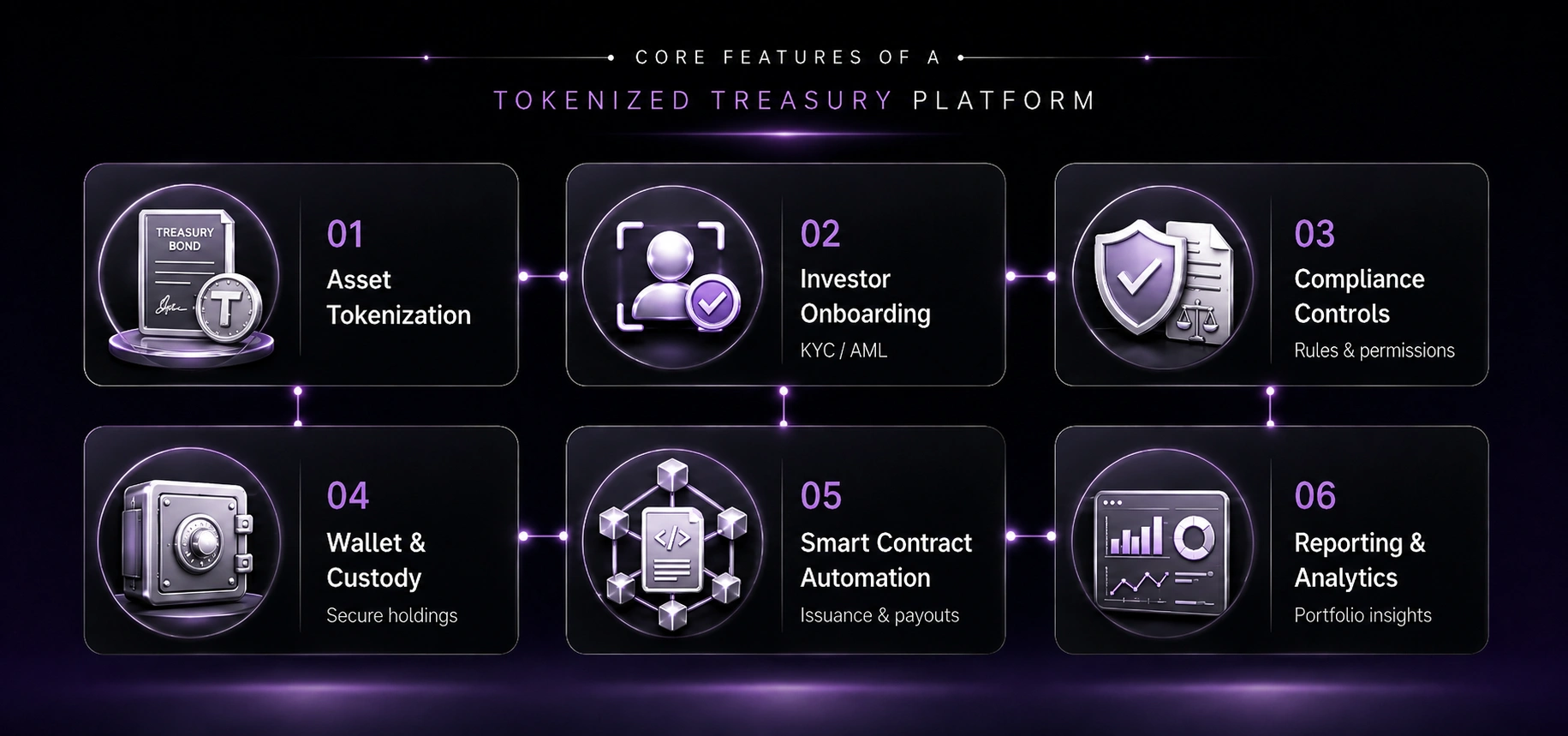
Here is what defines a production-grade Treasury platform in 2026:
1. Issuance, redemption and accrual of yield of tokens
The platform requires token issuance and redemption logic to mint and burn tokens against confirmed cash transfers and intraday NAV reporting and yield accrual to ensure balances track Treasury income in near real time. This is the fundamental financial logic behind all the other features.
2. Investor On-Boarding and Identity Verification
None of this can commence until each wallet has been investor onboarding (KYC, AML and accreditation). Only once identity verification is complete, is a wallet whitelisted and attached to an on-chain credential that the compliance layer can verify at each transfer, not just at the time the account is opened.
3. Compliance Reports and Audit Trails
Once investors are onboarded and holding tokens, the platform needs compliance reporting to produce the audit trails regulators and fund administrators expect, logging every mint, burn and transfer against the fund’s official books in a format an auditor can reconcile without manual cleanup. A good example of how the pieces fit together end-to-end is Ondo Finance’s OUSG token: subscriber cash flows into BUIDL via Securitize as primary issuer, and the underlying Treasury position is held in custody, while OUSG tokens settle redemptions same-day, rather than waiting for traditional fund cutoff windows that can take a business day or more.
4. Secondary market and institutional custody
The secondary marketplace allows eligible holders to trade with one another, without routing every transaction back thru the primary issuer, which becomes important once a fund has enough holders to make peer-to-peer liquidity really meaningful. At the heart of it all is institutional custody, which means Treasuries and, in many instances, tokens being held by a regulated custodian. Most institutional counterparties will not agree to an arrangement unless it is documented in advance.
5. Cross-Border Distribution
Platforms distributing to investors outside the United States must also use cross-border distribution logic that applies the right eligibility requirements by jurisdiction before accepting any subscriptions. A rule that clears one country’s investors can easily disqualify another.
Build a Compliant Tokenized U.S. Treasury Platform for Institutional Investors
Platform Architecture
The token layer typically follows the ERC-3643 permissioned token standard, which embeds identity checks and transfer restrictions directly into the smart contract rather than relying on off-chain enforcement alone. Building this layer correctly is a core piece of smart contract development work, covering minting, redemption, yield distribution, and NAV updates, usually fed by an oracle that pulls pricing from the fund administrator on a set schedule rather than an open market feed, since the underlying Treasury position does not trade the way a crypto asset does.
The Four Architecture Layers
- Token design: None of the logic will survive audit unless regulatory-compliant token design is baked in from the first line of code. Transfer limitations, if designed in from the start, are much cheaper to implement than retrofitting once a security analysis reveals a gap.
- Custody layer: The actual Treasury bills or fund shares are held by a registered custodian. The on-chain coin is a token of this off-chain foundation.
- Compliance layer: Applies transfer restrictions on each transaction according to the verified identity of investors, ensuring that tokens only move between whitelisted and approved wallets.
- Build vs. partner decision: Companies that do not have an internal blockchain team usually seek an established RWA tokenization platform partner as opposed to building each layer themselves. Getting custody, compliance, and smart contract logic right the first time is all very difficult, and all much more complicated than any one item in isolation. The architecture choices made here tend to mirror lessons learned across broader asset tokenization work in adjacent categories like private credit and tokenized equities, where the same custody and compliance layers largely carry over.
Compliance and Regulatory Considerations
The closest thing issuers have to direct guidance is a joint statement by SEC staff in January 2026. It confirms that a tokenized security is a security under federal law, regardless of whether the ownership information is on-chain or off-chain. Here are the main compliance levels that every Treasury platform has to contend with:
- Issuer-sponsored vs. third-party tokenization: The SEC distinguishes between issuer-sponsored tokenization, where the record on the blockchain is the authoritative record of ownership, and third-party tokenization, where a third-party platform creates a token that is intended to track or represent the underlying security. This distinction defines the regulatory framework to be applied.
- Structure and Registration of Funds: Fund sponsors must decide whether to register the vehicle under the Investment Company Act of 1940. Today, most tokenized Treasury funds are offered to accredited or qualified investors under a Regulation D exemption, rather than as retail “40 Act” products.
- KYC/AML and sanctions screening: Day-to-day compliance includes checking identity, verifying accreditation and running sanctions screening on onboarding – none of these change just because the fund has been tokenized.
- Transfer agent reconciliation: The transfer agent needs to reconcile the on-chain ledger with the official books of the fund to ensure that tokenized ownership records are consistent with traditional fund accounting.
- Ongoing reporting: Regulators and investors must always be kept informed. Tokenization doesn’t take the reporting load away, it just changes the format of the reported records.
Development Process and Timeline
Most builds start with fund structuring and legal work, because token design relies on the type of exemption and the eligible investor base, which a securities lawyer has to figure out before engineering starts. The broader industry has seen a massive surge in demand for the development of tokenized US treasury platforms. A recent market analysis suggests the on-chain tokenized Treasury sector is now worth well over $10 billion, up from about $1 billion in early 2024.
1. The Build Sequence
After legal launch, teams move to token design, smart contract work, custody integration, onboarding procedures, compliance tooling and marketplace features before a third-party security audit and mainnet deployment. Each phase depends on the choices made in the one before, which is why fund structure and legal work are always done first.
2. MVP Timeline: 5 to 8 Months
A single-fund MVP with one investor class and distribution jurisdiction generally takes five to eight months from legal start to debut. The pacing item is not the core token logic; custody integration and compliance tooling typically dominate the schedule.
3. Enterprise Timeline: 9 to 14 Months
The typical timeline for an enterprise structure with multiple funds and jurisdictions and a secondary market is 9-14 months. Extra audit cycles and rules around distributing across jurisdictions take time but don’t really change the basic token logic much. Teams with experience in previous RWA tokenization development services tend to shorten the engineering duration but legal structuring is rarely faster regardless of the partner picked. The same goes for larger engagements to build out RWA tokenization platforms, where custody and compliance integration are the drivers, not the token contracts themselves.
Cost to Build a Tokenized Treasury Platform
Cost is broken down into a few line items. What separates an MVP from enterprise build is a few important parameters. These are planning estimates, not bids, and actual costs will vary based on scope, jurisdiction and vendor. Here’s what a typical budget breakdown looks like:
Cost Components
- Fund legal structure: The first and most variable line item, depending on the type of exemption (Reg D, ’40 Act), number of jurisdictions and whether the fund vehicle already exists or has to be built from scratch.
- Smart contract engineering: Token issuance, redemption, yield distribution, NAV oracle logic. This is greatly mitigated by the use of certified contract patterns.
- Custody and transfer agent integration: Cost will depend on whether the platform connects to an existing certified custodian or builds its own custody infrastructure. This is exemplified by products including BlackRock’s BUIDL fund with BNY Mellon as custodian, which favors institutional providers over self-built options.
- KYC/AML & Compliance Tools: It includes modules for investor onboarding, sanctions screening, transaction monitoring and auditable reporting. SEC guidance on tokenized securities sets the minimum requirements for what these systems need to capture and report.
- Security audit: All contracts that involve funds or governance will be reviewed by an independent third party. Multi-firm audits are more expensive, but required for institutional builds.
- Continuous surveillance of infrastructure and compliance: Post-launch costs include custody fees, compliance staffing, audit refreshes and regulatory changes.
Illustrative Cost Ranges
- Single-Fund MVP: One jurisdiction Simple custody integration Basic compliance tools Usually in the low to mid 100,000 range.
- Multi-fund enterprise platform: It has multiple jurisdictions, a secondary marketplace, institutional custody and full KYC/AML automation. If there are legal, audit and integration issues, the cost is typically in the high six figures to low seven figures. Platforms of this size generally don’t build every layer themselves, they look for a proven RWA tokenization platform partner.
Key Cost Drivers
The most important variables are: fund complexity, the number of distribution jurisdictions, whether custody is built in-house or outsourced to an existing qualified custodian and the depth of the security audit required given the platform’s ultimate worth. Compare those factors with a white-label solution, where some customization is sacrificed in exchange for a faster, cheaper time to market.
Launch a Secure Blockchain-Based Treasury Fund with Automated Compliance
Choosing a Development Partner
Seek a partner with a track record of fund tokenization, not just general blockchain development, as Treasury systems have securities regulation and custody needs that generic DeFi experience does not address. The SEC’s existing tokenization framework, hands-on experience in permissioned token standards, and pre-existing relationships with qualified custodians and transfer agents all help bridge the gap between legal sign-off and the launch of a live platform.
Before you sign on the dotted line, ask a potential partner about how they handled KYC/AML integration in past projects, what their security audit process looks like, and how they structure ongoing compliance reporting once a fund is operational versus just at launch. A partner who can talk concretely about redemption mechanics, NAV oracle design and cross-jurisdiction distribution rules is a stronger signal than one who speaks in generalities about blockchain innovation.
Concluding Note
Tokenized Treasuries have evolved from experiment to institutional infrastructure, and the platforms powering BUIDL, BENJI and OUSG demonstrate what a compliant, production-grade build looks like: thoughtful fund structuring, a permissioned token architecture, qualified custody, and compliance baked in from the start, rather than tacked on afterward. If you’re a company looking to develop a tokenized U.S Treasury platform, you should start with the legal structure, then engineering and compliance, with an experienced partner who has done this before.
Frequently Asked Questions
1. What are tokenized treasury bonds?
Tokenized treasury bonds are digital tokens issued on a blockchain that give the holder a beneficial interest on short-term US government debt, typically in a fund structure. The transfer agent mints tokens on subscription and burns them on redemption. The underlying T-bills are held by a competent custodian. Securitize is the transfer agent for products like BlackRock’s BUIDL fund and BNY Mellon is the custodian.
2. How do I develop a tokenized U.S. Treasury platform?
To build a tokenized U.S. Treasury platform, start with fund structuring and legal work to determine the type of exemption and the qualified investor base. Then you would use ERC-3643 permissioned standards, design tokens and create minting and redemption intelligent contracts, integrate custody with a qualified custodian, onboard KYC/AML investors, report compliance and add secondary marketplace features. Finally, conduct a third-party security audit before mainnet deployment.
3. What features does a tokenized Treasury platform need?
The production-grade platform needs to support token issuance and redemption with intraday NAV and yield accrual, investor onboarding with KYC/AML and accreditation checks, compliance reporting with audit trails, a secondary marketplace for qualified holder transfers, institutional custody for the underlying Treasuries, and cross-border distribution logic that applies jurisdiction-specific eligibility rules.
4. How much does tokenized US treasury platform development cost?
A single fund MVP with one jurisdiction and simple custody is often in the low to mid six figures. Multi-fund business platforms with secondary trading and multi-jurisdiction distribution could cost high six or low seven figures. Key cost drivers include the number of jurisdictions, the complexity of the fund, the audit depth and the custody arrangement.
5. What is the development timeline for a tokenized Treasury platform?
For a single-fund MVP with a single investor class and single jurisdiction, the time from legal start to debut is five to eight months. A multi-fund, multi-jurisdiction enterprise structure with a secondary marketplace takes nine to fourteen months. Usually it’s custody and compliance integration that drives it, not the token contracts themselves.
Develop a Scalable Tokenized Treasury Platform with Institutional-Grade Infrastructure
