



Key Takeaways
- Faster Launch: White-label tokenization platforms enable businesses to launch compliant tokenization solutions in as little as 4-8 weeks, compared to the 6-12 months typically required for custom development.
- Lower Build Risk: The primary advantages of white-label platforms are speed, predictable costs, built-in compliance, and access to production-tested infrastructure, making them particularly attractive for first-time issuers and lean teams.
- 2026 Cost Range: White-label tokenization costs in 2026 generally range from $15,000 to $60,000 for setup and licensing, while equivalent custom platforms often require investments between $150,000 and $500,000 or more.
- Vendor Dependency: The trade-off for faster deployment is reduced flexibility and greater dependency on the provider, making vendor due diligence, data ownership, and exit planning critical considerations.
- Partner Selection: Choosing the right white-label tokenization partner requires evaluating live deployments, compliance capabilities, asset class support, cross-border functionality, and long-term post-launch support.
Introduction
Demand is rising for asset tokenization, but a bespoke platform can take 6-12 months to get to market. By licensing pre-built, rebrandable infrastructure instead of building a system from scratch, white label tokenization platform development can be reduced to weeks.
In tokenization, white-labeling means that the supplier has already built and configured the issuance engine, compliance logic, and investor tooling under your brand. In this guide, we will cover what these platforms offer, pricing versus custom builds, actual benefits and restrictions, and how to choose a supplier.
What a White Label Tokenization Platform Actually Includes
A white-label product is often a combination of a token issuance engine, investor dashboard, compliance modules, custodial integration, and in many cases a secondary marketplace, all rolled into a single customizable package.
Most providers offer support for a range of asset classes out of the box, including real estate tokenization, commodities, and tokenized bonds and equities, but the extent of support varies by vendor. Buyers should confirm exact coverage during due diligence rather than assuming a polished demo environment reflects production reality.
The issuance of tokens is typically based on compliance-first standards, like ERC-3643, that have identity verification and transfer limits baked directly into the token contract. Most systems are based on the idea of regulatory-compliant token design across jurisdictions without the need for new smart contracts for every transaction.
The core stack is delivered out of the box, but jurisdiction-specific legal architecture and specialized tokenomics will usually require further customization.
White-Label vs. Custom Build – Cost and Timeline Comparison
White-label price often includes a setup charge, a monthly or annual license, and per-transaction costs on issuance or transfers. Setup can range from $15,000 to $60,000 depending on vendor and scope.
After compliance engineering and custody work, a custom design, equivalent smart contract development, and independent audit typically cost anywhere from $150,000 to $500,000.
- White-label setup and licensing: Usually $15,000 to $60,000 depending on customization, vendor maturity, and included modules.
- Custom platform development: Usually $150,000 to $500,000 or more once compliance, custody, security, and audit requirements are included.
- White-label launch timeline: Often 4-8 weeks for a focused launch with standard workflows.
- Custom launch timeline: Often 6-12 months depending on product scope, jurisdiction, integrations, and audit cycles.
What Drives White Label Tokenization Platform Cost
The price of a white label tokenization platform depends mostly on the number of supported asset classes and jurisdictions, the level of customization, and the projected user traffic. Timelines are no different. White label launches are often live in four to eight weeks, while custom development takes six to 12 months.
Boston Consulting Group’s analysis estimates the overall tokenized asset market could be worth trillions of dollars by the end of the decade, which is why so many issuers are focused on speed. Custom builds are still useful when the token economics, governance, or integration requirements are highly unique.
Key Benefits of Choosing a White-Label Asset Tokenization Platform
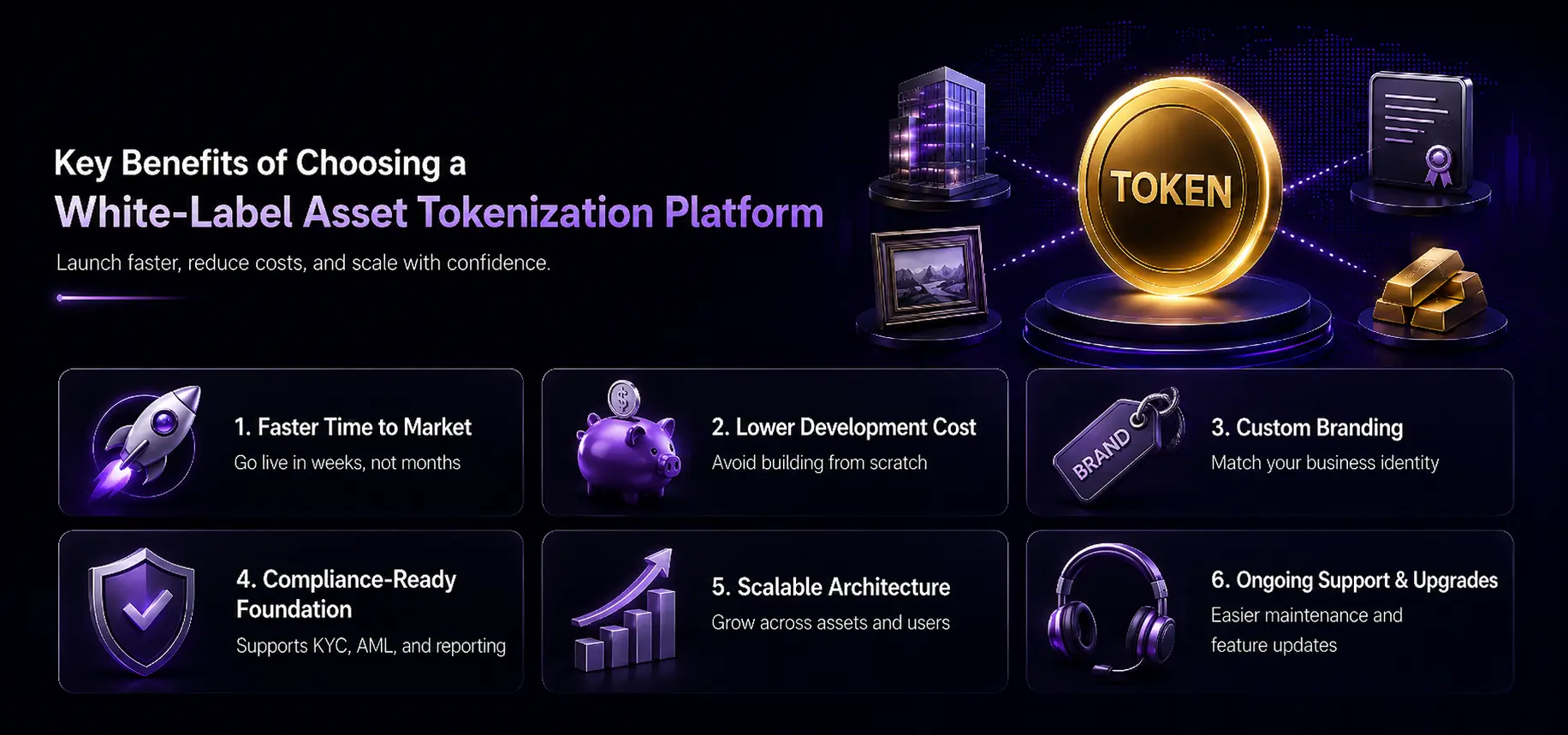
The most obvious benefits of a white-label asset tokenization platform are speed, cost control, compliance readiness, and operational support. Here is how each benefit works in practice for issuers and asset managers deciding whether to build or buy.
1. Speed to Market – From Concept to Live Offering in Weeks
With a white-label platform, the time from planning to launching a live tokenized asset is reduced from 6-12 months to 4-8 weeks. Rather than create an issuance engine, investor portal, and compliance layer from the ground up, teams adapt existing infrastructure under their own brand. For issuers with a market window or a first-mover opportunity, the time difference is often the deciding factor.
2. Regulatory Readiness – Compliance Built In, Not Bolted On
Most suppliers have pre-built compliance reporting and onboarding routines for KYC, AML, and accreditation checks. Issuers do not start from scratch to develop jurisdictional rule sets, but adapt existing modules. This regulatory head start is particularly important for multi-jurisdiction launches, where building compliance for each individual market would otherwise stretch the development timeline.
3. Predictable Costs – Fixed Pricing Instead of Open-Ended Development
White-label pricing is based on a predictable formula: a setup fee, a monthly or annual license fee, and per-transaction fees. This makes it easier to lock in budgets than custom development, where scope creep and compliance engineering often push costs beyond initial estimates. This predictability takes the biggest financial risk out of the build decision for lean teams.
4. Proven Infrastructure – Battle-Tested Contracts and Custody
Other clients will typically test the underlying smart contracts and custodial integrations in production before a new issuer goes live. The good news is that the leading failure points – token contract issues, custody reconciliation errors, and investor onboarding friction – have often already been identified and corrected. One documented case: a European real estate issuer reportedly used a white-label deployment, slashed onboarding costs by over 90%, and signed hundreds of investors in its first month of operations.
5. Ongoing Operations – Maintenance Handled by the Provider
Security patches, updates to regulations, and platform maintenance are the provider’s job, not the internal team’s. This takes the operational burden off lean fintech teams and ensures the platform can scale to meet evolving demand without tying up internal engineering resources.
The benefits depend on the company model. A developer may value speed, while an asset manager may care more about custody, investor onboarding, and reporting.
Limitations and Trade-Offs – What White-Label Doesn’t Solve
The trade-off for speed is reduced differentiation. If competitors deploy the same underlying platform, the issuance flow, dashboard design, and compliance logic can look nearly identical across brands.
Customization constraints are real too. Platforms built around standard token structures often cannot accommodate unusual governance models or nonstandard tokenomics without significant workarounds.
Dependency Risk and Exit Planning
There is also the risk of dependence: your roadmap, security posture, and regulatory response become linked to the priorities of the provider. Frameworks like the EU’s DLT Pilot Regime continue to evolve as regulators gather more real market data.
Think about data ownership and institutional custody requirements before signing, including what happens to investor records if you switch providers. Many issuers use white label as an intentional stepping stone to a fully customized, unique build at a later date.
Core Features to Evaluate in a White Label Tokenization Platform Solution
Do not be fooled by the presentation. Judge each white label tokenization platform solution on its own merit. Start by checking whether it can issue and manage the full lifecycle of the asset classes you will serve.
The investor portal should support KYC, accreditation checks, and portfolio reporting in one place rather than relying on disconnected third-party solutions.
- Token Issuance Engine: Supports compliant token creation, asset onboarding, cap table logic, and lifecycle events.
- Investor Dashboard: Gives investors access to portfolio holdings, documents, payouts, and transaction history.
- KYC and Accreditation: Connects investor onboarding compliance with jurisdiction-specific eligibility rules.
- Secondary Marketplace: Provides liquidity through a compliant secondary marketplace with transfer controls and investor restrictions.
- Custody Integrations: Connects tokenized assets and investor accounts with qualified custodians, wallet infrastructure, or regulated custody partners.
- Audit Trails and Reporting: Creates automated records for compliance review, investor reporting, and regulatory checks.
Compliance, Liquidity, and Cross-Border Capabilities
The fine print is where compliance depth matters most. Look for jurisdictional rule sets, automated audit trails, and a functional secondary marketplace with true order matching, not just a static holdings list.
Interoperability between platforms and standards is an open industry challenge, requiring careful consideration before investing in any single vendor relationship. This is especially important if multi-chain expansion is even remotely on the agenda.
If you plan to raise money in multiple markets, make sure the vendor supports real cross-border distribution, not just a one-jurisdiction product with an international label.
How to Choose a White Label Tokenization Company
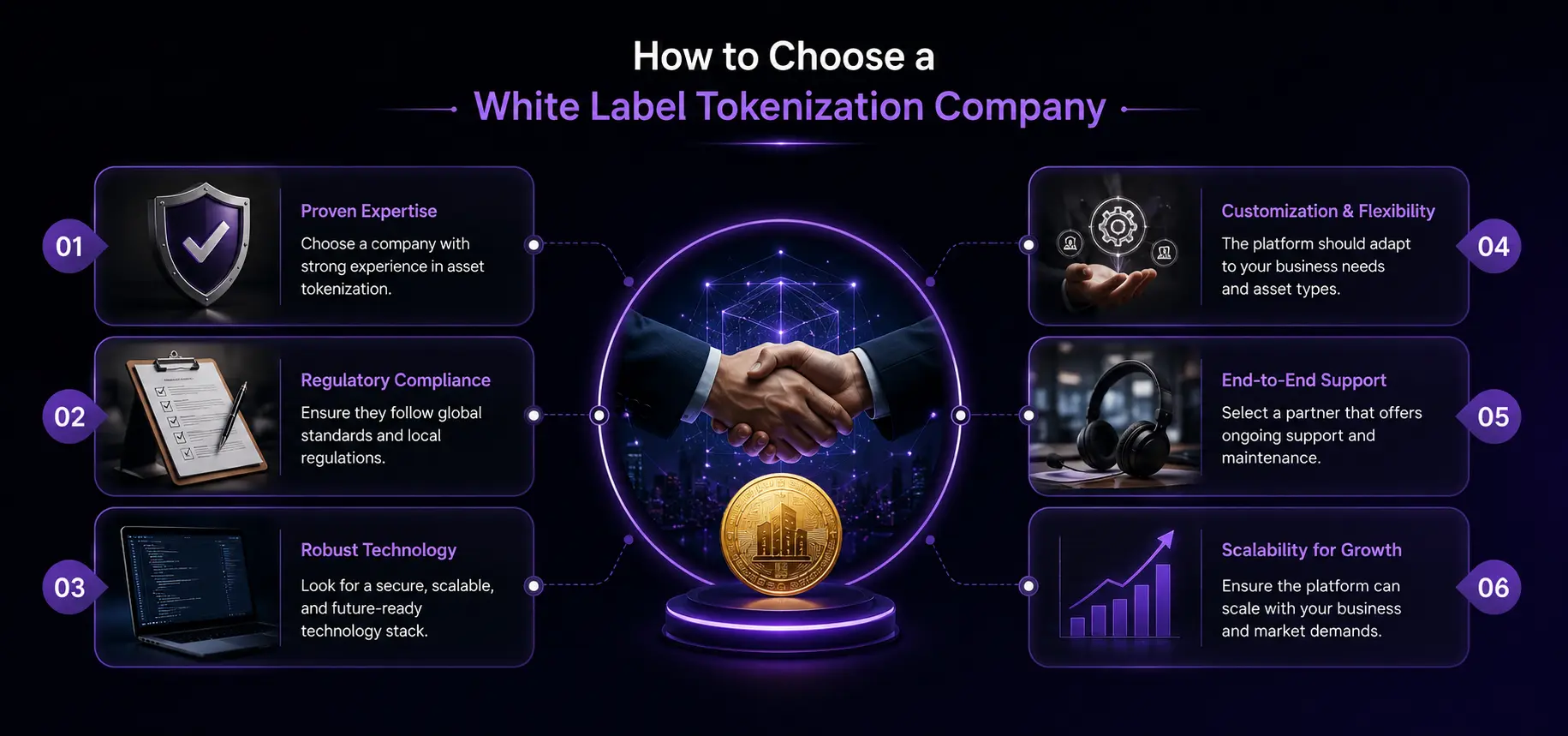
The quickest filter is track record: ask for live deployments, not pilots, and see what asset types and jurisdictions the vendor has in production. Technology flexibility is almost as important. Blockchain agnosticism, accepted token standards, and open APIs all reduce lock-in risk.
Compliance Depth and Post-Launch Support
Compliance depth should be in-house, not controlled by a third party outside the vendor’s accountability. Regulatory queries during a live raise require fast, accountable answers.
Post-launch support conditions should receive as much attention as the initial contract, especially when it comes to handling security patches and regulatory changes after go-live.
The right white label tokenization company will depend on target asset classes, jurisdictions, investor base, and how much control the business wants to retain over branding and reporting. A clear asset tokenization strategy should inform the shortlist well before a contract is signed.
That plan includes determining whether the business will eventually require independent smart contract audit support, separate from the vendor that manages day-to-day platform operations.
Conclusion
White-labeling is still the fastest possible route to a compliant, working tokenization platform, but the vendor you select will determine whether that speed comes at the cost of long-term flexibility.
The trick is to match the platform’s strengths to your asset classes, jurisdictions, and investor base, not to go with the vendor you know best.
With further improvements in regulatory frameworks and more issuers going live, 2026 could be the year when white label tokenization platform development becomes the default starting point, rather than a fallback. Teams evaluating providers today will be best positioned to move quickly when there is more clarity in the market.
Those who see white label as a strategic launchpad rather than a permanent solution will be best positioned to scale.
Frequently Asked Questions
1. What is white label tokenization platform development and how does it work?
White label tokenization platform development involves licensing a pre-built, rebrandable infrastructure that includes token issuance, compliance modules, investor dashboards, and custody integration.
Instead of building from scratch, you configure the platform under your brand and launch in weeks rather than months. The provider handles ongoing maintenance, security patches, and regulatory updates.
2. How much does a white label tokenization platform cost in 2026?
A white label tokenization platform will typically be in the range of $15,000 to $60,000, including setup fees, a monthly or annual license, and per-transaction costs.
A custom design with similar features may cost between $150,000 and $500,000 or more.
3. What are the main white-label asset tokenization platform benefits?
The key advantages of a white label asset tokenization platform are speed to market, regulatory readiness, predictable costs, and access to production-tested infrastructure.
A white-label platform can often launch in 4-8 weeks instead of 6-12 months, while compliance reporting, KYC/AML, and investor onboarding are already built into the product.
4. What limitations should I expect from a white label tokenization platform solution?
A white label tokenization platform solution limits differentiation since competitors may use the same underlying infrastructure. Customization constraints can block unusual governance models or nonstandard tokenomics.
There is also dependency risk. Your security posture and regulatory responsiveness become tied to the provider’s priorities, and switching providers later can be complex if data ownership terms were not negotiated upfront.
5. How do I choose the right white label tokenization company?
Ask a white label tokenization provider about live deployments, not pilots, and validate which asset classes and jurisdictions they support in production.
Consider blockchain agnosticism, token standard support, and API flexibility to reduce lock-in risk. Keep compliance knowledge in-house. How security fixes and regulatory changes will be handled after launch deserves the same attention as the initial contract.
