



Key Takeaways
- Sharia compliance is a market access requirement for RWA tokenization in the UAE, enabling issuers to tap into substantial pools of Islamic institutional and retail capital across the GCC and Southeast Asia.
- Tokenized assets must comply with core Islamic finance principles, including the prohibition of interest (riba), excessive uncertainty (gharar), and speculation (maysir), while maintaining a direct connection to tangible assets.
- Sharia compliance must be built into the token structure from the outset, with asset eligibility screening, approved contract models such as ijarah and musharakah, and ongoing Sharia governance.
- UAE issuers must satisfy both conventional regulatory requirements and Sharia oversight frameworks, including approvals from regulators such as VARA, SCA, DIFC, ADGM, and institutional Sharia boards.
- Embedding Sharia governance, audits, and compliant smart contract logic during development is significantly more cost-effective than retrofitting compliance after launch, while also improving investor trust and market liquidity.
Introduction
The UAE has succeeded in building two identities at once: as a global hub for Islamic finance and as a leading jurisdiction for blockchain innovation. Fintech startups and asset managers who are bringing tokenized real-world assets to investors in the Gulf and Southeast Asia must not treat these identities as separate entities. Sharia compliant RWA tokenization UAE is not just a marketing term, but a structural need to tap the pools of capital that matter most in this context. The article discusses the Sharia principles underpinning tokenized assets, AAOIFI standards, asset eligibility, audit requirements and how the UAE regulation applies Islamic jurisprudence to digital asset issuance.
Core Sharia Principles That Apply to Tokenized Assets
The tokenization of Islamic finance is built on a few ideas that predate the blockchain by centuries, but correspond to it with remarkable clarity.
- Riba or the prohibition of interest, means that tokenized loan instruments must include profit sharing or lease based payments instead of fixed guaranteed payments.
- Gharar or excessive uncertainty is forbidden in Islam so the token offerings need to clearly explain the ownership of the asset, its value and risk to avoid investors blindly speculating.
- Maysir, the gambling ban, sets apart legitimate investment tokens from the mere speculative ones.
The last condition, that the value is traceable back to a tangible asset or usufruct right, is the practical structure of the halal asset tokenization. The standards established by the Accounting and Auditing Organization for Islamic Financial Institutions (AAOIFI) continue to be the most accepted benchmark for the translation of these principles into uniform structural guidelines.
What Makes an RWA Token Sharia-Compliant: Asset Eligibility and Structure
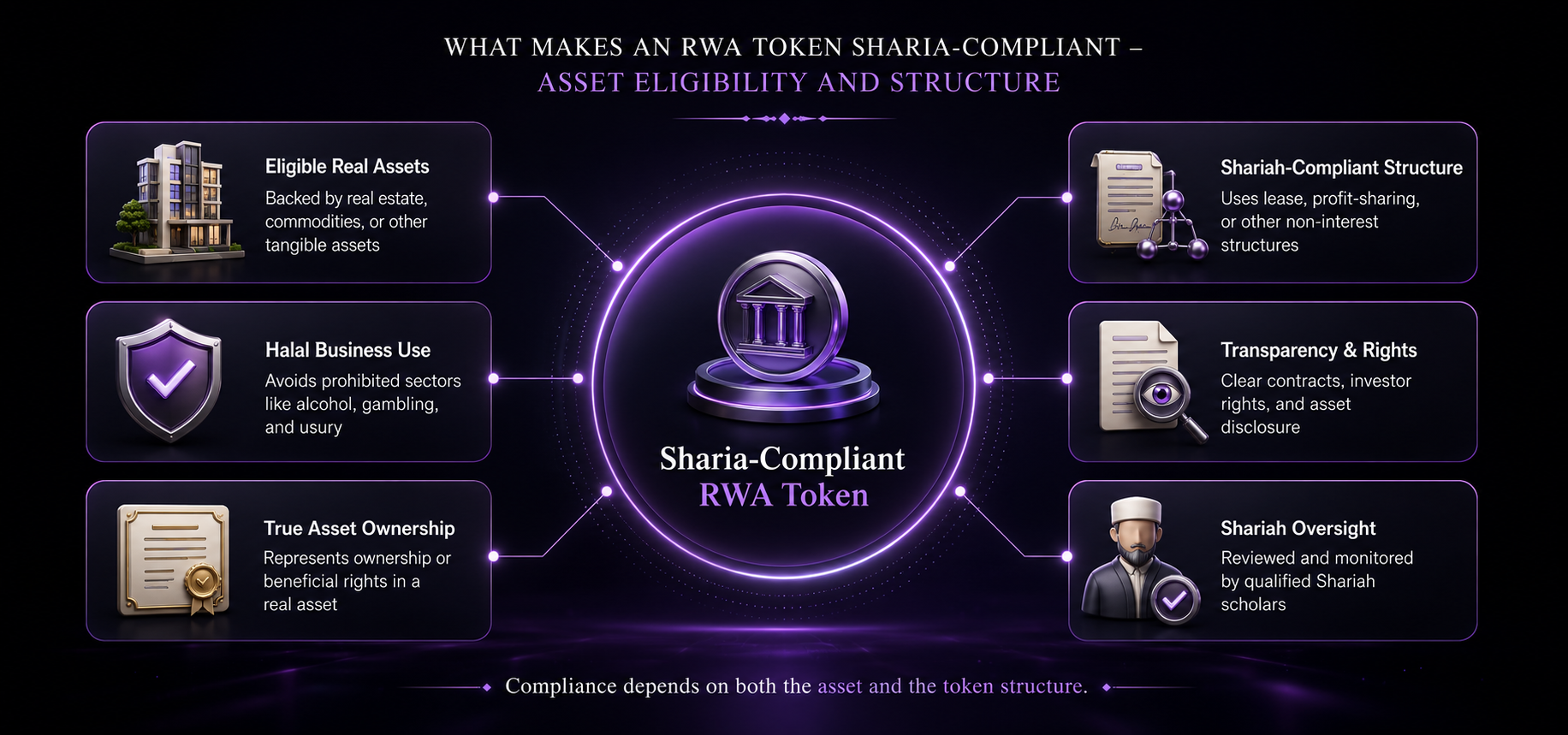
Not every asset class is eligible. Real estate, commodities, equipment leasing, and Islamic financial instruments generally qualify, while conventional interest-bearing products, alcohol, gambling, pork-related industries, weapons, and adult entertainment are excluded outright. This screening happens before any code is written, since a token cannot be made compliant after the fact.
Real estate tokenization is the clearest example of real estate tokenization halal structuring, typically built around ijarah — a lease-based contract where investors earn rental income rather than interest — or musharakah, a partnership tied to actual profit and loss sharing. Blockchain RWA UAE platforms increasingly encode these structures into token logic, distinguishing equity-based, asset-backed, and usufruct-right designs so legal form and economic substance stay aligned. The same discipline extends to commodity tokenization, where physical possession matters as much as pricing.
The Sharia Compliance Framework for Tokenization in the UAE
Islamic financial institutions in the UAE fall under the mandate of the UAE Central Bank’s Higher Sharia Authority, which sets binding standards that institutional Sharia boards must follow. For tokenized assets, this framework does not replace securities regulation — it runs alongside it. A compliance framework blockchain UAE issuer must satisfy both VARA or the Securities and Commodities Authority’s licensing requirements and Sharia governance obligations, with neither treated as secondary.
Sharia Board Review Pre-Issuance and Ongoing Oversight
A Sharia board typically reviews token structure, smart contract logic, and profit-distribution mechanics before issuance, then maintains oversight afterward. Digital asset Sharia compliance in practice means three checkpoints: pre-issuance screening of the underlying asset and contract terms, contract review verifying alignment with approved structures like ijarah or musharakah, and periodic post-issuance audit confirming ongoing operations remain compliant.
Building Compliance into Development – Not Retrofit
Enterprise blockchain Islamic finance projects that build these checkpoints into smart contract development from day one avoid costly redesigns later. Because UAE digital asset rules keep evolving, issuers should treat published guidance as a floor and confirm current requirements with regulators. The PwC coverage of the UAE’s Shariah Compliance Function standard shows how formalized this monitoring has become for regulated institutions.
Sharia Audit for Tokenized Assets: What It Covers and Why It Matters
The Sharia audit of tokenized assets is different from the conventional financial audit. Auditors check that the underlying asset is permissible, the contract follows an approved structure such as ijarah or musharakah and that the token economics do not contain any prohibited features before issuance. Once the audit is issued, the process continues with monitoring. Flows are regularly assessed and any non-compliant income is regularly flagged for cleansing rather than distribution to investors. PwC’s coverage of the UAE’s Shariah Compliance Function standard highlights the extent to which regulated entities have institutionalized monitoring.
Smart contract audit have a dual purpose in that they check whether code behavior actually matches agreed conditions and also because profit distribution and redemption are often automated. The Sharia documentation for the issuance of RWA tokens should contain the Sharia board’s permission letter, asset valuation and commitments to ongoing compliance reporting, providing investors with a paper trail similar to a conventional sukuk.
UAE Halal Investment Regulations and Tokenization
Halal investment legislation in the UAE for digital assets is a rapidly evolving space and issuers should remember that current advice is a starting point and not a complete framework. The DIFC’s Islamic finance regime requires a Sharia monitoring board of at least three competent experts and ADGM has a similar framework, both of which apply to tokenized offerings organized within the relevant jurisdictions. Based on this, a RWA tokenization platform must embed eligibility assessment at every point of the offering, rather than when the token goes live.
This in practice means investor onboarding processes that feature Sharia-compliant eligibility screening in addition to standard KYC screening, particularly for cross-border marketing into the GCC, Malaysia, Indonesia and the UK. This is why reliable institutional custody arrangements are particularly important, as institutional investors often prefer to have independent verification that custody does not contain unlawful structures.
The Business Case: Why Sharia Compliance Expands Investor Access
The global Islamic finance industry is worth $5 trillion-plus and S&P Global’s 2026 industry outlook foresees continued growth of Gulf banking assets and sukuk issuance despite the short-term regional challenges. Family offices and institutional allocators in the region increasingly see Sharia compliance as a baseline screening filter rather than a preference, which means that the non-compliant tokens are simply invisible to a big portion of regional capital.
That investor base is also what enables a liquid secondary marketplace in the first place, as Sharia-compliant demand tends to cluster rather than distribute evenly across all listed tokens. Sukuk al-ijarah and sukuk al-musharakah structures point to the direction of this market: tokenized bonds and equities can be converted into Islamic tranches without losing the settlement speed or transparency that blockchain already provides in conventional issuance. The same efficiency applies to financial services more generally. Building in compliance up front is much cheaper than retrofitting a token system after investors raise concerns.
Concluding Note
Sharia compliance with tokenized real-world assets is a market access requirement, not a niche option; it constrains the pools of Gulf and Southeast Asian capital an issuer can realistically access. The UAE’s infrastructure for Sharia governance and advanced legislation for digital assets is the perfect environment to develop Sharia compliant RWA tokenization UAE platforms that scale. Issuers that build for compliance from the start will be best positioned to take advantage of future growth as these areas evolve.
Frequently Asked Questions
1. What makes an RWA token Sharia compliant in the UAE?
A Sharia compliant RWA tokenization UAE structure cannot be riba (interest), gharar (extreme uncertainty) or maysir (gambling) and must be backed by a real asset. The underlying asset must be in one of the permitted categories which include real estate and commodities but do not include alcohol, gambling and conventional banking. A Sharia board reviews the structure before issuance and continuously monitors it.
2. How does Islamic finance tokenization differ from conventional tokenization?
Islamic finance tokenization combines Sharia governance with securities legislation, necessitating recognized contract types such as ijarah (lease-based) or musharakah (profit-and-loss sharing) instead of interest-bearing debt. A Sharia audit checks permissibility before issue and monitors ongoing compliance, including purification of income if non-compliant revenue is found.
3. What role does AAOIFI play in halal asset tokenization?
The most frequently referenced Sharia regulations for Islamic financial institutions, including permissible contract structures and asset eligibility for the tokenization of kosher assets, is the AAOIFI. AAOIFI compliance is a widely accepted benchmark for institutional allocators and sharia boards for products that are marketed towards Gulf and Southeast Asian investors.
4. Which UAE regulators oversee digital asset Sharia compliance?
The Central Bank’s Higher Sharia Authority is responsible for overseeing the Sharia compliance of digital assets, setting mandatory standards for Islamic financial institutions. This parallels the regulation of VARA or SCA securities. Both DIFC and ADGM have Islamic finance regimes which require Sharia monitoring boards of at least three competent scholars.
5. Can real estate tokenization halal structures work with smart contracts?
Yes, real estate tokenization halal structures integrate ijarah or musharakah concepts into smart contracts. A smart contract audit ensures that automated functions e.g. profit sharing are in accordance with accepted Sharia terms and the code should be reviewed by the Sharia board before being deployed and not after
