Smart Contract Audit Company for Secure Blockchain Applications
Secure your code before deployment. Our Smart Contract Audit Company delivers rigorous, line-by-line smart contract audits for DeFi protocols, token systems, and enterprise Web3 applications, protecting your blockchain assets from costly vulnerabilities.
- Comprehensive Vulnerability Detection
- Manual Expert Code Review
- Detailed Remediation Guidance
- Audit-Ready Smart Contract Report
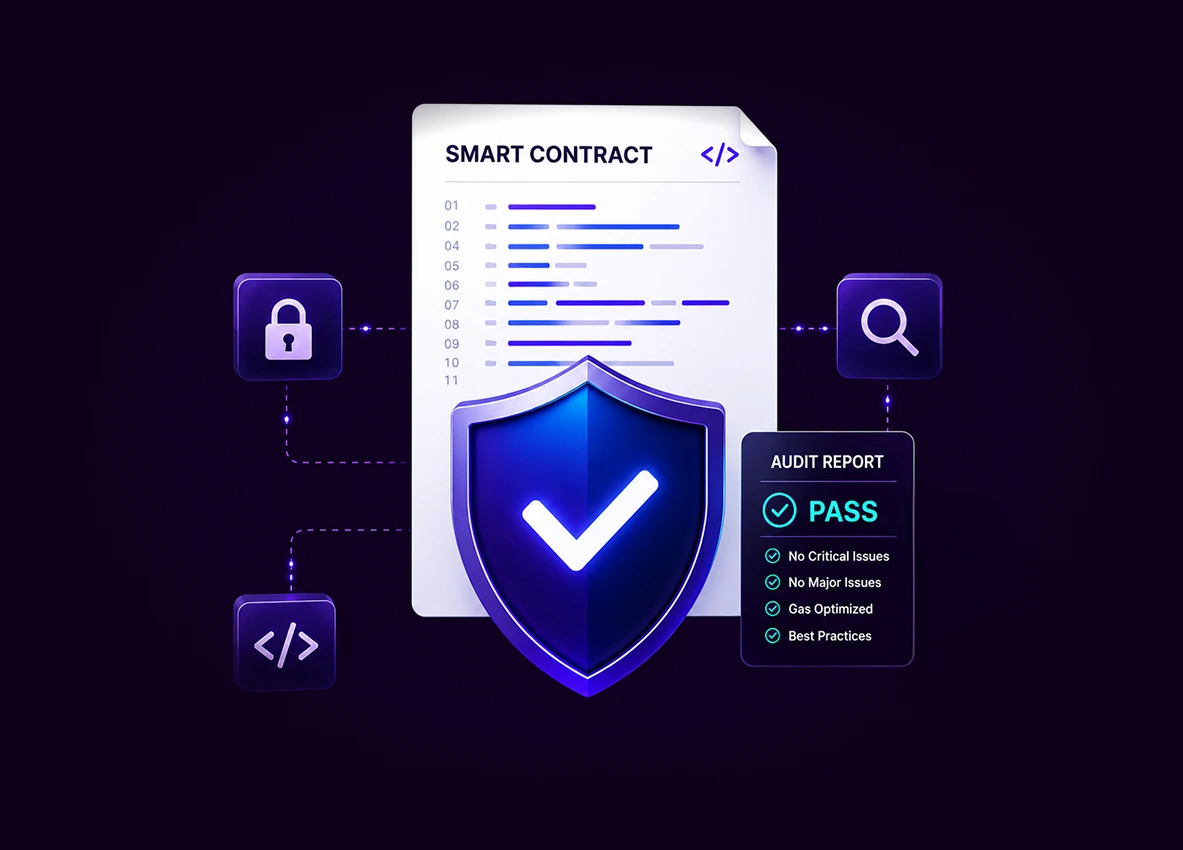










Smart Contract Security Audit: The Foundation of Secure Web3 Deployment
A Smart Contract Security Audit Service is a formal technical review of the blockchain code, to find vulnerabilities, logic errors and deployment hazards, before a smart contract is deployed live. It’s an integral component of blockchain security because it looks at how contracts behave in normal, malicious, and edge-case conditions, enabling DeFi protocols, token issuers, and enterprise Web3 platforms to avoid financial loss, unlawful access, and protocol failure. Smart contract auditing is also a way to strengthen risk controls, transaction integrity and compliance readiness for applications using predictive analytics solutions or securities tokenization.
- Static Code Analysis
- Dynamic Analysis & Fuzzing
- Manual Logic Review
- Formal Verification
150+
Smart Contract Audits Completed
12+
Years of Experience in Blockchain & Web3
98%
Client Satisfaction Across Blockchain Security Projects
120+
Blockchain Security & Smart Contract Experts
Complete Smart Contract Audit Services for Secure Deployment
Our smart contract audit process strengthens Smart Contract Audit Services with secure delivery for enterprise AI assistants.

Comprehensive Vulnerability Detection
Detect reentrancy, access control issues, integer overflows & front-running vulnerabilities before they are exposed on mainnet.

Manual Expert Logic Verification
Human-led security review workflows for validating business logic, economic assumptions, governance systems and privileged actions.

Detailed Remediation Guidance
Prioritize severity discoveries, actionable fix recommendations and code examples for faster developer resolution cycles.

Audit-Ready Final Report
Deliver comprehensive documentation that supports investor confidence, internal approvals, and exchange listing requirements.

Post-Audit Re-verification
Review implemented fixes and contract changes after remediation to confirm complete issue resolution.

Confidentiality & Non-Disclosure
Protect source code through signed NDAs, restricted access, and secure report delivery channels.
Secure Your Smart Contracts Before Mainnet Launch
Talk to Audit ExpertsEnterprises' Need to Reduce Risks With Smart Contract Audits
Without smart contract audit services, organizations face the risk of lost funds, lost governance, permanent transaction failures and long-term reputational damage. Vulnerable contracts can be exploited within minutes after deployment, especially in DeFi, token issuance and asset-backed blockchain systems, where the transfer of cash is automated. Whether it’s agentic process automation for safe workflows or real estate tokenization that requires investor protection, a smart contract audit company enables organizations to identify security loopholes early, minimize the risk of exploits, and enter the market with greater technical assurance.

$3B+ Lost to DeFi Hacks
Billions of stolen assets have been traced to flaws in smart contracts, showing how unaudited protocols can quickly become profitable targets for hackers.

Reentrancy Attacks
Attackers deplete contract balances using recursive calls before the state updates can run properly and prevent repeated withdrawals.

Access Control Vulnerabilities
Without properly designed or configured ownership controls, unauthorized individuals may be able to perform privileged operations, upgrade contracts or shift cash.

Integer Overflow & Underflow
Arithmetic errors can be more than variable boundaries, therefore yielding unexpected values, altered balances, and broken token or accounting logic.

Front-Running & MEV Risks
Transaction ordering flaws enable attackers or validators to steal value from pending transactions before users are aware of their execution.
Understanding How Smart Contract Auditing Works
Smart contract auditing consists of a systematic security assessment that enables teams to detect vulnerabilities, logic flaws, and deployment risks before contracts are deployed.
Codebase review
The first thing auditors need to do is understand how the system is supposed to behave by looking at the contract structure, dependencies, inheritance patterns, external integrations and expected functionality.
Automated vulnerability detection
Security tools scan source code for common issues including re-entrancy, unchecked calls, access control issues, unsafe math, and known exploit patterns.
Manual Security Auditing
Human auditors conduct manual audits of business logic, permissions, economic assumptions and multi-contract interactions to identify hazards that automated technologies cannot reliably detect.
Runtime Testing & Fuzz Testing
Smart contract security audit service providers review contracts with different inputs and edge-case conditions to find unexpected state changes, incorrect assumptions, and exploitable execution paths.
Risk Ratings & Findings
Flaws identified are ranked by severity, exploitability and business effect to allow teams to prioritize remediation based on actual security risk.
Final Validation/Remediation
Developers implement solutions and auditors re-examine the corrected code to certify that vulnerabilities have been resolved and no new risks have been created.
Features of a Smart Contract Audit
A smart contract audit involves both automatic tests and manual security review and technical validation to identify issues before launching the blockchain.

Static Code Analysis
Automated scanners search the smart contract code for known vulnerability patterns, unsafe functions, and dangerous implementation practices.

Dynamic Testing & Fuzzing
Runtime testing evaluates the contracts behaviour on random inputs , on corner cases and on unexpected execution pathways.

Manual Business Logic Review
Security specialists also manually review contract logic, permissions, economic assumptions, and role-based access outside of automated tool coverage.

Gas Optimization Review
Auditors spot excessive storage utilization, expensive loops, repetitive procedures and execution patterns that increase transaction fees.

Test Coverage Assessment
Existing test suites are evaluated to identify missing edge cases, untested functions and poor validation scenarios.

Dependency & Library Validation
Third party libraries, inherited contracts and external dependencies are examined for version risks, unsafe imports and known vulnerabilities.
Our Blockchain Smart Contract Audit Services at a Glance
We provide Blockchain Smart Contract Audit services to help secure deployment on web3 development services and cross-chain smart contract designs.

DeFi Protocol Security Audit
Find protocol level bugs that can be exploited in Loan pools, AMM DEXs, Staking contracts, Yield aggregators.

Token & NFT Contract Audit
Audit ERC-20, ERC-721 and ERC-1155 contracts for supply limits, minting rules and royalities logic.

DAO & Governance Contract Audit
Validate proposal systems, treasury controls, voting, quorum rules, and privileged governance execution flows.

Bridge & Cross-Chain Contract Audit
Review lock-and-mint bridge logic, validator signatures, replay protection, and security of cross-chain message verification.

Oracle Integration Security Review
What are the dangers of price feeds and what do Chainlink, Pyth and bespoke oracle connectors look for regarding stale data and manipulation?

Upgradeable Contract Audit
Identify proxy design patterns, storage collisions, initializer functions, admin controls, and upgrade approval issues

Quick Response Critical Audit
Emergency audit support for urgent deployments, suspected vulnerability patches and time sensitive security evaluations.

Smart Contract Gas Optimization Audit
Identify expensive storage patterns, wasteful loops and execution bottlenecks to reduce transaction costs.

DApp Backend Integration Audit
Evaluate risks of integration level by examining contract interactions, API calls, event listeners and backend signing flows.
Industries & Use Cases for DeFi Smart Contract Security Audit
We provide smart contract audit services to ensure the security of business-critical Web3 application cases such commodity tokenization and enterprise blockchain automation.

Financial Services & DeFi Platforms
We audit lending, staking, asset management and digital payment contracts to decrease financial exposure, secure pooled liquidity, validate transaction logic and improve user fund security across high-value DeFi networks.
- lending platforms
- staking products
- digital payments

Real Estate & Asset Tokenization
We bring tokenized property ownership, investor distribution logic, transfer limits, and compliance workflows to enable regulated asset-backed platforms with enhanced stakeholder protection, clear ownership records, and limited secondary-market involvement.
- property tokens
- investor payouts
- transfer compliance

Gaming & Digital Collectibles
We audit NFT ownership, marketplace royalty logic, in-game currencies, reward contracts and asset transfer flows to protect gamers, developers, marketplace operators and tokenized digital economies against contract level abuse.
- NFT ownership
- marketplace royalties
- reward logic

Supply Chain & Logistics
We monitor shipment records, supplier payments, product provenance, milestone-based settlements and automated logistics workflows to increase operational transparency, decrease disputes and foster confidence between vendors, carriers and enterprise purchasers.
- shipment records
- supplier payments
- product provenance

Energy & Commodities
As a smart contract audit company, we bring commodity-backed tokens, carbon credit logic, P2P energy trading, settlement rules and asset tracking contracts to enable transparent market operations, verifiable ownership and automatic transfer of value.
- energy trading
- carbon credits
- commodity tokens

Enterprise Automation & Payments
We review escrow workflows, payment automation, permissioned access rules, approval logic and business process contracts to support dependable corporate blockchain operations, mitigate execution risk and improve transaction accountability.
- escrow workflows
- access rules
- automated payments
Financial Services & DeFi Platforms
We audit lending, staking, asset management and digital payment contracts to decrease financial exposure, secure pooled liquidity, validate transaction logic and improve user fund security across high-value DeFi networks.
- lending platforms
- staking products
- digital payments
Real Estate & Asset Tokenization
We bring tokenized property ownership, investor distribution logic, transfer limits, and compliance workflows to enable regulated asset-backed platforms with enhanced stakeholder protection, clear ownership records, and limited secondary-market involvement.
- property tokens
- investor payouts
- transfer compliance
Gaming & Digital Collectibles
We audit NFT ownership, marketplace royalty logic, in-game currencies, reward contracts and asset transfer flows to protect gamers, developers, marketplace operators and tokenized digital economies against contract level abuse.
- NFT ownership
- marketplace royalties
- reward logic
Supply Chain & Logistics
We monitor shipment records, supplier payments, product provenance, milestone-based settlements and automated logistics workflows to increase operational transparency, decrease disputes and foster confidence between vendors, carriers and enterprise purchasers.
- shipment records
- supplier payments
- product provenance
Energy & Commodities
As a smart contract audit company, we bring commodity-backed tokens, carbon credit logic, P2P energy trading, settlement rules and asset tracking contracts to enable transparent market operations, verifiable ownership and automatic transfer of value.
- energy trading
- carbon credits
- commodity tokens
Enterprise Automation & Payments
We review escrow workflows, payment automation, permissioned access rules, approval logic and business process contracts to support dependable corporate blockchain operations, mitigate execution risk and improve transaction accountability.
- escrow workflows
- access rules
- automated payments
Build Investor Confidence With Verified Contract Security
Schedule Security ReviewOur Smart Contract Audit Process Explained
At Techfyte we provide smart contract security audit service with a clear, security-first process designed for technical transparency and confidence for launch.

Secure Audit On-Boarding
We begin with scope confirmation, access to repository setup, documentation review and communication channel setup. We also handle confidential contract code under NDA.
Deployment of Dedicated Audit Team
Based on the type of contract, chain ecosystem, architecture and business use case your project is assigned to blockchain security specialists to review.


Tool-Assisted Security Assessment
We use trusted audit tools such as Slither, Mythril, Echidna and Foundry on our team to produce a baseline of the technical vulnerabilities.
Senior Manual Review
Human-led security reasoning enables experienced auditors to analyze business logic, privileged roles, upgrade patterns, economic flows, and edge cases.


Remediation Practical Guidance
We provide severity based conclusions, context, code level recommendations and actionable recommendations that your developers can act on immediately.
Final validation and delivery
After remediation we re-test refreshed code, validate patches, record the final security posture and provide an audit report suitable for stakeholders.

Our Smart Contract Audit Expertise
Hire Techfyte as your smart contract audit company and enjoy our blockchain security skills that helps to protect assets, users and launching credibility.

Senior Blockchain Security Experts
Our auditors have a profound experience in Solidity and vulnerability research in DeFi, token, governance and asset-backed blockchains.

Multi-Chain Audit Capability
We do smart contract audits services on Ethereum, Solana, Polygon, Arbitrum, Avalanche and BNB Chain for safe multi-network deployment.

Comprehensive Tooling Mastery
We perform additional technical analysis using Slither, Mythril, Echidna, Foundry, and proprietary fuzzing frameworks.