



Key Takeaways:
- Core Value: The decision between white label and custom development affects the ownership, adaptability and the exchange’s potential to change strategically over time.
- Comprehensive Services: While both approaches provide the required exchange features, custom development allows for platform specific optimizations, deeper integration and workflows customized to your needs.
- Business Benefits: Custom exchanges allow for better positioning, operational control and long-term growth. White label solutions reduce launch costs and friction.
- Industry Use Cases: Custom platforms are best for regulated markets, institutional trading, scale-driven models and white label exchanges are best for rapid market entry and product validation.
- Future Trends: With the adoption of multi-chain access, hybrid models and embedded compliance by exchanges, custom-built architectures offer greater flexibility and durability.
White Label vs Custom Crypto Exchange Development: Which Is Right for Your Business?
One of the most important strategic decisions for any business stepping into the world of digital assets is to choose between white label vs custom crypto exchange development. What began as a technical decision has now become a fundamental business decision with implications for long-term profitability, investor confidence, scalability and regulatory readiness.
As the demand for cryptocurrency exchange platforms continues to grow in the US, Europe and MENA areas, companies are investing more in the crypto exchange platform development. According to Forbes, the global cryptocurrency market is expanding rapidly as institutional adoption increases and regulatory frameworks mature. However, the strategic question remains.
Do you want to invest in creating a completely unique exchange from scratch or do you want to quickly get up and launch with a white label solution?
The answer lies in your vision, your capital and your long term strategy, but it is important to fully understand both models before making a choice.
What Is a White Label Crypto Exchange?
White label cryptocurrency exchanges are much like ready-made trading platforms which companies can customize and launch under their own brand names. Companies leverage an existing setup and concentrate more on branding and daily operations, rather than dedicating time and resources to building systems such as trading engines, wallets, or order matching from the ground up.
This allows businesses to get their products to market much more quickly and to focus on acquiring users, developing marketing plans and growing their platforms rather than on complex technical development. This helps to reduce initial technical complexity and time-to-market especially for new entrants to the crypto space.
Most white label solutions come with a trading engine, hot and cold wallets, user and admin dashboards, basic liquidity connectivity and common security features such as encryption and authentication. Many vendors also provide hosting, maintenance, and technical support within the scope of their crypto exchange development services. It is frequently used for MVP launches and fast market entry but has limitations in customization and long-term scalability because the core technology is shared across multiple platforms. For businesses exploring ready-made infrastructure, understanding how leading providers structure these solutions can help simplify vendor selection and deployment decisions. Read our guide on Top White Label Crypto Exchange Providers in 2026.
What Is a Custom Crypto Exchange?
Custom cryptocurrency exchange is totally built on a business’s vision and not on ready templates. Each layer, from trade logic and architecture to interface design, is designed to deliver operational goals and user experience standards.
This approach enables teams to control the real-time behavior of vital functions such as liquidity flow of trading and compliance logic. In addition, it opens up access to more advanced capabilities like multi-chain communication among ecosystems such as Ethereum, Solana and BNB Chain, and smart contract-based systems.
This concept gradually transforms an exchange into a flexible financial system that is capable of growing, developing and accommodating to market demands and blockchain developments. More important than the development of a trading platform is the development of long-term digital infrastructure that facilitates continued growth, innovation and remains aligned with user and regulatory requirements across different regions, use cases and emerging technologies in the global crypto space. Custom exchange ecosystems are increasingly becoming part of broader decentralized applications and digital ecosystems, making it valuable to understand the fundamentals of Web3 development before planning long-term architecture.
White Label vs Custom Crypto Exchange Development: Pros and Cons
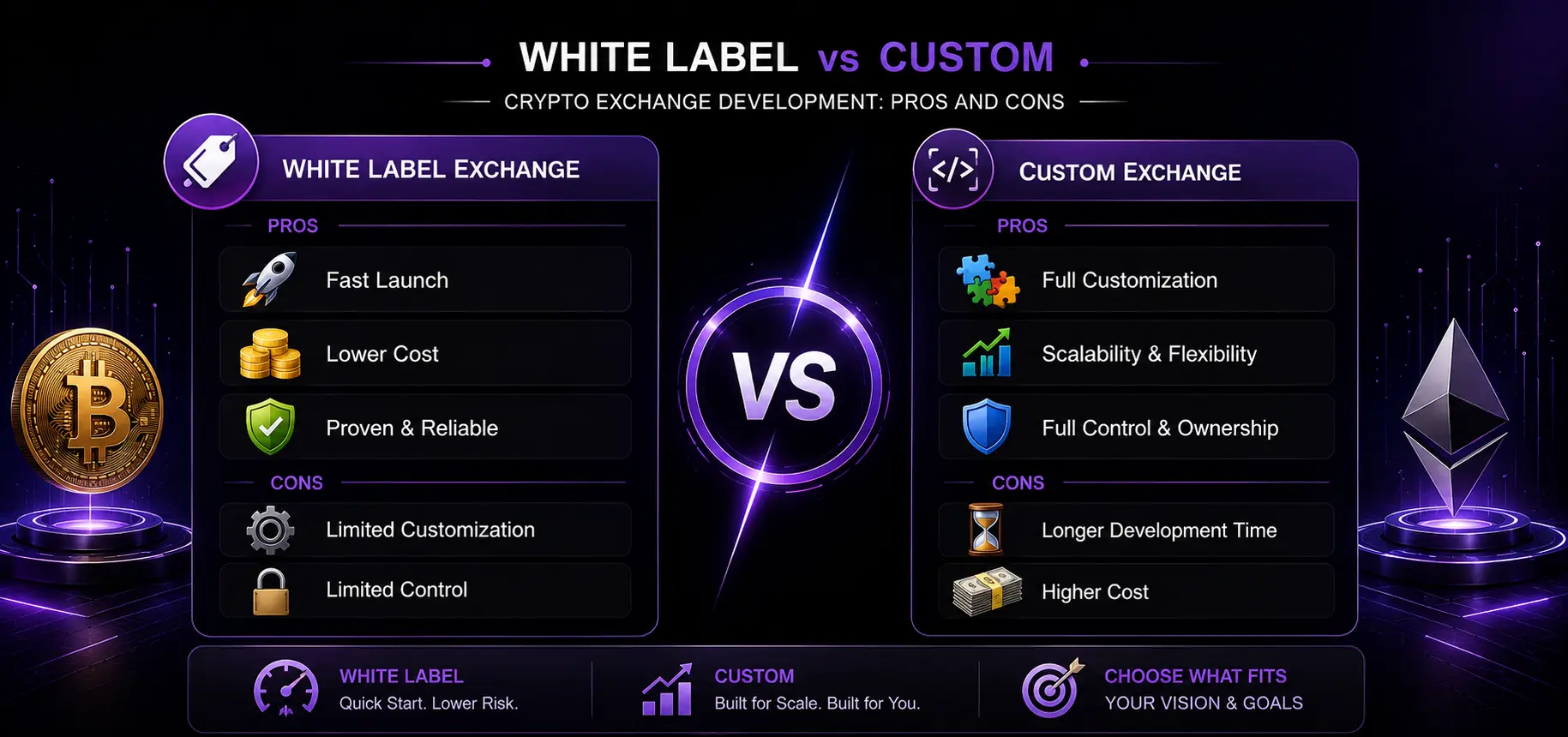
The white label and custom crypto exchange development models serve different requirements of the company as well as operational needs. The custom build is about flexibility, scalability and total ownership. White label solutions are about speed, price and getting to market fast. The final answer is a function of how a company trades off short-term launch needs against its long-term growth and innovation plan.
White Label Crypto Exchange Solutions
White label cryptocurrency exchange solutions are created for businesses that want to quickly enter the market without having to build everything from scratch through complicated processes. The platforms provide a ready-made architecture, which cuts down on development work and permits a faster focus on user acquisition, marketing and branding.
Advantages:
- Rapid Market Entry
White label solutions use pre-built infrastructure so organizations can just jump in. That cuts development time and accelerates their entire go-to-market strategy. For businesses validating a new trading model, launching a ready-built platf - Lower Initial Cost
These platforms are ideal for startups and early-stage crypto businesses as they significantly cut down the upfront costs by eliminating the need for extensive development. - Proven Infrastructure Stability
There are systems that have already been tested in real trading, which means reliability, reduced technical risks and stable results in user operations and transactions. - Minimal Technical Effort
Most of the backend systems are already set up, so companies don’t need to have deep expertise in blockchain, making it easy to run and without the need for big engineering teams. - Quick Business Launch
This means that businesses can focus on branding, marketing and user acquisition rather than development cycles, allowing for quicker revenue generation and early validation of the platform in markets.
Limitations:
- Restricted Customization
White label platforms are less flexible because it is more difficult to change the trade logic, core features or build highly differentiated user experiences. - Shared Infrastructure
In competitive marketplaces, multiple companies employing the same underlying technology can affect exclusivity, performance consistency and overall platform difference. - Vendor Dependency
Over time, they become heavily dependent on the provider for upgrades, maintenance and feature rollouts, and businesses lose control over platform evolution and operational independence. - Limited Scalability
Such systems are less suited to complex financial or institutional use cases as they are not able to support complex or high-volume trading needs. - Innovation Constraints
You’re dependent on the vendor roadmap for future upgrades, which leaves you unable to roll out unique features or respond quickly to changing customer demands.
White label systems work well when speed to market is more important than differentiation and long term customization.
Custom Crypto Exchange Development
Custom cryptocurrency exchange development is all about creating a platform from scratch to fulfill specific business goals, operational models and compliance standards. Unlike pre-made solutions, it provides businesses with full control of architecture, functionality and long-term scalability. This strategy is usually chosen by companies that want to build a strong and unique product instead of a quick way to market.
Advantages:
- Full Ownership of Architecture
There are no third-party dependencies and the business has full control over the system, trade engine, back-end structure and infrastructure. - Unlimited Customization
Each piece can be customized to your business needs, allowing for specialized user flows, complex functionality and unique trading experiences. - Better Scalability Potential
Building custom systems that scale with the company means an easier time managing growing user load, trade volume, and future growth. - Stronger Security Control
Businesses can create their own complex security architectures, layers of compliance and risk management systems based on their own rules and laws. - Unique Product Differentiation
A fully customized platform enables businesses to be different from the competition by offering unique features and a completely unique user experience.
Limitations:
- Higher Development Cost
It costs a lot of money to build from the ground up in terms of infrastructure, technology, and development teams. - Longer Development Cycle
Designing, developing, testing, and deploying custom exchanges requires more time than pre-built systems. - Need for Experienced Engineers
To manage intricate system design and connections, a solid blockchain and backend engineering staff is needed. - Higher Operational Responsibility
Maintenance, updates, performance tracking, and ongoing system enhancements are entirely the responsibility of businesses.
Custom development is often the preferred choice for companies building serious financial infrastructure.
Comparison Table
| Factor | White Label Exchange | Custom Exchange |
| Launch Time | 2–8 weeks | 3–12 months |
| Cost Range | $10K – $80K | $80K – $500K+ |
| Customization | Low | Very High |
| Ownership | Partial | Full |
| Scalability | Moderate | High |
| Security Control | Limited | Full control |
| Maintenance | Provider-managed | In-house/team-driven |
Development Timeline and Cost Comparison
When comparing white label versus custom cryptocurrency exchange development, cost should never be the only factor you consider. Pricing is not just about development effort. That is security design, long-term compliance preparedness, scalability potential and architectural depth.
White label exchanges offer the quickest way to the market. The majority of platforms can go live in two to eight weeks, depending on branding, configuration and basic feature setup. Development costs are still relatively low because the infrastructure needed is already there. Early-stage startups, MVP launches and companies that value demand validation over proprietary technology development find white label solutions attractive.
Custom cryptocurrency exchanges require a much larger time and financial investment. The development time usually ranges from three to twelve months, depending on the complexity of the system, blockchain interfaces, liquidity design and regulatory constraints. Pricing is typically in the range of $80,000 to $500,000 for enterprise platforms that have complex security, compliance and scalability requirements.
The big difference is in the long term value. Custom exchanges focus on ownership, flexibility and future-proof growth. White label alternatives maximize speed and affordability.
Development Cost Comparison
| Component | White Label | Custom Build |
| Core Development | Pre-built | Fully custom |
| UI/UX Design | Basic customization | Fully tailored |
| Wallet System | Standard integration | Secure custom architecture |
| Liquidity Integration | Limited | Advanced routing systems |
| Compliance Tools | Basic | Fully configurable |
| Infrastructure | Shared | Dedicated |
The real difference lies in long-term ownership and flexibility rather than upfront pricing.
Security & Compliance Considerations
Security and compliance are the cornerstones of a cryptocurrency exchange’s design, operation, and reliability. According to IBM research, enterprise-grade blockchain platforms require built-in security, governance, and scalable architecture to support financial-grade applications and protect digital assets. Security architecture has to go beyond breach prevention and focus on regulatory coherence, user asset protection, and long-term platform credibility across markets. Modern platforms are increasingly integrating formal security practices such as continuous audits and code verification to reduce smart contract vulnerabilities.
White label and custom exchanges offer different control levels. Custom exchanges give companies the opportunity to build layers of security and regulatory workflows that change as threats, volumes and regulations change. White label platforms offer standard security and compliance capabilities for faster launches.
Security & Compliance Comparison
| Aspect | White Label Exchange | Custom Exchange |
| Security Architecture | Pre-defined, standardized setup | Fully custom security design |
| Encryption & Access | Default SSL and basic authentication | Advanced encryption and access controls |
| Wallet Security | Standard hot wallet integration | Custom hot and cold wallet architecture |
| Fraud Detection | Basic monitoring systems | Advanced behavioral and AI-driven detection |
| Smart Contract Audits | Vendor-managed or limited | Integrated, continuous audit layers |
| Compliance Framework | Generic compliance templates | Jurisdiction-specific compliance logic |
| Regulatory Flexibility | Limited regional adaptability | Built for multi-region regulations |
| Control & Ownership | Provider-managed security | Full ownership and control |
Key Features in Both Exchange Models
When it comes to a cryptocurrency exchange, be it on a white label or built from scratch, users want a solid base of core features that make the platform stable, safe and easy to use. These basic features enable smooth user onboarding, safe asset custody, accurate order execution, and uninterrupted trading activities, which are crucial to build trust in modern cryptocurrency exchange platforms.
Both white label and custom exchanges offer these core features but the real difference is in the level of customization, optimization and change over time. White label systems are good for fast market entry because they focus on standard implementation and faster deployment. On the other hand, custom exchanges offer a higher level of control over features, enabling companies to customize functionality to their long-term product vision and scalability needs, along with a unique user experience that can shift with a changing market landscape.
See a Modern Crypto Trading Platform in Action
Get a closer look at how a modern cryptocurrency trading platform works. This video showcases secure digital asset trading with real-time market charts and analytics, fast and reliable order execution, and a simple, intuitive interface designed to deliver a seamless trading experience.
Core and Advanced Feature Comparison
| Feature Area | White Label Exchange | Custom Exchange |
| User Onboarding | Pre-built registration and login flows | Fully customized onboarding journeys |
| KYC & Verification | Standard third-party KYC integrations | Custom compliance and verification logic |
| Trading Engine | Shared, pre-configured matching engine | Custom-built trading and matching logic |
| Order Book | Standard order book functionality | Optimized for high-volume and advanced trading |
| Wallet Management | Default wallet integrations | Custom hot and cold wallet architecture |
| Liquidity Integration | Basic liquidity connections | Advanced liquidity routing and aggregation |
| Advanced Modules | Limited or unavailable | DeFi staking, lending, NFTs, cross-chain swaps |
| API Access | Basic API availability | Institutional-grade and extensible APIs |
| Trading Intelligence | Not supported | AI-powered trading analytics |
| Exchange UI/UX Design | Template-based layouts | Fully optimized, conversion-focused UI/UX |
How to Decide Which Option Suits Your Business
Based on your business development and expansion needs, you can choose between white label or custom crypto exchange creation. Some businesses want to develop a long-term platform, where they have complete control over how everything works, others need to move fast and test the market without too much resistance. The right choice for you depends on how much flexibility, investment and responsibility you want to take on right away.
- Speed to Market
Perfect for teams that want to avoid long development cycles in the early stages, launch quickly and start attracting consumers early. - Budget Planning
Works for businesses that want to enter the market with low development costs and little up-front spending. - Product Ownership
Outlines the control you have over feature direction, platform choices, and the ability to change the product over time. - Growth Readiness
This is critical for businesses that expect higher activity and growth in the future and cannot be limited by predefined limits of the system. - Regulatory Alignment
Becomes essential for companies operating in areas, where the platform architecture has to be changed to meet the changing legal and compliance requirements.
Top Companies Offering White Label or Custom Solutions
A handful of exchange and technology leaders continue to influence the design, launch and growth of modern cryptocurrency exchanges. Not all of these companies provide ready-made white label solutions, but their platforms, infrastructure and development approaches have a strong impact on the international standards of how to build cryptocurrency exchanges.
1. Techfyte
A blockchain, Web3 and AI development company specializing in white label and custom crypto exchange solutions. Techfyte focuses on architecture-driven platforms built for long-term scalability, regulatory readiness, and business ownership across global markets.
2. Binance
It is one of the largest cryptocurrency exchange networks in the world, setting standards in multi-product exchange architecture, matching engine performance and liquidity depth.
3. Coinbase
A leading compliance-driven exchange platform known for its institutional-grade infrastructure, regulated market approach and impact on security and governance standards.
4. Kraken
It is known for its security-first exchange architecture and high emphasis on operational transparency and regulatory compliance.
5. Consensys
A leading provider of blockchain infrastructure for the Ethereum ecosystem, supporting decentralized exchange foundations, wallets and smart contract tooling.
These organizations collaborate to develop best practices for the development of both centralized and decentralized exchanges, which then affects how new platforms approach long-term product design, scalability, and compliance.
Future Trends in Crypto Exchange Development
Crypto exchange platforms are developing towards becoming more intelligent, interoperable and flexible. One of the biggest changes is the emergence of multi-chain crypto exchange development, allowing users to trade assets across multiple blockchain networks without having to hop between platforms. As blockchain ecosystems expand, this strategy makes it easier to access liquidity and makes the trading process simpler.

The rise of hybrid exchanges that allow for decentralized custody and transparency but centralized execution speed is another big trend. In parallel, the exchanges are increasingly using AI to help deliver data-driven trade insights, better fraud protection and improved liquidity management. As regulatory frameworks around the world become more established, exchanges are being pushed to build compliance into core design rather than as a separate operational layer. Many modern platforms are also adopting intelligent automation and autonomous systems powered by AI trading agents to improve decision-making and market analysis
Final Thoughts
The choice between white label and custom crypto exchange development finally decides the course of a cryptocurrency firm. White label solutions are a perfect choice for early-stage experimentation and fast market entry because they are fast, easy to use, and have fewer entry barriers. In contrast, custom development lays the foundation for long-term market positioning, ownership and flexibility.
Deciding correctly in the fast moving cryptocurrency market is more than just starting an exchange. This means building a financial infrastructure that will grow with your company, be flexible to changing regulations and confidently compete in international markets. Organizations planning specialized exchange models can also explore architectures such as P2P crypto exchange development for direct peer-to-peer trading environments.
FAQs: Choosing Between White Label & Custom Exchanges
1. What is a white label crypto exchange?
A white label crypto exchange is a ready-built trading platform that businesses can launch under their own brand. The core systems such as the trading engine, wallets, and administration panels are already developed, allowing faster market entry without building infrastructure from scratch.
2. What is a custom crypto exchange?
A custom crypto exchange is a platform developed entirely around a company’s business goals, operational model, and regulatory requirements. Every component is purpose-built, giving full control over how the exchange operates and evolves over time.
3. Which option is faster to launch?
White label exchanges are faster to deploy and can typically be launched within a few weeks. This makes them suitable for businesses that want quick market entry or early validation before committing to long-term infrastructure.
4. Which option is more cost effective?
White label exchanges have lower upfront costs because development work is already completed. Custom exchanges require higher initial investment but often provide better long-term value through ownership, flexibility, and reduced platform limitations.
5. Can custom exchanges offer stronger security?
Yes, custom exchanges allow businesses to design security frameworks based on their own operational risk, asset exposure, and compliance needs. This includes full control over wallet design, access policies, and internal safeguards.
6. Which exchange model supports long term growth better?
Custom exchanges are better suited for long-term growth. Their architecture can be expanded and refined as user volume, trading activity, and product offerings increase, without dependency on third-party platform constraints.
7. Can DeFi features be integrated into both models?
Both models can support DeFi functionality, but custom exchanges allow deeper and more specialized integration. Advanced staking logic, lending mechanisms, and protocol-level features are easier to implement when the platform is built from the ground up.
8. What factors influence development cost?
Development cost depends on feature scope, compliance requirements, supported blockchains, liquidity strategy, and infrastructure design. Custom exchanges reflect these variables more directly, while white label pricing is usually predefined.
9. Is a white label exchange suitable for startups?
Yes, white label platforms are commonly used by startups to test product-market fit, acquire early users, or enter new regions without committing to high development costs upfront.
10. Do regulations impact the choice between white label and custom?
Yes, businesses operating in highly regulated markets often prefer custom exchanges, as compliance workflows can be designed specifically around local regulatory frameworks rather than adapted to predefined systems.
