



Key Takeaways
- Building a prediction market platform like Polymarket can range from $25,000 to $300,000+, depending on the required features, trading architecture, security, and scalability.
- CLOB infrastructure, smart contracts, oracle-based resolution, backend systems, security, compliance, liquidity, and ongoing maintenance have the biggest impact on overall investment.
- Businesses are inclined to create a prediction market platform like polymarket because of growing opportunities that offer reliable trading infrastructure, transparent market resolution, and scalable user experiences.
- Techfyte is a reliable prediction market development company. They understand blockchain architecture, exchange infrastructure, smart-contract security, real-time trading, and compliance.
Introduction
With the right partner by your side, a prediction platform development company assists with developing reliable, cost-effective and scalable prediction market platforms like polymarket. The final cost depends less on blockchain itself and more on trading architecture, smart contracts, oracle-based resolution, security, compliance and scalability. According to research, Polymarket is at a volume of $9 billion as stated by April 2026.
Polymarket has captured 97% of onchain prediction market fees establishing its growing dominance. It has already generated $7.1 million in fees within the first week of Q2 2026. The rising demand also involves the need for building an exchange-like system where blockchain is one part of the technology stack.In this blog, explore the factors affecting Polymarket prediction market platform development and its cost.
What is a Prediction Market Platform Like Polymarket?
Prediction market platforms like Polymarket allows users to trade contracts based on outcome or real-world events. Markets cover sectors like politics, sports, economics, technology and other measurable events.
- Users choose between YES/NO outcomes made for a defined event.
- Each outcome has a price ranging from $0 to $1 representing the market’s probability.
- Traders can buy or sell positions before the market is resolved, allowing them to manage positions as new information becomes available.
- Oracle or defined resolution mechanism determines the winning outcome once the event concludes.
- Winning positions are settled according to the market’s rules.
How Does a Polymarket-Style Prediction Market Work?
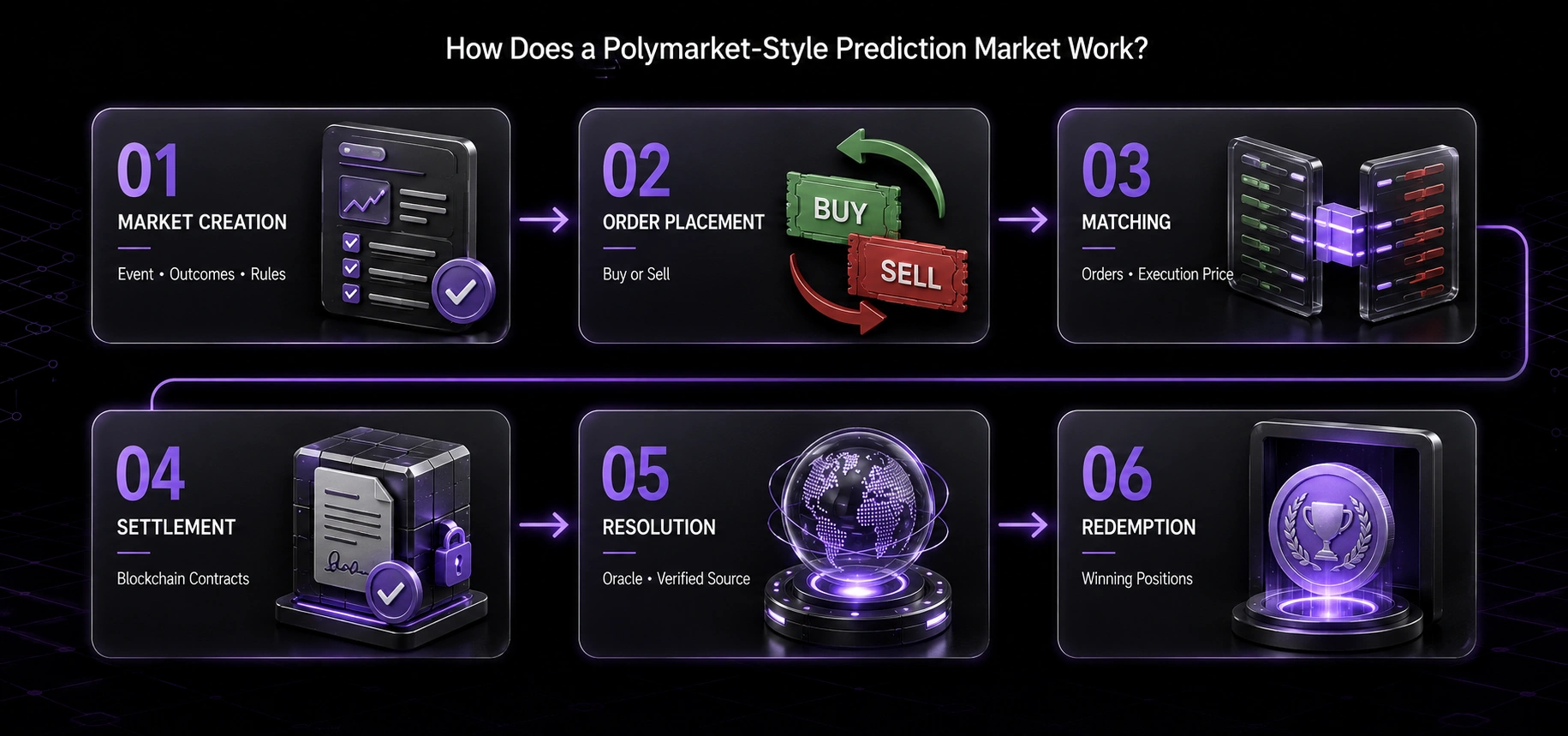
Step 1 – Market creation: An administrator defines the event, outcomes, closing time, and resolution rules.Step 2 – Order placement: Traders submit buy or sell orders through the platform.Step 3 – Matching: The matching engine pairs compatible orders and determines the execution price.Step 4 – Settlement: Completed trades are recorded and settled using blockchain-based contracts.Step 5 – Resolution: An oracle or predefined source determines the final outcome.Step 6 – Redemption: Winning positions can be redeemed according to the market’s settlement rules.
How Much Does It Cost to Build a Prediction Market Like Polymarket?
The cost of Polymarket clone development depends on business requirements. Factors like trading infrastructure, blockchain settlement, market-resolution system, and scalability. The average cost for polymarket clone software development ranges from $25,000 to $300,000.
| Development Approach | Approx. Cost | Typical Scope |
|---|---|---|
| Prototype / Basic Clone | $10K–$25K | Basic markets, wallet, simple trading |
| MVP | $25K–$50K | Core trading, smart contracts, admin panel |
| Custom Commercial Platform | $75K–$150K | CLOB, oracle, APIs, security, analytics |
| Enterprise-Grade Platform | $150K–$300K+ | High scalability, advanced risk and compliance |
Get a Clear Cost Estimate for Your Prediction Market Project
What Determines the Cost of Polymarket Prediction Market Platform Development?
The cost of building a prediction market platform like Polymarket depends on the complexity of its trading, blockchain, security and operational infrastructure.
1. Smart Contract Development and Blockchain Integration – 20%
Smart contracts handle outcome positions, collateral, settlement, redemption, permissions, and other on-chain operations. Blockchain selection influences wallet compatibility, stablecoin support, liquidity, transaction throughput, and development difficulty. Gas optimization and contract architecture require additional engineering effort. Smart-contract development should also be kept separate from independent auditing, as an audit is a security assessment rather than part of the coding process.
2. Backend, Matching Engine, APIs and Real-Time Data – 25%
Since a Polymarket-style platform requires more than just standard Web3 APIs, the backend may have the most share. A CLOB and matching engine, REST APIs, WebSockets, order management, market data services, blockchain indexing, portfolio tracking, caching, rate limitation, and monitoring can all be necessary. Concurrency, low latency processing, data consistency, and fault tolerance all become more crucial as trading volume rises. The architecture of Polymarket illustrates how exchange infrastructure can be far more intricate than a simple blockchain application.
3. Oracle and Market Resolution – 10%
Prediction markets need a reliable mechanism to determine whether an event occurred and which outcome should be settled. This layer includes Oracle integration, resolution rules, outcome suggestions, dispute resolution, and final settlement. While political, sports, or real-world event markets may need more complex resolution logic and edge cases, simple price-based markets could require less work. Thus, development and testing expenses are directly impacted by the Oracle architecture selected.
4. UI/UX and Trading Dashboard – 10%
The frontend cost depends on how closely the platform resembles a professional trading terminal. The Polymarket-type frontend may have features such as market discovery, probability graphs, order books, bid ask, trading screens, open positions, balances, profit and loss, transaction history, wallet integration, and the market resolution status. The real-time synchronization with backend market data and blockchain transactions increases the complexity beyond that of a typical Web3 frontend.
5. Security, KYC/AML and Compliance – 20%
Security and compliance can represent a significant portion of the budget, particularly when the platform handles user funds. The security-related tasks might consist of conducting audits of the smart-contracts, penetration tests, securing APIs, key management, access management, AI detection of fraudulent activities, monitoring and incident response. The need for legal compliance requirements require KYC/AML checks, sanctions screening, age verification, geo-blocking, transaction monitoring, and regulatory reporting.
6. Liquidity and Market-Making – 15%
Development cost is not the same as liquidity capital. A technically complete prediction market can still struggle if markets have thin order books, wide spreads, or insufficient trading activity. Launch costs may therefore include initial market-making capital, professional market makers, inventory, spread incentives, and liquidity rewards. There is no universal monthly figure because the requirement depends on the number of markets, expected trading volume, target spreads, and market-making strategy. Unlike development, liquidity is primarily an ongoing operational expense.
Choose the Right Trading Architecture and Technology Stack
CLOB or AMM? The Trading Architecture Changes the Development Cost
The trading model is one of the biggest factors affecting the cost of Polymarket platform development. A prediction market can use a Central Limit Order Book (CLOB) or an Automated Market Maker (AMM), and the two require very different infrastructure.
CLOB: Order Book-Based Trading
A CLOB follows the flow: user to order book to matching engine to settlement. Users can place market or limit orders, view bid/ask prices, cancel orders, and receive partial fills. It requires an order-matching engine, persistent order management, WebSocket connections, and market-data services, making cryptocurrency exchange development closely related to the trading infrastructure required for a Polymarket-style platform.
AMM: Pool-Based Trading
An AMM uses liquidity pools and mathematical pricing algorithms rather than matching individual buyers and sellers. This can simplify the trading infrastructure, but requires pool management, pricing curves, liquidity incentives, and sufficient capital to maintain usable markets.For a prediction market platform like Polymarket, a CLOB generally requires more engineering and infrastructure investment. A platform that copies Polymarket’s interface is therefore much cheaper than one that develops its exchange-grade trading architecture.
How Much Does Polymarket Clone Software Development Cost by Feature?
The cost of Polymarket clone software development varies by the complexity of each technical layer. The following ranges provide a practical planning estimate for a custom platform.
| Component | Cost |
|---|---|
| UI/UX + Trading Dashboard | $10K–$30K |
| Backend + APIs | $20K–$40K |
| CLOB / Matching Engine | $30K–$80K |
| Smart Contracts | $20K–$50K |
| Oracle / Market Resolution | $15K–$40K |
| Wallet / Payment Integration | $5K–$20K |
| Security + Audit | $15K–$50K+ |
| Admin + Risk Management | $10K–$25K |
Hidden Costs in Prediction Market Platform Development
Beyond development, these six costs can significantly affect the total investment in a prediction market platform like Polymarket:
- Security & Audits – Smart-contract audits, penetration testing, and ongoing security monitoring.
- Cloud & Infrastructure – Servers, databases, WebSockets, ndexing, storage, and scaling.
- Oracle & Data Services – Market data feeds, oracle services, and event-resolution infrastructure.
- Compliance & Legal – KYC/AML tools, licensing, legal reviews, and jurisdiction-specific compliance.
- Liquidity & Market Making – Initial liquidity, market-maker fees, inventory, and trading incentives.
- Maintenance & Third-Party Services – Bug fixes, upgrades, support, analytics, APIs, and other recurring subscriptions.
Final Cost Estimate at Techfyte for Creating a Prediction Market Platform Like Polymarket
The estimated cost to create a prediction market platform like Polymarket depends on architecture, infrastructure, security requirements and scalability. Techfyte lists blockchain development, smart contract auditing, prediction marketplaces, order-matching engines and crypto exchange development among its technology capabilities.
- Basic version: ($25K–$50K) Core markets, wallet, basic trading, contracts, and admin.
- Production Commercial Platform: ($75K–$150K) CLOB, APIs, oracle, security, analytics, and scalable infrastructure.
- Advanced/Enterprise Platform: ($150K–$300K+) High-volume trading, advanced risk controls, compliance, and enterprise scalability.
FAQs
1. How much does it cost to create a prediction market platform like Polymarket?
To create prediction market platform like polymarket the cost ranges from $25,000 to $300,000+. However, development cost at Techfyte depends on the platform’s complexity.
2. What factors affect the Polymarket clone development cost?
Polymarket clone software development cost varies depending on features and architecture. Other factors affecting cost include wallets, markets, trading, and an admin panel. While advanced development solutions include CLOB infrastructure, real-time APIs, oracle integration, analytics, security, and compliance capabilities.
3. How long does it take to build a prediction market platform like polymarket?
A basic version of polymarket prediction market platform development takes around 3 to 4 months. However, an advanced platform requires 6 to 12 months. The timeline depends on smart-contract complexity, trading architecture, oracle integration, security testing, compliance requirements, and the number of markets and features being launched.
4. What blockchain is best for a Polymarket-style platform?
There is no single best blockchain for Polymarket platform development. However, Layer-2 networks for lower transaction costs and Ethereum ecosystem for compatibility. The choice should consider transaction costs, throughput, finality, stablecoin availability, wallet compatibility, liquidity, developer tooling, ecosystem maturity, and security.
5. Do prediction markets need smart contracts?
Smart contracts development is important for a decentralized market platform. However, prediction markets don’t need them. A centralized platform can manage functions off-chain. The architecture depends on the desired level of decentralization, custody, transparency, and regulatory requirements.
6. How does a prediction market resolve events?
A prediction market platform like Polymarket has resolution architecture which is particularly important. It resolves incorrect or ambiguous outcomes that can directly affect user positions and payouts. The process can involve outcome proposals, verification, disputes, and final settlement.
7. How much does a prediction market development company charge?
A prediction market development company like Techfyte charges between$25,000 to $300,000+, depending on the scope. The final costs are affected by custom CLOB development, smart contracts, oracle systems, security audits, compliance integrations, real-time infrastructure, and enterprise scalability.
Build a Secure, Scalable Polymarket-Style Platform
