



Key Takeaways
- PRYPCO Mint has become Dubai’s reference model for tokenized property because it connects fractional ownership, land-registry recognition, investor onboarding and regulated trading in one compliant flow.
- Launching a similar platform requires licensing before technology, as VARA, Dubai Land Department, RERA and fund-safeguarding requirements define how the product must be structured.
- A strong platform needs permissioned token standards, smart contracts, custody, KYC and reporting rather than a simple ERC-20 token model.
- Investor experience matters as much as compliance, so fractional listings, dashboards, rent distributions, secondary trading and cross-border controls must be planned from day one.
- Development partners should prove regulatory, audit and tokenization expertise before being trusted with a Dubai real estate tokenization platform.
How to Launch a Dubai Real Estate Tokenization Platform Like PRYPCO Mint
Dubai has positioned itself as the main worldwide testbed for tokenized real assets, and the property industry exemplifies this goal. In 2025, the Dubai Land Department launched PRYPCO Mint, the region’s first licensed tokenized real estate platform designed with Prypco and licensed by the Virtual Assets Regulatory Authority (VARA). The platform allows investors to purchase fractional, blockchain-recorded shares in ready-to-own Dubai residences starting at a few thousand dirhams, with token ownership synced directly to the government’s property registry.
Its debut listing sold out in a single day, cementing its status as the model proptech teams worldwide study. Businesses that are still comparing models can first understand the broader opportunity through this guide to real estate tokenization in the UAE. The main task for developers who wish to build a platform like PRYPCO Mint is to precisely sequence licenses, technology, and compliance. This guide leads you through just that.
What Makes PRYPCO Mint a Blueprint for Dubai Tokenized Real Estate
The PRYPCO Real Estate Tokenization Platform did not invent fractional property ownership, but it did overcome one issue that previous attempts had grappled with: legal clarity. Each token generated by the PRYPCO Mint platform Dubai infrastructure represents a verified share of a title deed recorded with the Dubai Land Department, not a contractual claim against a special-purpose vehicle.
This distinction allows regular investors to purchase in for under AED 2,000, assess pricing and risk disclosures upfront, and finally exit via a regulated marketplace rather than waiting years for a buyer. To understand how this differs from older property investment routes, compare property tokenization vs traditional investment in Dubai. Within 24 hours, the initial property drew over 200 investors from dozens of different countries, and a subsequent phase included continuous marketplace trading.
That demand is precisely why Dubai’s tokenized real estate PRYPCO Mint has become a point of reference for developers: it demonstrated that authorities will license the model and that customer hunger for fractional, on-chain ownership is genuine.
The Regulatory Foundation – VARA, RERA, and the Licensing Pathway
Jurisdiction is the first step for anyone researching the PRYPCO Mint VARA license process. VARA is the exclusive regulator of virtual asset activity on the Dubai mainland and free zones, excluding the DIFC. It issues licenses for relevant operations, including broker-dealer and exchange services, in a two-step process. Current activity categories can be found on VARA’s official site.
PRYPCO is licensed as a VARA broker-dealer, with the Dubai Land Department monitoring the underlying real estate and the Central Bank protecting investor funds. The Dubai Land Department’s RERA function inspects and values each property prior to tokenisation and issues the Property Token Ownership Certificate, which grants holders the same legal status as a traditional title. For founders comparing regional providers, this list of real estate tokenization development companies in the UAE can help shortlist teams with relevant market knowledge.
Investment-purpose virtual assets were, before, regulated at the federal level by the Securities and Commodities Authority, now renamed the Capital Market Authority in the UAE’s 2026 overhaul of the capital markets, but platforms that operate solely within VARA’s Dubai jurisdiction generally do not need separate federal authorization.
Core Technology Stack for a Real Estate Tokenization Platform
The technical core of any serious platform rests on five interconnected layers. Each one addresses a specific risk that regulated real estate tokenization introduces:
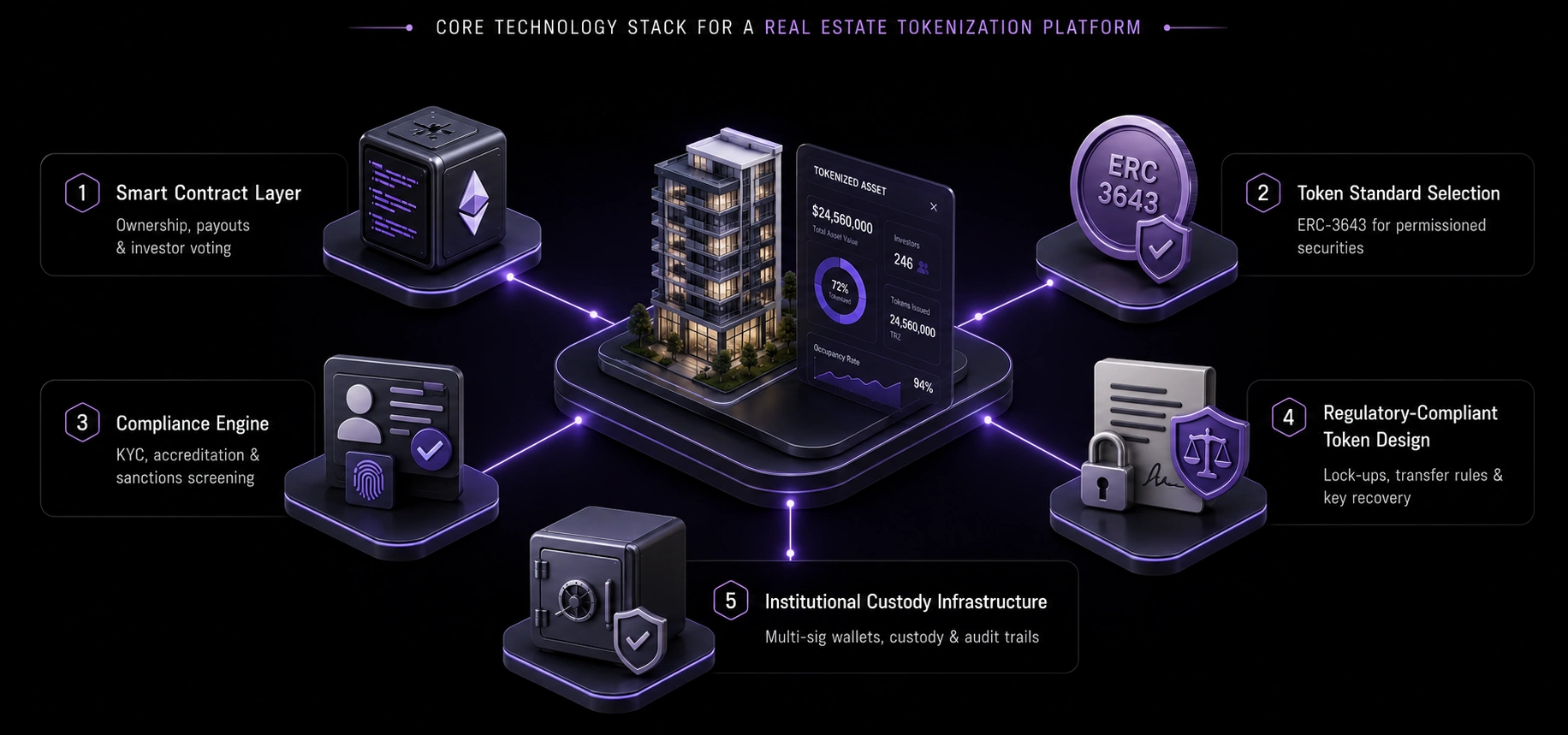
1. Smart Contract Layer for Ownership and Distributions
Smart contracts allow fractional ownership, distribution of rent and voting rights for investors. This layer is built through disciplined smart contract development, automating the key financial logic and enabling payouts and governance actions to occur without manual intervention.
2. Token Standard Selection
Choosing the token standard is more important than most teams realize. Plain ERC-20 tokens are not appropriate for regulated securities as they are permissionless and can be traded with anyone. The natural choice for real estate tokenization is the Ethereum standard for permissioned tokens, ERC-3643, which requires KYC and eligibility checks on every transaction. Teams planning this layer should also study token standards engineering before finalizing their architecture.
3. Compliance Engine for Investor Onboarding
In addition to the token, the platform needs a compliance engine to handle investor onboarding compliance, including verification of identification, accreditation checks, and sanctions screening before any wallet can receive a token. Without these gates, a compliant transfer flow cannot work. A dedicated investor onboarding compliance layer helps connect KYC, wallet eligibility and transfer permissions.
4. Regulatory-Compliant Token Design
Because the underlying asset is real property, regulatory-compliant token design must also encode lock-up periods, transfer restrictions, and key-recovery mechanics into the token contract. These constraints protect both the issuer and the investor from unauthorized transfers.
5. Institutional Custody Infrastructure
Like traditional brokerages, tokens and fiat revenues require institutional custody infrastructure to meet regulatory norms for client-fund segregation. That includes specialized custody accounts, multi-signature wallets and audit trails that can withstand regulatory scrutiny. Broader blockchain development expertise is also important when custody, smart contracts and investor dashboards must work as one secure system.
Key Features Users Expect
On top of the regulatory backend, investors compare a new platform to the user-facing features of PRYPCO Mint. The following five capabilities characterize a competitive offering:
1. Fractionalized Listings with Full Due Diligence
If you’re looking at a property listing, you need to see pricing history, risk disclosures, tech specs and legal documents before you commit. Investors want the same information as a traditional real estate transaction, just in a digital onboarding sequence.
2. Automated Rent and Dividend Distribution
Payouts need to be processed without manual reconciliation. Smart contracts calculate and distribute rental revenue or dividends to token holders based on their fractional ownership, reducing administrative overhead that reduces returns.
3. Secondary Marketplace with Managed Liquidity
After the initial lock-in time is over, investors need a secondary marketplace where tokenized property shares can be advertised and sold. That closes the liquidity gap that previously made property off-limits to smaller investors who couldn’t afford to lock up capital forever.
4. Compliance Reporting and Investor Dashboards
Build a consolidated dashboard to view holdings, distributions, tax documentation and compliance reporting in one place. Investors want the same transparency as a brokerage account, including position summaries, performance indicators and downloadable statements for tax purposes.
5. Cross-Border Distribution with Built-In Controls
Implement cross-border distribution controls, including geofencing, eligibility tiers, currency handling and jurisdictional restrictions from day one, rather than adding them post-launch, as Dubai regulators slowly open up platforms to non-residents. This is also where RWA tokenization strategy becomes important for connecting property assets with wider digital asset markets.
Choosing a Real Estate Tokenization Development Partner
Selecting a real estate tokenization development company is less about who can write Solidity and more about who has navigated VARA, DLD, and Central Bank approvals together. Ask for evidence of completed smart contract audit work from a reputable firm, since regulators increasingly expect independent audits before granting a licence for investor-facing contracts.
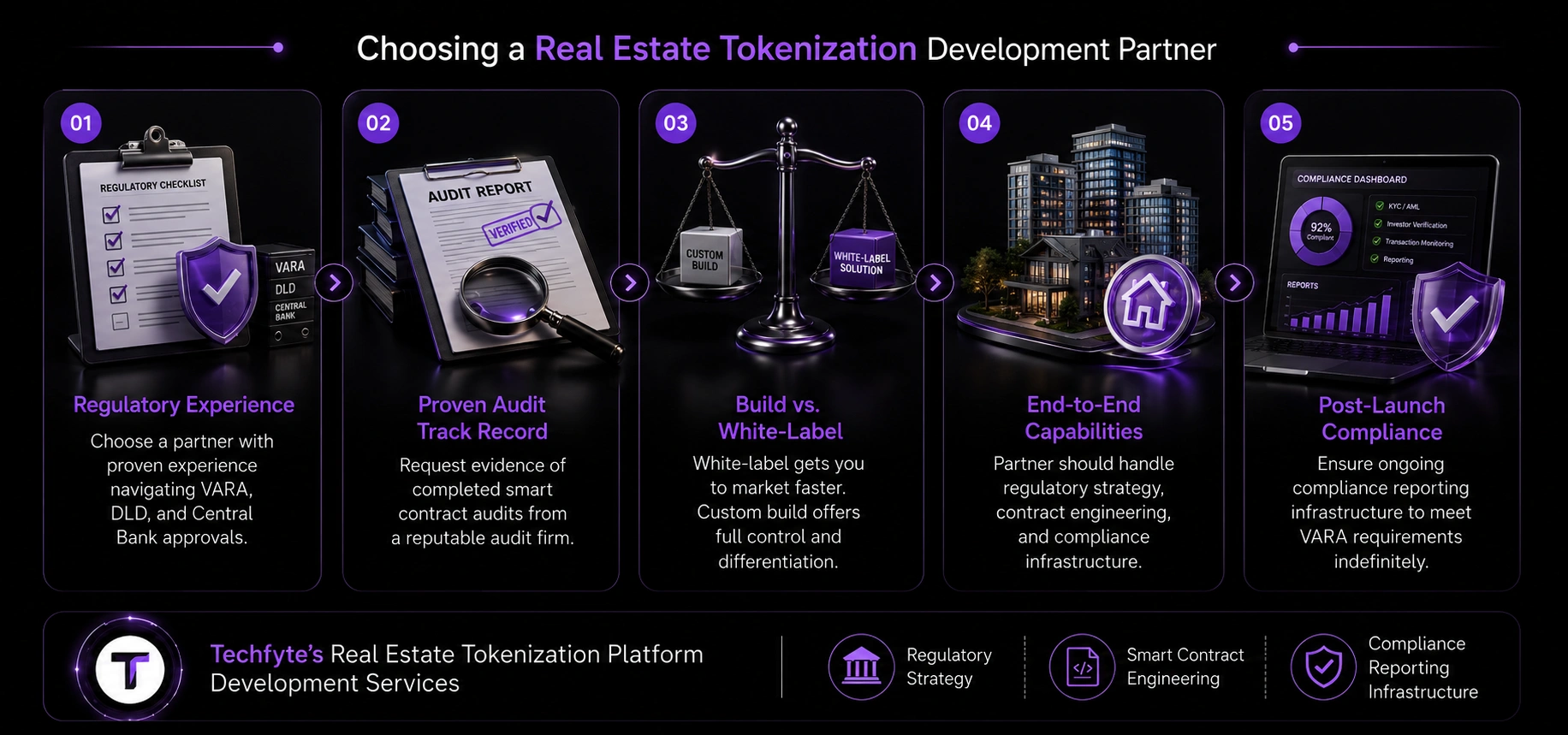
Decide early whether to build bespoke or adopt a white-label real estate tokenization platform. White-label speeds the path to a licence application but limits differentiation, while custom development costs more upfront and gives full control over compliance logic.
Either way, Techfyte’s real estate tokenization platform development services cover regulatory strategy, contract engineering, and the post-launch compliance reporting infrastructure VARA-licensed platforms must maintain indefinitely.
Market Outlook – Why the Timing Is Right
Dubai’s tokenization effort is not a standalone pilot but part of a bigger plan to establish the emirate as a global Web3 hub, with D33 economic goals and a government eager to register tokenized title documents directly. For a wider view of this technology shift, see what Web3 development means for modern digital platforms.
Deloitte’s real estate research estimates that globally, about $4 trillion worth of real estate can be tokenized by 2035, with an almost 27% annual growth rate, while Dubai’s own roadmap is aiming to tokenize 7% of its property market, or around $16 billion, by 2033. The combination of robust blockchain tooling, a licensed approach, and institutional appetite for real-world assets is why now is the time to build, not three years from now.
Startups that want a broader vendor comparison can also review the top blockchain app development companies in Dubai before choosing a long-term platform partner.
Concluding Note
In summary, PRYPCO Mint proved that Dubai’s regulators, land registry and capital markets infrastructure can support large-scale tokenized property, and that investors are willing to participate. Instead of copying the platform feature for feature, new entrants have the opportunity to apply the same regulatory rigor to a different asset mix, investor base or specialty in Dubai.
This is the time to build a platform like PRYPCO Mint when the rules are still being written and competition is low. Organizations that go ahead with proper licensing and audited infrastructure will be the next reference case for others to follow. To move from concept to launch, explore Techfyte’s asset tokenization development capabilities for regulated real-world assets.
Frequently Asked Questions (FAQ)
1. What does it take to build a platform like PRYPCO Mint in Dubai?
Creating a platform like PRYPCO Mint requires a VARA broker-dealer license, permissioned token infrastructure on ERC-3643, and direct interaction with the title deed record of the Dubai Land Department. A real estate tokenization development business with UAE regulatory experience can assist with sequencing, but licensing is the first step as that sets up the entire compliance architecture.
2. How does the PRYPCO Mint VARA license process work for new entrants?
PRYPCO Mint is developing a VARA license process that calls for two steps, first approval for preparation and final operational license under the broker-dealer category. Platforms should determine whether they require broker-dealer, exchange services or both first and then bring in oversight from Dubai Land Department and Central Bank for property verification and fund security.
3. Is tokenized real estate ownership in Dubai legally equivalent to conventional property ownership?
Yes. The Dubai tokenized real estate PRYPCO Mint model grants a Property Token Ownership Certificate to each token holder registered with the Dubai Land Department which enjoys the same legal standing as a traditional title deed. This is what makes the PRYPCO Real Estate Tokenization Platform different from former fractional ownership models built on contractual claims against special-purpose vehicles.
4. What should a real estate tokenization development company demonstrate before being hired?
Obtain independent smart contract audit reports, VARA or other regulatory clearances, and knowledge of ERC-3643 permissioned token requirements. If a real estate tokenization development company cannot provide audit documents or explain how compliance controls are encoded at the token level, it is not ready for regulated deployment. It should also provide post-launch compliance reporting in its Real Estate Tokenization Development services.
5. Can platforms built for the PRYPCO Mint platform Dubai model accept international investors?
Yes, but cross-border distribution requires geofencing, eligibility tiers and jurisdictional limits that are designed in from the beginning. The PRYPCO Mint Dubai tokenized real estate platform is currently servicing several nationalities but each new target market requires a separate KYC, accreditation and sanctions screening study. White-label tokenization platforms can accelerate development but regulatory work remains jurisdiction-specific.
