



Key Takeaways:
- Core Value: Blockchain is becoming practical infrastructure for supply chain traceability in Switzerland and the EU, especially where regulators require verifiable records.
- Regulatory Push: The EU Digital Product Passport, Falsified Medicines Directive, CSRD requirements and Swiss DLT framework are pushing enterprises toward auditable supply chain data.
- Business Benefits: Distributed ledgers help reduce reconciliation disputes, improve partner visibility, automate logistics workflows and strengthen compliance reporting.
- Best Use Cases: Pharma serialization, retail provenance, food traceability, cross-border asset tracking and smart contracts in logistics are among the strongest enterprise applications.
- Implementation Approach: European enterprises should begin with a narrow pilot, clear consortium governance, ERP/WMS integration and a compliance-first ledger architecture.
Blockchain for Supply Chain in Switzerland & EU: Complete Guide
Europe’s regulatory machinery is redefining the rules of supply chain management. The EU’s Digital Product Passport, the newly tightened Corporate Sustainability Reporting Directive, and Switzerland’s distributed ledger framework are converging to require a degree of traceability that spreadsheets and siloed ERP systems were never meant to offer.
Distributed ledgers provide regulators with what they increasingly want: an immutable, shareable record that numerous parties may trust without a central intermediary. It is becoming infrastructure, not a gamble, for supply chain directors, logistics managers and compliance officials across the region.
This guide to blockchain for supply chain in Switzerland & Europe explains why the region is leading adoption, where the technology is delivering real value and how firms are moving from pilot to production without stumbling over compliance.
Why Switzerland and the EU Are Leading Enterprise Blockchain Adoption
Regulatory clarity, not excitement, is fuelling enterprise blockchain adoption throughout the region. The Digital Product Passport compels manufacturers to link verifiable lifespan data to physical products, beginning with batteries and industrial equipment and expanding through 2030.
Pharmaceuticals must be serialized at pack level under the Falsified Medicines Directive. The 2026 Omnibus revision has limited the reach of the Corporate Sustainability Reporting Directive to larger operations, although it still guides thousands of firms towards verifiable supply chain data.
Switzerland has its own version of this: the Swiss DLT Act, also known as the Distributed Ledger Technology Act, has been in existence since 2021 and offers blockchain-based securities full legal status under Swiss law. Ongoing advice from FINMA, the Swiss financial regulator, has made Switzerland’s blockchain ecosystem, centered on Zug’s “Crypto Valley,” a real test bed for enterprise pilots.
Combined, these regulations allow boards legal security to invest in projects, turning European supply chain transparency into a true differentiator, not a compliance tick.
Core Applications Transforming Supply Chains
Distributed ledger technology supply chain deployments tend to anchor a handful of high-value use cases rather than digitizing everything at once. Instead of replacing every legacy system immediately, enterprises are using blockchain where trust, auditability and multi-party verification matter most.
1. Pharma Serialization and Compliance
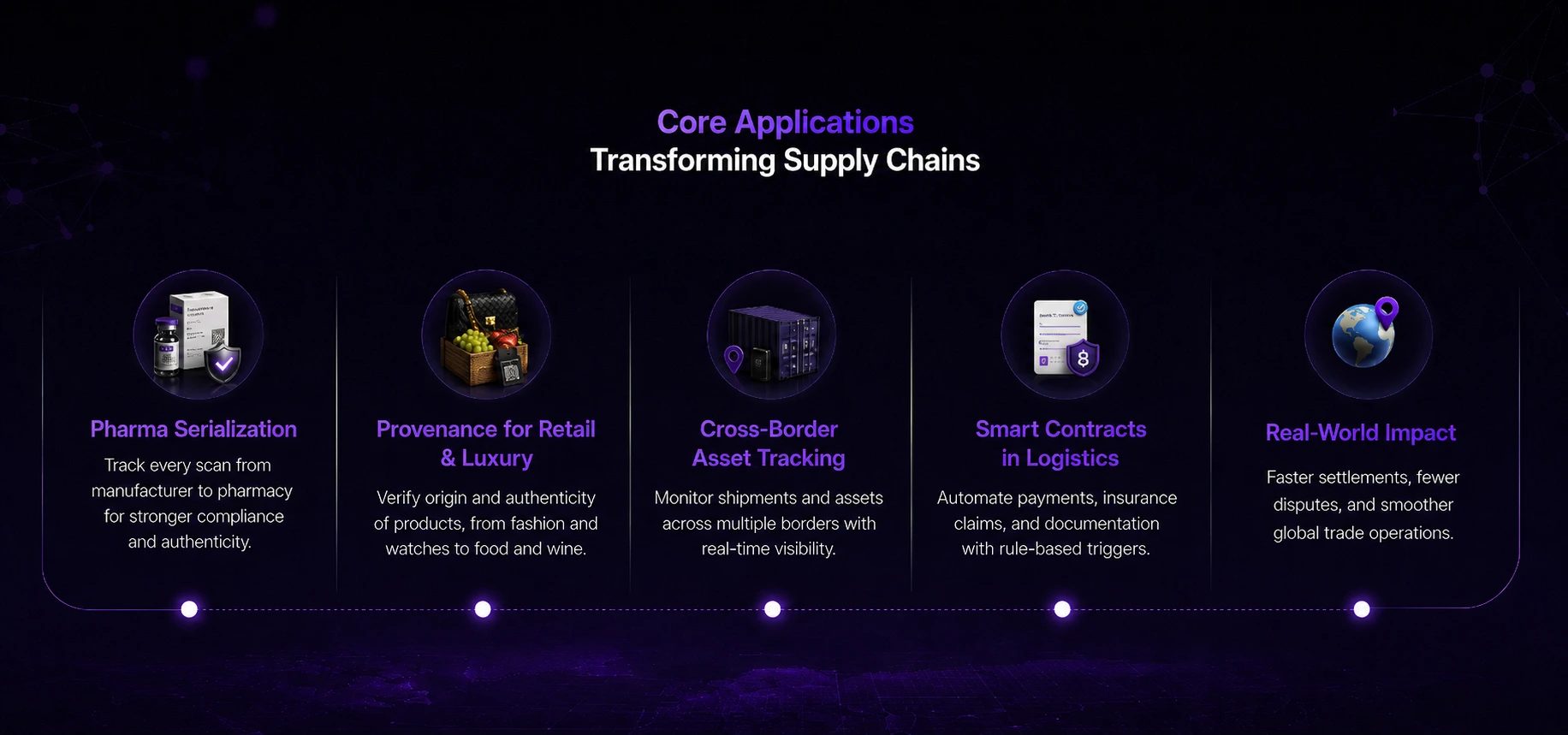
Pharma serialization is the most mature use case. A shared ledger restricted to verified partners can log every scan event from manufacturer to pharmacy, giving regulators and wholesalers a hard-to-falsify record for pharma supply chain compliance under the Falsified Medicines Directive.
2. Retail, Luxury and Food Provenance
Retail and luxury brands apply similar mechanics for retail supply chain blockchain provenance, verifying that a garment, a wine bottle, or a watch component came from where the label claims. This matters as much for food supply chain traceability in fresh produce and dairy as it does for fashion.
3. Cross-Border Asset Tracking
Cross-border blockchain asset tracking pairs ledger entries with sensor data to follow containers, pallets, or high-value components across multiple customs jurisdictions, cutting reconciliation disputes between carriers and shippers.
4. Smart Contracts in Logistics
Smart contracts in logistics automate the unglamorous but expensive parts of the process: releasing payment on confirmed delivery, triggering insurance claims when temperature thresholds are breached, or generating customs paperwork once a shipment clears a checkpoint.
A Swiss precision-instrument exporter, for example, can combine asset tracking with a smart contract that releases a portion of payment the moment a component clears customs in Rotterdam, instead of waiting weeks on manual invoice reconciliation between finance teams in two countries.
Transparency, Compliance, and Operational Efficiency
The operational case for blockchain rests on supply chain traceability that doesn’t depend on every party trusting the same software vendor. Each participant, including suppliers, freight forwarders and customs brokers, writes to a shared ledger without needing to control it, and reconciliation disputes shrink accordingly.
The harder problem is making this compatible with the GDPR, the EU’s data protection law. Personal data tied to drivers or individual customers generally shouldn’t sit on-chain at all.
Mature blockchain logistics solutions keep personal data off-chain and store only scrambled references on the ledger itself. These cryptographic techniques confirm a fact is true without exposing the underlying data, an approach the European Parliament’s own analysis identifies as central to reconciling distributed ledgers with data minimization. Privacy-focused supply chain systems can also use zero-knowledge proofs to verify product, shipment or compliance data without exposing sensitive commercial information.
On the trade side, blockchain deployment for logistics is already automating customs documentation and trade-finance instruments, replacing paper trails that historically added days to cross-border shipments. This is directly relevant for Swiss exporters who trade heavily with the EU from outside its customs union.
Implementation Roadmap for European Enterprises
A working deployment is a planned progression, not an enterprise-wide leap. For most European companies, the right roadmap starts with governance and moves toward controlled technical rollout.
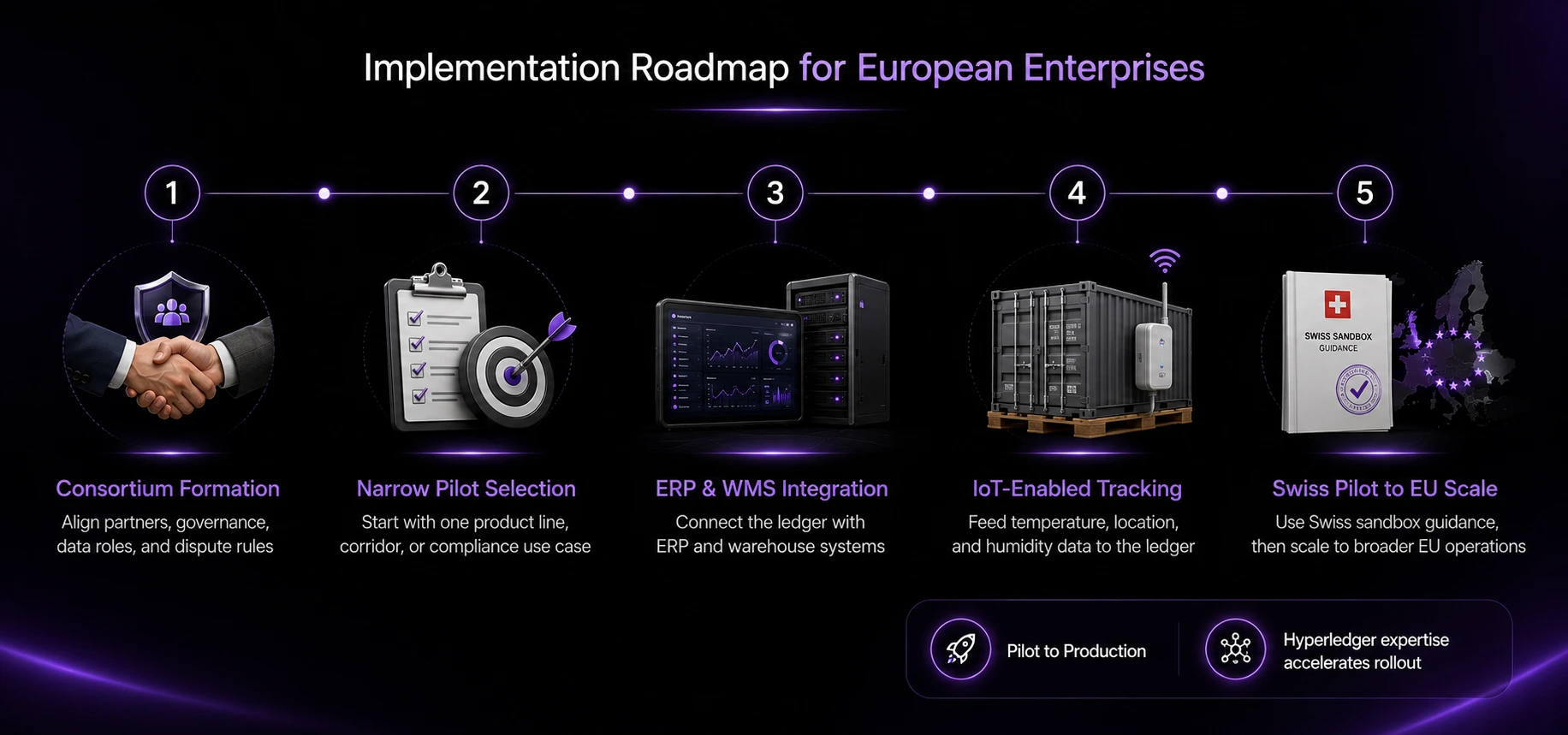
- Consortium Formation: Before writing any code, reach agreement with key trading partners on who will manage the system, who can contribute data to it, and how disputes will be resolved.
- Narrow Pilot Selection: Don’t try to adopt it all on day one. Focus your pilot on one product line, one trade corridor or one compliance deadline at a time.
- ERP and WMS Integration: Tie the ledger to existing enterprise resource planning (ERP) and warehouse management (WMS) systems. A ledger that does not talk to SAP or Oracle is just another silo.
In that third step, IoT-enabled blockchain tracking, where sensors write temperature, location or humidity data directly to the ledger, makes real-time visibility an actual reality instead of an ideal.
In Switzerland, the regulatory sandbox and FINMA’s case-by-case guidance enable a low-barrier environment for Swiss pilots to test these integrations before scaling up to the broader EU market.
For companies looking to structure these integrations in a way that will work, working with a Hyperledger enterprise solutions vendor who understands European regulatory requirements can help dramatically speed up the walk from pilot to production.
The Road Ahead – Interoperability and Pan-European Standards
The European Blockchain Services Infrastructure, built primarily for public-sector credentials, is now extending into supply chain pilots such as EBSI-ELSA, a project with the EU Intellectual Property Office that uses an open-source logistics module to track shipments and verify authenticity.
Expect corridors such as Rotterdam–Basel or Hamburg–Milan to become proving grounds for shared standards, since no single enterprise ledger scales without interoperability across borders and carriers.
The direction is convergence: fewer competing proprietary chains, more shared data formats any compliant participant can read, and growing pressure on vendors to support open standards instead of locking enterprises into a single platform.
For enterprises building on Ethereum-compatible networks, Polygon zkEVM and similar scaling solutions are increasingly being evaluated for supply chain deployments that demand both throughput and EVM compatibility.
Enterprises comparing scalability options can also review how Layer 2 blockchain development supports faster, lower-cost transaction processing for high-volume supply chain applications.
Concluding Note
Blockchain for supply chains in Switzerland and EU has moved past the hype cycle into something closer to regulatory plumbing. The Digital Product Passport, FMD serialization, and the Swiss DLT Act aren’t waiting for consensus, but setting deadlines.
Enterprises treating traceability as a compliance afterthought will spend the next several years catching up to competitors who built it in from the start. The technology question is largely settled; what remains is sequencing, choosing the right pilot, the right partners, and the right ledger architecture for your corridor and product category.
For supply chain leaders ready to move beyond theory, Techfyte’s blockchain development services provide the technical foundation to build traceability systems that satisfy both regulators and commercial partners from day one.
Frequently Asked Questions
1. What makes Switzerland a strategic hub for blockchain supply chain deployments in Europe?
Switzerland has the regulatory clarity and the infrastructure readiness. The Swiss DLT Act offers a clear legal status for blockchain-based records, and FINMA issues guidance that allows companies to conduct supply chain pilots using distributed ledger technology within the limits of a clearly defined regulatory sandbox.
Zug’s Crypto Valley is home to the talent and legal know-how needed to enable enterprise blockchain adoption, so European supply chain transparency projects can be headquartered there even if goods cross multiple EU borders.
2. How do smart contracts in logistics reduce cross-border friction?
In logistics, smart contracts automate the trigger events that would otherwise require manual intervention. These include releasing payment when a shipment clears customs, filing insurance claims when temperature limits are exceeded, and creating compliance documents when products cross a territory.
These automations eliminate invoice reconciliation time and disputes over when delivery standards were met for Swiss exporters trading with the EU from outside the customs union.
3. Is blockchain compatible with GDPR requirements for supply chain data?
Yes, but architecture is important. Personal data shall not be stored on the blockchain. Proven blockchain logistics solutions store personal data off-chain, keeping only cryptographic proofs, which are scrambled references that prove a fact without revealing the underlying information.
This respects the GDPR’s data minimization principle, and at the same time gives each participant a common and tamper-resilient log of events relevant for compliance and commercial objectives.
4. What does pharma supply chain compliance require under the Falsified Medicines Directive, and how does blockchain help?
The Falsified Medicines Directive requires serialization and end-to-end verification of prescription medicines at the pack level in the EU. Every time a scan of blockchain assets takes place on a permissioned ledger, a record is created that cannot be changed by any one entity, from manufacturer to wholesaler to pharmacy.
That gives regulators an audit trail that is hard to falsify and that meets pharmaceutical supply chain compliance standards, but without forcing competitors to share sensitive data or rely on a centralized database.
5. Where should an enterprise start with blockchain deployment for logistics?
Start narrow. Pick one product line, trade lane or compliance deadline, not the entire supply chain. Before you start coding, bring key partners together and agree on governance.
Then, integrate the ledger with the current ERP and WMS systems so you don’t create another silo. The best approach for logistics blockchain adoption is a small trial to show utility before scaling to larger European operations.
