



Key Takeaways
- Dubai Blockchain Hub: Dubai has evolved into a global blockchain innovation hub, with strong government support, regulatory clarity, and growing adoption across finance, real estate, logistics, and enterprise sectors.
- Specialized Expertise: Successful blockchain projects in 2026 require specialized expertise, including account abstraction, RWA tokenization, DeFi infrastructure, DePIN, interoperability, and compliance-first architecture.
- Realistic Budgeting: Blockchain development costs have increased due to regulatory and security requirements, with businesses needing to budget for audits, compliance frameworks, interoperability, and long-term maintenance.
- Partner Selection: Choosing the right blockchain development partner is a strategic decision, requiring evaluation of technical expertise, token economics, regulatory knowledge, user experience design, and enterprise integration capabilities.
- Future Trends: The future of blockchain development in Dubai is being shaped by emerging technologies, including Verifiable AI, zero-knowledge proofs, appchains, and institution-ready blockchain infrastructure.
Best Blockchain App Development Companies in Dubai: Services, Cost & Selection Guide 2026
Dubai is no longer just a city of architectural marvels; it has aggressively rebranded itself as the world’s top blockchain center. 2026 is a pivotal year with the successful execution of the Emirates Blockchain Strategy 2021 and the injection of fresh momentum from the Dubai Metaverse Strategy. We are no longer in the experimental phase; blockchain is the invisible spine of Dubai’s real estate, logistics and finance sectors.
What differentiates a successful decentralized product from a weak Proof of Concept (PoC) is the team building it. A new view is needed for corporations and startups to sift through the ocean of Blockchain App Development Companies in Dubai. This 2026 guide breaks down the existing service landscape, real-world costs and a non-negotiable selection framework. Businesses that are still comparing blockchain with broader decentralized technologies can first read this guide on what Web3 development is before choosing a Dubai development partner.
Top Blockchain App Development Companies in Dubai in 2026
You need a shortlist before you get into the technical scoping and pricing. The Dubai market is saturated with agencies, but these eight firms have distinguished themselves in 2026 with specific vertical expertise. Whether your priority is UX abstraction, gaming, business tokenization or DeFi, this list hits that fine balance between boutique specialization and large-scale delivery power.
1. Techfyte
Techfyte has found a place in the space between raw blockchain technology and user-friendly services. In 2026, they are the preferred partner for startups seeking user-friendly interfaces powered by Account Abstraction. The flagship offering is gasless smart wallet integration, allowing consumer apps to onboard customers without needing to comprehend seed words or Layer 2 bridges. Techfyte is a market leader in UX-centric blockchain app development if your project needs a frictionless, web2-feel interface that hides sophisticated on-chain logic, with their architecture-first approach.
2. ChicMic Studios
ChicMic Studios is pioneering the casual mobile game niche using blockchain. They’ve mastered the art of turning hyper-casual games into deep “play-to-own” experiences without hurting frame rates or the smoothness of the gameplay. In 2026 their Dubai subsidiary, which is working on the integration of undetectable NFT rental protocols and on-chain reward loops in iOS and Android games, is the preferred choice for creators bringing Web2 gaming audiences into Web3 economies.
3. Nevina Infotech
Nevina Infotech has been gaining substantial traction for its advanced skills in DEX, decentralized exchange, and token bridge development. Their key competency is multi-chain interoperability testing and implementation. While others make front-ends, Nevina Infotech builds elaborate settlement layers that allow assets to transit securely between isolated networks. If your DeFi project needs more robust cross-chain messaging or bespoke bridge technology, they offer backend precision few can match. If your product is closer to exchange infrastructure, this P2P crypto exchange development guide explains the feature set, development flow, and cost factors.
4. Nimble AppGenie
Fast mid-market prototyping is synonymous with Nimble AppGenie. They may not be building unique appchains, but they are global leaders in cross-platform DeFi wallet and GameFi asset lending businesses. Their value offer for 2026 is cost-efficiency with battle-tested code libraries. Nimble AppGenie can be a safe and trustworthy execution partner if you have a validated concept and are looking for a safe, polished MVP on Avalanche or Polygon under a strict budget and deadline.
5. Blockchain App Factory
Blockchain App Factory has significant bench strength in token standards and thrives on sophisticated economic concepts. They are the perfect fit for creators who want to build a “Token-as-a-Business-Model” firm. They offer pre-audited modules that greatly accelerate time-to-market, from advanced minting engines and NFT rental protocols to DePIN reward economies. Their Dubai section is focused on optimizing incentive mechanics to avoid securities classifications, merging economic strategy with technical delivery.
6. SoluLab
SoluLab is making a big transition to the “Verifiable AI” paradigm that is defining 2026. They are creating infrastructure to cryptographically prove off-chain AI calculations on-chain. If you have a project that involves building a decentralized computing marketplace or validating AI training data using ZK-proofs, SoluLab’s combined expertise in machine learning and Solidity/Rust make them a rare and important technical vendor in the region, straddling two bleeding edge disciplines.
7. Appinventiv
Appinventiv has “taken in” the blockchain into its basic DNA. They’re best suited to Dubai government subsidiaries or huge firms that want to put a blockchain module onto a massive old system. In 2026, the focus will be on Smart City integrations, where the immutable audit layer for IoT data streams will be provided by blockchain. If the size of the digital ecosystem outpaces the requirement for specialist DeFi experimentation, and you need an army of developers together with comprehensive compliance consulting, then choose Appinventiv.
8. Antier Solutions
Antier has gone full throttle on the institutional RWA, Real World Asset, narrative taking over Dubai. They are known for their white label tokenization engines preconfigured for VARA compliance. They can develop strong, permissioned DeFi platforms for real estate and gold trading with on-chain KYC included into token transfer protocols. Antier is a key player in a heavily regulated business tokenization project, where the legal architecture is just as important as the technology. For a deeper UAE-focused comparison, you can also review the top real estate tokenization development companies in UAE.
The 2026 State of Blockchain Development Services in Dubai
Gone are the days when hiring a blockchain engineer in Dubai would require merely tokenizing an asset on Ethereum. Blockchain Development Services in Dubai have evolved into full-fledged digital transformation. In 2026 clients aren’t asking “can we blockchain this?” they are asking “can you abstract the complexity so our users don’t know it’s web3?”
Today’s service portfolios have moved to enterprise-grade interoperability. Demand is exploding for cross-chain messaging protocols that enable Dubai’s government entities to message private banks, without compromising data sovereignty. We are seeing a tremendous shift from basic smart contract implementation to integrating zero-knowledge, or ZK, rollups customized to the Dubai Electronic Security Centre’s updated 2026 criteria.
Dubai’s top Blockchain App Development Companies are now incorporating AI co-processors with their blockchain design. This hybrid technique, frequently named “Verifiable AI”, enables apps to run machine learning models off-chain while anchoring the cryptographic proof on-chain. If a corporation is still selling a generic ERC-20 wallet app as its showpiece invention, it’s stuck in 2023.
Core Service Offerings: Beyond the Basics
One of the things you need to look for while assessing Blockchain Development Services in Dubai is specialization. The generic agency that also produces WordPress sites is not built to deal with DePIN, or Decentralized Physical Infrastructure Networks, architecture. Here’s what the top-tier talent provides in 2026. For businesses planning asset-backed products, our detailed guide on real-world asset tokenization on blockchain explains how physical and financial assets can be converted into compliant digital tokens.
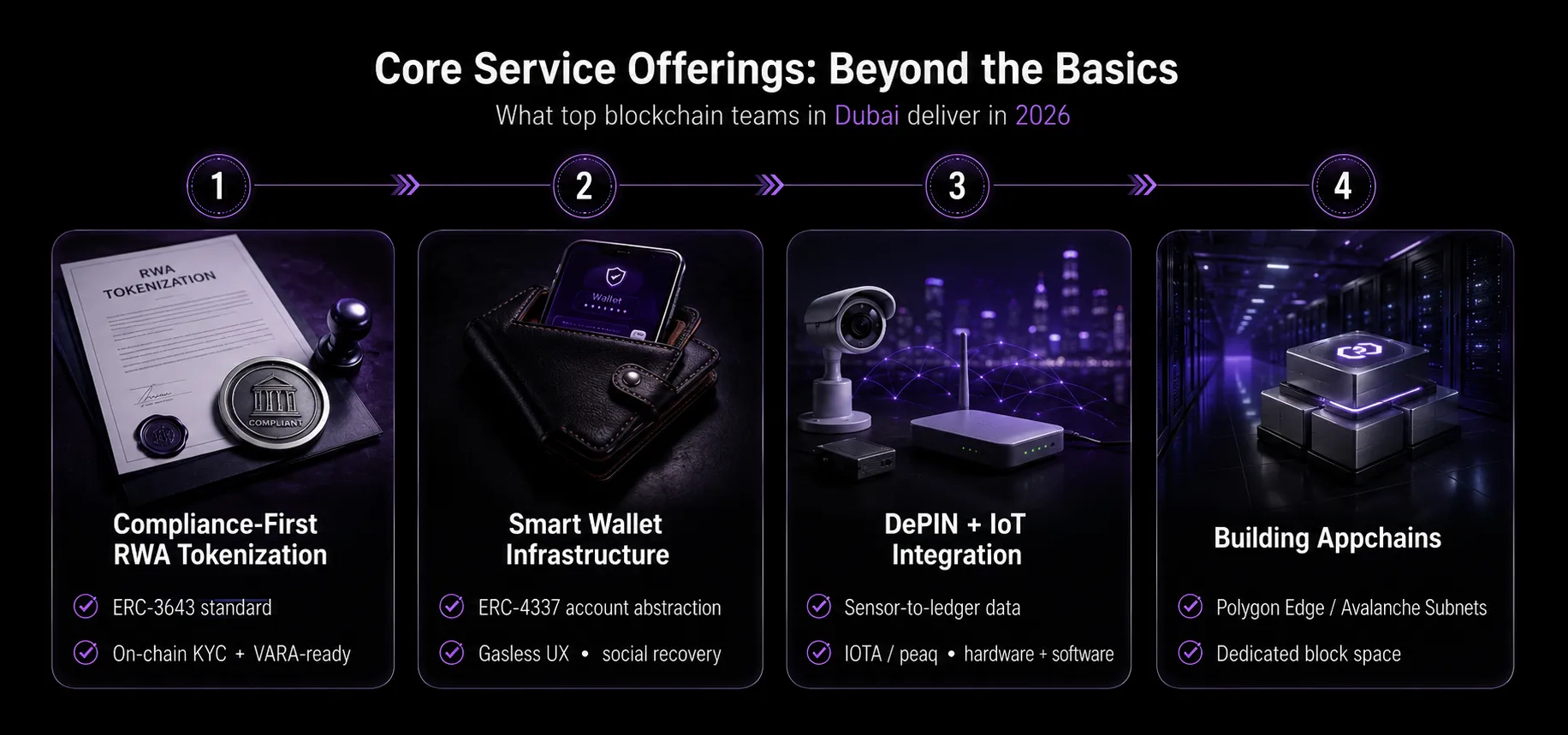
1. Compliance First RWA Tokenization
Dubai’s real estate and commodities industry is abuzz with tokenization, but the regulatory eye is sharper than ever with the advent of VARA, the Virtual Assets Regulatory Authority. Top organizations don’t just develop a smart contract, they embed legal logic straight into the token’s metadata using the ERC-3643 standard for permissioned assets. They’ve baked on-chain identity checks, KYC, right into the transfer functions, making the app VARA-compliant by architecture, not by accident.
2. Account Abstraction: Smart Wallet Infrastructure
The seed phrase was the biggest hurdle to blockchain app development acceptance. That barrier is gone in 2026. Top Dubai developers launch white-label smart wallets with ERC-4337 Account Abstraction. That means gasless transactions, sponsorship paymasters, social recovery, and multi-sig security baked into the UX of the app. If a Dubai company is offering a typical EOA, Externally Owned Account, wallet for a consumer-facing app, turn away. If wallet infrastructure is part of your product roadmap, this guide on multichain crypto wallet development explains the security, service, and partner selection factors in detail.
3. Integration of DePIN and IoT
DePIN is crucial for Dubai’s logistics industry, including DP World and Emirates SkyCargo. In today’s development, physical sensors write hashed data directly to distributed ledgers such as IOTA or peaq, coding at the firmware level. This is hardware-software co-development, a skill set that very few Blockchain App Development Companies Dubai actually have.
4. Building Appchains
Public mainnets are seeing variable gas fees, pushing corporations to establish L1s, Application-Specific Blockchains, using Polygon Edge or Avalanche Subnets. Companies are selling “Appchain-as-a-Service” – a dedicated block space that settles on a public L2 for security. It offers a block explorer and a dedicated faucet. This solution protects the organization from network congestion. Enterprises exploring scalable blockchain infrastructure should also compare Layer 2 blockchain development solutions before deciding between appchains, subnets, and rollups.
Cost Structures: A 2026 Reality Check
“Cost” is the most misleading part of the conversation. Post-2024 halving cycle and with the maturation of Layer 2s, the economics of blockchain app development have shifted. You aren’t paying for code; you are paying for cryptographic architecture and regulatory insurance.
Blockchain App Development Cost in Dubai
| Project Type | Estimated Cost | What It Includes |
| Proof of Concept / MVP | 60,000 to 100,000 AED | Minimal app with testnet deployment, smart contract functionality, simple React Native interface and wallet connection. |
| Mid-Scale Decentralized Application | 200,000 to 500,000 AED | Production-grade full-stack dApp, Solidity/Rust backend, frontend and subgraph or indexing layer. |
| Enterprise DePIN / Appchain Infrastructure | 800,000+ AED | Custom consensus tweaking, bridging infrastructure with Dubai trade platforms and VARA legal framework integration. |
For teams comparing wallet-specific budgets, this breakdown of TRC20 wallet app development cost can help estimate USDT wallet development requirements.
The 2026 Hidden Cost: Interoperability & Audit
Don’t budget without a security audit. Dubai’s cybersecurity guidelines now implicitly require smart contract assessments for any business application. Add 15-25% to your dev budget for a Tier-1 firm such as Trail of Bits, or local specialists recognized by Dubai Blockchain Center.
Maintenance isn’t just server maintenance, it’s “state maintenance.” If gas fees surge on Ethereum L1, an L2 arbitration costs money. Ask your potential partner what their retainer model is for “Gas Risk Management”. Privacy-focused enterprise applications should also understand zero-knowledge proofs because ZK technology is becoming central to secure blockchain architecture.
How to Select a Partner in 2026: The S.T.A.K.E. Framework
Web3 branding is a low barrier to entry space. There are a lot of agencies that slap “blockchain” on their site. When interviewing Blockchain App Development Companies in Dubai, use the S.T.A.K.E. framework to cut through the noise:
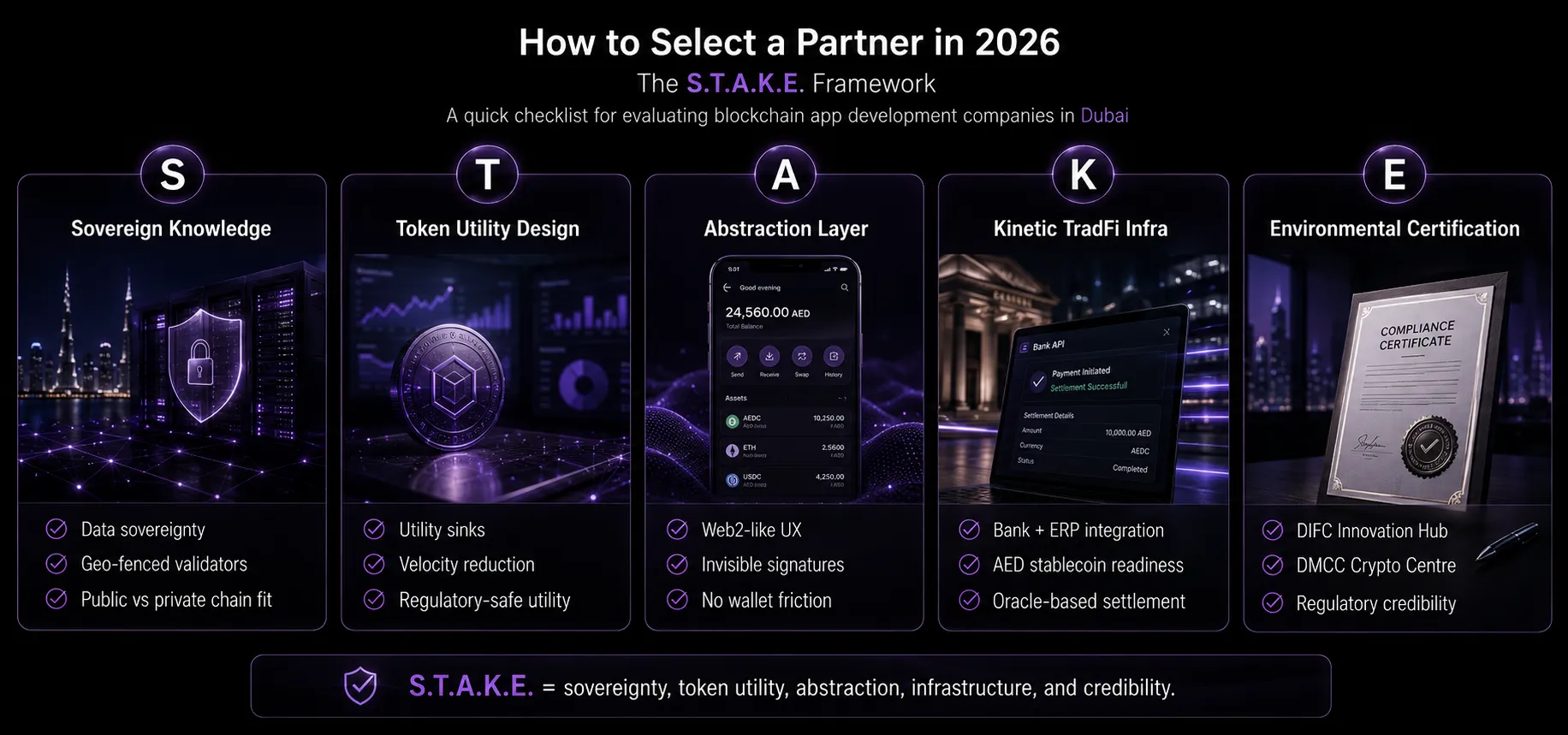
S – Sovereign Knowledge Domain
Dubai works on hyperledger variants, but it is also open to public chains. Ask them: “If the node is physically located in a non-DIFC jurisdiction, how does your architecture resolve the data sovereignty conflict between a public IPFS pin and Dubai’s Data Protection Law?” They must be able to give a particular answer about geo-fenced validators.
T – Token Utility Design, Not Technology
You don’t hire a dev, you employ a token economist. A dead token is a dead app in 2026. Ask to see their “Token Velocity Reduction Mechanisms.” Is it possible for them to develop a sink, a feature that removes tokens from supply, that adds utility but does not satisfy the Howey Test?
A – Abstraction Layer Logic
The good companies hide the blockchain. Request to demo a previous app. If you notice long hexadecimal hashes visible in the UI or a MetaMask pop-up for every small in-app action, the UX is obsolete. The interface has to feel like web2, with cookies and passwords replaced by invisible signatures.
K – Kinetic TradFi Infrastructure Knowledge
Your app will probably connect to legacy systems such as bank APIs and ERP platforms. The company should show expertise in AED stablecoin integration and in efficiently connecting off-chain fiat to on-chain logic. They need to understand the difference between a simple API call and a blockchain oracle that triggers a settlement. Since many Dubai blockchain apps involve fiat settlement or digital payments, this guide on stablecoins as payment infrastructure is useful for understanding the future of on-chain finance.
E – Environmental Certification
Being a “partner” with a tech behemoth isn’t enough. Specifically, look for DIFC Innovation Hub authorization or certification from the Dubai Multi Commodities Centre, DMCC, Crypto Centre. These agencies examine companies for legality, and an unregistered development agency can be a reputational risk if your token is later misclassified.
S.T.A.K.E. Framework Summary
| Letter | Evaluation Area | What to Check |
| S | Sovereign Knowledge Domain | Data sovereignty, geo-fenced validators and public/private chain architecture. |
| T | Token Utility Design | Token economics, utility sinks, velocity reduction and regulatory risk. |
| A | Abstraction Layer Logic | Web2-like UX, invisible signatures and no unnecessary wallet friction. |
| K | Kinetic TradFi Infrastructure | Bank APIs, ERP systems, AED stablecoin integration and oracle-based settlement. |
| E | Environmental Certification | DIFC Innovation Hub, DMCC Crypto Centre and regulatory credibility. |
Frequently Asked Questions
1. Which is the best blockchain app development company in Dubai?
The best choice depends on your project requirements, budget, industry, and technical goals. Businesses should evaluate experience, security standards, and past projects rather than relying only on rankings.
2. How long does blockchain app development take?
Simple applications may take two to three months, while enterprise platforms can require six months or more. Development timelines depend on complexity, features, testing, and integrations.
3. Is blockchain development expensive?
Blockchain development generally costs more than standard application development because it involves specialized skills, security requirements, and infrastructure considerations.
4. What industries benefit most from blockchain?
Finance, healthcare, supply chain, real estate, logistics, and e-commerce frequently benefit from blockchain technology because these sectors manage large amounts of data and transactions.
5. Can small businesses use blockchain solutions?
Yes. Small businesses increasingly use blockchain for payment systems, verification processes, and workflow automation without requiring large enterprise budgets.
Concluding Note
The landscape for blockchain app development in Dubai in 2026 is sophisticated, costly, and highly regulated; and that’s a good thing. The era of the ICO-cowboy agency is over. Today’s victors are the hybrid experts that bring together AI, ZK-cryptography and full-stack development under one roof.
Before you sign any deal, do the ‘transaction finality test’. Get them to sign a test transaction on a local DMCC-partnered testnet and see it on a real time explorer. If they can tell you why the block time was different from their theoretical pitch, you’re talking to an engineer. If they can’t, you’re talking to a go-between.
Architectural clarity, UX abstraction, and a partner that views VARA not as a roadblock, but the platform for mass adoption. The story of Dubai’s digital economy is being written now, ensure you are in safe hands.
